
Nikon Z5 II vs Nikon Z5: Is the Full-Frame Upgrade Worth It?
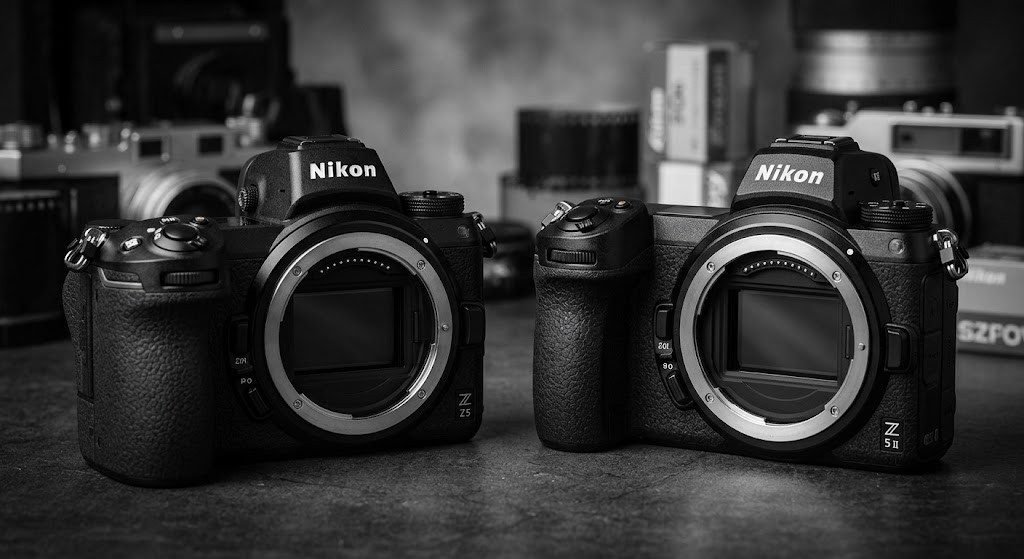
The full-frame camera market moves at a rapid pace. Value seekers often look to entry-level full-frame mirrorless cameras to achieve high image quality without excessive costs. When the original Nikon Z5 debuted in 2020, it gave photographers an accessible entry point into the Z-mount system. However, creators faced clear limitations with slow burst rates, heavy video crop factors, and contrast-based low-light autofocus struggles.
The Nikon Z5 II redesigns this line. Nikon equips the Z5 II with high-end capabilities borrowed directly from flagship models. It adds a Backside-Illuminated (BSI) CMOS sensor, an EXPEED 7 processor, uncropped 4K video, 10-bit color profiles, and AI-driven multi-subject autofocus tracking.
This deep review analyzes every single technical specification, operational feature, build quality change, and real-world performance metric. Read through this comprehensive comparison to decide whether you should upgrade to the Nikon Z5 II or keep the original Nikon Z5.
1. Executive Summary & Specification Overview
The original Nikon Z5 delivered great static image files, but it lagged in speed and video versatility. The Nikon Z5 II fixes almost every single flaw of its predecessor. It triples continuous burst performance, enhances low-light autofocus sensitivity down to -10 EV, and upgrades in-body image stabilization up to 7.5 stops.
┌────────────────────────────────────────────────────────────────────────┐
│                     GENERATIONAL LEAP HIGHLIGHTS                       │
├───────────────────────┬───────────────────────┬────────────────────────┤
│ Performance Metric    │ Original Nikon Z5     │ New Nikon Z5 II        │
├───────────────────────┼───────────────────────┼────────────────────────┤
│ Continuous Shooting   │ 4.5 Frames Per Second │ 14 FPS (30 FPS Elec.)  │
│ Video Crop Factor     │ 1.7x Heavy 4K Crop    │ Uncropped 4K/30p       │
│ Viewfinder Brightness │ 1,000 Nits            │ 3,000 Nits             │
│ IBIS Performance      │ 5.0 Stops             │ 7.5 Stops Focus Point  │
└───────────────────────┴───────────────────────┴────────────────────────┘
Complete Side-by-Side Specification Comparison
| Feature / Specification | Original Nikon Z5 | New Nikon Z5 II | Architectural & Operational Benefit |
| Release Date | July 2020 | April 2025 | Updated technology stack |
| Launch MSRP (Body Only) | $1,399.95 USD | $1,696.95 USD | Higher performance entry price |
| Sensor Type | Standard Front-Illuminated CMOS | Backside-Illuminated (BSI) CMOS | Faster readout & cleaner high-ISO noise |
| Effective Resolution | 24.3 Megapixels | 24.5 Megapixels | Maintained optical detail baseline |
| Image Processor | EXPEED 6 Engine | EXPEED 7 Engine | 10x faster processing data processing |
| Mechanical Burst Rate | 4.5 fps maximum | 14.0 fps maximum | Over 3x speed for action tracking |
| Electronic Burst Rate | Not supported | 30.0 fps (JPEG C30 Mode) | High-speed moment capturing |
| Pre-Release Capture | Not supported | Supported (Up to 1 second) | Prevents missing unexpected action shots |
| Autofocus Points | 273 Hybrid Phase-Detect | 273 Points + Deep Learning | Improved subject acquisition speed |
| AF Low-Light Limit | -3.0 EV (-4.5 EV Starlight) | -10.0 EV Starlight Mode | Locks focus in near-total darkness |
| Subject Detection | Humans & Basic Animals | 9 Subject Types + Dedicated Bird Mode | Automatic recognition of complex subjects |
| In-Body Stabilization | 5.0 Stops (Center Fixed) | 7.5 Stops (Focus Point VR) | Concentrates stabilization on active focus area |
| Rear Display Screen | 3.2-inch Tilting LCD (1.04M-dots) | 3.2-inch Vari-Angle LCD (2.10M-dots) | Full 360-degree flip view for video & selfies |
| EVF Brightness | ~1,000 cd/m² (Nits) | 3,000 cd/m² (Nits) | Clear visibility under direct overhead sun |
| 4K Video Resolution | 4K/30p (1.7x Heavy Crop) | 4K/30p Uncropped / 4K/60p (1.5x Crop) | Retains wide lens angles in 4K resolution |
| Video Internal Bit-Depth | 8-Bit 4:2:0 MOV/MP4 | 10-Bit N-Log / 12-Bit N-RAW Internal | Professional color grading dynamic headroom |
| Slow-Motion Capture | 1080p at 60 fps | 1080p at 120 fps | 4x fluid slow-motion recording |
| Picture Control Access | Sub-Menu Navigation | Dedicated Physical Button | Instant toggle for real-time color profiles |
| Storage Slots | Dual SD UHS-II Slots | Dual SD UHS-II Slots | Redundant or split RAW/JPEG recording |
| Body Weight (w/ Battery) | 675 g (23.8 oz) | 700 g (24.7 oz) | Slightly reinforced, weather-sealed chassis |
2. Sensor Design and Image Quality Analysis
The core difference between these two cameras lies in their silicon structure. The original Z5 uses a conventional front-illuminated CMOS sensor. The metal wiring layer sits above the light-sensitive photodiodes. This design limits light transmission efficiency and slows pixel readout speeds.
The Nikon Z5 II incorporates a 24.5MP Backside-Illuminated (BSI) CMOS sensor. The BSI construction moves the wiring behind the photodiodes. This shift improves light gathering capabilities at high ISO levels while dramatically increasing data transfer speed to the image processor.
[FRONT-ILLUMINATED SENSOR (Nikon Z5)]
Incoming Light  ──►  [ Metal Wiring Grid Layer ]  ──►  [ Photodiode Surface ]
                       (Blocks Marginal Photons)       (Higher ISO Noise Floor)

[BACKSIDE-ILLUMINATED SENSOR (Nikon Z5 II)]
Incoming Light  ──►  [ Photodiode Surface ]      ──►  [ Metal Wiring Grid Layer ]
                       (Direct Light Access)           (Faster Data Transmission)
Dynamic Range and High ISO Performance
Both cameras deliver roughly 14.5 stops of dynamic range at base ISO 100, letting you pull significant shadow detail out of high-contrast RAW files. However, as ISO increases past ISO 3200, the Z5 II shows a noticeable advantage. The BSI sensor structure reduces random thermal noise.
- ISO Range Comparison: The Z5 scales natively from ISO 100 to 51,200. The Z5 II expands its standard native ceiling up to ISO 64,000 for stills and ISO 51,200 for video capture.
- HEIF Support: The Z5 II captures 10-bit HEIF image files alongside standard 8-bit JPEGs and 14-bit RAW files. HEIF files offer richer color gradients while maintaining small file sizes.
3. The Power of the EXPEED 7 Processor
Processing speed determines how fast a camera calculates focus, processes images, and clears buffer data. The original Z5 features the EXPEED 6 engine, which struggled under heavy continuous burst demands.
The Nikon Z5 II upgrades directly to the EXPEED 7 processor—the exact same processing engine used in flagship cameras like the Nikon Z8 and Z9.
┌────────────────────────────────────────────────────────────────────────┐
│                   EXPEED 6 VS EXPEED 7 CAPABILITY                      │
├─────────────────────────────────────┬──────────────────────────────────┤
│ EXPEED 6 (Nikon Z5)                 │ EXPEED 7 (Nikon Z5 II)           │
├─────────────────────────────────────┼──────────────────────────────────┤
│ • 4.5 fps Max Burst Rate            │ • 14 fps Mechanical RAW Burst    │
│ • Basic Human/Animal Eye Detection  │ • 30 fps High-Speed Electronic   │
│ • 8-Bit Internal Video Processing   │ • 9-Subject Deep Learning AF     │
│ • Standard Menu Rendering           │ • 10-Bit N-Log / 12-Bit N-RAW    │
└─────────────────────────────────────┴──────────────────────────────────┘
The EXPEED 7 engine calculates autofocus measurements 68% faster than the Z5. It eliminates EVF lag during fast continuous bursts, giving you a smooth, real-time preview of fast action.
4. Autofocus Tracking & Subject Recognition
Autofocus performance shows the biggest real-world gap between these two models.
The Original Z5 AF System
The Z5 uses a 273-point hybrid phase-detection autofocus system. It handles static portraits and slow-moving subjects well. However, its eye detection drops out when subjects turn away, and it struggles to stay locked onto fast, erratic movements.
The Nikon Z5 II Deep Learning AF System
Powered by EXPEED 7, the Z5 II incorporates advanced deep-learning algorithms. The camera identifies, tracks, and locks focus onto complex targets across the entire frame automatically.
[AUTOFOCUS SUBJECT DETECTION MATRIX]
  ├── Humans (Eyes, Face, Head, Torso)
  ├── Animals (Dogs, Cats, Wild Mammals)
  ├── Birds (Specialized Flight Tracking)
  └── Vehicles (Cars, Motorcycles, Bicycles, Trains, Airplanes)
Low-Light Focus Sensitivity
Dark scenes pose no problem for the Z5 II. The original Z5 focuses down to -3 EV (or -4.5 EV in low-light mode). The Z5 II focuses down to an extraordinary -10 EV in Starlight Mode. You can easily lock focus on subjects outdoors under moonlight alone.
5. In-Body Image Stabilization (IBIS) Upgrades
Handheld shooting depends heavily on reliable sensor stabilization. Both cameras feature internal 5-axis sensor-shift Vibration Reduction (VR), but the underlying mechanics operate differently.
[STANDARD IBIS (Original Z5)]           [FOCUS POINT VR (Nikon Z5 II)]
┌─────────────────────────┐             ┌─────────────────────────┐
│        [ Center ]       │             │                         │
│            ▲            │             │        [ Focus ]        │
│    Pivot Axis Point     │             │            ▲            │
│  (5.0 Stops Total VR)   │             │    Pivots On Subject    │
└─────────────────────────┘             │  (7.5 Stops Total VR)   │
                                        └─────────────────────────┘
- Original Z5 IBIS: Provides 5.0 stops of compensation based on traditional CIPA standards. The sensor always pivots around its central axis, regardless of where your subject sits in the frame.
- Z5 II Focus Point VR: Delivers up to 7.5 stops of stabilization. It introduces Focus Point VR, which aligns the stabilization motion directly with your active focus point. If your subject is positioned near the edge of the frame, the camera stabilizes around that specific point to deliver sharper focus across rule-of-thirds compositions.
6. Viewfinder, Display, & Camera Ergonomics
Handling upgrades on the Nikon Z5 II directly improve the shooting experience in demanding environments.
           VISUAL MONITOR & VIEWFIENDER COMPARISON

   Nikon Z5:  [1,000 Nit EVF]  +  [Tilt-Only Display (1.04M-dots)]

   Z5 II:     [3,000 Nit EVF]  +  [Vari-Angle Display (2.10M-dots)]
1. Ultra-Bright 3,000-Nit Viewfinder
Both models feature a sharp 3.69-million-dot Electronic Viewfinder (EVF) with 0.8x magnification. However, the Z5 II boosts maximum EVF brightness to 3,000 nits. This is three times brighter than the original Z5’s 1,000-nit panel, allowing you to view scenes comfortably under harsh, direct sunlight.
2. Vari-Angle Articulated Screen
The original Z5 relies on a traditional tilt screen that only moves up and down. The Z5 II replaces it with a 3.2-inch, 2.1-million-dot fully articulating vari-angle display. You can flip the screen out to the side and rotate it 360 degrees, making it simple to frame vertical shots, low-angle compositions, and front-facing vlogs.
3. Dedicated Picture Control Button
The Z5 II adds a physical Picture Control Button to the top plate. Instead of digging through deep main menus, pressing this single button opens your custom color profiles instantly. You can switch color styles on the fly or download custom recipes via the Cloud.
7. Video Recording and Cinema Workflow
Video capabilities mark the largest practical performance gap between these two models.
[4K VIDEO SENSOR READOUT]

Original Z5:  |─── 1.7x Heavy Crop Area ───| (12.5MP Active Area)
              (Narrow Field of View, Loss of Wide-Angle Lenses)

Nikon Z5 II:  |================ Full Frame 4K/30p Readout ================|
              (Uses Full Sensor Width, Crisp Downsampled 4K Resolution)
Uncropped 4K Recording
The original Z5 applied a severe 1.7x crop when shooting in 4K resolution. A 24mm wide-angle lens effectively turned into a 40mm view.
The Nikon Z5 II captures uncropped 4K/30p video using the full width of its full-frame sensor. It downsamples 6K sensor data to produce sharp, detailed 4K footage. It also adds 4K/60p recording (with a minor 1.5x DX crop) for smooth action sequences.
Professional Color Formats & High-Speed Slow Motion
- 10-Bit N-Log & HLG: The original Z5 capped internal video recording at basic 8-bit SDR. The Z5 II records 10-bit N-Log and HLG directly to SD cards, giving colorists rich dynamic range for post-production grading.
- 12-Bit N-RAW Support: The Z5 II can output 12-bit N-RAW video internally for maximum production flexibility.
- 120 fps Slow Motion: Standard Full HD 1080p recording jumps from 60 fps up to 120 fps, allowing you to create smooth 4x slow-motion clips.
- UVC/UAC Webcam Integration: Connect the Z5 II to a computer via USB-C to stream live high-definition video without installing additional driver software.
8. Battery Life, Build Quality, & Storage
Nikon builds both cameras around high-durability magnesium alloy frames with comprehensive weather sealing against dust and moisture.
                        HARDWARE & CONNECTIONS MAP

┌───────────────────────────────────────┬───────────────────────────────────────┐
│ Feature Element                       │ Hardware Implementation               │
├───────────────────────────────────────┼───────────────────────────────────────┤
│ Memory Card Slots                     │ Dual UHS-II SD Card Slots             │
│ Battery Model                         │ EN-EL15c Rechargeable Li-ion          │
│ Power Delivery                        │ USB-C Constant Direct Power           │
│ Video Out Connector                   │ Micro-HDMI (Type-D Port)              │
│ Audio Interfaces                      │ 3.5mm Mic Input + 3.5mm Headphone Jack│
└───────────────────────────────────────┴───────────────────────────────────────┘
Dual UHS-II SD Card Slots
Both bodies include dual UHS-II SD memory card slots. You can configure the cards for overflow storage, real-time mirror backups, or split RAW files to Slot 1 and JPEGs/video to Slot 2.
Power Management
Both cameras use the standard EN-EL15c battery. The Z5 II achieves roughly 330–380 shots per charge according to CIPA ratings. Because the EXPEED 7 engine and 3,000-nit EVF draw more power, real-world battery life runs slightly shorter than the original Z5 during heavy video recording. However, continuous USB Power Delivery (USB-PD) lets you power the camera directly from external battery banks during long shoots.
9. Final Upgrade Decision: Which Camera Should You Buy?
The Nikon Z5 II transforms an entry-level photography body into a fast, feature-rich hybrid system.
                                [ PURCHASING DECISION TREE ]
                                              │
                    ┌─────────────────────────┴─────────────────────────┐
                    │                                                   │
        [ Priority: Static Photography ]                  [ Priority: Speed & Video ]
                    │                                                   │
            Buy the Original Z5                               Buy the Nikon Z5 II
       - 24MP Full-Frame Resolution                      - 14fps RAW / 30fps Burst Speeds
       - Dual SD Slots & IBIS                            - Uncropped 4K/30p & 10-Bit N-Log
       - Budget-Friendly Entry Price                     - Deep-Learning 9-Subject AF
Buy the Nikon Z5 II if you:
- Capture fast-moving subjects like sports, wildlife, pets, or running children.
- Require smooth video recording with uncropped 4K footage and 10-bit N-Log color grading.
- Shoot handheld in low-light environments requiring focus sensitivity down to -10 EV.
- Need an articulating flip screen for vertical framing, self-recording, or vlogging.
Stick with the Original Z5 if you:
- Focus strictly on static landscapes, architecture, studio portraits, or slow-paced travel photos.
- Rarely capture video clips or fast continuous action bursts.
- Want full-frame image quality while spending as little as possible on a camera body.
External Media & Resources
Explore complete camera gear tear-downs, lens tests, and production guides on the Alt Buzz YouTube Channel. For full spec breakdowns and hardware news, visit the official Alt Buzz Website.