
Fujifilm X100V Review: Why It Is Not Worth the Money in 2026
This Fujifilm X100V review is not the usual celebration you find scattered across camera forums and social media. The X100V earned its reputation honestly, and in many ways it deserves every bit of praise it gets. But a review is not just about whether a camera is good. It is about whether a camera is worth what people are currently paying for it, and in 2026, that is where the X100V runs into real trouble.
This review breaks down what the X100V does well, where it falls short, and why its current pricing no longer makes sense for most buyers.
Fujifilm X100V Specs at a Glance
The X100V pairs a 26.1MP X-Trans CMOS 4 sensor with a fixed 23mm F2 lens, giving a 35mm equivalent field of view. It uses Fujifilm’s X-Processor 4, includes a hybrid optical and electronic viewfinder, and offers in-camera film simulations that have become a signature part of the Fujifilm shooting experience. It is weather resistant when paired with the optional adapter ring and protective filter, and it records video up to 4K at 30fps.
On paper, none of this looks dated. The specs still hold up well against many current compact cameras. The trouble is not the spec sheet. It is what those specs cost you today.
Design and Handling
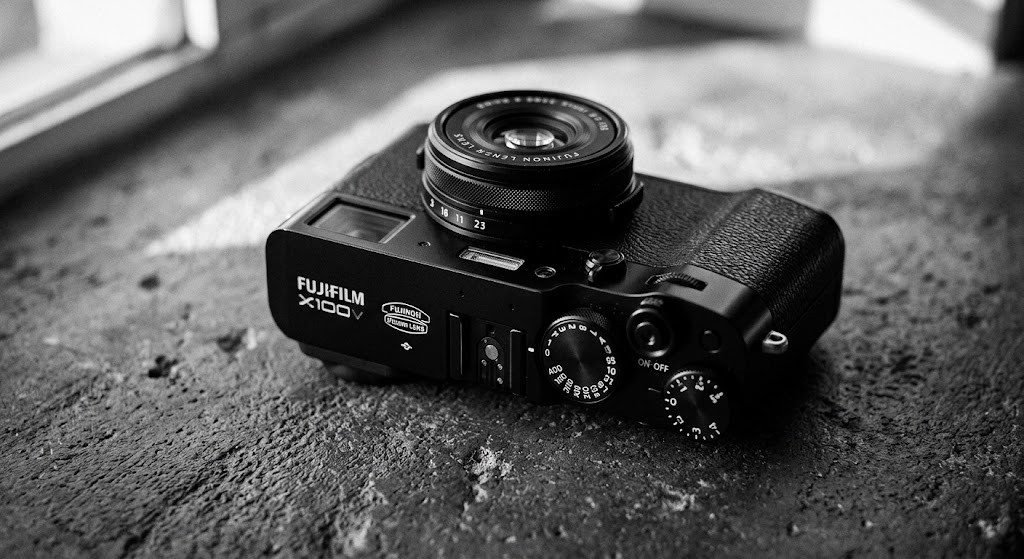
The X100V is one of the best-handling compact cameras Fujifilm has ever released. The dials feel mechanical and deliberate, the grip is small but usable, and the whole body has a density that feels like a proper tool rather than a lifestyle accessory. Street photographers and travel shooters consistently praise how unobtrusive it is, and that reputation is well earned.
The hybrid viewfinder remains one of its best features. Switching between optical and electronic modes with a small lever on the front of the camera still feels genuinely useful rather than gimmicky, letting you frame naturally in bright daylight and switch to full exposure preview when needed.
None of that has changed since launch, and none of it is the reason this review lands on a note of caution.
Image Quality and Sensor Performance
The 26.1MP X-Trans CMOS 4 sensor produces excellent color straight out of camera, with Fujifilm’s film simulations doing a lot of the heavy lifting. Classic Chrome, Acros, and Provia all hold up beautifully on the X100V’s fixed 23mm lens, and JPEG shooters in particular get a lot of mileage without touching a single slider in post.
Dynamic range and high ISO performance are solid for a camera of this sensor generation, though not class-leading anymore. Fujifilm’s own newer sensor, the 40.2MP X-Trans CMOS 5 HR found in the X100VI and several other current bodies, pulls ahead in resolution, dynamic range, and low light performance. That gap matters more the longer you own the camera, and it is central to why this review does not recommend paying current asking prices for the older sensor.
Autofocus and Shooting Experience
Autofocus on the X100V is dependable in good light and reasonably capable in mixed conditions, though it noticeably slows down in dim environments compared with Fujifilm’s current lineup. Eye and face detection work well for portraits and street shooting, and the leaf shutter lens allows for flash sync at almost any shutter speed, a detail that portrait photographers particularly appreciate.
Where it starts to show its age is in continuous autofocus for movement and low light tracking, both of which Fujifilm significantly improved in the newer X-Processor 5 generation. If autofocus speed and consistency matter to your shooting style, the X100V increasingly feels like a step behind rather than a step ahead.
Video Performance
Video is where the X100V feels most clearly outdated. It tops out at 4K 30fps with fairly limited bitrate options and no in-body stabilization, which makes handheld footage noticeably shakier than what current Fujifilm bodies produce. If video is even a secondary priority for you, this alone is enough reason to look elsewhere.
Fujifilm X100V Price in 2026
Here is the core issue this review keeps coming back to. Used X100V units have been selling anywhere from $1,500 to $2,000 depending on condition, and that price range is simply too high for what the camera delivers in 2026.
How It Compares to the X100VI
A new Fujifilm X100VI has been available around $1,800 when stock allows. That means the newer model, carrying a 40.2MP sensor, in-body image stabilization, the X-Processor 5, sharper autofocus, and significantly more cropping flexibility, can cost the same as or less than the older camera it replaced. There is no version of this comparison where paying X100VI money for an X100V makes financial sense.
Even against Fujifilm’s broader current lineup, the math does not favor the X100V. A used Fujifilm X-T5 offers the same 40.2MP sensor generation as the X100VI, interchangeable lenses, and more physical control, often for similar money to a used X100V.
Why the Fujifilm X100V Is Not Worth the Money Right Now
The X100V’s price is not driven by scarcity of good alternatives. It is driven by demand built on reputation. The camera carries genuine social media popularity, an industrial design people fall for immediately, and years of limited stock that turned simply owning one into something of an achievement. None of that desirability is fake, and none of it is a coincidence. But wanting a camera and it being the smart financial decision are two different questions, and this review exists specifically to separate them.
Paying close to $2,000 for a camera with a four-year-old sensor, no image stabilization, and video specs well behind its own direct successor is difficult to justify in almost any scenario in 2026, no matter how good the shooting experience feels in hand.
When the X100V Is Still a Smart Buy
This review is not a blanket argument against ever owning an X100V. If you find a genuinely clean used unit at a real discount, meaningfully below current X100VI pricing, it remains an excellent camera, especially if in-body stabilization and extra resolution are not priorities for your work. Around $1,400, the X100V becomes much easier to defend. Close to $2,000, it stops making sense next to what else that money buys.
If the fixed 23mm lens, the hybrid viewfinder, and the classic dial-based handling are specifically what you want, and you can find the camera at a fair price, it remains a genuinely rewarding camera to shoot with.
Final Verdict
The Fujifilm X100V is a well-built, well-designed camera with a shooting experience that still holds up in 2026. The problem this review keeps returning to is not the camera itself. It is the price buyers are currently expected to pay for it. When a four-year-old camera costs the same as its own direct successor, that price has stopped reflecting actual value and started reflecting pure demand.
Before buying an X100V at current market prices, compare it directly against the X100VI or a used X-T5. In most cases, you will get more camera for the same money, and that is exactly the kind of comparison this review wants you to make before spending your budget on reputation instead of capability.
Read More from Altbuzz
Want more honest camera reviews that look past the hype? Find more Fujifilm buying guides and in-depth comparisons at altbuzzmedia.com.
Subscribe to Altbuzz YouTube Channel
For more straightforward video breakdowns on whether a popular camera is actually worth its price, subscribe to the Altbuzz YouTube channel and never miss a new upload.