
Canon 5D Mark IV Review: Is This Workhorse DSLR Still Worth Buying in 2027?
Some cameras never chase headlines. They simply work, year after year, for photographers who need dependable results. The Canon EOS 5D Mark IV is one of those cameras. This Canon 5D Mark IV review looks at a professional full-frame DSLR that launched in 2016 and now sells at enthusiast prices.
We ranked the 5D Mark IV at number two in our cheap DSLR countdown. The reason is simple. You get yesterday’s professional standard at today’s enthusiast money. The camera did not become more capable. The market simply stopped charging professional-launch money for capability that still works.
At Altbuzz, we judge cameras by what they can still do, not by how old they are. So read on to see who should buy a 5D Mark IV in 2027, and who should look elsewhere.
How we built this review. This article draws on a published review of the 5D Mark IV, our own research notes and our used-market price snapshots. It is not a hands-on lab report from Altbuzz. Every strength and weakness below comes from those sources. Used prices move fast and vary widely by condition, so treat every range as a guide, not a promise.
Canon 5D Mark IV Review: Quick Verdict
The 5D Mark IV is a dependable all-rounder. It does almost everything well and nothing spectacularly. That balance suits working photographers who need a reliable tool more than a specialist.
Why You Might Love It
- A 30.4 megapixel full-frame sensor with strong detail
- Dual Pixel autofocus in live view
- A professional 61-point viewfinder autofocus system
- Dual card slots and a tough, sealed body
- Pleasing colors and skin tones
- The huge EF lens ecosystem
- A wide used price range with some great deals
Why You Might Skip It
- Heavy crop in 4K video
- A fixed rear screen
- Older autofocus behavior next to modern mirrorless bodies
- Dynamic range that trails newer rivals
- A shallow raw buffer
- A dated CompactFlash slot
Our Bottom Line
Buy the 5D Mark IV if you shoot weddings, portraits, events, commercial work or landscapes and want a dependable full-frame body. Choose something else if you shoot serious video or fast action. We explain every point below.
Canon 5D Mark IV at a Glance
Here are the key specifications from the published review.
| Feature | Canon EOS 5D Mark IV |
|---|---|
| Sensor | 30.4 megapixel full-frame |
| ISO range | 100 to 32,000, expandable to 102,400 |
| Autofocus | 61 points, 41 cross-type |
| Burst rate | 7 fps |
| Video | DCI 4K at up to 30p |
| Rear screen | 3.2-inch fixed touchscreen, about 1.62 million dots |
| Card slots | One CompactFlash and one SD |
| Battery | LP-E6N |
| Weight | About 890 g |
You can confirm current details on the Canon USA website.
Why the Canon 5D Mark IV Matters in 2027
The 5D Mark IV launched in 2016 as a professional standard. Its role has changed since then, yet its usefulness has not.
The Price Situation
In our recent snapshot, used 5D Mark IV bodies were listed between about $369 and $1,059. That spread is wide, and it matters. Many 5D Mark IV bodies spent years as professional workhorses. Condition explains the price gap, so check each body closely.
Mirrorless Changed the Conversation
Canon’s modern RF mirrorless bodies offer stronger video and newer autofocus. Even so, the 5D Mark IV remains a capable stills camera. It also gives buyers a full-frame sensor at a price that overlaps with many modern APS-C bodies.
Why Value Beats Age
The 5D Mark IV’s value argument is clear. It handles weddings, portraits, events, commercial work and landscapes. And it does that with a body that was not built to be delicate.
Design and Build Quality
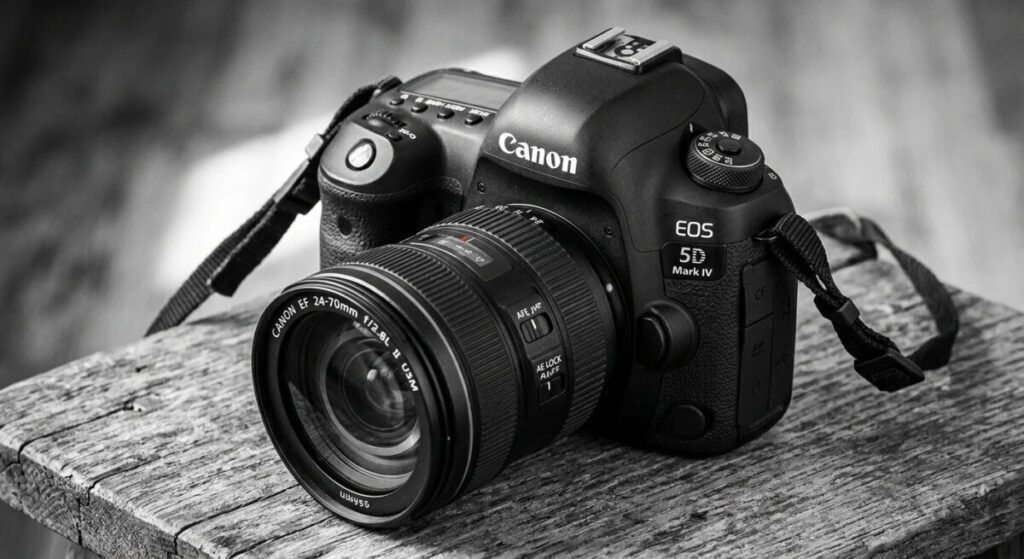
Canon built the 5D Mark IV as a professional tool. The body feels solid, and it shows careful refinement over its predecessor.
A Lighter, Better Sealed Body
Digital Camera World’s review noted that the 5D Mark IV weighs about 60 grams less than the Mark III. The reviewer also found improved weather sealing. The camera weighs about 890 grams, so you still feel it in a bag. Full-frame DSLR users will find that weight normal.
Secure Handling
The reviewer found the grip secure and comfortable. A customizable button lets you change ISO without leaving the viewfinder. That small feature speeds up work in changing light.
A Fixed Screen
The rear screen does not tilt or flip. Digital Camera World listed the fixed screen as a weakness. Photographers who shoot from low or high angles may miss an articulating display. Live view shooters will notice it the most.
Dual Card Slots
The camera has one CompactFlash slot and one SD slot. That mix gives you backup options for professional work. However, the reviewer called the CompactFlash slot dated. Buyers who want matching cards may find it inconvenient.
Image Quality
Image quality is the 5D Mark IV’s quiet strength. The 30.4 megapixel sensor offers enough detail for large prints without creating huge files.
Resolution
Digital Camera World found the detail strong enough for large prints. The reviewer also described the 30 megapixel sensor as a step ahead of 24 megapixel rivals. That extra resolution gives you cropping room and print flexibility.
Noise Control
Noise stayed well controlled across moderate ISO settings. The camera suits weddings and events where light changes quickly.
Colors and Skin Tones
The reviewer praised the colors and skin tones. That quality matters for portraits and weddings. Many photographers choose Canon for this look.
Dynamic Range
Dynamic range is good, but lab tests showed it falling behind newer 24 megapixel rivals at mid to high ISO. Sony and Nikon sensors of the era often offered more shadow recovery. Landscape photographers who push shadows hard should keep that in mind.
A Mid-Range Resolution Position
Digital Camera World made an interesting point. The reviewer said the camera’s 30 megapixel resolution sits awkwardly between newer 24 megapixel and 45 megapixel rivals. The Nikon D850 offers 45.7 megapixels, for example. Therefore, buyers who want maximum detail may prefer a higher-resolution body.
Our Take on Image Quality
The 5D Mark IV produces clean, pleasing files for almost any professional job. If you want the highest resolution or dynamic range, choose a rival.
Autofocus and Performance
The 5D Mark IV uses a 61-point viewfinder autofocus system, and 41 of those points are cross-type.
Strong Viewfinder Autofocus
Digital Camera World said the system is nearly identical to the one in Canon’s flagship EOS-1D X Mark II. The reviewer found that it performs very well. That lineage gives the 5D Mark IV a real professional foundation.
Center Bias
The reviewer noted a noticeable bias toward the center of the frame. Subjects near the edges can fall outside the best coverage. Compose carefully, or use focus and recompose techniques.
Dual Pixel Autofocus in Live View
Dual Pixel autofocus makes live view focusing much faster than on the Mark III. That upgrade helps tripod work, quiet shooting and casual video. It does not turn the camera into a modern mirrorless tracker.
Burst Speed and Buffer
The camera shoots 7 frames per second. That speed suits portraits, weddings and events. It does not suit fast action. Digital Camera World also noted a limited buffer, at about 21 raw files. Plan for that limit during long bursts.
Our Take on Autofocus
The viewfinder autofocus works well for most professional jobs. For birds, motorsport and fast sport, a D500 suits that work better.
Video Quality
The 5D Mark IV records DCI 4K at up to 30 frames per second. That feature was impressive in 2016. Today it feels limited.
The Heavy Crop
Digital Camera World found a 1.64x crop in 4K mode. That crop makes wide-angle shooting difficult. Your lenses behave like longer lenses.
Codec Limits
The reviewer also noted that 4K uses Motion JPEG and offers no flat gamma option. Those limits restrict editing flexibility. Serious video creators will notice them quickly.
What Still Works
Dual Pixel autofocus helps video focus more smoothly than older Canon DSLRs. For casual clips and events, the camera works well.
Our Take on Video
For video and hybrid shooting, cropped 4K and older autofocus behavior keep the camera behind modern RF bodies. Choose a mirrorless camera if video matters.
Battery and Storage
The 5D Mark IV uses Canon’s LP-E6N battery. That battery is common, and spares are easy to find. A common battery type makes long shoots simpler.
Dual Card Slots
One CompactFlash slot and one SD slot give you backup options. Professional wedding and event photographers value that safety net. Buy cards in both formats if you plan to use both slots.
Lens Ecosystem
The 5D Mark IV uses Canon’s EF mount. That mount has been sold for decades, so used lenses are everywhere.
A Huge Used Catalogue
You can build a strong kit on a careful budget. EF lenses cover nearly every focal length and price point. That supply is one of the biggest reasons to buy into this system.
Full-Frame Access
The camera works with the entire EF full-frame lens range. You can also use EF-S lenses in crop mode, though full-frame lenses make better use of the sensor.
A Note on the Future
Canon’s modern bodies use the RF mount. Adapters let you use EF lenses on RF bodies. That path gives you flexibility if you move to mirrorless later.
Canon 5D Mark IV vs Nikon D850
This is the most important comparison for many buyers.
What the D850 Offers
The D850 offers 45.7 megapixels, a 153-point autofocus system and 7 frames per second. Its used price in our snapshot ran from about $869 to $1,599. It also offers full-frame 4K without a crop.
What the 5D Mark IV Offers
The 5D Mark IV offers 30.4 megapixels, Dual Pixel live view autofocus and Canon colors. Its used price ran from about $369 to $1,059. It also offers access to the EF lens ecosystem.
Which One Fits You
Choose the D850 if you want maximum resolution and detail. Choose the 5D Mark IV if you already own Canon lenses or prefer Canon’s colors. Our D850 review explains the Nikon’s strengths in depth.
Canon 5D Mark IV vs Canon 6D Mark II
The 6D Mark II is a cheaper full-frame Canon.
What the 6D Mark II Offers
The 6D Mark II has a 26.2 megapixel full-frame sensor, 6.5 frames per second and a fully articulating display. In our snapshot, used 6D Mark II bodies ran from about $464 to $704.
What the 5D Mark IV Adds
The 5D Mark IV adds a stronger autofocus system, dual card slots and a tougher body. It also offers more resolution and a faster burst rate.
Which One Fits You
Choose the 6D Mark II if you want an articulating screen and a lower price. Choose the 5D Mark IV if you want a stronger professional tool for busy events.
Canon 5D Mark IV vs Canon EOS 90D
The 90D is an APS-C alternative.
What the 90D Offers
The 90D has a 32.5 megapixel APS-C sensor, 10 frames per second and uncropped 4K video at 30 frames per second. It also has an articulating touchscreen. In our snapshot, used 90D bodies ran from about $694 to $979.
Which One Fits You
Choose the 90D if you shoot wildlife, sports or video and want crop reach. Choose the 5D Mark IV if you want a full-frame sensor and a professional body.
Who Should Buy the Canon 5D Mark IV?
Match yourself to a buyer type.
Wedding and Event Photographers
You get dual card slots, dependable autofocus and pleasing skin tones. The camera suits ceremonies in dim light.
Portrait Photographers
You get resolution, color and an excellent lens ecosystem.
Commercial and Product Photographers
You get detail for large prints and a body that handles heavy use.
Landscape Photographers
You get strong resolution. Remember that dynamic range trails some rivals.
Existing Canon EF Owners
You already own the lenses. A 5D Mark IV gives you a major upgrade without changing systems.
Who Should Skip the Canon 5D Mark IV?
Skip the 5D Mark IV in these cases.
Video Creators
The 4K crop, Motion JPEG codec and older autofocus limit serious video work.
Fast Action Shooters
Seven frames per second and a shallow buffer will frustrate sports and wildlife photographers.
Buyers Who Want Modern Autofocus
Modern mirrorless bodies offer subject detection and wider tracking coverage.
Buyers Who Want an Articulating Screen
The 5D Mark IV has a fixed screen.
How to Buy a Used Canon 5D Mark IV Safely
Condition matters even more here. Many 5D Mark IV bodies spent years as professional workhorses. Shutter count and physical wear deserve a close look before you buy.
Check the Shutter Count
Ask the seller for the shutter count. Compare it with Canon’s expected shutter life where reliable manufacturer information exists. A heavily used body can cost far less, but it carries more risk.
Inspect the Sensor and Mirror
- Look for dust, scratches or oil on the sensor.
- Check the mirror and viewfinder for damage or heavy dust.
Inspect the Body
- Check the rubber grips, the corners and the hot shoe for signs of hard use.
- Look for corrosion or moisture exposure, which should worry you.
- Check the weather seals and port covers.
- Test all buttons, dials and the customizable controls.
Test Key Features
- Test viewfinder autofocus and live view autofocus.
- Test both card slots with cards you trust.
- Check the touchscreen and the rear display.
Check the Battery and Charger
Make sure the battery holds a charge and the charger is genuine and works.
Choose a Reliable Seller
Prefer sellers with a clear grading standard, a return window or a warranty. You can browse used inventory at MPB, B&H Photo and Adorama.
Budget for Lenses and Cards
Add the cost of lenses and cards before you decide a body is cheap. The lens is where the real shooting starts.
Canon 5D Mark IV Pros and Cons
Pros
- Strong 30.4 megapixel full-frame detail
- Pleasing colors and skin tones
- 61-point autofocus system with a flagship lineage
- Dual Pixel autofocus in live view
- Dual card slots
- Improved weather sealing
- Lighter than the Mark III
- Customizable ISO button
- Huge EF lens ecosystem
- Wide used price range with real deals
Cons
- 1.64x crop in 4K video
- Motion JPEG video with no flat gamma
- Fixed rear screen
- Autofocus bias toward the center
- Dynamic range trails newer rivals
- Shallow raw buffer of about 21 files
- Dated CompactFlash slot
- Mid-range resolution and burst rate
Final Verdict: The Dependable Workhorse
The 5D Mark IV deserves its reputation. Digital Camera World described it as a dependable professional workhorse where everything is good in a market full of outstanding cameras. That description fits perfectly. It does not lead in any single category, yet it delivers a balanced package that handles almost any job.
Its weaknesses are real. Video is dated. The screen is fixed. Dynamic range trails newer sensors. Still, none of those flaws matter to a photographer who shoots weddings, portraits, events or commercial work.
So here is our advice. If you own Canon EF lenses and need a dependable full-frame body, the 5D Mark IV is one of the best values in photography. If you want maximum resolution, choose the D850. If you shoot video or fast action, choose a different camera. And always check condition before you buy.
Now we want to hear from you. Would you pick the 5D Mark IV for its balance, or the D850 for its detail? And does Canon’s color matter more to you than resolution? Tell us in the comments.
Frequently Asked Questions About the Canon 5D Mark IV
Is the Canon 5D Mark IV still worth buying in 2027?
Yes, for stills photographers who need a dependable full-frame body. Video, dynamic range and the fixed screen are the main limits.
How many megapixels does the Canon 5D Mark IV have?
The 5D Mark IV has 30.4 megapixels on a full-frame sensor.
Does the Canon 5D Mark IV shoot 4K video?
Yes. It records DCI 4K at up to 30 frames per second. However, the video uses a 1.64x crop and a Motion JPEG codec.
How fast does the Canon 5D Mark IV shoot?
It shoots 7 frames per second. The reviewer noted a raw buffer of about 21 files.
Does the Canon 5D Mark IV have dual card slots?
Yes. It has one CompactFlash slot and one SD slot.
Does the Canon 5D Mark IV have a tilting screen?
No. The rear screen is fixed, though it offers touch control.
Canon 5D Mark IV or Nikon D850?
The D850 offers more resolution and a stronger autofocus system. The 5D Mark IV suits Canon lens owners and offers pleasing colors.
Canon 5D Mark IV or 6D Mark II?
The 5D Mark IV offers dual card slots, a stronger autofocus system and a tougher body. The 6D Mark II offers an articulating screen and a lower price.
Read More from Altbuzz
Want more camera reviews, rankings and value guides? Explore the latest articles at altbuzzmedia.com.
Subscribe to Altbuzz YouTube Channel
If you like judging cameras by what they can still do, subscribe to the Altbuzz channel on YouTube. We cover rankings, used-market reality checks and the latest rumors. Visit @AltBuzzMedia on YouTube and stay for the next one.
You can also support the channel through memberships and Super Thanks. Find everything else at altbuzzmedia.com.