
Nikon D500 Review: Is This Still the Best Budget Action DSLR in 2027?
Some cameras win by doing one job better than everything around them. The Nikon D500 is one of those cameras. This Nikon D500 review looks at an APS-C flagship that launched in 2016 and still tracks action better than many newer bodies at its used price. Its sensor is smaller than full frame. Its autofocus is not.
We ranked the D500 at number three in our cheap DSLR countdown, and we placed it above the D810 and the D750 on purpose. Up to that point, the list compared sensor size and resolution. The D500 changes the question to what job you actually need done. For birds, wildlife, motorsport and field sports, the answer often points here.
At Altbuzz, we match cameras to real photographic jobs instead of ranking them by sensor size alone. So read on to see who should buy a D500 in 2027, and who should look elsewhere.
How we built this review. This article draws on published reviews, official figures and our own used-market price snapshots. It is not a hands-on lab report from Altbuzz. Every strength and weakness below comes from those sources. Used prices move fast, so treat every range as a guide, not a promise.
Nikon D500 Review: Quick Verdict
The D500 is an action specialist with a professional body and a budget-friendly used price. It rewards photographers who shoot moving subjects through the viewfinder. It disappoints anyone who needs strong video or live view performance.
Why You Might Love It
- Fast 10 frames per second shooting with a deep raw buffer
- A 153-point autofocus system built for tracking
- Rugged, weather-sealed professional body
- Excellent battery life
- Very good image quality and low-light performance
- A 1.5x crop that adds reach to telephoto lenses
- Full access to the F-mount lens world
Why You Might Skip It
- Live view and video autofocus still hunt
- 4K video uses a crop
- No in-body stabilization
- A smaller sensor than full-frame rivals
- Nikon discontinued the camera
Our Bottom Line
Buy the D500 if you shoot birds, wildlife, motorsport or field sports and already own telephoto F-mount lenses. Choose something else if you shoot video, rely on live view or want the most resolution for the money. We explain every point below.
Nikon D500 at a Glance
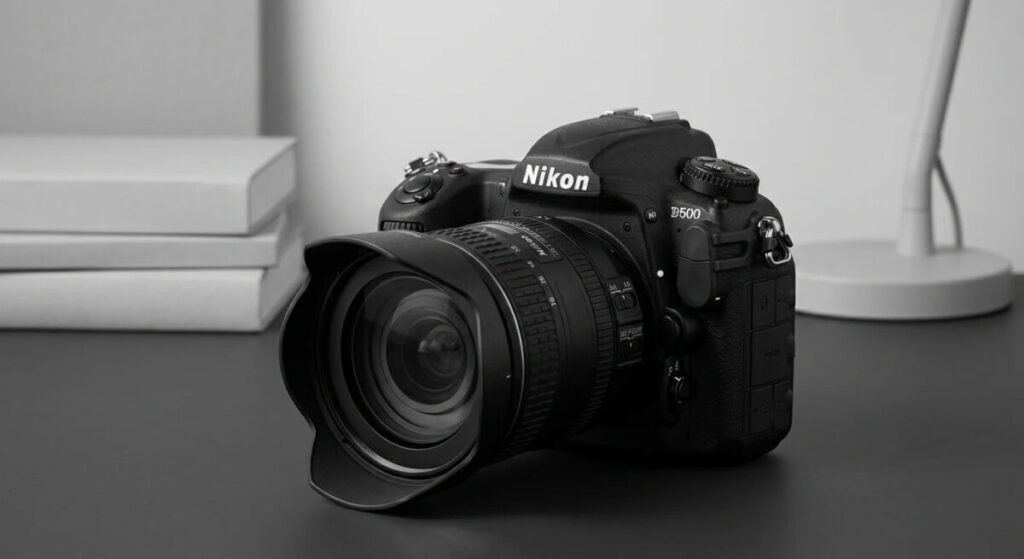
Here are the key specifications from published reviews.
| Feature | Nikon D500 |
|---|---|
| Sensor | 20.9 megapixel DX (APS-C), 1.5x crop factor |
| ISO range | 100 to 51,200, expandable far higher |
| Autofocus | 153 points, 99 cross-type |
| Burst rate | 10 fps |
| Raw buffer | About 200 shots (14-bit lossless compressed, with a fast card) |
| Video | 4K UHD at up to 30p, Full HD up to 60p |
| Viewfinder | Pentaprism, 100% coverage |
| Rear screen | 3.2-inch tilting touchscreen, about 2.36 million dots |
| Card slots | One SD and one XQD |
| Battery life | More than 1,200 shots (CIPA) |
| Weight | About 760 g |
You can confirm current details on the Nikon USA website.
Why the Nikon D500 Matters in 2027
The D500 launched in January 2016 at $2,000. That was a lot of money for an APS-C camera. Today the picture looks very different.
The Price Situation
In our recent snapshot, used D500 bodies were listed between about $699 and $1,059. A Digital Camera World article from August 2025 cited MPB used prices of about $424 to $959 in the United States, depending on condition. The two ranges differ because they come from different dates and sources. Both show the same pattern. A flagship that once cost $2,000 now sells for far less.
A Discontinued DSLR With a Loyal Following
Nikon discontinued the D500 in 2022. Even so, its reputation has grown. The same article called it the budget DSLR for sports and wildlife photography. That label fits, because the camera offers professional speed and tracking at enthusiast prices.
Why Value Beats Sensor Size
The D500 outranks bigger-sensor cameras on our list because it does one job extremely well. Its value comes from action capability, not sensor size. A photographer who shoots a heron lifting off or a bike through a corner gets more from this camera than from a higher-resolution body with slower tracking.
Design and Build Quality
Nikon built the D500 as a professional tool in a smaller body than its flagship siblings.
A Tough Metal Chassis
Digital Camera World found that the D500’s metal chassis is tougher and better sealed than the older D300S. It is not as robust as the flagship D5. The 2025 article described a weather-sealed magnesium alloy body with reassuring ergonomics. Nikon also placed a weather seal on the hotshoe.
Light for a Pro Body
The camera weighs about 760 grams. That makes it lighter than the D5 and far easier to carry on long days. Wildlife photographers who hike with heavy lenses will appreciate every gram.
No Pop-Up Flash
Nikon removed the pop-up flash. That choice helps weather sealing and simplifies the design. If you need flash, plan to buy an external unit.
Comfortable Handling
The reviewer praised the grip and thumb rest. The controls also earned praise. Still, a few quirks appeared. The touchscreen cannot navigate menus, and the Info screen is not interactive. The i menu cannot be customized. The focus selector lock also engaged accidentally while the reviewer walked with the camera on a strap.
The Viewfinder
The pentaprism viewfinder is bright and shows 100% of the frame. At high frame rates, the reviewer noticed a short blackout. That behavior is normal for DSLRs, yet it matters when you follow a fast subject.
Autofocus: The Reason to Buy a D500
Autofocus is the heart of this camera. Nikon borrowed the 153-point system from the D5, and 99 of those points use cross-type sensors.
What Reviewers Found
Digital Camera World called the autofocus fast and accurate. The reviewer followed skateboarders and found the camera tracked them well. A bounding dog also stayed sharp when the active focus point remained on it. The 2025 article praised the system for tracking subjects with long lenses.
Metering and White Balance
The reviewer also found matrix metering and auto white balance reliable. Exposures were often well balanced. That consistency saves editing time on long shoots.
How It Compares With Mirrorless
The 2025 article made a bold claim. It said the D500’s autofocus can beat the Canon EOS R7 and the Sony A6700 when tracking erratic, low-contrast subjects. It also said mirrorless systems can struggle with fast lateral movement. We treat that as one writer’s view, not a universal rule. Still, it shows how respected the D500’s tracking remains.
A Fair Warning About Modern Autofocus
Current mirrorless bodies recognize birds, animals and vehicles automatically. The D500 does not offer that feature. Therefore, mirrorless cameras can make focus easier for beginners. The D500 rewards photographers who understand how to place and hold a focus point.
Live View Autofocus Is Weak
Live view and video autofocus improved over other Nikon DX models. Even so, Digital Camera World found that they still hunt in bright light. The viewfinder is where this camera shines.
Our Take on Autofocus
For birds, wildlife, motorsport and field sports, the viewfinder autofocus is the reason to buy this camera. For anything that depends on live view, look elsewhere.
Speed, Buffer and Performance
The D500 shoots 10 frames per second. That speed suits action photography well.
A Deep Buffer
Digital Camera World reported a buffer of about 200 shots for 14-bit lossless compressed raw files. The 2025 article agreed, but noted that you need a fast card to reach that depth. Buy a quick XQD or fast SD card to get the most from the camera.
Why Buffer Depth Matters
A deep buffer lets you hold the shutter down during a long sequence. That ability matters when a bird takes off or a rider approaches a corner. Shallow buffers make you stop and miss moments.
Our Take on Speed
Ten frames per second with a large buffer gives you real confidence in the field. Few cameras near this price match that combination.
Image Quality and Low Light
The D500’s 20.9 megapixel sensor does not chase maximum resolution. Instead, it balances detail, noise control and speed.
Everyday Image Quality
Digital Camera World found most images sharp, well exposed and accurately colored. The lab results showed color accuracy among the best in the test group. They also showed low noise, especially at low and mid ISO.
Dynamic Range
The lab found that dynamic range matched the Nikon D7200. It also narrowly beat the Canon 7D Mark II and the Sony A77 II. That result suits a camera built for action rather than landscapes.
Low-Light Performance
Low-light performance was very good up to ISO 12,800. Slight color noise appeared from about ISO 25,600, but it stayed acceptable. The Hi 1 setting at ISO 102,400 held up well. Banding appeared at Hi 2, which is ISO 204,800, and the settings above it are not worth using.
The Crop Factor Advantage
The 1.5x crop factor turns a 500mm lens into a 750mm equivalent view. Wildlife and sports photographers love that extra reach. Remember that the focal length itself does not change. The framing simply gets tighter.
Our Take on Image Quality
The D500 delivers clean, accurate images for action work. If you need huge resolution for large prints or heavy cropping, a high-resolution full-frame body suits you better.
Video Quality
The D500 records 4K UHD at up to 30 frames per second. It also records Full HD at up to 60 frames per second.
What You Get
Recording lasts up to 29 minutes and 59 seconds. The camera also offers in-camera 4K time-lapse and electronic stabilization for handheld shooting. Digital Camera World called the 4K video excellent for its time.
The Limits
The 2025 article noted that 4K video is cropped and less refined than current hybrid cameras. It also called video autofocus sluggish. Those limits matter if you plan to shoot video seriously.
Our Take on Video
Treat the D500 as a stills camera that can record useful clips. Serious video creators should choose a modern hybrid body.
Battery Life and Storage
Battery life is a major D500 strength. The 2025 article cited a rating of more than 1,200 shots per charge under CIPA standards. It compared that number with roughly 300 to 500 shots for many mirrorless rivals.
Why It Matters in the Field
Long shoots punish short battery life. Wildlife photographers sit for hours. Motorsport photographers shoot all day. The D500’s endurance means fewer battery swaps and fewer missed moments.
Dual Card Slots
The camera has one SD slot and one faster XQD slot. That mix gives you backup options and a way to buy speed where it matters. Buy a fast XQD card for deep bursts.
No In-Body Stabilization
The D500 has no in-body stabilization. Therefore, you rely on lens stabilization for handheld shooting in dim light.
What That Means for Telephoto Work
Many Nikon telephoto lenses include vibration reduction. Check that your lens offers it before you buy. Lenses without stabilization will need faster shutter speeds.
Lens Ecosystem
The D500 uses Nikon’s F-mount. Used F-mount lenses are everywhere, and nearly every budget has an answer.
Telephoto Lenses Make the Camera
For someone who already owns telephoto F-mount lenses, this can be an exceptionally attractive used price. You gain a professional action body without changing systems.
Mirrorless Adaptation
Nikon also sells mirrorless bodies that can use F-mount lenses through an adapter. Still, the D500 works natively with those lenses and avoids that extra step.
Nikon D500 vs Nikon D850
This comparison is about jobs, not sensors.
Different Strengths
The D850 offers 45.7 megapixels, a full-frame sensor and 7 frames per second. The D500 offers 20.9 megapixels and 10 frames per second. Both use a 153-point autofocus system.
Which One Fits You
If birds and fast sport are your whole life, the D500 still suits that work better. Everyone else gets more from the D850. It combines roles, from landscapes to weddings to studio work. Our D850 review explains why.
Nikon D500 vs Nikon D7500
The D7500 is a smaller and cheaper enthusiast body.
What the D7500 Offers
The D7500 has a 20.9 megapixel DX sensor, 8 frames per second, 4K video at 30 frames per second and a tilting touchscreen. It also costs less. In our snapshot, used D7500 bodies ran from about $599 to $749.
What the D500 Adds
The D500 adds faster shooting, professional autofocus, a tougher body, dual card slots and stronger battery life. Our Nikon D7500 notes also point out that it should not be called a mini D500 in every respect.
Which One Fits You
Choose the D7500 if you want a lighter, cheaper body for wildlife and travel. Choose the D500 if you want the best tracking, the deepest buffer and a professional build.
Nikon D500 vs Mirrorless Options
You can also leave the DSLR world.
Mirrorless Alternatives
The 2025 article pointed to the Nikon Z50 II for APS-C, and to the Z5 II and Z8 for full frame. These cameras offer modern autofocus, subject recognition and better video. They also cost more.
Which One Fits You
Choose a mirrorless body if you want automatic subject detection, strong video and live view. Choose the D500 if you want proven viewfinder tracking, long battery life and a lower price.
Who Should Buy the Nikon D500?
Match yourself to a buyer type.
Bird and Wildlife Photographers
You get reach, tracking and a deep buffer. The D500 suits your work well.
Motorsport and Field Sports Photographers
You get speed and reliable autofocus. A heavy battery helps on long race days.
Existing Telephoto F-Mount Owners
You already own the lenses. A D500 gives you a professional action body at a modest price.
Budget-Conscious Action Shooters
You get a flagship-level tool without flagship money.
Who Should Skip the Nikon D500?
Skip the D500 in these cases.
Video Creators
The camera uses a 4K crop, and video autofocus hunts.
Live View Shooters
Live view autofocus does not match modern mirrorless systems.
Resolution-Hungry Photographers
If you crop heavily or print large, choose a higher-resolution camera.
Buyers Who Want Automatic Subject Detection
The D500 has no bird, animal or vehicle recognition.
How to Buy a Used Nikon D500 Safely
Condition matters more than price. Many D500 bodies lived hard lives as action cameras.
Check the Shutter Count
Ask the seller for the shutter count. Compare it with Nikon’s rated shutter life where reliable manufacturer information exists. A heavily used action camera can have a very high count.
Inspect the Body
- Check the weather seals, the grip and the corners for wear.
- Check the hotshoe and the port covers.
- Test the buttons, dials and the focus selector lock.
- Look for dents near the card slots and battery compartment.
Inspect the Sensor and Viewfinder
- Look for dust, scratches or oil on the sensor.
- Confirm that the viewfinder looks clean and clear.
Test Key Features
- Test viewfinder autofocus on a moving subject.
- Test both card slots with cards you trust.
- Test the tilting touchscreen.
- Check burst shooting for smooth operation.
Check the Battery and Charger
Make sure the battery holds a charge and the charger works.
Choose a Reliable Seller
Prefer sellers with a clear grading standard, a return window or a warranty. You can browse used inventory at MPB, B&H Photo and Adorama.
Budget for Cards and Lenses
Add the cost of a fast memory card and a good telephoto lens. A D500 without long glass is only half a tool.
Nikon D500 Pros and Cons
Pros
- Fast 10 fps shooting
- Deep raw buffer of about 200 shots
- 153-point autofocus system with excellent tracking
- Tough, weather-sealed professional body
- More than 1,200 shots per battery charge
- Very good low-light image quality
- 1.5x crop adds telephoto reach
- Dual card slots
- Light body for its class
- Strong value on the used market
Cons
- Live view and video autofocus hunt
- Cropped 4K video
- No in-body stabilization
- No automatic subject detection
- Banding at the highest ISO expansion settings
- Limited touchscreen use and fixed menus
- Discontinued by Nikon
Final Verdict: The Specialist Value Hero
The D500 earns its reputation. It combines professional speed, tracking and toughness in a body that costs far less than it once did. Digital Camera World called it a dream camera and suggested it may be Nikon’s best DSLR for the money.
Its weaknesses are real. Video is dated. Live view hunts. Mirrorless cameras now offer subject detection that the D500 cannot match. Yet none of those flaws matter to a photographer who shoots action through the viewfinder.
So here is our advice. If you shoot birds, wildlife, motorsport or field sports and own telephoto F-mount lenses, the D500 is one of the best buys in photography. If you need resolution, choose the D850. If you need video or subject detection, choose mirrorless.
Now we want to hear from you. Would you take the D500 for its speed, or the D850 for its balance? And do you trust viewfinder tracking more than modern subject detection? Tell us in the comments.
Frequently Asked Questions About the Nikon D500
Is the Nikon D500 still worth buying in 2027?
Yes, for action photographers. Its autofocus, speed, battery life and build quality still hold up. Video and live view are the main limits.
How fast does the Nikon D500 shoot?
The D500 shoots 10 frames per second. Reviewers reported a raw buffer of about 200 shots with a fast card.
Does the Nikon D500 shoot 4K video?
Yes. It records 4K UHD at up to 30 frames per second, with a crop. Autofocus in video mode still hunts.
How many autofocus points does the Nikon D500 have?
The D500 has 153 autofocus points, and 99 of them are cross-type.
Does the Nikon D500 have in-body stabilization?
No. Use lenses with vibration reduction for handheld telephoto work.
What memory cards does the Nikon D500 use?
It uses one SD card and one XQD card. A fast card gives you the deepest buffer.
Nikon D500 or D850 for wildlife?
The D500 suits fast action better. The D850 gives you more resolution and cropping room for patient work.
Nikon D500 or D7500?
The D500 offers faster shooting, stronger autofocus and a tougher body. The D7500 is lighter and cheaper.
Read More from Altbuzz
Want more camera reviews, rankings and value guides? Explore the latest articles at altbuzzmedia.com.
Subscribe to Altbuzz YouTube Channel
If you like matching cameras to real photographic jobs, subscribe to the Altbuzz channel on YouTube. We cover rankings, used-market reality checks and the latest rumors. Visit @AltBuzzMedia on YouTube and stay for the next one.
You can also support the channel through memberships and Super Thanks. Find everything else at altbuzzmedia.com.