
Pentax K-3 Mark III Monochrome Review: The Only DSLR Built to See in Black and White
The Pentax K-3 Mark III Monochrome exists because Pentax owners asked for it directly. Following the launch of the standard K-3 Mark III, Ricoh Imaging surveyed its user base about what should come next, and a monochrome version scored near the top of that list. Ricoh listened, and in April 2023 it released the only monochrome-specific digital SLR camera currently on the market, a genuinely unusual product in an industry that almost always chases broader appeal rather than narrower specialization.
This article breaks down everything worth knowing about the Pentax K-3 Mark III Monochrome. We will cover the custom sensor that makes this camera unique, its image quality and processing engine, autofocus and stabilization, build quality, and exactly why removing color capability entirely can actually improve an image. We will also compare it against the standard color K-3 Mark III and look honestly at who this camera does and does not make sense for. By the end, you will understand exactly why this camera has developed such a devoted following despite serving such a narrow purpose.
What Is the Pentax K-3 Mark III Monochrome and Why It Exists
Understanding this camera starts with recognizing it is not a filtered or reprogrammed version of an existing product, but a genuinely separate piece of sensor engineering.
Born From a Direct Customer Request
According to Ricoh’s official Pentax product page, the PENTAX K-3 Mark III Monochrome was exclusively designed to capture black-and-white images, built specifically to serve photographers who wanted the ultimate expression of monochrome photography rather than a color camera with a black-and-white mode bolted on. This origin story matters, since it explains why Pentax was willing to invest in a custom sensor for what was always going to be a niche product rather than a mass-market release.
The Same Flagship Body, A Completely Different Sensor
The camera’s design is based directly on the standard K-3 Mark III, the flagship model of Pentax’s APS-C lineup, according to Ricoh’s official product materials. Nearly everything about the body, the control layout, and the overall handling carries over unchanged. The genuine transformation happens entirely inside the sensor itself, where Pentax replaced the standard imaging chip with a custom-engineered monochrome-specific sensor built for this camera alone.
A Market Response That Validated the Bet
The Monochrome edition reportedly sold faster than manufacturing could keep up with at launch, remaining difficult to find in stock months after release despite not being a limited-edition model. For a camera built around such a specialized use case, this kind of sustained demand suggests Pentax read its own community correctly when it decided to greenlight this project.
Pentax K-3 Mark III Monochrome Sensor and Image Quality
The sensor is the entire reason this camera exists, and understanding exactly how it differs from a standard color chip explains everything else about this camera’s character.
A 25.73 Megapixel Sensor With No Color Filter Array
According to Ricoh’s official specifications, the K-3 Mark III Monochrome uses a custom-engineered APS-C sensor delivering approximately 25.73 effective megapixels, closely matching the resolution of the standard color K-3 Mark III. The defining difference is the complete absence of a Bayer color filter array, the grid of red, green, and blue filters that sits over every pixel on a conventional sensor and forces the camera to interpolate full color information from filtered, incomplete data.
Why Removing Color Filtering Improves Sharpness
According to Ricoh’s own technical explanation, this custom sensor does not need to convert or interpolate any color data, since it can register the actual brightness reaching each individual pixel directly. Every photosite captures real luminance information rather than a color-filtered approximation later reconstructed through demosaicing software. The result is a meaningful increase in per-pixel sharpness and fine detail compared to converting a color image to black and white after the fact, since nothing is lost to the color filter’s light absorption or the interpolation process a standard sensor requires.
Rich Tonal Gradation as the Sensor’s Signature Trait
According to Ricoh’s own marketing language, the sensor delivers highly sensitive expression with natural bokeh, rich gradation, and extra-fine sharpness that only a monochrome-specific sensor can produce. Tonal gradation, the smoothness of transition between different brightness values, benefits directly from having dedicated luminance data at every pixel rather than color information later converted to grayscale, giving black-and-white images a genuinely different quality than a color file simply desaturated in post-production.
An Extraordinary ISO Ceiling
According to technical specifications compiled from the camera’s official documentation, the K-3 Mark III Monochrome offers a native ISO range extending up to an extraordinary 1,600,000, matching the standard K-3 Mark III’s already impressive sensitivity ceiling. Removing the color filter array allows more light to reach each pixel unobstructed, contributing directly to the sensor’s exceptional low-light performance at these extreme sensitivity settings.
How Demosaicing Normally Works and Why Skipping It Matters
Understanding why this sensor produces such distinct results requires a brief look at what a standard color sensor actually has to do before it can even show you an image. A conventional Bayer sensor covers each pixel with a red, green, or blue filter, meaning any single pixel only ever records one of the three color channels directly. The camera’s processor then has to estimate the two missing color values for every pixel by examining its neighbors, a mathematical reconstruction process called demosaicing. This process works remarkably well in modern cameras, but it is still an estimate, not a direct measurement, and it introduces a small amount of softness and occasional color artifacts around fine detail and high-contrast edges. The K-3 Mark III Monochrome sensor skips this entire step, since every pixel already captures the one thing the camera actually needs for a black-and-white image: real, unfiltered brightness data.
Practical Implications for Fine Detail and Texture
This difference becomes most visible in subjects with fine repeating texture, such as fabric weave, foliage, or architectural brickwork, areas where demosaicing on a standard sensor can occasionally produce subtle moiré patterns or slightly softened detail. Since the Monochrome sensor never has to reconstruct this information from filtered, incomplete data, these same subjects render with genuinely crisper edge definition and texture separation, a difference experienced photographers frequently describe as the image having more apparent three-dimensionality despite being entirely black and white.
Pentax K-3 Mark III Monochrome Processing and Custom Image Modes
Beyond the sensor itself, Pentax built dedicated processing tools specifically for working with monochrome-only image data.
The PRIME V Processing Engine
The K-3 Mark III Monochrome uses the advanced PRIME V image processor, the same processing engine found across Pentax’s current camera lineup, adapted here to handle the unique data stream coming from a sensor with no color information to process. This processor supports fast autofocus performance and continuous shooting up to 12 frames per second.
Three Custom Image Modes Built for Black and White
According to Ricoh’s official announcement, the camera includes three Custom Image modes exclusively designed for monochrome photography: Standard, Hard, and Soft. Each mode provides fine adjustment of tone, key, contrast, and sharpness, letting photographers shape the character of their black-and-white output directly in-camera rather than relying entirely on post-processing to achieve a specific look.
A Menu System Redesigned for Monochrome
Even the camera’s menu system takes a decidedly black-and-white aesthetic approach, and the top display panel lights up white rather than the standard color found on the regular K-3 Mark III. These design choices reinforce the camera’s singular purpose at every level of the user experience, down to small details most photographers would never expect a manufacturer to bother customizing.
Pentax K-3 Mark III Monochrome Autofocus and Stabilization
Beyond its unique sensor, the camera inherits the strong autofocus and stabilization foundation established by the standard K-3 Mark III.
SAFOX 13 Autofocus With 101 Points
According to Ricoh’s official specifications, the camera uses the SAFOX 13 autofocus system with 101 phase-detection points, 25 of which are cross-type sensors for improved accuracy. This system’s autofocus working range extends from negative 4 EV up to 18 EV, giving the camera genuine low-light focusing capability that complements its already exceptional high-ISO sensor performance.
Five-Axis In-Body Image Stabilization
The K-3 Mark III Monochrome includes a 5-axis in-body image stabilization system, letting photographers shoot handheld at slower shutter speeds than an unstabilized camera would allow. This stabilization also enables Pentax’s signature Pixel Shift Resolution and AA filter simulation features, both inherited directly from the standard K-3 Mark III’s established feature set.
Twelve Frames Per Second Continuous Shooting
The camera supports continuous shooting up to 12 frames per second, giving it genuine capability for action and documentary photography despite its specialized monochrome focus. This burst rate places the K-3 Mark III Monochrome well within range of many general-purpose APS-C cameras, meaning photographers do not need to sacrifice shooting speed in exchange for the dedicated black-and-white sensor.
Pentax K-3 Mark III Monochrome Build Quality and Design
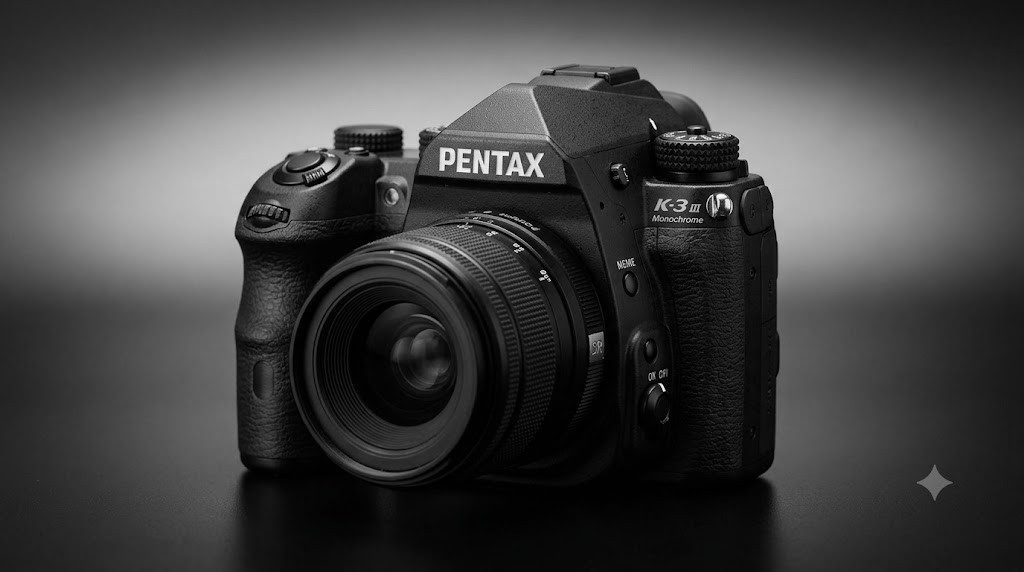
Beyond its unique sensor, the camera carries over the flagship build quality that has defined the K-3 line since its introduction.
A Durable, Compact DSLR Body
According to Ricoh’s official specifications, the camera features a 1.05x magnification pentaprism optical viewfinder alongside a 3.2-inch touchscreen LCD with 1.62 million dots. Ricoh’s own marketing describes the design as integrating remarkable imaging performance and a host of advanced features into a compact and durable body, continuing Pentax’s longstanding reputation for genuinely weather-resistant DSLR construction.
Subtle Visual Distinctions From the Color Model
The Monochrome edition includes the word Monochrome in subtle lettering on the back panel, an understated distinction from the standard color K-3 Mark III that avoids drawing unnecessary attention while still clearly identifying the camera’s specialized purpose to anyone familiar with the lineup.
The Pentax KAF2 Lens Mount
According to specifications compiled from the camera’s official documentation, the K-3 Mark III Monochrome uses the Pentax KAF2 bayonet mount, maintaining compatibility with KAF4, KAF3, KAF2, KAF, and KA mount lenses. This backward compatibility gives photographers access to decades of accumulated Pentax K-mount glass, a genuine advantage for anyone already invested in this lens ecosystem or drawn to the vintage lens compatibility Pentax cameras have long been known for.
Weather Sealing Built for Genuine Field Use
Pentax has built its DSLR reputation substantially around weather-resistant construction, and the K-3 Mark III platform continues that tradition with extensive sealing throughout the body against dust and moisture intrusion. For black-and-white photographers who frequently work outdoors in unpredictable conditions, whether documentary photojournalists covering events in poor weather or landscape photographers waiting out a storm for dramatic light, this durability represents a genuinely practical advantage that pure image quality specifications do not capture on their own.
Dual Card Slots for Reliable Backup
The camera includes dual SD card slots, with the primary slot supporting faster UHS-II cards and the secondary slot supporting UHS-I speeds, according to compiled specifications from the camera’s documentation. This dual-slot configuration lets photographers configure automatic backup recording, writing the same image simultaneously to both cards, a meaningful reliability feature for photographers capturing irreplaceable moments where a single card failure could mean permanently lost work.
Vintage Lens Compatibility as a Creative Advantage
Beyond simple backward compatibility, many black-and-white photographers specifically seek out older manual-focus Pentax lenses for their distinctive rendering characteristics, including unique bokeh shapes and contrast behavior that modern computer-optimized lens designs often smooth away. The K-3 Mark III Monochrome’s KAF2 mount welcomes this entire vintage lens ecosystem, letting photographers pair genuinely old optical designs with a thoroughly modern sensor built specifically to extract maximum tonal information from whatever light those lenses deliver.
Pentax K-3 Mark III Monochrome vs the Standard K-3 Mark III
Understanding exactly what changes and what stays the same between these two closely related cameras helps clarify the actual value of the monochrome-specific investment.
Identical Body, Completely Different Sensor Output
Both cameras share essentially the same body design, autofocus system, stabilization, and overall handling, according to Ricoh’s own product materials. The entire difference comes down to the sensor’s fundamental capability. The standard K-3 Mark III captures full color images that can be converted to black and white in post-production, while the Monochrome edition captures only luminance data directly, with no color information ever recorded in the first place.
A Real Price Premium for a Genuinely Different Sensor
According to Ricoh’s own announcement, the Monochrome edition launched at 2,199.95 dollars, a 200 dollar premium over the standard model’s original launch price. That price gap reportedly grew to approximately 500 dollars more than the regular model’s street price later in 2023, reflecting genuine manufacturing costs tied to producing a custom sensor for a comparatively low-volume specialty product.
Why You Cannot Simply Convert Color to Match This Sensor
Photographers sometimes assume converting a color photograph to black and white achieves the same result as a dedicated monochrome sensor, but the underlying data capture process differs fundamentally. A color sensor’s Bayer filter absorbs a meaningful portion of incoming light and requires interpolation to reconstruct full resolution color data, introducing softness and processing artifacts that a filterless monochrome sensor simply does not encounter. The sharpness and tonal gradation advantages this camera offers are baked into the capture process itself, not something achievable through post-processing conversion alone.
Pentax K-3 Mark III Monochrome vs the Leica M11 Monochrom
The Pentax is not entirely alone in this niche. Understanding its closest philosophical competitor clarifies exactly where this camera fits within the broader dedicated monochrome category.
Two Very Different Price Points for the Same Core Idea
Leica also produces a dedicated monochrome-sensor camera in its M11 Monochrom, built around the same fundamental principle of removing the color filter array entirely for maximum sharpness and tonal gradation. The Leica, however, launches at a price point several times higher than the Pentax, positioning it as a luxury rangefinder experience rather than a working photographer’s tool built around genuine value.
DSLR Practicality Versus Rangefinder Tradition
Beyond price, the two cameras represent entirely different shooting philosophies. The K-3 Mark III Monochrome offers a conventional DSLR experience with autofocus, an optical pentaprism viewfinder, and a familiar control layout that any Pentax shooter could pick up immediately. The Leica M11 Monochrom instead continues the manual-focus rangefinder tradition the M system has maintained for decades, appealing specifically to photographers who value that deliberate, manual shooting process as part of the monochrome photography experience itself.
Why the Pentax Represents the More Accessible Entry Point
For photographers curious about dedicated monochrome photography without committing to Leica’s considerably higher investment and steeper manual-focus learning curve, the K-3 Mark III Monochrome offers a genuinely more accessible path into this specialized category. Autofocus, in-body stabilization, and a familiar DSLR shooting experience remove several barriers that might otherwise discourage a photographer from exploring dedicated monochrome capture in the first place.
Who Should Buy the Pentax K-3 Mark III Monochrome
Understanding the ideal buyer for this camera matters enormously, given how specifically it serves one particular type of photography.
Dedicated Black-and-White Photographers
Photographers who shoot predominantly or exclusively in black and white represent the clearest audience for this camera. This camera rewards photographers who have already committed to monochrome as their primary creative language, rather than those who occasionally convert color images for stylistic variety.
Fine Art and Documentary Photographers Who Value Tonal Range
The camera’s exceptional tonal gradation and sharpness make it particularly compelling for fine art printmakers and documentary photographers who depend on subtle tonal transitions to convey mood and depth in their work. The absence of color as a creative variable forces complete focus on light, shadow, and composition, a discipline many serious black-and-white photographers actively seek out.
Photographers Who Shoot Predominantly in Low Light
Given the sensor’s extraordinary ISO ceiling and improved light gathering from the missing color filter array, photographers working frequently in challenging low-light conditions, from astrophotography to night documentary work, stand to benefit meaningfully from this camera’s specific sensor advantages.
Who Should Skip This Camera Entirely
Photographers who need color capability for any portion of their work should obviously look elsewhere, since this camera offers no color recovery option whatsoever once an image is captured. Casual photographers who only occasionally shoot black and white would also find better value in the standard color K-3 Mark III, converting select images to monochrome in post-production rather than paying a genuine premium for a capability they would use only occasionally.
Real World Shooting Scenarios Where This Sensor Advantage Matters Most
Understanding exactly when the monochrome sensor’s advantages translate into a genuinely different final image helps clarify whether this camera fits your specific photographic practice.
Portrait Work With Natural Bokeh
According to Ricoh’s own marketing language, the sensor delivers natural bokeh alongside its tonal gradation strengths, making it a genuinely compelling option for portrait photographers working in black and white. Skin tones rendered through dedicated luminance capture, rather than a color-to-grayscale conversion, tend to preserve subtle gradations in shadow and highlight detail across a face that a converted color file can sometimes flatten or compress during the conversion process.
Landscape and Architectural Photography
Landscape and architectural photographers who value dramatic tonal separation between sky, structure, and shadow benefit directly from the sensor’s improved dynamic range and gradation handling. Since no color filter absorbs incoming light before it reaches the sensor, subtle texture in stone, cloud formations, and shadowed architectural details all render with a level of fine detail that a standard sensor’s demosaicing process cannot fully replicate.
Astrophotography and Extreme Low Light
Given the camera’s extraordinary ISO ceiling and the sensor’s improved light-gathering efficiency without a color filter array in the way, astrophotographers and night photographers represent a genuinely strong audience for this camera. Star fields and faint nebulosity often benefit from maximum luminance sensitivity more than color accuracy, making the tradeoff this camera represents a genuinely favorable one for this specific type of photography.
Frequently Asked Questions About the Pentax K-3 Mark III Monochrome
Can the Pentax K-3 Mark III Monochrome shoot in color at all?
No. The camera’s sensor has no color filter array and captures only luminance data, meaning it is permanently limited to black-and-white image capture with no option to record or recover color information.
Is the Pentax K-3 Mark III Monochrome just a K-3 Mark III with a black-and-white filter applied?
No. The camera uses a genuinely custom-engineered sensor built specifically without a Bayer color filter array, rather than software or an in-camera filter applied to a standard color sensor. This is a fundamentally different piece of hardware, not a mode switch.
How much more does the Monochrome edition cost compared to the standard K-3 Mark III?
The Monochrome edition launched at a 200 dollar premium over the standard model’s original price, a gap that reportedly grew to approximately 500 dollars more than the regular model’s street price later in 2023.
What lenses work with the Pentax K-3 Mark III Monochrome?
The camera uses the Pentax KAF2 bayonet mount and maintains compatibility with KAF4, KAF3, KAF2, KAF, and KA mount lenses, giving photographers access to decades of accumulated Pentax K-mount glass.
Does removing the color filter array actually improve image sharpness?
Yes. Since the sensor does not need to interpolate color data through a demosaicing process, and no color filter absorbs incoming light before it reaches each pixel, the camera produces measurably sharper detail and richer tonal gradation compared to a standard color sensor converted to black and white afterward.
Final Thoughts on the Pentax K-3 Mark III Monochrome
The Pentax K-3 Mark III Monochrome represents a genuinely rare product in the modern camera industry, a manufacturer building a specialized tool in direct response to customer demand rather than chasing the broadest possible market. Its custom sensor delivers real, measurable advantages in sharpness and tonal gradation compared to converting color images after the fact, backed by the same strong autofocus, stabilization, and build quality that already made the standard K-3 Mark III a respected flagship APS-C DSLR.
At 2,199.95 dollars, this camera demands genuine commitment to monochrome photography as a primary creative practice rather than an occasional stylistic choice. For the specific photographers who have made that commitment, Pentax built something that genuinely does not exist anywhere else in the current camera market.
Read More from Altbuzz
For more Pentax coverage, check our Pentax K-3 Mark III review, our Leica M11 Monochrom comparison, and our best DSLR cameras still worth buying guide for additional context on this specialized camera category.
Follow every Pentax release and monochrome camera update at altbuzzmedia.com.
Subscribe to Altbuzz YouTube Channel
Full hands-on impressions of the Pentax K-3 Mark III Monochrome, comparisons against the standard color model, and ongoing Pentax DSLR coverage are live on the Altbuzz YouTube channel @AltBuzzMedia. Subscribe now for weekly camera reviews and gear breakdowns through the rest of 2026.