
Canon EOS M200: Full Review, Specs, Performance and Buyer Verdict
The Canon EOS M200 arrived in October 2019 carrying a 24.1MP APS-C sensor, Dual Pixel autofocus, and 4K video capability inside a body weighing just 299 grams. For a beginner mirrorless camera at its price point, that combination set a strong benchmark. Even years after its release, the M200 continues to attract first-time camera buyers who want a meaningful step up from smartphone photography without diving into overwhelming complexity.
Numbers alone never tell the complete story, though. This guide covers every major aspect of the Canon EOS M200 in plain, technical language. Each specification gets explained in terms of what it actually means during real shooting situations. By the end, you will know precisely whether this camera fits your needs or whether a different option serves you better.
Who Is the Canon EOS M200 Built For?
Understanding the target audience makes every design decision in the M200 easier to evaluate. Canon built this camera specifically for photographers transitioning from smartphone photography for the first time. The guided interface explains what settings do directly on screen. Creative Assist adjusts image look through visual sliders rather than technical menus. The compact dimensions mean the camera actually comes out of the bag rather than staying home.
Experienced photographers who want deep manual control, extensive physical dials, or a growing lens ecosystem will find the M200 limiting quickly. For its intended audience, however, it delivers exactly what it promises without unnecessary complexity getting in the way.
Canon EOS M200: Complete Specifications
| Feature | Specification |
|---|---|
| Sensor Type | APS-C CMOS, 24.1MP |
| Processor | DIGIC 8 |
| ISO Range | ISO 100 to 25,600 (expandable to 51,200) |
| Autofocus System | Dual Pixel CMOS AF, 143 AF zones |
| AF Coverage | Approx. 88% horizontal, 100% vertical |
| Stabilization | None built-in, lens OIS only |
| Video Recording | 4K UHD 25fps, 1080p 60fps |
| Viewfinder | None |
| LCD Screen | 3.0-inch tilting touchscreen, 1.04M dots |
| Burst Shooting | 6.1fps continuous |
| Battery | LP-E12, approx. 315 shots per charge |
| Storage | Single SD/SDHC/SDXC slot |
| Connectivity | Wi-Fi, Bluetooth, Micro-USB |
| Lens Mount | Canon EF-M |
| Dimensions | 108.2 x 67.1 x 35.1mm |
| Weight | 299g with battery and card |
| Launch Price | Approx. $549 USD with 15-45mm kit lens |
Canon EOS M200 Sensor Performance and Image Quality
Resolution and Detail Rendering
The 24.1MP APS-C sensor produces files with strong, clean detail at base ISO. Landscape subjects reveal fine textures, sharp edges, and smooth tonal gradations across the frame. Portrait subjects show clean skin detail without artificial over-sharpening that makes faces look plastic or processed. Furthermore, at 24.1 megapixels, prints up to A2 size look sharp and well-defined, and moderate cropping retains acceptable image integrity without breaking down into obvious pixel artifacts.
RAW files respond predictably to editing in Lightroom, Capture One, and other RAW processors. Shadows hold recoverable detail down to approximately minus two and a half stops of underexposure. Highlight recovery works well in moderate contrast situations. However, in extreme high-contrast scenes, highlights clip before significant recovery remains possible. For beginners learning to edit RAW files, this sensor provides a solid and forgiving foundation without punishing small exposure errors too severely.
Canon Color Science
Canon’s color rendering reflects decades of refinement across both film and digital camera production. Specifically, the M200 produces natural, slightly warm-leaning colors that flatter human subjects consistently across varying lighting conditions. Skin tones appear accurate and appealing under both natural daylight and indoor artificial light without requiring manual white balance correction in most situations.
Seven Picture Style profiles come built in: Standard, Portrait, Landscape, Fine Detail, Neutral, Faithful, and Monochrome. Each profile allows further adjustment of sharpness, contrast, saturation, and color tone individually. For JPEG shooters, Standard produces social-media-ready files straight from the camera with no editing required. Portrait mode delivers warmer and slightly softer results, particularly suited to natural light people photography where gentle rendering of skin is a priority.
Low-Light Sensitivity
ISO 800 produces clean, sharp images with minimal visible noise across the frame. At ISO 1600, noise appears but remains fine-grained and controlled rather than blotchy or visually disruptive. ISO 3200 stays usable for casual sharing and small prints up to A4. Beyond ISO 3200, however, noise reduction processing begins softening fine detail noticeably in areas like hair strands, fabric weaves, and distant foliage.
The expandable maximum of ISO 51,200 exists as a last-resort option. Realistically, images at this level show heavy noise alongside processing artifacts that smear fine detail beyond recovery. For practical indoor available-light photography at events, family gatherings, or restaurant environments, ISO 3200 represents a sensible upper limit where quality remains acceptable for most purposes.
Dynamic Range Explained
The M200 captures approximately 11.5 stops of dynamic range at base ISO. This figure is competitive within the entry-level price class it occupies. Compared to mid-range and professional sensors offering 13 to 14 stops, the M200 shows its class positioning most clearly in high-contrast situations. Bright skies above shaded subjects, for instance, challenge the sensor to either clip highlights or sacrifice shadow detail.
RAW shooters manage this limitation through careful metering and targeted shadow or highlight adjustments in post-processing. JPEG shooters benefit significantly from enabling Canon’s Auto Lighting Optimizer, which automatically balances exposure across the frame and reduces harsh shadow areas in backlit situations. This feature makes a noticeable practical difference in the kinds of high-contrast conditions beginners encounter most frequently during outdoor daylight shooting.
Canon EOS M200 Dual Pixel Autofocus System
How Dual Pixel AF Works
Every single photosite on the M200 sensor splits into two separate photodetectors. The camera reads phase-difference information directly from the imaging sensor itself, calculating both the direction and distance to the focus point in a single measurement. This instant directional calculation means the lens moves decisively toward correct focus rather than searching back and forth like older contrast-detect systems that had to hunt for peak sharpness iteratively.
The practical result is an autofocus system that feels confident, quick, and reliable in most everyday shooting situations. Pointing the camera at a subject in normal light produces fast, accurate focus confirmation with the kind of decisive response that beginner photographers appreciate immediately when switching from slower-focusing alternatives.
Face Detection Behavior
Face detection activates automatically and finds faces within fractions of a second under good lighting. The system tracks detected faces reliably as subjects move laterally across the frame. Tracking confidence decreases in lower light, against busy backgrounds, or when subjects move rapidly directly toward the camera, which is expected behavior at this price tier rather than a specific flaw.
Eye autofocus is not available on the M200. Photographers who want automatic precise eye-level focus need to consider Canon’s M6 Mark II or RF-mount APS-C bodies instead. On the M200, careful framing or center-composition approaches compensate practically for the absence of eye AF in most portrait situations without significant inconvenience.
Tracking and Continuous AF
Continuous AF during burst shooting locks onto a moving subject and attempts to maintain focus as it moves. At 6.1fps, the M200 does not qualify as a sports camera by any practical standard. However, for moving children, casual family moments, and slow-action subjects like people walking or cyclists at moderate speed, the continuous AF tracks adequately. Fast, unpredictable athletic movement exceeds what the system handles reliably.
Low-Light AF Performance
Reliable autofocus performance extends down to approximately EV minus 2, which covers dim indoor lighting, candlelit table settings, and shaded outdoor subjects. Below this threshold, the camera occasionally hunts without confirming focus cleanly. For general indoor available-light photography at parties, restaurants, and home environments, the system rarely causes frustration in practice.
Video Autofocus Quality
During video recording, Dual Pixel AF transitions smoothly between subjects with minimal focus breathing. Focus breathing, the slight apparent zoom that occurs as the lens adjusts focus distance, remains present but subtle enough that casual viewers rarely notice it. This smooth continuous AF during video recording represents one of the M200’s strongest practical advantages over competing cameras at this price, many of which rely on slower and less confident contrast-detect systems for video work that produce more obvious focus hunting on screen.
Canon EOS M200 Video Capabilities
4K Recording and the Crop Factor Problem
The M200 records 4K UHD at 25fps, which sounds like a strong specification. Understanding the full picture requires examining the crop factor that applies during 4K recording. The camera applies a 1.56x crop to the sensor image when recording in 4K. Combined with the APS-C sensor’s inherent 1.6x crop factor relative to full-frame, total effective field of view in 4K narrows to approximately 2.5x compared to a full-frame sensor.
In practical terms, a 22mm lens behaves like a 55mm equivalent during 4K recording. Standard kit lens focal lengths become significantly more telephoto than photographers expect when they switch from stills to 4K video. Wide-angle shooting becomes considerably more difficult, and environmental context in travel or event footage narrows substantially.
No built-in stabilization exists on the M200. The 4K crop magnifies any camera shake, making stable handheld 4K footage genuinely difficult without a stabilized lens or tripod support. Most practical 4K shooting on the M200 therefore requires a stabilized EF-M lens to deliver usable, watchable footage.
Why 1080p Is the Better Practical Choice
Full-pixel readout in 1080p mode uses the complete sensor width, preserving normal focal length behavior across all lenses. At 60fps, footage looks smooth and detailed with good color rendering. Dual Pixel AF tracks subjects confidently during 1080p recording without the crop complications of 4K.
For the vast majority of casual videographers, vloggers, and travel shooters, 1080p at 60fps delivers entirely satisfying results for YouTube, Instagram, TikTok, and personal video archives. The full-width readout also means lens stabilization works as intended across the frame rather than only stabilizing a cropped portion.
Slow Motion Capability
At 1080p 60fps, the M200 enables simple 2.5x slow-motion playback when edited to a 24fps timeline. This is enough for gentle slow-motion effects on casual subjects like falling water, blowing leaves, or children playing. It does not provide the dramatic high-speed slow motion that cameras with 120fps or higher 1080p recording deliver.
Audio Limitations
The built-in microphone is mono with no external microphone input available on the body. This is a significant constraint for anyone prioritizing audio quality in video production. Recording caps at 29 minutes 59 seconds per clip due to file format limitations. No logarithmic video profile is available, so dynamic range in video footage is considerably narrower than in still photography.
Overheating Behavior
Extended 4K recording in warm outdoor environments can trigger thermal shutdown, requiring a cooling period before recording resumes. Short travel clips and family event videos rarely encounter this limitation under typical conditions. Continuous long-form recording in warm weather makes overheating a more realistic practical concern that shooters should plan around.
Canon EOS M200 Design and Physical Build
Body Construction and Materials
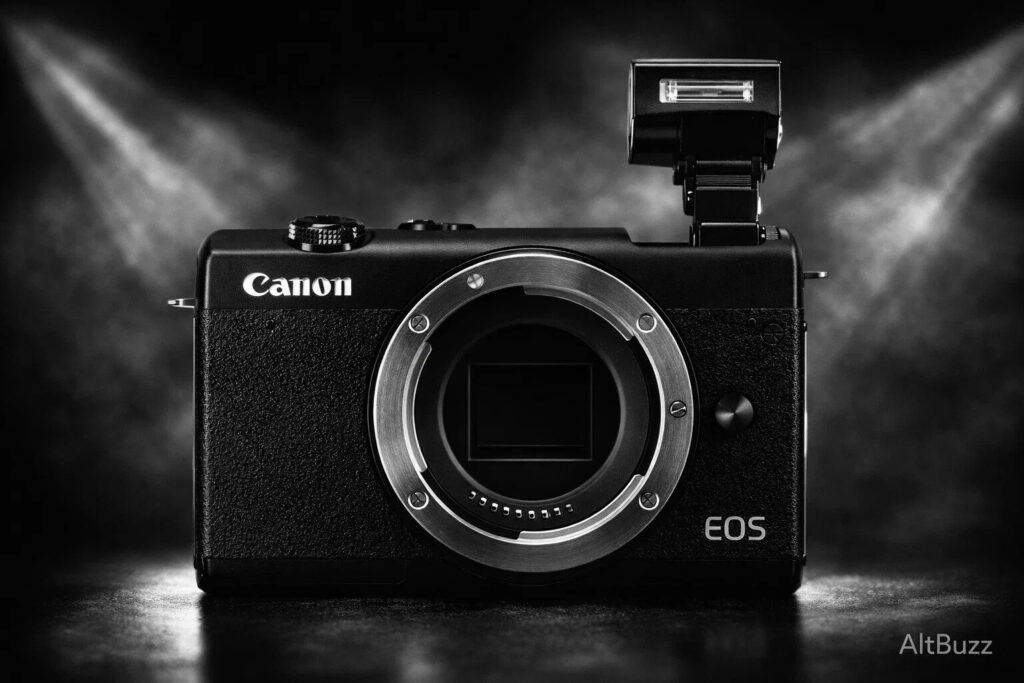
Polycarbonate construction keeps weight at just 299 grams. No weather sealing protects against moisture or dust ingress. The body feels solid and well-assembled for its class, with panels that do not flex or creak under normal daily handling pressure. The shallow grip accommodates smaller hands comfortably, though larger-handed photographers sometimes find single-handed security with heavier EF-M lenses slightly uncertain during extended sessions.
The overall dimensions of 108.2 by 67.1 by 35.1mm make the M200 genuinely pocketable with the 22mm f/2 pancake lens attached. With the 15-45mm kit zoom extended, the combination fits in a large jacket pocket but no longer qualifies as truly compact in the way a fixed-lens camera does.
Touchscreen Interface and Usability
The 3.0-inch tilting LCD offers 180-degree upward rotation for selfie shooting and vlogging. This tilting mechanism works smoothly and holds its position firmly under the weight of the camera during extended self-filming. Touch AF, touch shutter, and touch-to-drag AF during playback all work reliably and responsively.
Menu navigation via touch is faster than button navigation for most operations, particularly for beginners who are not yet memorizing button shortcuts. The screen does not tilt downward, which limits overhead shooting angles where the screen would need to face downward to remain visible. Nonetheless, the upward rotation covers the most common use cases for this camera’s target audience effectively.
Physical Controls
Mode selection happens entirely through the touchscreen rather than a physical mode dial, which keeps the top plate clean and minimal. One control dial, a directional pad, and a small set of dedicated buttons for playback, delete, menu, and quick menu access cover essential operations.
Beginner photographers transitioning from smartphones find this layout approachable and manageable without a learning curve. Experienced photographers wanting a dedicated ISO button, exposure compensation dial, multiple custom function buttons, or extensive direct control access will quickly feel constrained by the M200’s deliberately simplified control scheme.
Viewfinder Absence
The M200 has no optical or electronic viewfinder. All composition happens through the rear LCD screen. In bright outdoor daylight, screen visibility can become a challenge, particularly if the screen brightness is not set to maximum. Photographers who are accustomed to composing through a viewfinder will notice this absence immediately and consistently in sunny conditions.
Canon EOS M200 Battery Life and Connectivity
Battery Performance in Real Use
The LP-E12 battery delivers approximately 315 shots per charge under CIPA standards. Real-world performance varies meaningfully based on usage patterns. Heavy touchscreen interaction, sustained video recording, active Wi-Fi connectivity, and frequent image review all reduce endurance noticeably below the rated figure.
Carrying one spare battery comfortably covers a full day of moderate shooting. The LP-E12 is compact, lightweight, and relatively inexpensive, making two or three spare cells a practical and affordable solution for photographers planning full-day outings or travel sessions.
Charging Limitations
USB charging through the camera body is not supported on the M200. The battery must come out for charging in the included LC-E12 charger or a compatible third-party USB charger. This adds inconvenience for travel photographers who prefer charging directly from power banks or hotel USB ports without removing the battery and carrying a separate charging unit.
Wireless Connectivity
Canon Camera Connect app connectivity via Wi-Fi and Bluetooth enables wireless image transfer, remote live view shooting, and GPS location tagging via smartphone. Bluetooth maintains a persistent low-energy pairing so the camera connects automatically with a linked smartphone on power-up, making image transfer reasonably fast and frictionless for JPEG files.
Large RAW file transfers via Wi-Fi run noticeably slower than wired Micro-USB transfer. Photographers who regularly transfer complete RAW shooting sessions wirelessly will find the process time-consuming enough that a direct cable connection becomes more practical for bulk transfers.
Canon EOS M200 Lens Ecosystem
The EF-M Lineup
The EF-M mount accepts Canon’s M-series lens lineup, which covers the most common focal length ranges for hobbyist photography. The current lineup includes the 11-22mm f/4-5.6 IS STM ultrawide zoom, 15-45mm f/3.5-6.3 IS STM kit zoom, 22mm f/2 pancake prime, 28mm f/3.5 macro, 32mm f/1.4 STM portrait prime, and 55-200mm f/4.5-6.3 IS STM telephoto zoom.
Together, these lenses cover ultrawide landscape work through moderate telephoto reach, with the 22mm f/2 pancake providing an excellent fast prime option and the 32mm f/1.4 delivering a professional-grade portrait lens in a compact format.
The Discontinuation Issue
Canon officially confirmed in 2023 that no new EF-M lenses are planned, as the company focuses entirely on the RF mount system going forward. Existing EF-M lenses continue to perform perfectly and remain available for purchase new and used. However, the ecosystem will not grow, which matters for photographers planning to expand their lens collection significantly over multiple years.
EF Adapter Compatibility
The EF-M to EF adapter enables full use of Canon’s extensive EF and EF-S DSLR lens library, including Dual Pixel AF compatibility with most lenses. This adapter opens access to a vast range of focal lengths, apertures, and specialist lenses that the native EF-M lineup does not cover. For photographers who already own Canon EF glass or want access to affordable used EF lenses, the adapter significantly expands the M200’s optical flexibility despite the native mount limitations.
Canon EOS M200 Real-World Use Cases
Family and Everyday Photography
Face detection AF and responsive touch shutter make the M200 a practical family camera for capturing children, events, and casual everyday moments. The selfie screen enables family group photos and self-portraits without requiring a tripod or a second person to hold the camera. The compact size means it travels to family events without burden.
Travel Photography
At 299 grams with a kit lens, a complete travel photography setup fits in a small shoulder bag or large daypack pocket. Dual Pixel AF handles tourist crowds, street scenes, and candid portraits confidently. The image quality advantage over smartphone photography becomes most visible in lower light travel conditions like covered markets, evening streets, and dim interiors.
Beginner Learning Platform
The guided interface explains what each setting does on screen as you adjust it. Creative Assist provides visual slider controls for beginners who are not yet comfortable with technical terms like aperture and shutter speed. These features make the M200 a genuinely effective first camera for learning photography fundamentals at a practical pace without feeling overwhelmed.
Casual Vlogging
The upward-tilting selfie screen and smooth Dual Pixel video AF support casual vlogging adequately for personal and social media purposes. Audio quality limitations prevent serious content production without external audio solutions. For casual travel diaries, family event videos, and personal documentation, the M200 handles the role well.
Street Photography
The compact and unobtrusive body with the 22mm f/2 pancake lens creates a lightweight and discreet street photography package. At 299 grams total with that lens, the combination attracts minimal attention in public environments and fits comfortably in a jacket pocket for day-long carry without physical fatigue.
Canon EOS M200 Pros and Cons
Strengths
The 24.1MP APS-C sensor delivers strong resolution for the entry-level price class, producing files with detail that prints well at A2 and beyond. Dual Pixel CMOS AF brings technology originally developed for professional Canon cameras down to a beginner body, delivering confident and responsive face-tracking performance that competing cameras at this price rarely match. The 180-degree tilting selfie screen covers vlogging, self-portrait, and group photo use cases without any additional equipment.
At 299 grams, the M200 is genuinely pocketable with the pancake lens and practical for all-day carry without physical strain. Canon’s color science produces flattering JPEG output that looks social-media-ready straight from the camera. Wi-Fi and Bluetooth integration with Canon Camera Connect delivers seamless smartphone image transfer and remote control. EF adapter compatibility opens access to the extensive Canon EF lens library for photographers wanting optical flexibility beyond the native EF-M lineup.
Weaknesses
The complete absence of a built-in viewfinder means all composition happens through the rear screen in every condition, including bright sunlight where screen visibility suffers. No weather sealing of any kind leaves the camera vulnerable to light rain, mist, and dusty environments that photographers encounter regularly outdoors. The 4K crop factor of 1.56x limits wide-angle video shooting significantly and complicates focal length planning for video-focused users.
The mono microphone with no external input prevents quality audio recording without proprietary or third-party add-ons. The EF-M system’s confirmed discontinuation limits long-term lens ecosystem growth for photographers planning extensive investment. The absence of USB body charging adds logistical inconvenience for travel use. At 6.1fps burst speed, the camera falls well short of cameras suited to sports and fast action photography.
Final Verdict on the Canon EOS M200
The Canon EOS M200 consistently delivers on its core promise. APS-C image quality, Dual Pixel autofocus, and compact dimensions at an accessible price represent a genuinely strong beginner mirrorless package that holds up well against alternatives in its class.
The EF-M system’s discontinuation is the most important long-term consideration. Photographers who plan to own one or two lenses for casual shooting have little to worry about in practical terms. Photographers who envision growing a serious lens collection over years would be better served by Canon’s RF-mount APS-C options, even at slightly higher initial cost.
At current street prices below the 2019 launch figure, the M200 offers exceptional value for the right buyer with clear and realistic expectations about what a beginner mirrorless camera does well and where it asks for compromise.
Read More from AltBuzz
For honest camera reviews, clear spec breakdowns, and photography content written for real people at every level, visit AltBuzz. AltBuzz covers every camera category with depth and practical clarity.
Subscribe to the AltBuzz YouTube Channel
Stay updated with the latest camera reviews and comparisons. AltBuzz makes technical photography accessible and easy to understand for enthusiasts at every experience level. Subscribe to AltBuzz on YouTube and never miss a new review.