
Leica M12-D Rumors: Expected Specs, Features & Release
There are cameras. Then there are Leica cameras. And within Leica’s storied lineup, few concepts generate as much quiet anticipation as the Leica M12-D. This camera is unreleased. It has not been officially confirmed by Leica. But based on a growing body of leaks, trademark activity, industry sources, and Leica’s own history, the M12-D appears to be a very real possibility and a deeply compelling one.
The Leica M12-D would follow in the tradition of Leica’s “D” series digital-purist rangefinders that strip away distractions and return the camera to its essential function: the act of seeing and capturing. Previous “D” editions from Leica, such as the M-D and M10-D, eliminated the rear LCD screen entirely, forcing photographers to engage more deliberately with their subject and their craft.
The M12-D, if it arrives, is expected to carry this philosophy forward but with meaningful technical upgrades over all previous iterations. It would combine Leica’s most advanced sensor technology yet with the brand’s most restrained, intentional design philosophy.
This blog is based entirely on speculation, leaks, and informed analysis. Nothing here is officially confirmed by Leica AG. Treat all specifications and details as educated rumor until Leica speaks.
The Leica M12-D is expected to appeal to rangefinder purists, fine art photographers, photojournalists, and serious Leica collectors who value the analog-like shooting experience above all else.
Expected Release Date and Market Position
The Leica M12 the standard model has been among the most rumored and delayed cameras in recent memory. FCC certification documents hinted at a May 2025 announcement that never materialized. The Leica M12 trademark has gone through complex status changes at the USPTO. As of early 2026, the most credible estimates place the M12 launch in the second half of 2026 or first half of 2027.
The Leica M12-D, as a variant of the M12 platform, would likely follow several months after the standard M12 announcement. Historical precedent supports this Leica typically launches core M models first, then follows with special editions and “-D” variants.
Market positioning places the Leica M12-D firmly at the very top of Leica’s pricing structure. Previous “-D” models have commanded premium prices over standard variants. Expect the M12-D to land between $8,500 and $10,500 USD — potentially higher depending on the edition.
One interesting rumor suggests Leica may offer the M12 in two configurations: a standard model with a fixed bottom base plate, and a “Heritage” edition with a classic removable base plate a nod to Leica’s film camera loading system. The M12-D may align with or serve as the Heritage edition.
Rumored Specifications Table
| Feature | Rumored Details |
|---|---|
| Sensor Type | Full-Frame BSI CMOS — Leica-developed, manufactured in Europe |
| Resolution | ~60 Megapixels (speculative) |
| Processor | Next-Generation Maestro Processor |
| ISO Range | ISO 64 – ISO 50,000 (est.) |
| Autofocus System | Manual Focus (rangefinder-coupled) — possible contrast AF assist |
| Stabilization | IBIS — tested, not confirmed for inclusion |
| Video Recording | Likely limited or absent (true to M-D philosophy) |
| Viewfinder | Optical Rangefinder — possible hybrid EVF overlay |
| LCD Screen | None (M-D philosophy) or minimal status display only |
| Burst Shooting | ~5 fps (est.) |
| Battery | Upgraded Li-Ion — improved over M11 |
| Storage | Internal 64GB + single SD/CFexpress slot |
| Connectivity | Wi-Fi, Bluetooth, USB-C |
| Weight | ~640g (est. — ~3mm smaller body than M11) |
| Expected Price | $8,500 – $10,500 USD |
Sensor and Image Quality (Rumored)
The sensor story around the Leica M12-D is perhaps the most compelling in the entire Leica rumor cycle. The M11 used a customized Sony-manufactured sensor. But for the M12 generation, Leica is rumored to be introducing a proprietary sensor developed entirely in-house, manufactured in Europe.
This would be a landmark moment for Leica. Developing a sensor independently rather than sourcing from Sony or other suppliers — gives Leica complete control over the imaging characteristics. It means the colour rendering, tonal response, and low-light behaviour can be tuned specifically to Leica’s exacting standards.
Resolution is expected to increase significantly. The M11 offered a 60-megapixel sensor with a multi-shot option. Rumours suggest the M12 platform will maintain or exceed this level of resolution — possibly pushing into 60–64 megapixel territory with improved pixel-level performance.
Dynamic range improvements are widely expected. Leica cameras are celebrated for their extraordinary tonal latitude and richness. The new proprietary sensor should advance both dynamic range and colour depth beyond the already excellent M11 standard.
Low-light performance — an area where the M11 excels should improve further. ISO handling in the M11 up to ISO 6400 is already exceptional. The M12-D could push clean performance even higher.
Autofocus System (Rumored)
The Leica M12-D will almost certainly remain a manual focus camera. That is the soul of the M system. The optical rangefinder has guided Leica photographers since 1954. It is not going away.
Rangefinder focusing — where a superimposed patch in the viewfinder aligns when focus is achieved — remains one of the most precise and satisfying methods of focusing ever devised. It rewards deliberate shooting and punishes rushing. For the M-D philosophy, this is exactly the point.
There are rumours of a contrast-detect autofocus assist mode a gentle addition that aids focus confirmation without taking control from the photographer. However, this is speculative and contested in the rumour community. Many Leica purists would reject even this minor concession.
What is likely is improved focus accuracy through mechanical rangefinder refinements and possibly rangefinder calibration tools accessible via the camera’s software.
Video Capabilities (Expected)
The Leica M12-D is expected to offer very limited or no video capability. This is consistent with the M-D philosophy. Previous M-D models stripped video out entirely. The M-D is not a hybrid camera. It is a still photography instrument.
If video is included at all, it will likely be basic perhaps limited 4K capture at conservative frame rates. Do not buy the Leica M12-D for video. That is not what it is for. It exists to make still photographers better at the act of still photography.
This deliberate limitation is actually one of the most appealing aspects of the M-D concept for its target audience. Removing video removes temptation. It removes menu complexity. It removes weight and heat management demands. The camera becomes purer as a result.
Design and Build (Expected)
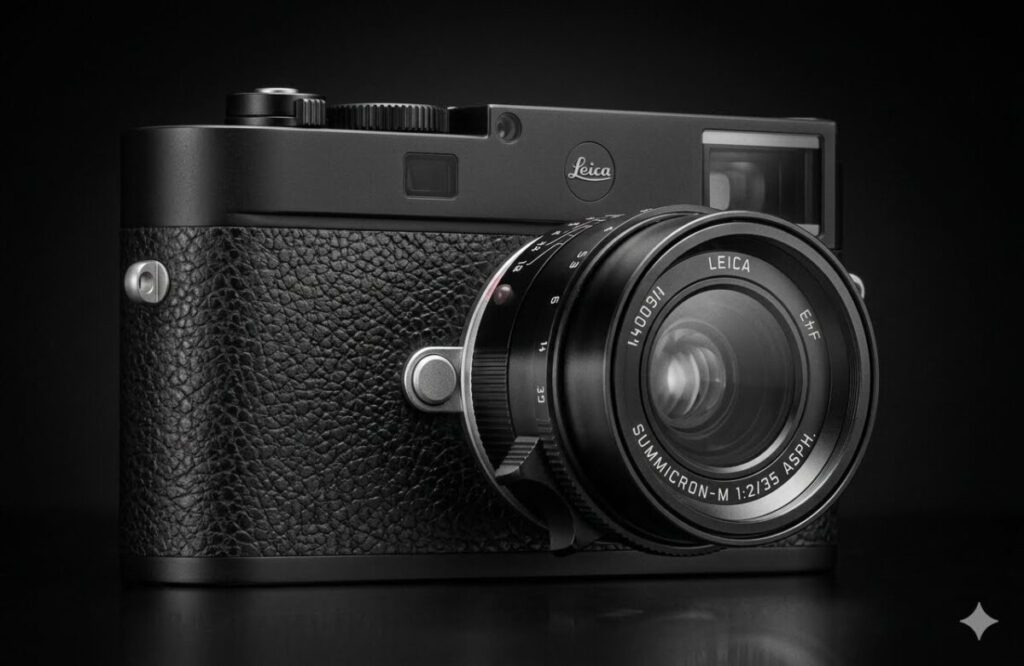
Design is where the Leica M12-D is expected to be most distinctive. Leica has confirmed through a survey sent to existing M-series customers — that the M12 generation will feature changes to the underside of the camera. This suggests at least one configuration involving a fixed bottom plate, departing from Leica’s classic removable base plate design.
The body is expected to be approximately 3mm smaller than the M11 in at least one dimension a subtle but meaningful refinement for a camera that is often carried for hours at a time.
The most significant design rumour involves the viewfinder system. Some sources suggest a classic optical rangefinder only. Others hint at a hybrid vision system similar in concept to Fujifilm’s X100 series where the optical viewfinder can overlay electronic information. However, for the M12-D specifically, a pure optical rangefinder feels more likely. Leica has separately launched the M EV1 for photographers who want electronic viewfinder capabilities.
The rear of an M12-D is expected to be largely blank. No rear LCD, or only a minimal status display showing essential settings. This forces the photographer to engage fully with the scene, not with a screen. Controls will be minimal — shutter speed dial, ISO dial or selector, and basic function buttons.
Build quality will be Leica’s trademark excellence — brass and aluminum construction, precisely assembled, with exceptional fit and finish. Weather sealing improvements over the M11 are possible.
Battery and Connectivity (Rumored)
Battery performance should improve meaningfully in the Leica M12-D. The M11 delivered reasonable battery life for a rangefinder. The new platform’s more efficient processor and the elimination of a large rear LCD should extend battery life considerably.
Internal storage a feature Leica introduced with the M11 is expected to return. Rumours suggest 64GB of internal storage as a baseline, supplemented by a single card slot. A USB-C port for charging and data transfer will almost certainly be present.
Wi-Fi and Bluetooth connectivity will enable wireless image transfer to Leica’s FOTOS app. However, the M12-D is not expected to prioritize connectivity features. That runs counter to its philosophy.
The charging experience may improve, with faster USB-C charging potentially offered. An optional battery grip for extended shooting sessions is always a possibility given the M series’ loyal professional following.
Real-World Use Cases
The Leica M12-D exists for very specific photographers doing very specific work. Understanding its use cases helps explain why, despite its extraordinary price, it remains deeply desirable.
Street photography is the M series’ spiritual home. The rangefinder is quiet, discreet, and unobtrusive. The absence of a rear screen eliminates the temptation to chimping the habit of constantly reviewing shots. Street photographers using the M12-D will trust their exposure, trust their focus, and shoot more decisively.
Documentary and photojournalism work benefits from the same qualities. Small, quiet, and unintimidating, a Leica M camera draws less attention than a large DSLR or mirrorless body. Subjects behave more naturally. Moments are captured more authentically.
Fine art photography finds the M12-D compelling for its colour rendering and tonal response. Printing from a high-resolution Leica file remains one of the finest experiences in photography.
Travel photography at a personal and artistic level not commercial travel work requiring video — is another ideal use. The M12-D encourages a slower, more thoughtful approach to capturing a place.
Pros and Cons (Based on Rumors)
Expected Pros
- Leica-developed, European-manufactured sensor — a historic first
- Expected resolution improvement over the M11’s already excellent 60MP sensor
- M-D philosophy encourages pure, intentional photography
- Compact body — approximately 3mm smaller than M11
- Exceptional build quality in Leica’s tradition
- Possible IBIS inclusion — a first for the M series
- M-mount lens compatibility — access to one of the world’s great lens systems
Expected Cons
- Extraordinary price — expected to exceed $8,500 USD
- Manual focus only — steep learning curve for new users
- No rear LCD makes image review impossible in the field
- Very limited or no video capability
- Slow burst shooting compared to mirrorless alternatives
- Release timeline remains uncertain — possibly 2027
- Proprietary sensor is unproven in production
Final Thoughts
The Leica M12-D is not a camera for everyone. It was never meant to be. It is designed for photographers who have made a deliberate choice — to slow down, to see more carefully, and to commit fully to each frame. In a world of cameras that do everything, the M12-D promises to do one thing: help photographers take better photographs.
The rumoured Leica-developed sensor is the detail that excites us most. If Leica can engineer a proprietary imaging chip that surpasses what Sony provides in tonal response, colour depth, and that indefinable “Leica look” the M12-D could become the definitive digital rangefinder.
Watch Leica’s official channels closely. When the M12-D arrives and based on current leaks and registrations, it appears to be a matter of when, not if it will be worth every word written about it.
Read More from AltBuzz
Read more from Altbuzz for camera reviews, rumors, and detailed specs. AltBuzz delivers trusted and easy-to-understand photography content.
Subscribe AltBuzz YouTube Channel
Stay updated with camera reviews, rumors, and comparisons. Subscribe Altbuzz for regular coverage of the cameras you care about most.
All information in these blogs is based on rumors, leaks, and speculation as of May 2026.