
Sony ZV-E10 II vs Fujifilm X-S10: Which APS-C Vlog Camera Should You Buy in 2026?
The APS-C vlog camera market is one of the most competitive spaces in photography right now. Two cameras that sit squarely at the centre of that conversation are the Sony ZV-E10 II and the Fujifilm X-S10. Both are compact, capable, and priced for creators who are serious about content but not ready to commit to the weight and cost of full-frame.
But they approach the same job from very different philosophies. Sony builds for immediacy, automation, and seamless integration with its content creation ecosystem. Fujifilm builds for character, control, and the kind of image output that makes you want to shoot more. After testing both cameras extensively in the field, here is everything you need to know before choosing between them.
Quick Verdict: Sony ZV-E10 II wins for vloggers and auto-everything shooters. Fujifilm X-S10 wins for hybrid creators who want more manual control and better overall image character.
Sony ZV-E10 II vs Fujifilm X-S10: Specifications Compared
| Feature | Sony ZV-E10 II | Fujifilm X-S10 |
|---|---|---|
| Sensor | 26MP APS-C BSI CMOS | 26.1MP APS-C BSI CMOS |
| Processor | BIONZ XR | X-Processor 4 |
| Video | 4K 60fps | 4K 30fps |
| Stabilisation | Electronic + optical | 5-axis IBIS 6 stops |
| Autofocus | 759-point phase detect | 425-point phase detect |
| Battery Life | Approx 440 shots | Approx 325 shots |
| Screen | Fully articulating LCD | Fully articulating LCD |
| Weather Sealing | No | No |
| Card Slots | Single SD | Single SD |
| Weight | 292g body only | 465g with battery |
| Price (approx.) | $800 body only | $650 to $750 used/refurbished |
Design and Build Quality
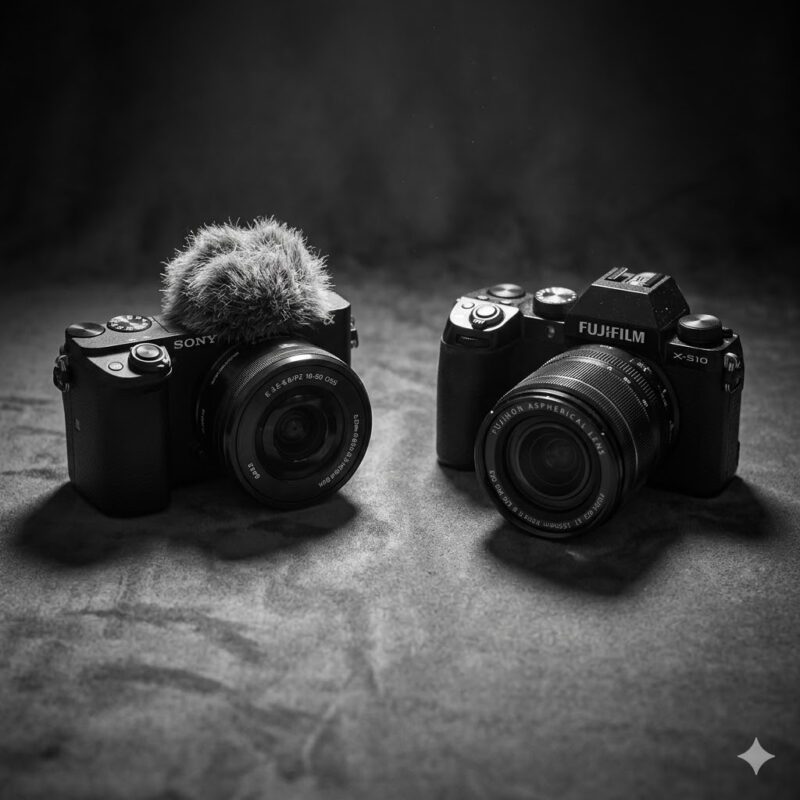
The Sony ZV-E10 II is immediately striking for how small it is. At 292g without a lens, it is genuinely pocketable with a compact prime attached, and the form factor is clearly optimised for one-handed vlogging with a phone-style grip. The fully articulating screen flips out and rotates to face forward, which is the standard requirement for any self-shooting setup.
The Fujifilm X-S10, by comparison, feels like a proper camera. The grip is deeper, the body is heavier, and the overall construction communicates a level of solidity that the ZV-E10 II does not attempt to match. There are dedicated dials for exposure compensation and drive mode, and the tactile feedback from the controls is meaningfully better.
Neither camera offers weather sealing, which is a shared weakness at this price point. Both use a single SD card slot, and both rely on USB-C charging. The Sony charges via USB-C and can run on power delivery, which is a practical advantage for long vlogging sessions or livestreams.
For pure portability, the Sony wins by a significant margin. For build quality and handling satisfaction, the Fujifilm is clearly the better camera to hold.
Autofocus Performance
Autofocus is one of Sony’s strongest competitive advantages across its entire camera lineup, and the ZV-E10 II benefits directly from that heritage. The 759-point phase-detect system with AI-based subject recognition tracks humans, animals, birds, and vehicles with the kind of reliability that makes manual focus feel unnecessary for most situations.
Face and eye detection is class-leading. The camera locks onto eyes almost instantaneously, maintains tracking through movement and partial obstructions, and transitions smoothly between subjects in frame. For vloggers who are frequently the only person in front of the camera, this reliability is enormously valuable.
The Fujifilm X-S10’s 425-point phase-detect system is capable but operates at a different level. Face detection is reliable in good light, and the system handles standard portrait and street photography situations well. Where it falls behind Sony is in continuous tracking during video, particularly when subjects move laterally at speed or when shooting in lower light conditions.
For the solo content creator, the Sony’s autofocus advantage is real and meaningful. For the photographer who is mostly shooting stills at a measured pace, the Fujifilm’s autofocus is entirely sufficient.
Video Quality and Capabilities
The Sony ZV-E10 II shoots 4K at up to 60fps, which is a significant upgrade over its predecessor and a genuine advantage over the Fujifilm X-S10’s 4K at 30fps ceiling. For content creators who want slow-motion capability at full 4K resolution, the Sony is the clear choice.
Sony’s colour science in video mode is clean, accurate, and immediately usable. The S-Log3 profile captures wide dynamic range for grading in post, and the camera’s automatic white balance performance during video is excellent, maintaining consistent colour as lighting conditions change throughout a shot.
The Fujifilm X-S10’s video quality, while technically limited to 4K 30fps, has a character that Sony cannot match through specification alone. The Eterna Cinema Film Simulation produces footage with a filmic quality that requires minimal grading to look intentional and polished. For creators who want their footage to look distinctive without spending hours in a colour suite, Fujifilm’s approach has real value.
The X-S10’s five-axis IBIS is also a meaningful video advantage. Sony’s electronic stabilisation on the ZV-E10 II is effective but introduces a slight crop and occasional micro-jitter at the edges of the frame. The Fujifilm’s optical stabilisation produces smoother, more natural-looking handheld footage with no crop penalty.
Image Quality for Stills
Both cameras use 26-megapixel BSI CMOS sensors, but the output they produce reflects their manufacturers’ very different philosophies.
Sony files are detailed, clean, and technically excellent. Raw files have wide dynamic range and respond well to aggressive editing. JPEGs are accurate rather than characterful, which suits photographers who do significant post-processing but can feel clinical straight out of camera.
Fujifilm files have colour and tonality that is simply more pleasing to most eyes straight out of camera. The Film Simulations are not gimmicks. Classic Neg, Velvia, and Acros are distinct, carefully considered looks that reference decades of Fujifilm film stock development. Shooting in JPEG with a Film Simulation applied produces images that look finished and intentional without any editing.
For technical image quality in controlled conditions, the cameras are very close. For real-world shooting satisfaction and JPEG output that you can share directly, Fujifilm has a clear advantage.
Battery Life
The Sony ZV-E10 II offers approximately 440 shots per charge, which is a meaningful improvement over many earlier Sony APS-C bodies. USB-C charging is convenient, and the camera supports continuous USB power delivery for extended shooting sessions.
The Fujifilm X-S10’s 325-shot CIPA rating is genuinely limiting in practice. A full day of shooting will typically require at least one spare battery, which adds to the cost of the initial purchase. The X-S20 addressed this significantly with its 750-shot rating, but the X-S10 remains constrained.
For vloggers and creators who shoot extensively in a single session, the Sony’s better battery life and USB power delivery are practical advantages that matter in the field.
Lens Ecosystem
Sony E-mount is the largest APS-C lens ecosystem in the world. First-party Sony options cover every practical focal length, and third-party support from Sigma, Tamron, Tokina, and others means the selection is enormous. Prices range from very affordable to professional-grade, and the range of options at every price point is unmatched.
Fujifilm X-mount is smaller but thoughtfully curated. The first-party Fujifilm lenses are universally well-regarded, and the XF lens lineup covers every practical need for most photographers. Third-party support from Sigma and Viltrox has grown significantly, making the ecosystem meaningfully more accessible than it was a few years ago. The character of Fujifilm glass complements the camera’s image rendering in a way that feels coherent as a system.
For buyers who want the widest possible choice at every price point, Sony E-mount wins. For buyers who want a focused, high-quality selection with a coherent aesthetic, Fujifilm X-mount is excellent.
Read More from AltBuzz
Read more from AltBuzz for camera rumors, leaked specs, and expert insights. AltBuzz delivers trusted and easy-to-understand photography content.
Sony ZV-E10 II vs Fujifilm X-S10: Pros and Cons
Sony ZV-E10 II Pros:
- Best-in-class autofocus with AI subject recognition
- 4K at 60fps for smooth slow-motion content
- Extremely lightweight and compact body
- Excellent USB-C power delivery for unlimited runtime
- Largest APS-C lens ecosystem available
- Strong automatic modes ideal for beginners
Sony ZV-E10 II Cons:
- Electronic stabilisation introduces crop and occasional jitter
- JPEG colour science lacks character compared to Fujifilm
- Build quality feels plasticky at this price
- No weather sealing
- Menu system can be overwhelming for new users
Fujifilm X-S10 Pros:
- Film Simulations produce outstanding JPEG output straight from camera
- Five-axis optical IBIS produces natural, smooth handheld footage
- Superior build quality and handling
- More intuitive physical controls for manual shooters
- Eterna Cinema profile for filmic video with minimal grading
Fujifilm X-S10 Cons:
- 4K limited to 30fps
- Battery life of 325 shots requires carrying spares
- Autofocus tracking less reliable than Sony in demanding conditions
- No weather sealing
- Older processor compared to Sony’s BIONZ XR
Which Camera Should You Buy?
Buy the Sony ZV-E10 II if you are primarily a video creator, vlogger, or content producer who wants the best possible autofocus, 4K 60fps capability, and a lightweight body that disappears into any shooting setup. The Sony’s automation and ecosystem breadth make it the more versatile tool for pure content creation.
Buy the Fujifilm X-S10 if you care deeply about image character, shoot a mix of stills and video, and want a camera whose output makes you genuinely excited to share photographs without touching a computer. The Fujifilm rewards shooters who engage with it and produces results that feel personal rather than generic.
Subscribe AltBuzz YouTube Channel
Stay updated with camera rumors and early previews. AltBuzz shares the latest camera leaks and comparisons. Subscribe AltBuzz
Final Verdict
These two cameras represent two genuinely different answers to the same question. The Sony ZV-E10 II is the more capable tool by conventional specification metrics: better autofocus, higher frame rates, lighter body, bigger ecosystem. The Fujifilm X-S10 is the more satisfying camera to use and produces images with a quality and character that technical specifications cannot fully capture.
Neither choice is wrong. The right answer depends entirely on what kind of creator you are and what you value most in the shooting experience.
Sony ZV-E10 II Score: 8.7 / 10 Fujifilm X-S10 Score: 8.4 / 10