
Nikon Z50 II vs Fujifilm X-T30 II: The Best Enthusiast APS-C Camera in 2026
The enthusiast APS-C camera market attracts a very specific kind of buyer: someone who has outgrown beginner cameras, understands enough about photography to have opinions, and wants a camera that respects their developing skill set without requiring a professional budget.
The Nikon Z50 II and the Fujifilm X-T30 II both answer that brief, but they do so from fundamentally different positions. Nikon brings modern autofocus technology, a bright future in the Z-mount ecosystem, and a shooting experience that will feel immediately familiar to DSLR users. Fujifilm brings decades of colour science heritage, physical controls that photographers genuinely love, and an image output that has built one of the most loyal user communities in photography.
This is one of the most interesting comparisons in the APS-C segment. Here is everything you need to know.
Quick Verdict: Nikon Z50 II wins on autofocus and ecosystem future-proofing. Fujifilm X-T30 II wins on image character, physical controls, and overall shooting satisfaction.
Nikon Z50 II vs Fujifilm X-T30 II: Specifications Compared
| Feature | Nikon Z50 II | Fujifilm X-T30 II |
|---|---|---|
| Sensor | 20.9MP APS-C BSI CMOS | 26.1MP APS-C BSI CMOS |
| Processor | EXPEED 7 | X-Processor 4 |
| Video | 4K 60fps (with crop) | 4K 30fps |
| Stabilisation | None (lens OIS only) | None (lens OIS only) |
| Autofocus | 299-point phase detect with subject detection | 425-point phase detect |
| Continuous Shooting | 14fps mechanical / 30fps electronic | 8fps mechanical / 20fps electronic |
| Battery Life | Approx 320 shots | Approx 380 shots |
| Screen | Tilting touchscreen | Tilting touchscreen |
| Viewfinder | 2.36 million-dot EVF | 2.36 million-dot EVF |
| Weather Sealing | No | No |
| Card Slots | Single SD UHS-I | Single SD UHS-I |
| Weight | 415g with battery | 383g with battery |
| Price (approx.) | $900 body only | $700 to $800 body only |
Design and Handling
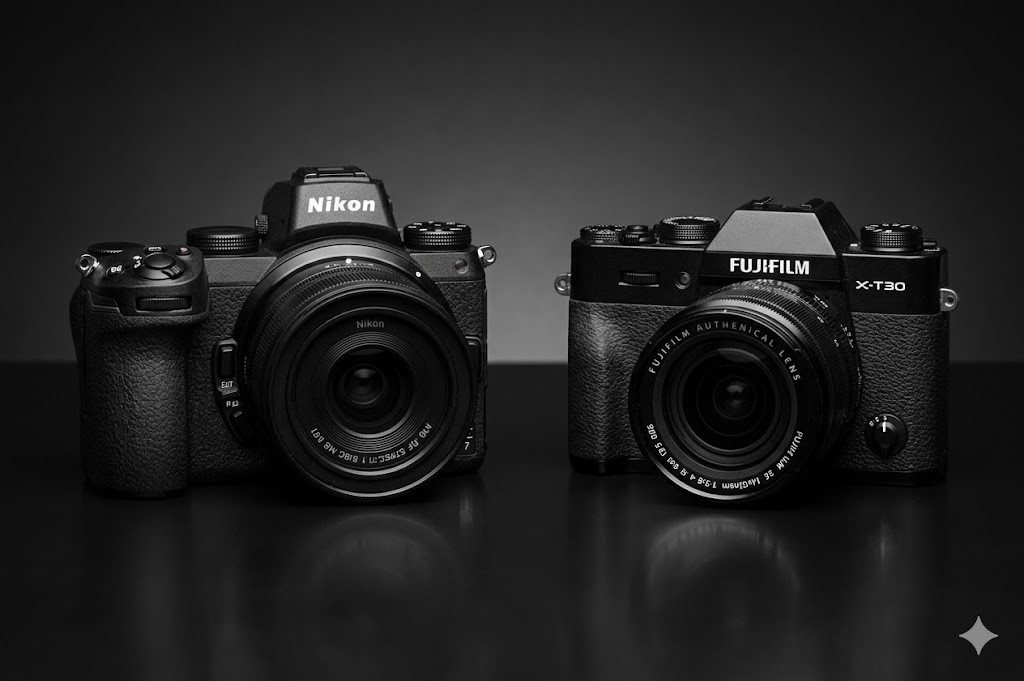
The Nikon Z50 II is a camera that feels immediately accessible. The grip is comfortable and secure, the button placement is intuitive for anyone with DSLR experience, and the overall design communicates reliability without intimidation. Nikon has always been good at making cameras that new users feel confident holding, and the Z50 II continues that tradition.
The Fujifilm X-T30 II takes a deliberately retro-inspired approach that divides opinion but earns loyalty. The top plate dials for shutter speed, ISO, and exposure compensation are physical, tactile, and satisfying to use. You can see your exposure settings at a glance without turning the camera on. This is a philosophy of shooting that many photographers find genuinely freeing, and once you have used a camera this way, the button-and-dial abstraction of most modern cameras can feel like a step backward.
The tilting screen on both cameras is a practical limitation compared to the fully articulating screens on more video-focused bodies. For stills photographers who occasionally shoot from low or high angles, the tilt is sufficient. For vloggers or self-shooters, neither camera is ideally suited.
Neither body offers weather sealing, which is a shared limitation worth noting at this price point.
Sensor and Resolution Comparison
The resolution gap between these two cameras is meaningful. The Fujifilm X-T30 II’s 26.1-megapixel sensor gives it a clear advantage for large print work, significant cropping in post, or any situation where maximum detail is the priority. The Nikon Z50 II’s 20.9-megapixel sensor is entirely adequate for most practical purposes but falls noticeably short when you need to crop aggressively or produce very large prints.
In terms of image quality per pixel, both sensors are excellent. The Nikon’s BSI CMOS design handles low light cleanly, and dynamic range is strong throughout the ISO range. The Fujifilm’s BSI CMOS, the same sensor found in the more expensive X-S20, delivers outstanding results across all practical shooting situations.
Where the comparison becomes interesting is in processed output. Nikon’s EXPEED 7 processor produces clean, detailed files that reward editing. Fujifilm’s Film Simulations produce finished, character-rich JPEGs that often need no editing at all. These are different approaches to image-making, and the right one depends on how you prefer to work.
Autofocus: A Generational Gap
The Nikon Z50 II arrives with EXPEED 7 processing that brings genuine subject detection autofocus to this price point. Human, animal, bird, and vehicle detection all work reliably, and the continuous autofocus during video is notably improved over the original Z50. The system uses deep learning subject recognition that matches the behaviour of Nikon’s more expensive Z-series bodies, making it one of the most capable autofocus systems at this price.
Continuous shooting at 14fps mechanical with autofocus is impressive for a camera in this class, and the 30fps electronic shutter option opens up possibilities for capturing fast action that the X-T30 II simply cannot match.
The Fujifilm X-T30 II’s autofocus is competent but operates in a different league. Face and eye detection works reliably for standard portrait work, and zone tracking is dependable in good light. Where the gap shows is in fast-moving subject tracking, particularly in video mode, and in low-light continuous autofocus situations.
For photographers who regularly shoot action, sports, children, or animals in motion, the Nikon’s autofocus advantage is significant. For photographers who work at a more considered pace across portrait, landscape, street, and travel photography, the Fujifilm’s autofocus is entirely sufficient.
Video Capabilities
The Nikon Z50 II shoots 4K at up to 60fps, though the 60fps mode applies a crop that reduces the field of view. 4K at 30fps is available without crop and produces clean, detailed footage. The camera also offers N-Log capture for flat, gradeable footage in post, and 10-bit HDR output is available via HDMI.
The Fujifilm X-T30 II is more limited at 4K 30fps maximum, though the quality within that ceiling is excellent. Eterna Cinema produces filmic footage straight from camera, and F-Log capture gives sufficient dynamic range for serious grading. The 10-bit output via HDMI is available and produces high-quality results for external recorders.
Neither camera has in-body stabilisation, which is a real limitation for handheld video on both bodies. Shooters planning to do significant video work with either camera will want to budget for a gimbal or prioritise lenses with optical stabilisation.
For video specifications, the Nikon is the more capable camera. For video aesthetics and the quality of footage straight from camera without post-processing, Fujifilm’s Film Simulations give the X-T30 II a meaningful advantage.
Z-Mount vs X-Mount Ecosystem
The Nikon Z-mount was designed from the beginning with full-frame cameras in mind, and the APS-C DX lens lineup is relatively limited. There are currently only a handful of native DX lenses, meaning Z50 II shooters frequently use full-frame Z lenses on their APS-C body. This works perfectly well optically but means carrying lenses designed for a larger sensor, which affects portability.
The positive reading of this situation is that Z-mount gives the Z50 II a clear upgrade path. When you are ready to move to full-frame, every Z lens you own works perfectly on Nikon’s Z6, Z7, or Z8 bodies. The ecosystem investment carries forward completely.
Fujifilm X-mount is purpose-built for APS-C. The lenses are designed to match the sensor size, which means the system is more compact and coherent. The XF lens lineup is one of the best in any APS-C system, covering every practical focal length with high optical quality at reasonable prices. Third-party support from Sigma and Viltrox has added affordable options that make the system more accessible than ever.
Read More from AltBuzz
Read more from AltBuzz for camera rumors, leaked specs, and expert insights. AltBuzz delivers trusted and easy-to-understand photography content.
Nikon Z50 II vs Fujifilm X-T30 II: Pros and Cons
Nikon Z50 II Pros:
- EXPEED 7 delivers class-leading subject detection autofocus
- 4K 60fps video capability
- 14fps mechanical continuous shooting
- Clear full-frame upgrade path within Z-mount ecosystem
- Familiar, intuitive controls for DSLR users
- Strong low-light performance
Nikon Z50 II Cons:
- Lower resolution at 20.9MP versus 26.1MP
- Limited native DX lens selection
- No in-body stabilisation
- Tilting screen only, not fully articulating
- Single UHS-I card slot limits write speeds
- No weather sealing
Fujifilm X-T30 II Pros:
- 26.1MP sensor for excellent resolution and cropping flexibility
- Film Simulations produce outstanding JPEG output
- Physical top-plate dials for intuitive manual control
- Purpose-built APS-C lens ecosystem with excellent glass
- Lighter body at 383g
- Strong colour science and overall image character
Fujifilm X-T30 II Cons:
- 4K limited to 30fps maximum
- Autofocus tracking less competitive for fast subjects
- No weather sealing
- Slower continuous shooting than Nikon
- Tilting screen only, not fully articulating
- No in-body stabilisation
Which Camera Should You Buy?
Buy the Nikon Z50 II if autofocus performance is a priority, if you shoot action or fast-moving subjects regularly, if you want a camera with a clear full-frame upgrade path, or if you are coming from a Nikon DSLR and want to stay within a familiar ecosystem.
Buy the Fujifilm X-T30 II if you care about physical controls and the experience of shooting manually, if image character and JPEG output matter more to you than pure specification numbers, if you want a lighter and more coherent APS-C system, or if you prioritise resolution and image quality over autofocus speed.
Subscribe AltBuzz YouTube Channel
Stay updated with camera rumors and early previews. AltBuzz shares the latest camera leaks and comparisons. Subscribe AltBuzz
Final Verdict
The Nikon Z50 II and Fujifilm X-T30 II are both excellent cameras that will satisfy enthusiast photographers who choose either one. The Nikon is the more technically capable camera by modern specification standards, with better autofocus, faster continuous shooting, and a stronger upgrade path. The Fujifilm is the more satisfying camera to use day to day, with image output and physical controls that inspire shooting in a way that raw specifications cannot measure.
If you only care about numbers, the Nikon wins several categories. If you care about how a camera makes you feel and what its images look like, the Fujifilm makes a compelling argument that is hard to dismiss.
Nikon Z50 II Score: 8.8 / 10 Fujifilm X-T30 II Score: 8.5 / 10