
Sony a6100 Full Review: Specs, Performance & Verdict
The Sony a6100 is a camera that aged better than most. Released in August 2019 alongside the flagship a6600, this entry-level APS-C mirrorless camera brought Sony’s most advanced autofocus technology of its time to the most accessible price point in the lineup. Years later, it still holds its own as a genuinely capable beginner and intermediate camera.
For anyone upgrading from a smartphone, stepping into mirrorless photography for the first time, or looking for a compact and affordable family camera, the Sony a6100 remains a compelling option. This review looks at everything this camera offers, where it falls short, and who it is best suited for.
Release Date and Market Position
Sony announced the Sony a6100 in August 2019. It launched alongside the a6600 and positioned itself as the entry point of Sony’s refreshed APS-C lineup that year. The original launch price was $749 body-only. Since then, the price has dropped to around $599, making it even more attractive for budget-conscious buyers.
The a6100 sits below the a6400 and a6600 in Sony’s E-mount APS-C range. It shares the same autofocus system as those more expensive models. What it gives up in return for the lower price is in-body image stabilization, weather sealing, a higher-resolution viewfinder, and a more premium build. For beginners who are not shooting in rain or relying on slow shutter speeds regularly, these trade-offs are very manageable.
Sony a6100 Specifications
| Feature | Details |
|---|---|
| Sensor | 24.2MP APS-C Exmor CMOS |
| Processor | BIONZ X with Front-End LSI |
| ISO Range | 100 – 32,000 (expandable to 51,200) |
| Autofocus | 425-point phase detection + 425 contrast AF |
| Burst Rate | 11fps (with AF/AE tracking) |
| Video | 4K (6K oversampled), 1080p up to 120fps |
| Stabilization | None (IBIS or OIS) |
| Viewfinder | 1.44M-dot EVF |
| LCD Screen | 3-inch tilting touchscreen (180 degrees), 921K dots |
| Built-in Flash | Yes (pop-up) |
| Memory Card | Single UHS-I SD slot |
| Connectivity | Wi-Fi, Bluetooth, Micro USB |
| Audio Input | 3.5mm microphone jack |
| Battery | NP-FW50 (~380 shots CIPA) |
| Dimensions | 120 x 66.9 x 48.8mm |
| Weight | 396g (with battery and card) |
| Lens Mount | Sony E-Mount |
| Weather Sealing | No |
| Price | ~$599 (body only) |
Sensor and Image Quality
The Sony a6100 features a 24.2MP APS-C Exmor CMOS sensor paired with the BIONZ X processor and a Front-End LSI borrowed from Sony’s full-frame cameras. This combination delivers image quality that genuinely competes above the camera’s price point.
For everyday photography, files are detailed, sharp, and accurate in color. Sony’s skin tone rendering is particularly strong, producing natural results in portrait situations. Dynamic range at base ISO is good, with usable shadow recovery and clean highlight retention. Colors are faithful without looking overly processed.
At higher ISO values, the Sony a6100 holds up well for its class. Files at ISO 3200 are clean enough for online sharing and moderate-sized prints. At ISO 6400, detail begins to soften, but the results remain acceptable with light noise reduction in editing. The extended ceiling of ISO 51,200 is available for extreme conditions but is best used as a last resort.
4K video is recorded using a full pixel readout without binning, which means the camera reads all the pixel information before downscaling. This results in sharper, more detailed footage than many competitors that use pixel binning or crops for 4K output.
Autofocus Performance
The autofocus system is the defining feature of the Sony a6100. It uses 425 phase-detection points and 425 contrast-detection points covering 84% of the sensor area. At launch, it was one of the most advanced AF systems Sony had ever put into an entry-level body.
Real-Time Eye AF works for both humans and animals. It continuously tracks the nearest eye, maintains sharp focus even through partial obstructions, and keeps up with moving subjects reliably. For family photography, portraits, and pet photography, this feature alone makes the a6100 stand out from cameras at similar prices.
Real-Time Tracking allows you to touch a subject on the screen and have the camera follow it across the frame. The system is fast, accurate, and requires minimal intervention. Touch Tracking provides smooth, continuous focus as subjects move, using a simple tap on the display to lock onto them.
Burst shooting at 11fps with continuous AF and AE tracking is solid on paper. In practice, the buffer fills reasonably quickly with RAW files, and the camera takes time to clear before full performance returns. For casual action shooting, it works well. For demanding sports photography, the buffer limitations become noticeable.
Video Capabilities
The Sony a6100 shoots 4K video with a full pixel readout, meaning it reads all sensor data before downscaling to 4K. This oversampling approach produces clean, detailed footage that handles well in post-production.
1080p slow motion is available at up to 120fps, delivering smooth 5x slow motion footage. This is a useful creative tool for family videos, travel content, or product shoots.
A 3.5mm microphone jack is included, allowing external microphones for better audio. The built-in microphone is adequate for casual use but picks up handling noise easily. No headphone monitoring jack is available, which is a limitation for serious video work.
The 180-degree tilting LCD is excellent for selfie-style vlogging and self-recording. Flip it fully upward and you can see yourself clearly while filming. Face detection activates reliably in this orientation.
One limitation is 8-bit color recording only. There is no log format or 10-bit option. For creators who want grading flexibility in post-production, this is a real constraint. The footage looks good straight from the camera with natural color profiles, but the ceiling for color grading is lower than newer cameras at comparable prices.
Design and Handling
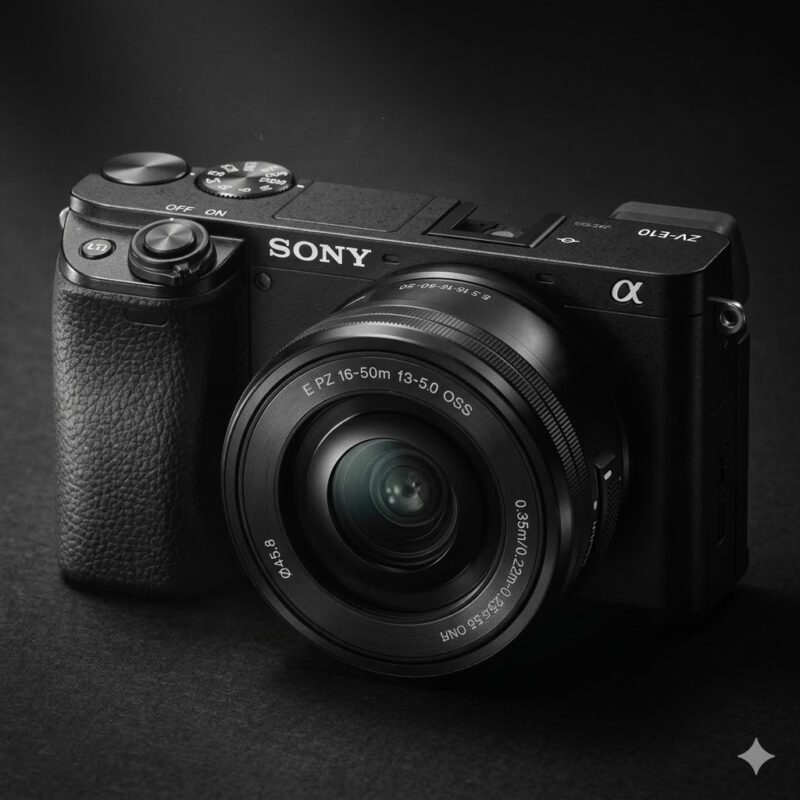
The Sony a6100 follows the familiar Sony APS-C body design. It is compact, flat-fronted, and light at 396g. The form factor fits comfortably in smaller hands or a coat pocket with a kit lens attached.
The grip has a modest depth, which gives enough to hold securely but may feel shallow for larger hands with heavier lenses. Three command dials allow independent control of shutter speed, aperture, and ISO without digging through menus. This control layout is practical and beginner-friendly.
The 3-inch tilting touchscreen pivots up to 180 degrees for selfie mode. Touch functions are somewhat limited compared to newer Sony cameras. Touchscreen use is mainly for selecting AF points and tracking subjects. Menu navigation still requires physical buttons.
The viewfinder is present but modest. At 1.44M dots, it shows a clear image but lacks the sharpness of the higher-resolution finders on the a6400 and a6600. It is functional and useful in bright light when the rear screen becomes hard to read.
The pop-up flash is a practical addition for indoor events and casual fill-flash situations. The camera body is plastic, which keeps weight down but does not feel as premium as magnesium-alloy competitors.
Battery and Connectivity
The Sony a6100 uses the NP-FW50 battery, rated at approximately 380 shots per charge under CIPA testing. Real-world performance varies: moderate shooting yields around 250 to 350 frames before a recharge is needed. For a full day of shooting, carrying a spare battery is strongly recommended.
The charging setup uses Micro USB, which feels dated compared to the USB-C ports found on newer cameras. Charging speed is slow, and there is no in-camera charging via a wall adapter without purchasing an optional grip or separate charger.
Wi-Fi and Bluetooth allow wireless connection to Sony’s Imaging Edge Mobile app for remote shooting and image transfer. The app experience is functional but not as polished as more recent Sony software offerings.
The single UHS-I SD card slot limits transfer speeds slightly. For 4K video recording and burst shooting, a fast UHS-I card is recommended to avoid write buffer delays. The single slot also means no backup recording option.
Real-World Use Cases
Family Photography — The Real-Time Eye AF and subject tracking make the a6100 an outstanding family camera. It captures sharp images of children and pets reliably, even in unpredictable, fast-moving situations.
Portrait Photography — Eye AF for humans and animals produces sharp, consistent portrait results. The wide 425-point AF coverage means you can compose freely without recentering the subject for focus.
Travel Photography — Small body, wide lens selection, and solid image quality make the a6100 a great travel companion. Battery life is the main management point on longer trips.
Beginner Learning Camera — The Sony a6100 is approachable without being limiting. As skills grow, the camera grows with you. Manual controls, RAW shooting, and a large lens ecosystem give plenty of room to develop.
Vlogging — The 180-degree flip screen and 4K video make it capable for self-filming. The 8-bit footage and lack of log format are limitations for serious video creators but fine for casual YouTube content.
Sports and Action — 11fps burst and Real-Time AF work for moderate action. The buffer depth limits sustained shooting at maximum speed, so demanding action sports are better served by higher-end bodies.
Pros and Cons
Pros
- Real-Time Eye AF for humans and animals
- 425-point phase detection AF covering 84% of the sensor
- 4K video with full pixel readout (no binning)
- 180-degree tilting screen for selfies and vlogging
- 11fps burst with AF/AE tracking
- Built-in pop-up flash
- Built-in EVF (rare at this price point)
- Access to Sony’s extensive E-mount lens ecosystem
- Strong beginner-friendly automatic modes
- Competitive price, especially at current reduced pricing
Cons
- No in-body image stabilization
- 8-bit video only (no S-Log or 10-bit)
- No headphone jack for audio monitoring
- Micro USB charging (not USB-C)
- NP-FW50 battery life is modest
- Single UHS-I card slot
- Viewfinder resolution is modest at 1.44M dots
- No weather sealing
- Menu system can feel complex for beginners
Final Verdict
The Sony a6100 is a camera that delivers far more than its price suggests. At $599 body-only, it brings the same autofocus system as cameras that cost twice as much. The Real-Time Eye AF is genuinely impressive even by today’s standards, and the image quality from the 24.2MP sensor remains competitive with current alternatives.
It is not the newest camera on the market. The 8-bit video, Micro USB charging, and modest battery life reflect its 2019 origins. If video quality and modern connectivity are priorities, newer options like the Sony ZV-E10 II or the Nikon Z50 II offer more current specifications.
But for a beginner who wants an outstanding autofocus system, strong image quality, 4K video, and the flexibility of Sony’s E-mount lens ecosystem, the Sony a6100 at its current price is hard to argue against. It is the kind of camera that makes you a better photographer without demanding that you already be one.
Read More from AltBuzz
Read more from Altbuzz for camera reviews, rumors, and detailed specs. AltBuzz delivers trusted and easy-to-understand photography content.
Subscribe AltBuzz YouTube Channel
Stay updated with camera reviews, rumors, and comparisons. Subscribe Altbuzz for regular camera content on the latest gear, hands-on tests, and buying guides.