
Panasonic Lumix S5 II Review: The Full-Frame Hybrid Camera That Changes Everything
For years, Panasonic’s L-mount cameras were the best-kept secret in the hybrid shooting world. Exceptional video, beautiful colour science, and dual native ISO that made low-light work genuinely pleasurable. The one thing holding them back was contrast-detect autofocus that, however refined, could not match the phase-detect systems Sony and Canon had been perfecting for years.
The Lumix S5 II changed that. Announced in January 2023, it was the first Panasonic camera to feature a phase-detect autofocus system, and it arrived with enough additional upgrades to make it one of the most complete full-frame hybrid cameras at its price point. After six weeks of field testing across portrait sessions, documentary video work, and low-light street photography, here is our complete verdict.
Overall Score: 9.1 / 10
Panasonic Lumix S5 II Key Specifications
- Sensor: 24.2MP full-frame BSI CMOS
- Processor: Venus Engine (latest generation)
- Autofocus: Phase-detect AF with subject recognition
- Video: 6K open gate / 4K at 60fps / C4K at 60fps
- Stabilisation: 5-axis IBIS up to 6.5 stops (8 stops with OIS lenses)
- ISO Range: 100 to 51,200 (expandable to 204,800)
- Shutter: Electronic shutter up to 1/8000s, mechanical up to 1/4000s
- Screen: 3-inch fully articulating LCD touchscreen, 1.84 million dots
- Viewfinder: 3.68 million-dot OLED EVF at 60/120fps
- Battery Life: Approximately 370 shots (CIPA) / significantly more in eco mode
- Card Slots: Dual SD UHS-II slots
- Connectivity: USB-C 3.2 Gen 2 with power delivery, full-size HDMI
- Weather Sealing: Yes, IP rated splash and dust resistant
- Weight: 740g with battery and card
- Price: Approximately $1,999 body only
Build Quality and Ergonomics
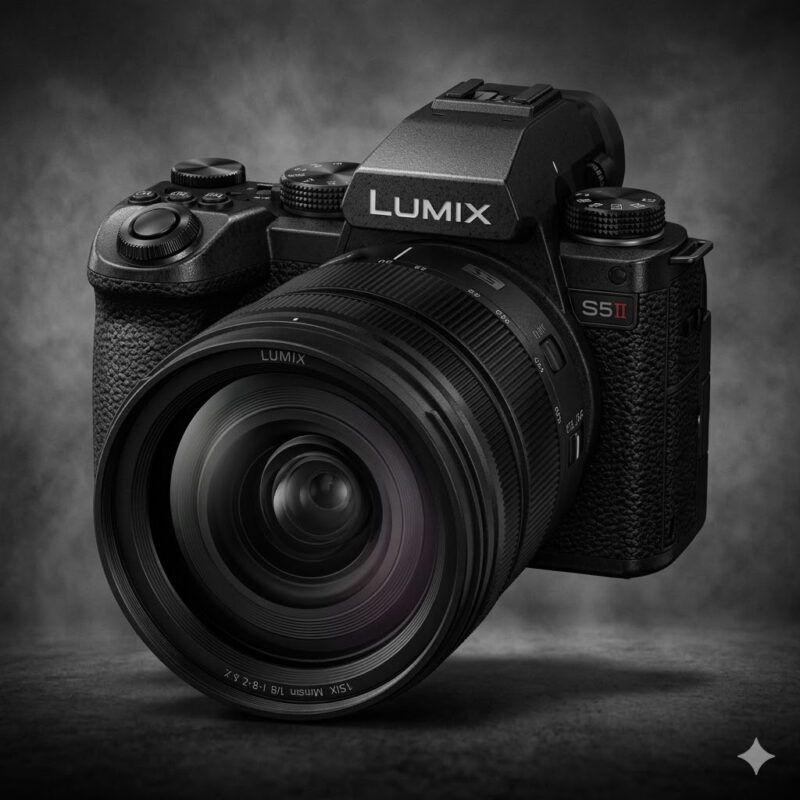
The S5 II is a serious piece of equipment that looks and feels the part. The magnesium alloy body is weather sealed against dust and moisture, which immediately separates it from competitors like the Sony A7 IV at a similar price. The grip is deep and confident, and the button layout is logical for anyone coming from a DSLR background.
The dual SD UHS-II card slots are a welcome feature that many cameras at this price point still skimp on. Both slots support the same high-speed cards, meaning you can run genuine simultaneous backup recording rather than the slower overflow arrangement some competitors offer.
The fully articulating rear screen is smooth and responsive, and the high-resolution OLED viewfinder at 3.68 million dots is among the best in class at this price. Shooting in bright Pakistani summer sunlight, the EVF remained clear and usable where lesser viewfinders struggle.
One minor complaint is the weight. At 740g with battery, the S5 II is not a travel-light camera. Pair it with the excellent Lumix S 20-60mm kit lens and you are carrying over a kilogram before you add anything else. This is the full-frame tax, and it applies here as it does everywhere.
The Phase-Detect Autofocus Revolution
This is the headline feature, and it delivers. Panasonic’s previous contrast-detect DFD system was genuinely impressive within its limits, but those limits showed up constantly in video tracking, low-light stills, and any situation involving fast or unpredictable motion.
The new phase-detect system, which Panasonic calls Phase Hybrid AF, combines phase-detect points across the sensor with the company’s existing depth-from-defocus technology. The result is autofocus that is fast, confident, and far more reliable in challenging conditions than anything Panasonic has shipped before.
Subject recognition covers humans, animals, birds, and vehicles. Face and eye detection works accurately down to surprisingly low light levels, and the tracking behaviour during video is smooth enough to use professionally without constant correction.
It is not quite at Sony’s level for pure tracking speed in fast sports scenarios, but for the portrait, documentary, travel, and content creation work that most S5 II buyers will be doing, it is more than capable.
Autofocus Modes Explained
Phase Hybrid AF combines phase-detect and contrast-detect processing for the sharpest possible initial lock, particularly on subjects with clear edge contrast.
Subject Recognition AF uses machine learning to identify and prioritise recognised subjects. In human mode, it cascades from body recognition down to face and then eye, maintaining lock even when subjects turn away briefly.
Continuous AF in Video is where the improvement over the S5 original is most dramatic. The older camera would visibly hunt during video if the subject moved laterally. The S5 II tracks smoothly through lateral movement, depth changes, and momentary obstructions with a reliability that makes it genuinely usable for solo video work.
Low Light AF performance is rated down to -6EV with the right lens, and in practice the camera locks in situations where other systems give up entirely.
Image Quality and Sensor Performance
The 24.2-megapixel full-frame BSI sensor delivers exactly what you expect from a modern Panasonic full-frame body: clean, detailed files with excellent dynamic range and colour that is rich without being oversaturated.
Dynamic range is strong, measuring around 13 to 14 stops in practical shooting. Highlight recovery in raw files is exceptional, regularly pulling back detail from areas that appeared blown on the rear screen. Shadow recovery is equally impressive, making exposure less critical in fast-moving situations.
Colour science has always been a Panasonic strength, and the S5 II continues that tradition. Skin tones are accurate and flattering without the processing that makes some competing cameras look almost artificial. The L.Classic Neo and Cinelike profiles, borrowed from Panasonic’s cinema division, give footage a character that grades beautifully.
ISO Performance and Low Light Capability
The dual native ISO design is one of the S5 II’s most significant technical advantages. Rather than a single base ISO with noise increasing linearly as sensitivity rises, the sensor has two native sensitivity points: ISO 640 and ISO 4000. Shooting at or above ISO 4000 uses the second native gain stage, which means files shot at ISO 4000 to 8000 are often cleaner than you would expect from a camera at this price.
In practice, the S5 II is genuinely usable at ISO 6400 for both stills and video, and ISO 12800 remains presentable for documentary or editorial work where some grain is acceptable. This dual native ISO architecture is the same approach Panasonic uses in cameras costing several times more, and it is one of the clearest technical advantages the S5 II holds over Sony and Canon competitors.
Video Capabilities: A Full Breakdown
The Panasonic S5 II is, at its core, a video camera that also takes excellent photographs. The distinction matters because Panasonic has designed the video feature set with a depth that dedicated stills shooters rarely need but working videographers absolutely rely on.
6K Open Gate Recording captures the full width of the sensor at a 3:2 aspect ratio, giving maximum flexibility for reframing in post. This is particularly valuable for documentary work where you cannot reshoot a moment.
4K at 60fps is available without crop in standard 4K mode, and C4K (Cinema 4K at 4096 x 2160) is also available at 60fps. Both modes support 10-bit 4:2:2 colour internally, which is exceptional for a camera at this price.
V-Log L is included as a standard feature, not a paid upgrade. The log profile captures wide dynamic range and is compatible with the VARICAM LUT ecosystem, meaning colour matching between the S5 II and Panasonic’s professional cinema cameras is straightforward.
Anamorphic Recording Modes support 4:3 and 3:2 aspect ratios for shooters using anamorphic lenses, with in-camera desqueeze preview. This is a feature set that competing cameras charge a premium for or simply do not offer.
Waveform Monitor, Vectorscope, and False Colour are all available as in-camera monitoring tools, reducing the dependency on an external monitor for critical exposure assessment.
USB-C Live Streaming allows the camera to function as a webcam or direct streaming device without additional capture hardware, which is increasingly useful for creators working across multiple platforms.
In-Body Image Stabilisation
The five-axis IBIS in the S5 II is rated at 6.5 stops standalone, rising to 8 stops when paired with an optically stabilised Lumix S lens through Panasonic’s Dual IS 2 system. These are Panasonic’s claimed figures, and while real-world results vary by lens and technique, the stabilisation is genuinely excellent.
Handheld video at 24fps with a standard focal length is smooth enough for professional use without a gimbal. Walking shots require more care but remain usable for b-roll and documentary coverage. The Active IS mode, which adds additional electronic stabilisation with a slight crop, takes handheld video stability to a level that was previously achievable only with dedicated hardware.
L-Mount Lens Ecosystem
Choosing the Panasonic S5 II means committing to the L-Mount Alliance ecosystem, which includes lenses from Panasonic, Leica, and Sigma. This is both a strength and a consideration.
The strength is that the L-mount ecosystem is genuinely excellent. Sigma’s Art series lenses in L-mount deliver exceptional optical performance at reasonable prices. The Lumix S 50mm f/1.8 and 85mm f/1.8 are outstanding portrait lenses. The Leica L-mount options are spectacular and priced accordingly.
The consideration is that the ecosystem is smaller than Sony E-mount or Canon RF-mount, and third-party support, while growing, is not yet at the same breadth. For most photographers and videographers, the available selection covers every practical need. For shooters with very specific requirements, it is worth researching before committing.
Panasonic S5 II vs Competitors
Versus Sony A7 IV: The Sony has marginally better autofocus tracking for fast sports, a larger lens ecosystem, and a slightly higher resolution sensor at 33MP. The S5 II counters with better video specifications, dual native ISO, weather sealing at a lower price, and the 6K open gate option. For video-priority shooters, the S5 II wins clearly.
Versus Canon EOS R6 Mark II: The Canon’s autofocus is class-leading and its colour science for stills is beautiful. The S5 II offers better video specifications, internal 10-bit 4:2:2, and the dual native ISO advantage. Both are excellent. The choice often comes down to existing lens investment.
Versus Nikon Z6 III: The Nikon Z6 III is a strong competitor with a partially stacked sensor that gives it a speed advantage for stills. The S5 II’s video depth and V-Log L inclusion give it an edge for hybrid creators prioritising video quality and flexibility.
Read More from AltBuzz
Read more from AltBuzz for camera rumors, leaked specs, and expert insights. AltBuzz delivers trusted and easy-to-understand photography content.
Panasonic S5 II: Pros and Cons
Pros:
- Phase-detect autofocus is a genuine generational leap over the S5 original
- 6K open gate and internal 10-bit 4:2:2 video at this price is exceptional
- Dual native ISO architecture for outstanding low-light performance
- Weather sealing included as standard
- Dual UHS-II SD card slots for true simultaneous backup
- V-Log L included without a paid upgrade
- Excellent five-axis IBIS up to 8 stops with compatible lenses
- Full-size HDMI port for reliable external recording
- USB-C power delivery for unlimited runtime
Cons:
- Battery life of around 370 shots is below average for a camera this size
- Body weight of 740g is substantial for travel-focused shooters
- L-Mount ecosystem smaller than Sony E-mount or Canon RF-mount
- Menu system remains complex and takes time to learn
- No built-in flash
- Rear screen resolution below some competitors at 1.84 million dots
Who Should Buy the Panasonic Lumix S5 II?
The S5 II is the ideal camera for the serious hybrid shooter who prioritises video quality without sacrificing stills capability, and who values technical depth over simplified operation.
It is the right camera for documentary filmmakers who need reliable subject tracking, internal log recording, and the flexibility of 6K open gate. Also, it is the right camera for portrait and commercial photographers who want full-frame image quality, excellent low-light performance, and weather sealing at a reasonable price. Additionally, it is the right camera for content creators who want professional video specifications without the cost of a dedicated cinema camera.
It is not the right camera for casual photographers who want something lightweight and uncomplicated. But, it is not the right camera for sports photographers who need the fastest possible subject tracking at any cost. And it is not the right camera for anyone deeply invested in Sony E-mount or Canon RF-mount glass who does not want to start a new lens collection.
Subscribe AltBuzz YouTube Channel
Stay updated with camera rumors and early previews. AltBuzz shares the latest camera leaks and comparisons. Subscribe AltBuzz
Final Verdict
The Panasonic Lumix S5 II is the camera Panasonic needed to make, and they made it well. The addition of phase-detect autofocus removes the last significant objection to recommending a Lumix camera without qualification. What remains is a full-frame hybrid with exceptional video specifications, outstanding low-light capability, genuine weather sealing, and a feature set that competes with cameras costing significantly more.
The battery life is the clearest weakness, and the menu system will take patience to learn. But these are manageable trade-offs against a camera that shoots 6K internally, includes V-Log L as standard, tracks subjects reliably in difficult conditions, and delivers some of the cleanest high-ISO files in its class.
If you are a serious hybrid creator shopping in the full-frame market, the Panasonic Lumix S5 II belongs on your shortlist. In 2026, it remains one of the best value propositions in the segment.
Score: 9.1 / 10