
Sony ZV-1F Review: Full Specs, Video Quality and Honest Verdict
What does the perfect vlogging camera look like? Sony answered that question directly in October 2022 with the Sony ZV-1F, a compact fixed-lens camera built entirely around the practical needs of self-filming content creators. Every specification, every button placement, and every software feature on this camera addresses a specific problem that a vlogger or creator encounters during filming.
Rather than covering the ZV-1F with traditional review structure alone, this article uses a deep-dive question format alongside technical analysis. Most buyers approach this camera with specific questions. They want direct answers grounded in technical understanding. This review provides exactly that, covering everything from sensor physics to real-world audio performance in complete detail.
What Exactly Is the Sony ZV-1F?
The ZV-1F is a fixed-lens compact camera. The lens cannot be changed, swapped, or extended with adapters. It uses a 1/2.3-inch sensor paired with a 20mm equivalent f/2.0 ultrawide fixed lens. It records 4K video, tracks faces with impressive reliability, and fits in a jacket pocket at 256 grams.
Crucially, the ZV-1F is not a photography-first camera. It does not compete with APS-C or Micro Four Thirds cameras on image quality metrics. Rather, Sony designed it to answer one specific question: what does the most capable and convenient camera for a self-filming content creator look like at under $500? Every technical compromise and every notable feature makes sense when read through that lens.
Sony ZV-1F: Complete Specifications
| Feature | Specification |
|---|---|
| Sensor Type | 1/2.3-inch Exmor RS CMOS, 12.1MP effective |
| Processor | BIONZ X |
| Lens | 20mm f/2.0 equivalent (fixed, non-interchangeable) |
| ISO Range | ISO 125 to 12,800 video, ISO 100 to 6,400 photo |
| Autofocus System | Fast Hybrid AF, 247 phase-detect and contrast-detect points |
| AF Coverage | Approx. 84% of frame |
| Stabilization | Optical SteadyShot plus Active Mode electronic stabilization |
| Video Recording | 4K UHD 30fps, 1080p 120fps, HLG and S-Log2 available |
| Microphone | Built-in 3-capsule directional microphone |
| LCD Screen | 3.0-inch fully articulating touchscreen, 921K dots |
| Burst Shooting | Up to 24fps |
| Battery | NP-BJ1, approx. 260 shots per charge |
| Storage | Single microSD slot |
| Connectivity | Wi-Fi, Bluetooth, USB-C |
| Dimensions | 105.5 x 60.0 x 43.8mm |
| Weight | 256g with battery and card |
| Launch Price | Approx. $399 USD |
Why Did Sony Choose a 20mm Ultrawide Lens?
The Self-Filming Focal Length Problem
The lens choice is the most defining technical decision Sony made with the ZV-1F, and understanding it reveals the camera’s entire design philosophy. Most fixed-lens compact cameras use 24mm or 28mm equivalent focal lengths. These focal lengths work well for general photography. For self-filming, however, they create a specific compositional problem.
When you hold a camera at arm’s length and point it toward your own face at a 24mm or 28mm focal length, the frame fills primarily with your face and shoulders. The location behind you narrows into a tight strip. Context disappears. A creator filming in a Tokyo street market, a mountain hiking trail, or a busy European cafe loses most of that environmental identity in the background.
Why 20mm Changes the Result
A 20mm equivalent lens captures significantly more width in the same arm-length self-filming position. Your face occupies a natural proportion of the frame while the environment behind you remains visible, contextual, and immersive. Viewers feel present in the location rather than watching a face against an indistinct blurred background that could be anywhere.
This focal length choice specifically suits travel vlogging, outdoor adventure content, event coverage, and any situation where environmental context adds value to the footage. For static studio-style talking-head content, the difference matters less. For location-based creators, it fundamentally changes the character of the footage.
The f/2.0 Aperture Significance
Achieving f/2.0 at a wider focal length requires more complex optical engineering than at longer focal lengths. Sony delivers this aperture on the ZV-1F, enabling filming in dim indoor environments, evening cafes, night markets, and low-light street scenes without immediately pushing ISO into noise-generating territory. On a 1/2.3-inch sensor, maintaining f/2.0 at 20mm provides a meaningful practical advantage in mixed lighting conditions that creators encounter regularly.
How Does the 1/2.3-Inch Sensor Affect Image Quality?
Sensor Size Physics
The ZV-1F uses a smaller sensor than its sibling, the original ZV-1, which featured a 1-inch chip. Understanding this size difference matters for setting realistic expectations before purchase.
A 1/2.3-inch sensor measures approximately 6.17 by 4.55mm. By comparison, a 1-inch sensor measures approximately 13.2 by 8.8mm. The larger sensor captures significantly more light per pixel at the same ISO setting, producing cleaner images with less noise in low-light conditions. The ZV-1F’s sensor trades low-light capability for a lower body price point and a more pocketable physical size.
Daylight Performance
In good light, quality differences between sensor sizes become largely invisible for web and social media delivery. The ZV-1F produces sharp, colorful, well-exposed footage and stills in daylight conditions that look excellent in YouTube videos, Instagram posts, and short-form content. Colors render accurately and consistently. Detail in 4K footage looks crisp on standard display screens.
Low-Light Limitations
In lower light, the smaller sensor shows noise earlier than larger alternatives. At ISO 800, noise appears visibly in video shadow areas. At ISO 1600, noise is clearly present across the frame and becomes a noticeable element of the footage rather than a subtle background artifact. For outdoor filming, well-lit indoor content, and daylight travel footage, the sensor performs entirely adequately. For frequent filming in dark restaurants, evening outdoor events, or dim indoor venues, creators will encounter the sensor’s limits regularly and need to plan lighting accordingly.
BIONZ X Processing
Sony’s BIONZ X processor applies intelligent noise reduction that keeps footage acceptable for web video and social media delivery even at higher ISO values. The processor also handles color science, white balance algorithms, and the various video processing modes that give the ZV-1F its software-driven capabilities. While processing cannot overcome fundamental sensor physics, it maximizes the performance available from the 1/2.3-inch chip in a meaningful way.
How Good Is the Autofocus for Self-Filming?
Fast Hybrid AF Architecture
Sony’s Fast Hybrid AF combines 247 phase-detect and contrast-detect points across 84% of the frame. This system uses phase-detect points for initial subject acquisition and direction calculation, then uses contrast-detect refinement for final precision. The result is AF that acquires subjects quickly and confirms focus accurately.
Face Detection Reliability
Face detection activates instantly when a face enters the frame and finds subjects quickly across a range of angles, partial profiles, and partially obscured views. Once locked, tracking maintains through lateral movement, forward and backward movement relative to the camera, and head turns up to roughly three-quarter profile.
For a solo creator, this reliability is genuinely transformative. Setting up the camera, pressing record, and walking into frame produces immediate, confident face lock without manual intervention. The creator can speak, gesture, move closer, step back, and turn partially away while the camera follows without breaking tracking unnecessarily.
Eye AF Precision
Eye AF provides precise focus directly on the nearest visible eye rather than the general face region. For close-up talking-head shots where face-level focus can land on ears or foreheads at f/2.0, eye AF ensures the sharpest element of the frame is exactly where it needs to be. This level of precision at short shooting distances makes a visible difference in close-up portrait-oriented vlogging.
Touch Tracking
During video recording, tapping any subject on the touchscreen initiates tracking AF on that element, even at a distance or when partially obscured by other subjects. This flexibility allows creators to redirect focus within a scene without stopping recording, which is valuable during multi-subject content like conversations, street interviews, or event coverage.
Sony ZV-1F Video Performance
4K Quality and Frame Rate
The ZV-1F records 4K UHD at up to 30fps using full sensor readout. No additional crop applies beyond the standard 20mm focal length, so the field of view visible during live preview matches exactly what the camera records in 4K. Footage looks sharp and detailed in good light with Sony’s characteristic color rendering delivering clean whites, accurate blues and greens, and natural skin tones that hold up well without heavy color correction.
At 30fps, 4K footage reproduces motion smoothly for standard viewing on YouTube and social media platforms. Transitions, pans, and walking shots look natural and well-resolved at this frame rate.
Cinematic Vlog Setting Explained
The Cinematic Vlog Setting is one of the ZV-1F’s most distinctive software features. This dedicated recording mode applies a pre-designed cinematic color grade directly in-camera during capture, producing a cooler, slightly desaturated look that references the travel and lifestyle vlogging aesthetic popular across YouTube and social media.
Alongside the color grade, the mode provides aspect ratio framing guides on screen during recording and integrates with Sony’s Creators App editing workflow for a streamlined end-to-end content production process. For creators who want a consistent and polished stylistic identity across their content without learning color grading in post-production, this mode provides genuine practical value in a simple and accessible way.
S-Log2 for Advanced Users
S-Log2 captures a flat, low-contrast image that preserves maximum dynamic range information for color grading in post-production. Footage recorded in S-Log2 looks visually washed out on playback without a color grade applied. After grading, however, the additional tonal information produces footage with wider shadow and highlight detail than standard video profiles allow.
Hybrid Log-Gamma for HDR
HLG offers a practical middle path between standard video and full log recording. It captures wider dynamic range than standard profiles while displaying correctly on HDR screens without requiring a dedicated color grading stage. For creators shooting content intended for HDR delivery platforms, HLG provides practical advantages without the technical complexity of a full S-Log2 workflow.
1080p Slow Motion Capability
At 1080p resolution, the ZV-1F records at up to 120fps, enabling 4x slow-motion playback when edited to a standard 30fps timeline. This frame rate suits lifestyle vlog content, food videos, travel moments, and fashion content where slow-motion adds production polish to ordinary scenes. The effect is smooth and visually convincing at 4x reduction on standard display screens.
Sony ZV-1F Stabilization System
How Active Mode Works
The ZV-1F combines Optical SteadyShot lens-based correction with electronic Active Mode stabilization. Active Mode applies a digital crop of approximately 1.1x to the video frame and uses sensor shift data alongside optical correction to compensate for camera movement. The combination of both systems working simultaneously produces noticeably smoother footage than either system alone.
Walking Footage Results
Walking shots with Active Mode enabled look smooth enough for casual vlogging without any additional equipment. The stabilization removes the jarring micro-wobble that makes unstabilized walking footage appear amateur and unwatchable for extended viewing. Fast walking, running, or aggressive movement exceeds what Active Mode stabilizes cleanly. For standard walking pace, however, the results hold up well for social media delivery.
Field of View Trade-off
Active Mode applies the 1.1x crop to stabilize footage, slightly reducing the already-wide 20mm field of view. The resulting effective focal length sits closer to 22mm equivalent during Active Mode recording. For most creators, this minor narrowing is imperceptible in finished content. Creators who specifically need maximum field of view can disable Active Mode and use Optical SteadyShot alone, accepting somewhat less stabilization in exchange for the full 20mm field.
Sony ZV-1F Audio System
Three-Capsule Directional Microphone
The built-in microphone uses three capsules arranged to create a cardioid front-facing pickup pattern. This configuration emphasizes sound arriving from directly in front of the camera, specifically the presenter’s voice, while reducing sound arriving from the sides and rear of the camera, including ambient noise, passing traffic, and background crowd sounds.
In quiet to moderate indoor environments, the audio quality is noticeably better than a single-capsule microphone found in most compact cameras at this price. Voice clarity and presence are strong enough for casual content delivery without sounding hollow or thin.
Wind Noise Reduction
The wind noise reduction function automatically reduces wind interference during outdoor recording. A small foam windscreen accessory comes included with the camera for additional physical protection against wind noise in mild outdoor conditions. In moderate wind situations, this combination produces workable and intelligible audio without an external microphone. In strong wind conditions, audio quality degrades regardless of wind reduction settings, and an external solution becomes necessary.
Multi Interface Shoe for External Audio
The ZV-1F does not include a 3.5mm microphone input. Sony made this deliberate design choice to maintain the compact body dimensions. Creators requiring professional audio quality connect Sony’s ECM-W2BT wireless microphone or ECM-B10 digital shotgun microphone through the Multi Interface Shoe on the top of the body. Both accessories are sold separately and add meaningful cost to the total setup price, though they deliver substantially improved audio quality compared to the built-in microphone in demanding environments.
Sony ZV-1F Dedicated Creator Features
Background Defocus Button
A dedicated Background Defocus button sits on the top plate. Pressing it maximizes the aperture to f/2.0 and applies Sony’s background defocus processing for the shallowest possible depth of field the sensor can produce. The background softening effect is more modest than a larger-sensor camera produces at the same aperture due to the physical depth-of-field characteristics of the smaller sensor. However, the visible separation adds visual interest to close-up talking-head shots and differentiates subject from background in a natural-looking way.
Product Showcase Mode
Product Showcase mode detects when an object or product enters the frame in front of the presenter. The camera smoothly shifts focus from the presenter’s face to the demonstrated item, then returns to face focus when the object moves out of the close focus zone. This mode works reliably during product review content, cooking demonstrations, unboxing videos, craft tutorials, and any situation where showing an item to camera while talking requires both hands.
For solo creators who previously had to stop recording and manually adjust focus whenever demonstrating something, Product Showcase mode removes this operational interruption entirely.
Sony ZV-1F Design and Build Quality
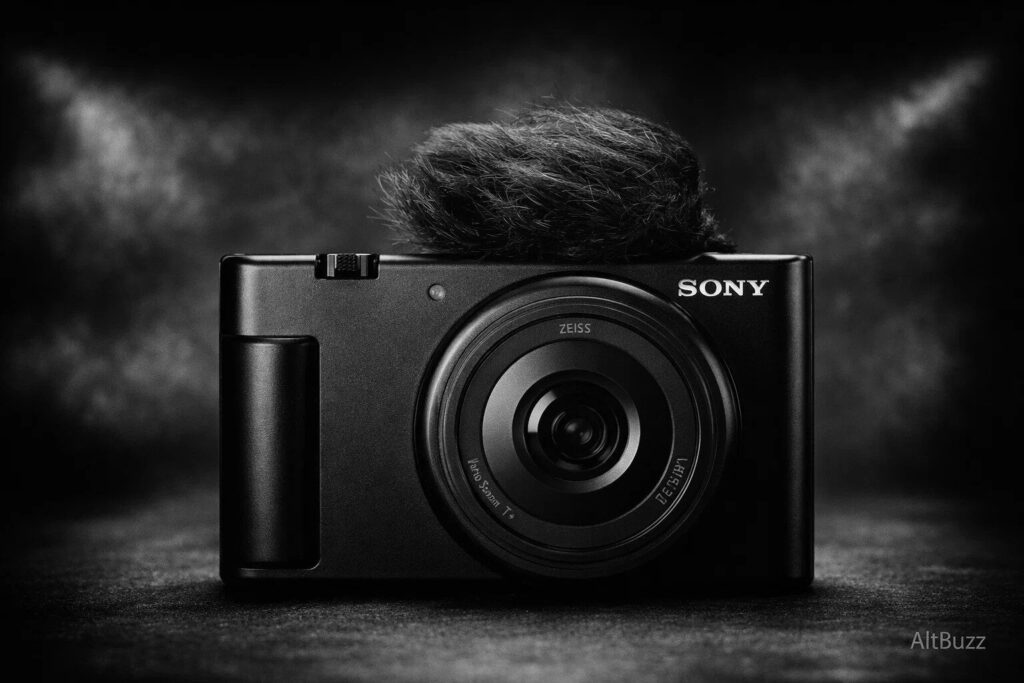
Physical Layout
The ZV-1F body measures 105.5 by 60.0 by 43.8mm and weighs 256 grams with battery and card. The front grip is minimal but textured for better one-hand holding security. The right side houses the Multi Interface Shoe, a USB-C port, and a Micro-HDMI output for clean HDMI recording to an external recorder.
The top plate carries the power button, shutter button, zoom lever, video record button, and the dedicated Background Defocus button. This layout prioritizes functions that creators use during active recording over traditional camera controls like direct ISO and white balance dials that would require attention away from the subject.
Fully Articulating Screen
The 3.0-inch LCD articulates fully in all directions rather than just upward. This full articulation allows the screen to face forward for self-filming, angle upward for overhead shots, angle downward for low perspectives, and fold inward to protect the panel during transport. The range of motion is smooth and holds position firmly under the weight of the camera without drifting.
Touch responsiveness is strong. Tapping a subject on screen during recording initiates tracking AF immediately. The screen remains visible in moderately bright outdoor conditions, though direct bright sunlight reduces visibility noticeably at lower brightness settings.
USB-C Charging Advantage
USB-C charging while the battery remains in the camera is one of the ZV-1F’s most practically significant features for active creators. Any USB-C power adapter, portable power bank, laptop USB-C port, or car USB-C charger tops up the battery during transit, meals, and downtime between filming sessions. This flexibility compensates meaningfully for the modest NP-BJ1 battery capacity and reduces the logistical planning required for all-day shooting.
Sony ZV-1F Battery Performance
The NP-BJ1 delivers approximately 260 shots per charge under CIPA standards. In continuous video recording, the battery depletes faster than still shooting, particularly in 4K mode. A typical full day of active vlogging that includes setup, review sessions, and substantial recording time will generally require at least one spare battery or planned USB-C charging during natural breaks.
Carrying one spare NP-BJ1 battery provides a practical buffer for most shooting days. The battery is compact and lightweight, so adding two spares to a camera bag adds negligible weight and cost relative to the problem they solve.
Sony ZV-1F: Honest Pros and Cons
What the ZV-1F Does Exceptionally Well
The 20mm f/2.0 ultrawide lens is a genuine competitive differentiator that no other camera in this price range replicates with equivalent sensor quality. For self-filming creators who want environmental context in their footage, this focal length solves the compositional problem that narrower alternatives create. The lens delivers strong sharpness across the frame with well-controlled distortion for a wide-angle design.
Face tracking autofocus performs with a reliability that removes technical uncertainty from solo content creation completely. Creators who previously struggled with inconsistent focus in self-filmed content will find the ZV-1F’s tracking transformative for both workflow confidence and output consistency. USB-C charging provides practical field flexibility that travel creators depend on daily. The three-capsule directional microphone delivers audio quality meaningfully above what single-element alternatives in this price class typically provide.
Where the ZV-1F Falls Short
The 1/2.3-inch sensor produces noise at ISO 800 and above in video that creators who film frequently in low light will encounter regularly. This is a physical limitation of sensor size rather than a processing failure, and no firmware update can address it meaningfully. Creators who need reliable performance in dark environments should consider cameras with larger sensors despite the higher cost.
The absence of a 3.5mm microphone input prevents connection of standard external microphones without purchasing Sony-proprietary accessories. This increases total setup cost for professional audio and limits microphone selection to Sony’s accessory ecosystem. The NP-BJ1 battery capacity is modest, making spare battery management or USB-C charging planning a consistent logistical requirement on full shooting days.
Who Should Buy the Sony ZV-1F?
The ZV-1F suits creators who self-film content regularly, shoot primarily in good light, value the 20mm ultrawide perspective for context-rich environmental footage, and want a camera that operates reliably without constant technical management. It suits travel vloggers, lifestyle creators, and casual content producers who want a pocketable dedicated camera rather than using a smartphone.
It does not suit photographers who prioritize still image quality over video, videographers who frequently film in low-light conditions, creators who need a standard 3.5mm microphone input, or buyers who want a camera that grows into a larger interchangeable-lens system over time.
At $399, the ZV-1F delivers outstanding value for its specific and clearly defined creative purpose. Understanding your workflow before purchase is essential. If the ZV-1F matches it, very few cameras at this price deliver as focused, reliable, and purpose-built a creative experience.
Final Thoughts on the Sony ZV-1F
The Sony ZV-1F succeeds because it knows exactly what it is and never pretends to be anything else. Every technical decision serves a creator filming themselves in varied locations. The ultrawide lens, directional microphone, face tracking, Background Defocus button, Product Showcase mode, USB-C charging, and Cinematic Vlog Setting all exist because a specific type of creator needed them to work consistently and simply.
For creators who fit that profile, the ZV-1F performs with reliable consistency that more broadly designed cameras sometimes cannot match within this specific use case. Evaluate your workflow honestly before purchasing. If it aligns with what the ZV-1F offers, this camera will serve you with impressive effectiveness.
Read More from AltBuzz
For detailed camera reviews and honest buying advice that cuts through marketing language, visit AltBuzz. AltBuzz helps you make smart gear decisions without unnecessary complexity or confusion.
Subscribe to the AltBuzz YouTube Channel
Stay updated with the latest camera reviews and comparisons. AltBuzz breaks down every major release in clear and practical terms built for real photographers and creators. Subscribe to AltBuzz on YouTube and build your camera knowledge one video at a time.