
Fujifilm X-A7 vs Nikon Z50: Full Comparison, Specs and Final Verdict
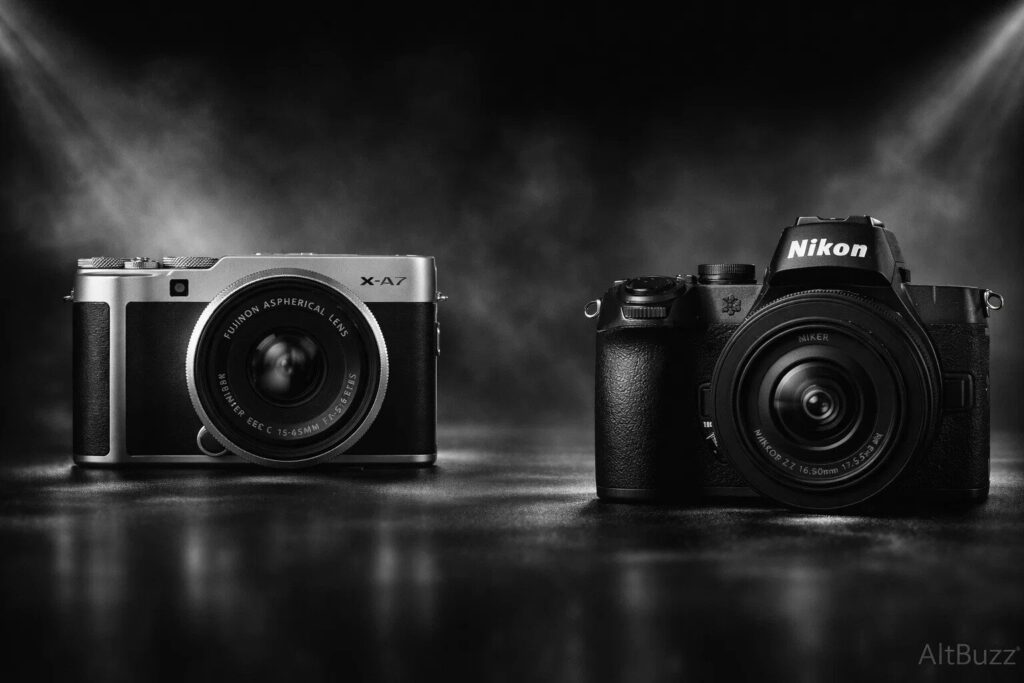
Two cameras. One budget. One decision. The Fujifilm X-A7 vs Nikon Z50 sits at the heart of one of the most competitive segments in the mirrorless camera market. Both cameras use APS-C sensors. Both target enthusiast beginners who want serious image quality without professional-level complexity. Both launched within months of each other in late 2019, aiming at the same shelf in camera stores worldwide.
Despite sharing a general market position, these two cameras take fundamentally different approaches to nearly every design decision. Fujifilm emphasizes creative expression, Film Simulations, and a vlogger-friendly screen. Nikon, on the other hand, prioritizes optical performance, autofocus reliability, and a traditional photography-first control philosophy that experienced camera users find immediately comfortable.
This comparison covers every major technical aspect of both cameras in plain and precise language. Each specification receives a thorough explanation of what it means during real shooting situations, not just in controlled lab conditions. By the end, you will understand clearly which camera serves your specific needs better and exactly why that choice makes sense for your particular photography or video goals.
Market Positioning and Target Audience
Where the Fujifilm X-A7 Fits
Fujifilm launched the X-A7 in September 2019 as an entry-level mirrorless camera aimed at content creators, vloggers, and beginner photographers who wanted Fujifilm’s color science in an accessible and affordable body. Importantly, the X-A7 uses a Bayer sensor rather than Fujifilm’s signature X-Trans array, which keeps production costs lower and maintains compatibility with standard RAW processing workflows without requiring specialized software handling.
The X-A7 targets a buyer who values a fully articulating selfie screen above almost everything else, wants social media-ready JPEG output with distinctive color character, and prioritizes a compact lightweight design that encourages daily carry. Fujifilm designed it to appeal to Instagram-focused photographers and casual content creators as much as traditional photography enthusiasts who want their first proper camera system.
Where the Nikon Z50 Fits
Nikon launched the Z50 in October 2019 as the brand’s first APS-C mirrorless camera built on the Z-mount system. The Z50 targets traditional photography enthusiasts who are transitioning from entry-level DSLRs or upgrading from smartphone photography with serious intent. Nikon built the Z50 around familiar DSLR ergonomics compressed into a more compact mirrorless form, making it feel approachable to photographers already comfortable with Nikon’s shooting philosophy and menu structure.
The Z50 targets a buyer who prioritizes image quality across varied subjects, autofocus performance for real-world shooting situations, and traditional camera handling that rewards deliberate photographic decisions. Video capability exists as a secondary feature rather than a primary selling point, which reflects the camera’s genuine design priority hierarchy.
Full Specifications Comparison Table
| Feature | Fujifilm X-A7 | Nikon Z50 |
|---|---|---|
| Sensor Type | APS-C Bayer CMOS, 24.2MP | APS-C BSI CMOS, 20.9MP |
| Processor | EXR Processor IV | EXPEED 6 |
| ISO Range | ISO 200 to 12,800 (expandable to 51,200) | ISO 100 to 51,200 (expandable to 204,800) |
| Autofocus System | Contrast-detect AF, 425 selectable zones | Hybrid phase-detect, 209 AF points |
| Face Detection | Yes, contrast-detect based | Yes, with eye detection AF |
| Stabilization | None | None |
| Video Recording | 4K UHD 15fps, 1080p 59.94fps | 4K UHD 30fps full pixel, 1080p 120fps |
| Viewfinder | None | 2.36M-dot OLED EVF |
| LCD Screen | 3.5-inch fully articulating touchscreen, 2.07M dots | 3.2-inch tilting touchscreen, 1.04M dots |
| Burst Shooting | 6fps | 11fps |
| Battery | NP-W126S, approx. 440 shots | EN-EL25, approx. 300 shots |
| Storage | Single SD UHS-I slot | Single SD UHS-I slot |
| Connectivity | Wi-Fi, Bluetooth | Wi-Fi, Bluetooth |
| Lens Mount | Fujifilm X-mount | Nikon Z-mount |
| Dimensions | 121.0 x 83.9 x 55.5mm | 126.5 x 93.5 x 60.0mm |
| Weight | 320g with battery and card | 395g with battery and card |
| Launch Price | Approx. $750 USD body only | Approx. $857 USD body only |
Sensor Architecture and Fundamental Image Quality
Resolution Difference in Context
The Fujifilm X-A7 uses a 24.2MP APS-C Bayer CMOS sensor. The Nikon Z50, by contrast, uses a 20.9MP APS-C BSI CMOS sensor. On paper, the X-A7 holds a resolution advantage of roughly 3.3 megapixels. In practice, the difference between 24.2MP and 20.9MP is visible when printing very large or when cropping heavily into images, but it does not represent a dramatic gap for the everyday photography applications most users in this price bracket pursue.
The more architecturally significant difference lies not in resolution but in sensor construction. BSI stands for Back-Side Illumination, a manufacturing approach that repositions the wiring layer behind each photosite rather than in front of it. This rearrangement allows a greater proportion of the available light to actually reach the light-sensitive area of each pixel, improving light-gathering efficiency at the photosite level. The Fujifilm X-A7’s standard front-side illuminated Bayer sensor does not benefit from this architectural efficiency advantage.
What BSI Architecture Delivers in Practice
The BSI design in the Z50 sensor translates into measurable real-world advantages in two specific areas. First, low-light performance improves because each pixel captures more light before noise becomes dominant. Second, dynamic range at base ISO improves because the sensor extracts more tonal information from each exposure before the signal-to-noise ratio degrades.
For casual photographers who shoot primarily in daylight or well-lit indoor conditions, this architectural difference is largely invisible. For photographers who frequently shoot in challenging low-light situations, indoor events, shaded outdoor environments, or golden hour conditions, the BSI advantage produces consistently cleaner results that become apparent when comparing files side by side.
Dynamic Range Comparison
The Nikon Z50 delivers approximately 12.9 stops of dynamic range at base ISO, benefiting directly from its BSI sensor architecture. The Fujifilm X-A7 produces approximately 12.3 stops at base ISO under equivalent measurement conditions. The difference of roughly half to two-thirds of a stop is not dramatic in moderate contrast scenes photographed under even lighting. However, it becomes more visible and practically significant in high-contrast situations such as bright skies above shadowed subjects, window-lit interiors, or scenes with strong directional sunlight creating deep shadow areas.
In practice, Z50 RAW files recover slightly more usable shadow and highlight detail during editing before tonal clipping becomes visible and unrecoverable. Furthermore, the Z50’s expanded ISO ceiling of 204,800 compared to the X-A7’s 51,200 reflects the BSI sensor’s underlying light-gathering efficiency advantage in extreme shooting conditions, even though images at maximum expansion are not practically usable for serious photography.
High ISO Noise Behavior
The Z50 handles high ISO noise more cleanly than the X-A7 in direct comparison testing under equivalent shooting conditions. At ISO 1600, Z50 files show fine, controlled luminance grain that retains subject detail well across edges and tonal transitions. At the same setting, the X-A7 shows slightly more luminance noise in shadow areas alongside marginally reduced fine detail in hair, fabric, and foliage textures.
Both cameras produce usable results at ISO 3200 for casual web sharing and moderate print sizes. At ISO 6400 and beyond, however, the Z50 maintains acceptable quality for longer before noise degradation becomes visually prominent across the frame. This consistent pattern reflects the underlying BSI architectural advantage rather than processing differences alone.
Color Science and JPEG Output Quality
This is where the two cameras diverge most significantly in terms of daily user experience and creative satisfaction. The Fujifilm X-A7 includes access to Fujifilm’s Film Simulation system, even though it uses a Bayer rather than X-Trans sensor. Film Simulations including Provia, Velvia, Classic Chrome, Astia, PRO Neg, and Acros apply directly to JPEG output, giving photographers extensive creative color control at the point of capture without any post-processing involvement.
Classic Chrome delivers desaturated, cool-toned documentary aesthetics. Velvia saturates landscape colors intensely. Astia flatters skin tones with gentle contrast. Acros renders black-and-white with fine grain and deep tonal gradation. Each simulation creates genuinely distinct visual output that changes the mood and character of images before any editing is applied.
The Nikon Z50 offers Picture Control profiles including Standard, Neutral, Vivid, Monochrome, Portrait, and Landscape. These profiles are well-engineered and produce reliable, accurate JPEG output with natural color rendering. However, they do not carry the same historical depth, aesthetic character, or community enthusiasm as Fujifilm’s Film Simulations. For photographers who shoot JPEG and want expressive, distinctive in-camera color, the X-A7 holds a meaningful and genuine advantage that affects the daily shooting experience.
Autofocus System Comparison
Nikon Z50 Hybrid Phase-Detect Architecture
The autofocus comparison between these two cameras is clear, significant, and directly affects real-world shooting results more than almost any other specification in this comparison. The Nikon Z50 uses a hybrid phase-detect system with 209 AF points covering approximately 90% of the frame. Phase-detect autofocus calculates focus direction and required adjustment distance from a single sensor reading, enabling fast, confident, and directed focus acquisition without iterative searching.
Subject tracking, eye detection, and continuous AF during burst shooting all benefit fundamentally from the phase-detect architecture’s ability to predict subject movement rather than reactively searching for contrast. The Z50 finds subjects quickly, holds them through movement, and recovers lock after brief obstructions with the kind of confidence that makes photographers trust their equipment rather than second-guess it.
Z50 Eye Detection Performance
The Z50’s Eye Detection AF finds human eyes reliably and holds focus through movement, head turns, and changing subject-to-camera distances in a way that transforms portrait and people photography for beginner photographers who previously relied on center-focus and recompose techniques. The system locks onto the nearest eye consistently across a range of subject angles from full-face to roughly three-quarter profile before losing detection.
During continuous shooting at the Z50’s 11fps burst rate, the AF system tracks moving subjects with impressive confidence for a camera at this price point. Animal detection was added via firmware update after launch, extending subject recognition capabilities beyond human subjects to include dogs, cats, and birds, which expands the practical autofocus use cases considerably.
Fujifilm X-A7 Contrast-Detect Limitations
The X-A7 uses contrast-detect autofocus with 425 selectable zones. The higher zone count sounds impressive compared to the Z50’s 209 points, but the underlying detection technology matters far more than the raw zone quantity in determining real-world autofocus performance. Contrast-detect AF searches for the focus position by maximizing contrast values in the selected zone, which requires a physical seeking motion before confirming focus.
In good light with stationary or slowly moving subjects, the X-A7’s contrast-detect system focuses accurately and adequately for casual portrait, travel, and street photography applications. However, tracking performance degrades notably in lower light conditions, against busy backgrounds that create competing contrast edges, and when subjects move quickly or change direction unpredictably. The camera lacks true eye detection AF at the phase-detect precision level, relying instead on face-region focus that can land on ears, foreheads, or chins in close-up portrait situations where eye-level precision matters most.
Continuous AF During Burst Shooting
The burst speed difference between these cameras reinforces the autofocus gap. The Z50 shoots at 11fps with phase-detect AF tracking maintaining lock between frames. The X-A7 shoots at 6fps with contrast-detect AF that degrades in tracking consistency at higher speeds. For photographing children at play, moving animals, cyclists, or any subject that combines lateral movement with changing distance, the Z50’s phase-detect burst shooting delivers a fundamentally higher keeper rate than the X-A7 can achieve under the same conditions.
Video Autofocus Behavior
During video recording, the Z50’s phase-detect system produces smooth, confident continuous AF with minimal hunting or breathing artifacts. Subject tracking during video maintains lock through movement, compositional changes, and partial obstructions with a reliability that makes hands-off video shooting practical and anxiety-free. The X-A7’s contrast-detect video AF functions adequately for slowly moving subjects and controlled vlogging situations but shows visible hunting when subjects move quickly, when lighting changes during a shot, or when the subject-background contrast balance shifts unexpectedly during recording.
Video Capabilities Comparison
The X-A7 4K Problem
This is the Fujifilm X-A7 vs Nikon Z50 comparison’s most dramatic and practically consequential technical divergence. The Fujifilm X-A7 records 4K UHD at only 15fps. As discussed in depth in other review contexts, 15fps produces visibly stuttering and choppy footage during any camera movement or subject motion when viewed at standard playback frame rates of 24fps, 25fps, or 30fps. The judder effect is immediately apparent to any viewer and makes footage look technically broken rather than cinematic.
For practical video production of any conventional kind, including YouTube vlogs, travel documentation, family event recording, and social media content, the X-A7’s 4K mode is essentially unusable. Fujifilm limited 4K to 15fps as a market differentiation decision that protected higher-tier X-series bodies at the time of launch. For buyers in 2024, this remains a real and unavoidable constraint regardless of the reasoning behind it.
Nikon Z50 4K Without Meaningful Compromise
The Nikon Z50 records 4K UHD at up to 30fps with full-pixel readout and no additional crop factor beyond the standard APS-C multiplication. Full-pixel readout means the camera reads every pixel on the sensor and downsamples to 4K resolution, rather than reading only the pixels within a cropped central region. This approach produces sharper, more detailed 4K footage with better color accuracy and fewer moiré artifacts than line-skipping or binning approaches that some cameras use to achieve 4K recording speeds.
The absence of additional crop in 4K recording means the field of view visible during live view and stills shooting matches exactly what the camera captures in 4K video. Wide-angle shooting works as expected. Lens focal lengths behave normally. There are no compositional surprises when switching between stills and video modes.
1080p Frame Rate Comparison
The Nikon Z50 records 1080p at up to 120fps, enabling 4x slow-motion playback at standard 30fps timelines. This slow-motion capability opens meaningful creative options for travel content, lifestyle footage, food photography videos, and any situation where slowing motion reveals detail or creates visual rhythm. The Fujifilm X-A7 records 1080p at up to 59.94fps, enabling 2x slow-motion. The gap between 4x and 2x slow motion is significant for creators who use slow-motion regularly as a storytelling tool rather than an occasional effect.
Film Simulation Advantage in Video
The X-A7 does retain one meaningful video-related advantage over the Z50. Film Simulations apply to video recording, meaning Classic Chrome, Velvia, Acros, and all other profiles produce their characteristic color grades in video clips as well as stills. For creators who want consistent visual identity across both photo and video output without color grading in post-production, the Film Simulation availability in video adds genuine creative value that the Z50’s Picture Control profiles cannot match in terms of aesthetic character.
Screen Design for Video Use
The X-A7 wins the screen comparison clearly and completely. Its 3.5-inch fully articulating touchscreen rotates to face forward for self-filming, tilts downward for overhead compositions, tilts to any angle for low perspectives, and folds inward for transport protection when not in use. The screen resolution of 2.07 million dots is also noticeably sharper and more detailed than the Z50’s 1.04M-dot panel, which provides a more accurate and comfortable live view experience.
The Z50’s 3.2-inch screen tilts downward but does not rotate to face forward under any circumstances. Self-filming without an external monitor or mirror accessory is not practically possible on the Z50. For vloggers and self-directed video creators, this screen design limitation is a genuine daily constraint that the X-A7 eliminates entirely.
Viewfinder Comparison
The Nikon Z50 includes a 2.36M-dot OLED electronic viewfinder that the Fujifilm X-A7 lacks entirely. This difference affects multiple aspects of the shooting experience beyond the obvious compositional preference. The EVF on the Z50 provides accurate color representation and detail that allows precise exposure assessment in conditions where rear screen glare and reflections compromise visibility. It enables reliable composition in bright sunlight where even high-brightness rear screens struggle against direct light.
Additionally, eye-level composition with the camera pressed against the face braces the camera against a stable platform, reducing the micro-shake that arm-length screen shooting introduces. At shutter speeds between 1/60s and 1/125s, this stabilization from body contact can make a measurable difference in sharpness for handheld shots without image stabilization, which neither camera provides internally.
For photographers who work primarily outdoors in varied lighting, the Z50’s EVF provides consistent compositional accuracy regardless of ambient light levels. For indoor and controlled-environment photographers who primarily compose via screen, the EVF absence on the X-A7 creates no consistent practical inconvenience.
Design, Build, and Ergonomics
Fujifilm X-A7 Physical Design
The X-A7 body measures 121.0 by 83.9 by 55.5mm and weighs 320 grams. The design prioritizes compactness and a clean, modern consumer aesthetic over deep ergonomic grip security. The front grip is modest in depth, which suits smaller hands comfortably but can feel insecure with heavier X-mount lenses like the 18-55mm f/2.8-4 zoom or the 55-200mm telephoto. The top plate carries a standard mode dial and exposure compensation dial without additional complexity.
The overall X-A7 presents as a sleek, consumer-oriented mirrorless body that suits its content-creation target audience both visually and physically. Photographers who value a camera that does not attract unwanted attention in social situations will appreciate the X-A7’s clean and unobtrusive visual design.
Nikon Z50 Physical Design
The Z50 body measures 126.5 by 93.5 by 60.0mm and weighs 395 grams. The body is noticeably larger and heavier than the X-A7, reflecting the deeper front grip that Nikon designed for secure single-hand holding confidence with a range of Z-mount lenses. The grip depth provides genuine ergonomic security that translates into more stable handheld shooting with larger and heavier lenses.
The top plate carries Nikon’s familiar mode dial, an exposure compensation dial, and a dedicated video record button, reflecting a more traditional photography-first control philosophy. Photographers transitioning from Nikon DSLRs find the Z50’s control layout immediately familiar and intuitive without a learning curve. Photographers coming primarily from smartphones may find the X-A7’s simpler layout more approachable initially, though both cameras remain accessible to genuine beginners with patience.
Control Layout Philosophy
The X-A7 runs a touchscreen-centric control philosophy where many functions happen through the LCD rather than through physical buttons and dials. This suits the touchscreen generation of photographers who are comfortable navigating camera settings through a screen interface similar to their smartphone experience.
The Z50 runs a physical control-centric philosophy with dedicated dials, buttons, and a more traditional button arrangement inherited from Nikon’s DSLR lineage. This suits photographers who prefer to change settings by feel without looking away from the viewfinder or scene. Neither approach is objectively superior, but knowing your preference in advance helps identify which camera will feel more natural on a daily basis.
Weather Sealing
Neither camera offers weather sealing of any kind. Both require caution in rain, mist, and dusty environments that photographers encounter regularly during outdoor shooting. This shared limitation means weather resistance does not influence the comparison between these two cameras, and both owners should exercise similar caution in challenging weather conditions.
Lens Ecosystem Comparison
Fujifilm X-Mount System Depth
The X-mount system gives X-A7 owners access to Fujifilm’s extensive APS-C lens lineup, which includes some of the highest-quality dedicated APS-C lenses available from any manufacturer. The 16mm f/1.4, 23mm f/1.4, 35mm f/1.4, 56mm f/1.2, and 90mm f/2 represent a genuinely excellent prime lens range covering wide, normal, and portrait focal lengths at fast apertures. High-quality zoom options including the 10-24mm f/4 ultrawide, 16-55mm f/2.8 standard zoom, and 50-140mm f/2.8 telephoto provide professional-grade zoom coverage for photographers who prefer versatile zoom options.
The X-mount system is mature and well-established, with extensive third-party lens support from Sigma, Tamron, and particularly Viltrox, which produces affordable fast prime alternatives that have become popular in the X-mount community. For photographers who plan to build a substantial lens collection over time, the X-mount provides a rich, high-quality ecosystem with many options at various price points.
X-Mount Future Considerations
It is worth acknowledging that Fujifilm has publicly committed to the X-mount system’s future development, including new XF and XC lenses. Unlike Canon’s EF-M situation, the X-mount is an active and growing system that Fujifilm continues to invest in. This makes lens investment in the X-mount a more future-proof decision than the discontinued EF-M ecosystem, though the system remains APS-C only without a full-frame upgrade path within the same mount.
Nikon Z-Mount Optical Advantages
The Z50 uses Nikon’s Z-mount, which is physically larger in internal diameter than the X-mount or most competing APS-C mirrorless mounts. This larger mount diameter enables the design of faster, sharper lenses with exceptional optical quality because lens designers have more physical space to work with when routing light from the rear element to the sensor plane. Nikon has developed dedicated DX Z-mount lenses specifically for APS-C bodies, including the well-regarded Z DX 16-50mm f/3.5-6.3 kit lens and Z DX 50-250mm f/4.5-6.3 telephoto.
Beyond dedicated DX lenses, the full Z-mount FX system also gives Z50 users complete access to Nikon’s full-frame Z lenses, which function at their APS-C crop factor on the Z50 body. This means outstanding full-frame optics including the Z 50mm f/1.8 S, Z 85mm f/1.8 S, Z 24-70mm f/4 S, and Z 70-200mm f/2.8 S all mount directly on the Z50 without adapters and operate with full autofocus and stabilization compatibility.
Z-Mount Long-Term Investment Logic
The Z-mount provides a clear and direct upgrade path from APS-C to full-frame photography within the same lens ecosystem. A photographer who builds a Z-mount lens collection on the Z50 can transition to a Nikon Z5 II, Z6 III, or Z7 III in the future without replacing any lenses, carrying every dollar of glass investment forward. Third-party support from Sigma and Tamron continues expanding the Z-mount ecosystem further with affordable alternatives to Nikon’s own lineup.
Battery Life Comparison
X-A7 Battery Advantage
The Fujifilm X-A7 holds a clear and significant battery life advantage over the Z50. The NP-W126S delivers approximately 440 shots per charge under CIPA standards. This capacity covers a full day of moderate shooting comfortably on a single battery for most photographers, reducing the need to carry and manage multiple spare cells during typical outings.
The NP-W126S battery is additionally compatible with other Fujifilm X-series cameras, meaning photographers who own or upgrade to other Fujifilm bodies can share batteries across their system. This interoperability adds practical value beyond the raw capacity figure.
Z50 Battery Considerations
The Nikon Z50’s EN-EL25 delivers approximately 300 shots per charge. For moderate shooting days this covers typical needs, but photographers planning full-day outings, travel days, or events should carry at least one spare battery to avoid interruptions. The 300-shot capacity falls in the lower range for APS-C mirrorless cameras, and heavy EVF use or extended live view sessions reduce real-world endurance below the CIPA-rated figure.
The EN-EL25 became the standard battery for subsequent Nikon Z-series APS-C bodies including the Zfc and Z30, meaning spare batteries purchased for the Z50 carry forward to future Nikon APS-C bodies within the same battery ecosystem.
Neither camera supports USB body charging in their standard production configurations. Both require removing the battery for charging in an external charger, which adds inconvenience for travel photographers who prefer in-body USB charging from power banks.
Real-World Use Cases
For Vlogging and Content Creation
The Fujifilm X-A7 wins this category clearly. The fully articulating 3.5-inch touchscreen enables self-filming compositions that the Z50’s downward-tilting screen cannot replicate without accessories. Film Simulations provide in-camera color grade variety for creators who want different aesthetic looks across their content without post-processing workflows. The 440-shot battery life outlasts the Z50 during long shooting days. The lighter 320-gram body reduces physical fatigue during extended arm-length filming sessions. Film Simulation variety in both stills and video creates visual consistency across all content types without additional software investment.
For dedicated content creators and vloggers who self-film regularly, the X-A7’s screen flexibility and creative color system make it the more practical and more expressive daily tool between these two cameras.
For Traditional and Documentary Photography
The Nikon Z50 wins this category convincingly. The hybrid phase-detect autofocus system performs reliably for portraits with precise eye detection, street subjects with confident tracking, children with continuous AF at 11fps, and general action in a way the X-A7’s contrast-detect system simply cannot match. The electronic viewfinder enables accurate eye-level composition in all lighting conditions including direct sunlight. The 11fps burst rate with phase-detect tracking captures decisive moments in fast-moving situations before the photographer consciously reacts. The BSI sensor delivers cleaner high-ISO performance and better dynamic range in RAW files for photographers who edit their work seriously.
For Landscape and Architecture
Both cameras perform well in stationary, deliberate shooting applications where autofocus speed and tracking matter less than sensor quality and color rendering. The X-A7’s Film Simulations, particularly Velvia for vivid landscape color saturation and Classic Chrome for architectural documentary rendering, give it a creative JPEG output advantage that landscape photographers who shoot primarily JPEG will genuinely value.
The Z50’s higher dynamic range and better shadow recovery in RAW editing provide slightly more post-processing flexibility in high-contrast conditions. The choice between them in this category depends primarily on whether the photographer prefers expressive in-camera JPEG output with Film Simulations or maximum RAW editing latitude for post-processing control.
For Portrait Photography
The Z50 wins portrait work requiring precise eye focus in uncontrolled environments. Its Eye Detection AF finds and holds eye-level focus reliably across a range of subject distances, angles, and movement situations that the X-A7’s contrast-detect face-region AF handles less precisely. In terms of image quality for portrait rendering, both cameras produce excellent results with appropriate fast prime lenses from their respective mounts, with Fujifilm’s Film Simulations providing a JPEG output character advantage and the Z50’s sensor providing a technical performance advantage.
Fujifilm X-A7 vs Nikon Z50: Full Pros and Cons
Fujifilm X-A7 Strengths
The X-A7 delivers fully articulating screen flexibility that directly enables self-filming and vlogging workflows that no downward-tilting screen can match practically. Film Simulations provide genuine and historically grounded creative color control in-camera that no comparable camera system replicates with equivalent depth or aesthetic character. The 440-shot battery life outlasts the Z50 significantly on demanding shooting days, reducing logistics and interruptions. The lighter 320-gram body reduces carry fatigue substantially for all-day shooting, travel days, and extended street photography sessions. The high-resolution 2.07M-dot screen provides noticeably sharper and more detailed live view and image review compared to the Z50’s 1.04M-dot panel. The X-mount system’s active development ensures continued lens availability and ecosystem growth without the discontinuation concerns that affect Canon EF-M.
Fujifilm X-A7 Weaknesses
The contrast-detect AF falls clearly behind the Z50 for any photography involving subject movement, unpredictable subjects, pets, children, or situations requiring precise eye-level focus. The 4K 15fps recording renders the camera’s 4K specification essentially meaningless for any conventional video production purpose. The complete absence of a viewfinder creates real compositional inconvenience in direct sunlight and bright outdoor conditions where screen visibility suffers. The front-side illuminated sensor produces higher high-ISO noise than the Z50’s BSI chip in challenging lighting conditions that photographers frequently encounter.
Nikon Z50 Strengths
The hybrid phase-detect autofocus with Eye Detection performs reliably across all real-world photography scenarios including portraits, children, moving subjects, and tracking situations that the X-A7’s contrast-detect system cannot handle with equivalent confidence. The 4K 30fps full-pixel readout produces sharp, detailed, smooth video that genuinely serves content creators without the crop factor or frame rate compromises affecting competing cameras. The BSI sensor provides cleaner high-ISO performance and marginally better dynamic range in RAW files that benefit photographers who edit seriously and shoot in challenging light. The built-in OLED EVF enables accurate eye-level composition in all lighting conditions and physically stabilizes the camera against the face for sharper handheld results.
The 11fps burst rate with AF tracking handles fast-moving subjects competently at a frame rate the X-A7 cannot approach. The Z-mount provides a clear and direct upgrade path from APS-C to full-frame photography within the same lens ecosystem, making lens investment in the Z50 more future-proof than investment in many competing APS-C systems.
Nikon Z50 Weaknesses
The downward-tilting screen prevents practical self-filming without accessories, which directly limits vlogging functionality in the camera’s most common content creation use case. The 300-shot battery life falls short for full-day shooting without a spare battery, requiring photographers to carry and manage additional cells. The heavier 395-gram body increases carry fatigue compared to the X-A7 during all-day photography and travel sessions. The Picture Control color profiles cannot match the aesthetic depth and creative variety of Fujifilm’s Film Simulation system for photographers who prioritize expressive in-camera JPEG output. The higher launch price makes the initial investment less favorable for budget-conscious buyers who are comparing the two cameras purely on price per feature.
Final Verdict: Fujifilm X-A7 vs Nikon Z50
The right camera in this comparison depends entirely on what you genuinely plan to do with it on a daily basis.
Choose the Fujifilm X-A7 if you self-film content regularly and the fully articulating screen is a non-negotiable requirement, if you shoot primarily JPEG and genuinely value Film Simulations as a core part of your creative identity, if battery life for extended shooting days without carrying spares is important, if you want a lighter carry for daily use, and if your photography subjects are primarily stationary or slow-moving in reasonably good light.
Choose the Nikon Z50 if you prioritize reliable autofocus for varied subjects including moving people, children, pets, and general action, if practical 4K video at 30fps is a genuine part of your content output, if you prefer a built-in viewfinder for bright outdoor composition and stable handheld shooting, if you plan to invest in a lens ecosystem with a clear full-frame upgrade path, and if technical image quality across challenging conditions matters more than expressive color processing.
Both cameras produce excellent image quality for their respective target audiences. Neither is objectively better across all use cases simultaneously. Honest assessment of your primary shooting purpose, your most common subjects, and your most important feature priorities leads directly and clearly to the correct choice between them.
Read More from AltBuzz
For detailed camera comparisons, honest spec analysis, and photography content written for real photographers at every level of experience, visit AltBuzz. AltBuzz covers every camera category with technical depth and practical clarity that helps you buy the right camera the first time.
Subscribe to the AltBuzz YouTube Channel
Stay updated with the latest camera comparisons and reviews. AltBuzz delivers clear, practical video content that makes every gear decision straightforward and well-informed. Subscribe to AltBuzz on YouTube and never miss a comparison that matters to your photography.