
Canon PowerShot V1 Full Review: Specs, Video and Verdict
The Canon PowerShot V1 is the compact camera that Canon users have been waiting years for. Canon announced it in March 2025. It went on sale in April 2025 at $899. Additionally, it immediately sold out at launch in Japan and received strong demand internationally throughout its first months of availability.
The Canon PowerShot V1 replaces the G7X Mark III as Canon’s premium compact camera. However, it makes completely different choices from its predecessor. It prioritizes video production, vlogging, and content creation above traditional photography concerns. Furthermore, it carries a 1.4-inch 22MP sensor, a built-in cooling fan, a built-in ND filter, and a 16-50mm equivalent zoom lens built specifically for self-filming creators.
Release Date and Market Position
When Did Canon Launch the PowerShot V1?
Canon announced the PowerShot V1 on March 27, 2025 at CP+ in Japan. It launched in Japan in late February 2025. Additionally, it rolled out globally in April 2025 and sold out immediately in Japan on its release day, demonstrating the enormous pent-up demand for a new Canon premium compact.
What Does the V Stand For?
Canon named the PowerShot V1 with V standing for Video. This naming makes the camera’s design priority explicit from the start. All major decisions prioritize video production over traditional photography ergonomics. Consequently, the built-in cooling fan, the vari-angle screen, and the lack of a traditional hot shoe all make complete sense within this video-first design philosophy.
How Does It Compare to the G7X Mark III?
The G7X Mark III used a 1-inch sensor. The PowerShot V1 uses a 1.4-inch sensor. This represents a meaningful physical sensor area increase. Additionally, the V1 adds a built-in ND filter, a built-in cooling fan for unlimited recording, 10-bit internal recording, and Canon Log 3 support. These are all features the G7X Mark III lacked entirely.
What Is the Competitive Context?
The Canon PowerShot V1 competes primarily against the Sony ZV-1 II and the DJI Osmo Pocket 3. Reviewers consistently note that the V1 outperforms the ZV-1 II in most measurable categories. It offers a wider focal length starting point, a larger sensor, higher resolution, better autofocus, and a built-in ND filter. Furthermore, the DJI Osmo Pocket 3 provides strong competition for solo vlogging applications specifically.
Where Does It Sit in the Market?
The $899 price positions the Canon PowerShot V1 at the premium end of the compact camera market. Most compact cameras for general use cost significantly less. However, the professional video feature set including 10-bit internal recording, Canon Log 3, a built-in cooling fan, and advanced Dual Pixel CMOS AF justifies premium pricing for the specific audience it targets.
Specifications Table
| Feature | Details |
|---|---|
| Sensor | 1.4-inch CMOS, 22.3MP |
| Lens | 16-50mm equivalent f/2.8-4.5 |
| AF System | Dual Pixel CMOS AF from EOS R6 Mark II |
| Image Stabilization | 5-stop optical IS with Subject Tracking IS |
| ISO Range | 100 to 32000 stills, expanded to 51200 |
| Max Video | 4K at 60fps (1.4x crop) |
| Uncropped 4K | 4K at 24 and 30fps (full sensor width) |
| 6K Oversampling | Yes for 4K/24 and 4K/30 modes |
| 1080p | Up to 120fps slow motion |
| Internal Recording | 10-bit 4:2:2 |
| Canon Log | Canon Log 3 |
| Built-In ND Filter | Yes, optical ND |
| Cooling System | Built-in active cooling fan |
| Max Recording Time | Theoretically unlimited with USB-C power |
| Screen | 3-inch 1,040K-dot vari-angle touchscreen |
| EVF | None |
| Flash | None built-in |
| Hot Shoe | Multifunction Canon accessory shoe |
| Burst Speed | 40fps electronic shutter |
| Battery | Canon LP-E17 |
| Storage | Single UHS-II SD card slot |
| Connectivity | USB-C, micro-HDMI, 3.5mm mic, headphone, Wi-Fi, Bluetooth |
| Weight | 426g with battery and card |
| Dimensions | 118.3 x 68.0 x 52.5mm |
| Colors | Black only |
| Price | $899 |
Sensor and Image Quality
What Makes the 1.4-Inch Sensor Special?
The Canon PowerShot V1’s 1.4-inch sensor is its most significant hardware advantage over competing compact cameras. Canon describes it as providing approximately twice the physical sensor area of a standard 1-inch sensor. This additional area directly translates to better dynamic range, lower noise at higher ISO values, and more natural depth-of-field rendering in both video and stills.
How Do Real-World Stills Look?
The 22.3MP sensor produces excellent still images. Canon’s characteristic color rendering produces warm, accurate, and flattering tones. Dynamic range in RAW mode is substantial for the compact camera category. Additionally, Dual Pixel CMOS AF delivers sharp results across the full zoom range in both center and off-center subject positions without hunting.
What Is Canon Color Science?
Canon’s JPEG processing and color science produce images that many photographers prefer directly from the camera without any post-processing. Skin rendering is particularly flattering. Highlight rolloff appears gradual and natural. Furthermore, Canon Log 3 gives videographers the same wide-latitude color grading option used throughout Canon’s Cinema EOS lineup for professional productions.
How Does It Handle Low Light?
The 1.4-inch sensor handles challenging low-light significantly better than 1-inch or smaller compact sensors. ISO 3200 produces usable images with manageable noise characteristics. Additionally, ISO 6400 retains enough detail for social media and online content delivery. The larger sensor area creates meaningful separation from competitors at equivalent price points in real-world low-light performance.
Is RAW Useful Here?
Yes. RAW capture gives photographers meaningful additional flexibility in post-processing. Shadow recovery from RAW files is noticeably cleaner than pushing JPEG brightness in editing software. Furthermore, the combination of a strong JPEG processor for everyday shooting and RAW availability for demanding situations gives the PowerShot V1 versatility that pure video-focused compact cameras lack.
Built-In ND Filter
What Is an ND Filter?
An ND filter reduces the amount of light entering the lens without changing any other optical characteristic. It acts like sunglasses for the camera. This allows videographers to maintain wide apertures in bright outdoor conditions without overexposing footage. Furthermore, it enables the 180-degree shutter rule for natural-looking motion blur at standard frame rates.
Why Is This Significant at This Price?
Built-in ND filters are typically reserved for cameras costing significantly more than the PowerShot V1. The Panasonic LX100 II and Sony RX100 VII both lack built-in ND filters despite competitive pricing. Having this feature built in eliminates the need to carry, manage, and attach external screw-in ND filter sets. Additionally, the smooth automatic ND adjustment prevents exposure jumps during recording.
How Does It Work in Practice?
The ND filter engages automatically in the camera’s automatic exposure modes when ambient light exceeds a threshold. In manual video mode, users activate the ND filter through the quick settings menu. The transition in and out of ND is smooth and does not disrupt recordings in progress. Furthermore, multiple ND stop strengths are available to handle very bright direct sunlight as well as moderately bright overcast conditions.
Autofocus Performance
What Is Dual Pixel CMOS AF?
Dual Pixel CMOS AF is Canon’s phase detection technology built directly into the imaging sensor. Every active pixel on the sensor contributes to both image capture and focus detection simultaneously. This gives the system an enormous number of focus detection points covering the entire frame. Furthermore, Canon introduced this specific implementation from the EOS R6 Mark II into the PowerShot V1, bringing professional-camera AF quality to the compact category.
How Fast Is It?
The autofocus is genuinely fast. Subject acquisition happens almost instantaneously in good to moderate lighting. The system rarely hunts or misses focus on a clearly visible subject. Additionally, transitioning between subjects at different distances happens smoothly and quickly without the brief focus instability that slower contrast detection systems show during transitions.
How Does Subject Detection Work?
The AF system detects and tracks people, animals, and vehicles throughout the frame. Eye detection for humans works reliably in both stills and video modes. Body tracking continues when the face moves out of frame or becomes partially obscured. Furthermore, this means the camera maintains focus on a walking subject even when they momentarily look away from the lens or turn sideways.
How Does Video AF Perform?
The Canon PowerShot V1’s Dual Pixel AF in video mode is smooth and predictable throughout. Focus transitions between subjects at different distances occur naturally without the sudden snapping that creates jarring video edits. Furthermore, the Movie Close-Up mode shifts focus smoothly to products held in front of the lens, which is specifically designed for the product review and unboxing content creation market.
What Is Manual Focus Like?
Users can override autofocus at any point by rotating the control ring on the lens barrel. This intervention does not permanently disable tracking. The camera returns to AF tracking when the ring stops moving. Additionally, focus peaking is available for manual focus confirmation in video mode, helping operators verify focus placement on specific details within the scene.
Video Capabilities
What Is the Headline Video Mode?
The primary video capability is 4K recording at 24 and 30fps with full-sensor 6K oversampling. The camera reads all pixels across the full sensor width and downsamples to 4K mathematically. As a result, the footage has exceptional sharpness, minimal aliasing, and smoother tonal gradation compared to cameras that capture 4K at native sensor resolution without oversampling.
What About 4K at 60fps?
The 4K at 60fps mode applies a 1.4x crop to the sensor. This narrows the field of view from 16mm equivalent to approximately 22mm equivalent at the wide end. For fast-motion content and action sequences where high frame rate matters more than maximum field of view, this crop is an acceptable trade-off. Furthermore, 4K at 60fps delivers smooth motion that works excellently for active lifestyle and sports content creation.
What Is 10-Bit 4:2:2 Recording?
The Canon PowerShot V1 records 10-bit 4:2:2 internally. This is a professional-grade recording specification typically found only in much larger and more expensive dedicated video cameras. For color graders who need maximum post-production flexibility, 10-bit capture preserves subtle tonal gradations that 8-bit recording compresses into visible banding. Additionally, 10-bit files handle aggressive color adjustments without the posterization that 8-bit files develop under extreme grading.
What Is Canon Log 3?
Canon Log 3 is a logarithmic capture profile that encodes maximum highlight and shadow latitude into the recorded file. It uses the same algorithm as Canon’s Cinema EOS lineup. This enables the PowerShot V1’s footage to be graded into the same color space as EOS C70 and EOS C300 footage. Furthermore, Canon provides free downloadable LUT files for converting Canon Log 3 footage to standard color spaces, which simplifies multi-camera production workflows significantly.
How Does the Built-In Cooling Fan Work?
The built-in active cooling fan draws warm air away from the sensor and processor during extended recording sessions. This prevents the thermal throttling that forces many compact cameras to stop recording after 30 minutes or less. The Canon PowerShot V1 can record for theoretically unlimited duration with sufficient power supply from USB-C. Furthermore, the fan operates quietly enough that the built-in microphone captures clean audio during typical indoor recording scenarios.
How Good Is the 1080p Slow Motion?
1080p at 120fps delivers smooth slow-motion footage at a factor of five at 24fps playback. This mode records at full sensor width without additional cropping. Furthermore, the combination of the 1.4-inch sensor and the wide 16-50mm starting focal length makes the V1’s slow-motion footage look more cinematic than typical compact camera slow-motion results at comparable resolutions.
Audio Capabilities
What Microphone Does It Have?
The multi-module microphone system on top of the Canon PowerShot V1 captures stereo audio with effective directionality. A foam windscreen is included in the box for outdoor recording sessions. Additionally, the directional pickup pattern helps reduce ambient room noise compared to omnidirectional microphones found in most competing compact cameras.
Is the Built-In Microphone Good Enough?
For vlogging, social media content, and casual video production, the built-in microphone performs adequately and produces usable audio. However, for professional interview content, podcasting, or any application where audio quality equals or exceeds the visual quality requirement, an external microphone is recommended.
What External Audio Options Exist?
The 3.5mm microphone input accepts any standard miniature microphone or wireless receiver system. A 3.5mm headphone output allows real-time audio monitoring during recording. Additionally, the multifunction hot shoe accepts Canon’s directional stereo and mono microphone accessories directly. These Canon microphone accessories clip on and connect without any cable routing required.
Design and Handling
Is It Genuinely Pocketable?
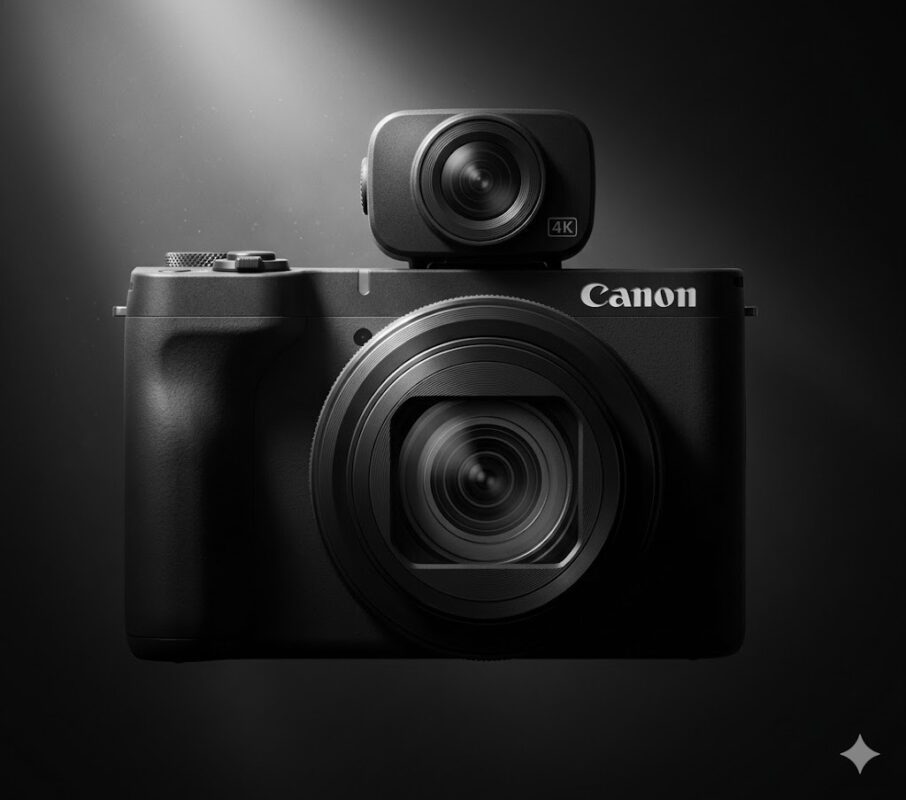
The Canon PowerShot V1 measures 118.3 by 68 by 52.5mm and weighs 426 grams with battery. It is larger than the G7X Mark III but still fits in a generous jacket pocket or a small dedicated camera pouch. The raised thumb grip on the rear provides secure one-handed holding that reviewers praise as more comfortable than expected from the compact body dimensions.
How Does the Vari-Angle Screen Work?
The 3-inch 1,040K-dot vari-angle touchscreen flips out from the left side and rotates to face fully forward for self-filming. This design covers overhead shots, low-angle scenes, and face-forward vlogging compositions equally well. Furthermore, the touchscreen interface handles focus point selection, scene mode switching, and settings navigation with smooth and reliable responsiveness.
What Is the Control Layout?
A control ring around the lens handles aperture adjustment and manual focus override. A rear dial controls additional exposure parameters including shutter speed in manual modes. Several reviewers note that neither the front ring nor the rear dial clicks with the precise tactile feedback that enthusiast photographers prefer. The V1 clearly deprioritizes tactile control precision in favor of compact size and video workflow simplicity.
What Are the Hot Shoe Limitations?
The multifunction hot shoe accepts Canon’s directional stereo microphone, directional mono microphone, and Canon-compatible flash accessories. However, it is not a standard universal hot shoe. It does not support third-party center-pin flash units commonly used in professional photography. For creators who rely on standard hot shoe audio or lighting accessories, adapter solutions exist but add operational complexity.
Is There a Built-In Flash?
No. The Canon PowerShot V1 has no built-in flash. Canon made room for the active cooling fan and prioritized the multifunction hot shoe position instead. For street photographers and social photographers who rely on fill flash for indoor and nighttime people photography, this is a genuinely notable omission. The multifunction hot shoe limits flash accessory choices to Canon-compatible units only.
Battery and Connectivity
What Battery Does It Use?
The Canon LP-E17 battery powers the PowerShot V1. This battery is widely available and compatible with multiple Canon EOS bodies. Battery life in stills mode covers a typical day of casual photography comfortably. However, sustained 4K recording with the cooling fan active drains the battery significantly faster than stills shooting sessions.
Can You Power It via USB-C During Recording?
Yes. This is one of the most important practical features for creators who use the V1 for extended recording. Connecting a USB-C power bank or wall adapter keeps the camera continuously powered. This effectively removes battery life as a limiting factor for stationary recording scenarios like live streaming, interviews, and event coverage. Furthermore, the theoretical unlimited recording time becomes practically unlimited when USB-C power is available.
What Ports Does It Offer?
The Canon PowerShot V1 provides a comprehensive port selection for its compact class. Micro-HDMI enables connection to external monitors and field recorders. USB-C handles power delivery and fast data transfer. A 3.5mm microphone input and dedicated headphone output cover all monitoring and recording audio needs. Furthermore, the multifunction hot shoe eliminates separate cable connections for compatible Canon audio accessories.
How Does Wireless Connectivity Work?
Wi-Fi and Bluetooth enable Canon’s Camera Connect app for wireless image transfer, remote shooting control from a smartphone, and automatic location tagging from a connected phone GPS. Additionally, Bluetooth maintains a persistent low-power background connection for quick wireless activation from the smartphone app without waiting for a Wi-Fi handshake process each time.
Does It Work as a Webcam?
Yes. The PowerShot V1 supports UVC and UAC plug-and-play webcam functionality via USB-C connection to any computer. This allows direct use as a high-quality webcam for video calls, live streaming, and remote presentations without any drivers, software downloads, or additional hardware. Furthermore, this functionality activates immediately upon USB-C connection to a compatible computer.
Real-World Use Cases
Vlogging and Self-Filming
The Canon PowerShot V1 is purpose-built for front-facing vlogging. The wide 16mm equivalent minimum focal length captures the creator plus sufficient environmental context behind them. The smooth Dual Pixel AF maintains reliable eye tracking during free movement without operator intervention. Furthermore, the vari-angle screen shows clear composition and focus confirmation from any self-filming angle in any orientation.
Street Photography and Daily Carry
Despite its video focus, the V1 performs well as a street photography and daily carry stills camera. The 22MP sensor captures detailed images in good and moderate light. The compact form factor allows discreet shooting in busy public environments without attracting unwanted attention. Additionally, Canon’s color science produces ready-to-share JPEG files that look polished without requiring any editing work.
Live Streaming
The USB-C webcam functionality and USB-C power delivery combine to make the V1 an excellent dedicated live streaming camera. The active cooling fan ensures the stream continues without any thermal interruptions regardless of how long the session runs. Furthermore, the built-in ND filter, Dual Pixel AF, and professional audio input create a complete live streaming solution in a genuinely compact body.
Product Review and Unboxing Content
The Movie Close-Up mode is designed specifically for product display content creators. Products held in front of the camera trigger smooth and automatic focus shifts from background to subject. This eliminates the awkward hunting focus behavior that plagues product content shot with standard autofocus cameras. Additionally, the wide focal range allows flexible composition from desk-level overhead shots to tight product detail closeups.
Corporate Video Production
The active cooling system makes the V1 practical for long corporate interview sessions without overheating interruptions. Canon Log 3 provides color grading flexibility for matching footage to a specific brand look. Furthermore, the 10-bit 4:2:2 recording meets broadcast delivery specifications for many corporate and commercial video production requirements.
Travel Documentation
The 16-50mm zoom range covers typical travel photography and videography scenarios in a single pocketable body. Wide shots at 16mm capture sweeping architectural spaces and scenic landscapes. The 50mm end handles natural-looking environmental portraits. Furthermore, the compact size means the V1 is always accessible and ready rather than stored in a bag due to weight concerns.
Pros and Cons
Pros
The 1.4-inch 22MP sensor provides superior dynamic range and low-light performance compared to 1-inch compact cameras. Dual Pixel CMOS AF from the EOS R6 Mark II delivers the best autofocus available in any compact camera at any price point. The built-in optical ND filter is a professional feature rarely found below the GBP 2,000 camera tier in any form. Additionally, 10-bit 4:2:2 internal recording with Canon Log 3 provides genuine professional post-production flexibility. The active cooling fan enables unlimited recording duration as long as power is available. 6K oversampled 4K at 24 and 30fps produces footage that clearly outperforms competing compact camera output at these frame rates. Furthermore, the comprehensive port selection including microphone input, headphone output, micro-HDMI, and USB-C power supports complete professional audio-visual production from a single compact body.
Cons
The $899 price is at the premium end of the compact camera market and requires genuine commitment from buyers who are not sure about the video-first design philosophy. The lack of a built-in flash limits its usefulness for casual social photography where fill flash is commonly used. The 4K at 60fps mode applies a 1.4x crop that meaningfully changes the effective focal range compared to uncropped modes. Additionally, the multifunction hot shoe does not support standard universal third-party flash units, which restricts accessory choices for photographers. No weather sealing means the camera requires protection from rain and dusty outdoor environments. Furthermore, the DJI Osmo Pocket 3 and gimbal-integrated camera category increasingly challenges the V1’s value proposition for solo vlogging use cases at a lower price point.
Final Verdict
The Canon PowerShot V1 is one of the most capable compact cameras released in 2025. It delivers genuine professional video specifications in a truly pocketable body. The 10-bit 4:2:2 recording, Canon Log 3, built-in ND filter, active cooling fan, and advanced Dual Pixel AF create a combination that justifies the premium positioning clearly.
For content creators, vloggers, travel videographers, and corporate video professionals who want quality without a full mirrorless system, the PowerShot V1 is an exceptional tool. The $899 price requires genuine commitment. However, given the sensor size advantage, the autofocus quality, the active cooling, and the comprehensive video feature set, that price delivers real professional value.
For anyone who wants a camera that produces professional-quality video, handles travel stills reliably, works as a high-quality webcam, and fits in a jacket pocket, the Canon PowerShot V1 is the strongest answer currently available in the compact camera market.
Read More from AltBuzz
Read more from Altbuzz for camera reviews, rumors, and detailed specs. AltBuzz delivers trusted and easy-to-understand photography content.
Subscribe AltBuzz YouTube Channel
Stay updated with camera reviews, rumors, and comparisons. AltBuzz shares regular camera content.