
Leica M11-P Full Review: Specs, Performance & Verdict
The Leica M11-P is not just a camera upgrade. It is a statement. Announced in October 2023, this camera builds on the legendary M11 and adds something no other camera in the world had offered before: built-in image authentication technology. For street photographers, photojournalists, and documentary shooters, the Leica M11-P arrives at exactly the right moment in history.
This is a camera that carries 70 years of rangefinder tradition on its shoulders. And somehow, it still feels fresh.
In this full review, we break down everything you need to know about the Leica M11-P: from its sensor and image quality to its groundbreaking Content Credentials feature, design refinements, and real-world shooting experience.
Release Date and Market Position
Leica officially announced the Leica M11-P on October 26, 2023. It replaced the M10-P as the premium discreet variant in the M11 family.
The M11-P sits at the top of the M11 lineup. It is positioned firmly as a tool for professional photographers who demand both optical excellence and image authenticity. It is available in two finishes: black aluminum and silver brass chrome. The black version weighs 530g, while the heavier silver brass version comes in at 640g.
At a retail price of around $9,195 USD, this is undeniably a luxury instrument. But for the audience it is designed for, the price is part of the conversationand that is not a dealbreaker.
Leica M11-P Specifications
| Feature | Details |
|---|---|
| Sensor | 60.3MP Full-Frame BSI-CMOS |
| Processor | Leica Maestro III |
| Resolution Options | 60MP / 36MP / 18MP (Triple Resolution Technology) |
| ISO Range | 64 – 50,000 |
| Shutter Speed | 60 minutes – 1/16,000 sec |
| Mechanical Shutter | Up to 1/4,000 sec |
| Electronic Shutter | Up to 1/16,000 sec |
| Autofocus | Manual Focus Only |
| Image Stabilization | None |
| Video Recording | None |
| Viewfinder | Optical Rangefinder |
| LCD Screen | 2.95-inch, 2.33M dots, Sapphire Glass |
| Internal Storage | 256GB |
| Memory Card | UHS-II SD Card |
| Connectivity | Wi-Fi, Bluetooth, USB-C |
| Battery | Leica BP-SCL7 Li-Ion |
| Dimensions | 139 × 38 × 80mm |
| Weight | 530g (Black) / 640g (Silver) |
| Lens Mount | Leica M-Mount |
| Weather Sealing | Yes |
| Special Feature | Leica Content Credentials (CAI-compliant) |
| Price | ~$9,195 USD |
Sensor and Image Quality
The Leica M11-P uses a 60.3MP full-frame BSI-CMOS sensor. It is the same one found in the standard M11. That is not a criticism. This sensor is genuinely exceptional.
Paired with the Leica Maestro III processor, it delivers images with remarkable natural color rendering, deep dynamic range, and extraordinary detail. The BSI (Backside Illuminated) design improves light-gathering efficiency, which directly benefits performance in low-light conditions.
One of the standout features here is Triple Resolution Technology. Instead of cropping, the camera uses pixel-binning to offer three native resolutions: 60MP, 36MP, and 18MP. Each lower resolution also gains an additional stop of dynamic range. This gives photographers real flexibility without sacrificing sensor coverage.
The native ISO range runs from 64 to 50,000. At base ISO, files are clean, detailed, and rich. High-ISO performance is solid for the class, though users coming from modern Sony or Canon bodies may notice that dedicated autofocus systems paired with faster lenses can edge ahead in extreme low-light scenarios. With the right Leica glass, however, the results at ISO 3200 and beyond are still very usable.
RAW files from the Leica M11-P respond beautifully to editing in Lightroom, Capture One, and Darkroom. Shadows lift cleanly. Highlights retain detail well. The Leica look. That particular quality of color and tonal rendering is is genuinely present in these files.
Autofocus Performance
This section is short by design. The Leica M11-P has no autofocus. It never will.
That is the point.
Manual focus via the rangefinder mechanism is the entire experience. The coupled rangefinder patch allows precise focus through a coincident-image system. Once you internalize the distance scale and learn to read light quickly, it becomes meditative. You slow down. You compose deliberately. You choose your moment.
For street photography and documentary work, this manual approach is not a limitation. For many photographers, it becomes their preferred way to work. That said, those coming from fast AF systems should set realistic expectations before spending this kind of money.
Content Credentials: The Leica M11-P’s Defining Feature
This is what separates the Leica M11-P from every other camera on the market.
The M11-P is the world’s first camera to embed encrypted metadata compliant with the Content Authenticity Initiative (CAI). A dedicated hardware chip inside the camera attaches a digital signature to every image at the moment of capture. This is called Leica Content Credentials.
The credential travels with the image file wherever it goes. If the image is published on a platform that supports the CAI standard, viewers can click an icon to verify the original and see exactly what changes, if any, have been made. If AI has generated or manipulated elements within the image, that too becomes visible.
For photojournalists, documentary photographers, and anyone whose work depends on the integrity of the image, this is a significant development. The feature can be verified at contentcredentials.org/verify or directly within the Leica FOTOS app.
It is worth acknowledging that the system is still maturing. Some reviewers have noted that the credentials can currently be stripped or bypassed if images pass through platforms that do not yet support the standard. However, as adoption of CAI grows across the industry, this protection becomes increasingly meaningful. Leica planted a flag. The rest of the industry is catching up.
Video Capabilities
The Leica M11-P does not shoot video.
Again, this is by design. Leica M cameras are built purely for still photography. There is no video mode, no live view recording, and no intention to change that. If video is a priority, this is the wrong tool entirely. Consider the Leica SL3 instead.
Design and Handling
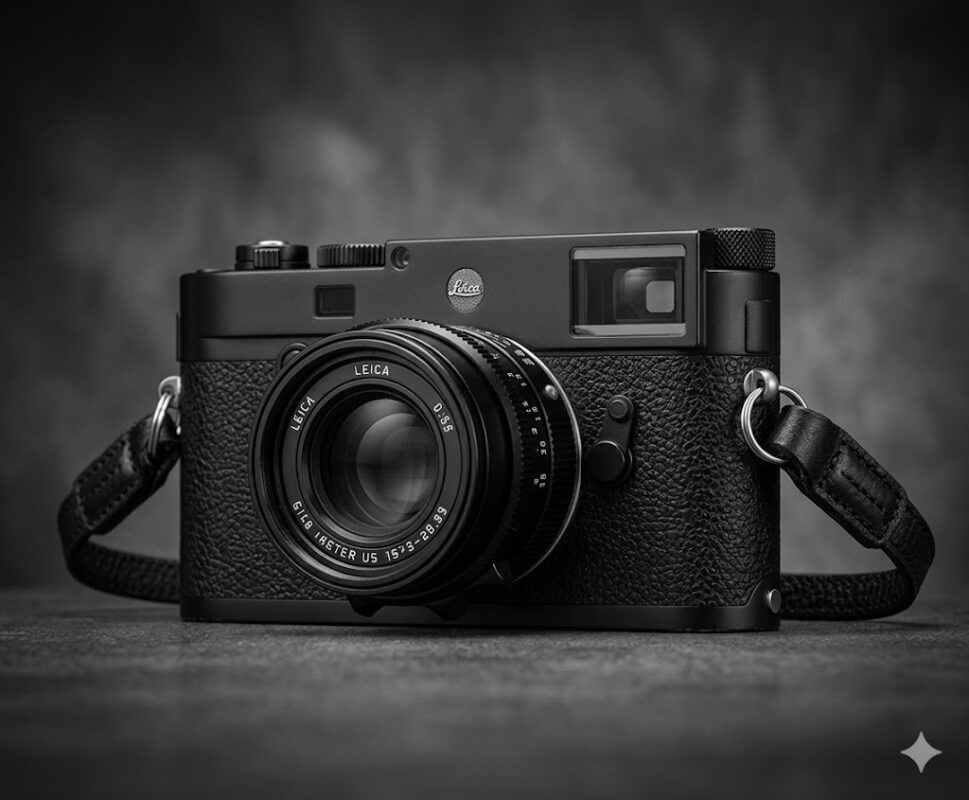
Few cameras in the world are as immediately recognizable as the Leica M. The Leica M11-P refines that iconic form rather than reinventing it.
The most visible change is the removal of the signature red Leica dot on the front of the body. In its place sits an engraved Leica script on the top plate. The result is a more discreet, understated appearance. It is perfect for documentary and street work where camera presence can change a scene.
The LCD on the rear is covered with sapphire glass, one of the hardest materials available for consumer optics. It resists scratches far better than standard glass and carries an anti-reflective coating for improved outdoor visibility. The black version uses a black aluminum top plate. The silver version uses a heavier brass chrome construction, which gives it a distinctly classic feel.
The viewfinder eyepiece frame on the M11-P uses a dark chrome surround, replacing the more conspicuous bright chrome of the standard M11. It is a subtle touch that fits the overall philosophy of the camera.
Ergonomics are minimal by design. There is no grip. The body is compact and flat-fronted. For long shooting sessions, some photographers find the edge of the body pressing into the palm uncomfortable. An optional thumb grip or hand strap helps significantly. The ISO dial on top pops up to prevent accidental changes. It is a smart, practical detail.
The battery compartment uses a spring-loaded tray at the bottom, dropping the older baseplate design that was notoriously slow to access. This is a welcome change first introduced with the M11 family.
Battery and Connectivity
The Leica M11-P runs on the BP-SCL7 lithium-ion battery. It is the same unit found in the M11. Battery life is genuinely impressive by rangefinder standards. Leica estimates up to 1,700 shots per charge when using the optical viewfinder. CIPA-rated performance for live view shooting comes in at around 700 frames. Real-world results will fall somewhere in between depending on workflow.
Charging happens via the USB-C port on the base of the camera. This is a practical improvement over the older micro-USB standard and allows charging from any modern USB-C power source.
Connectivity includes Wi-Fi and Bluetooth Low Energy for wireless image transfer to the Leica FOTOS app. The app supports iOS natively and carries the Made for iPhone and iPad certification. This is a first for any camera brand. Geotagging, image browsing, and direct editing pipeline connections to Lightroom, Capture One, and Darkroom are all available through the app.
Internal storage stands at 256GB. This is a massive increase from the 64GB in the base M11. This can be used alongside a UHS-II SD card for redundant storage, or independently without a card at all. Images can also be transferred from internal memory to the SD card within the camera itself, offering useful flexibility in the field.
Real-World Use Cases
The Leica M11-P is built for a specific kind of photographer.
Street Photography: The discreet body, silent shutter option, and compact form make the M11-P an ideal street camera. The absence of the red dot reduces conspicuousness. The manual focus workflow encourages patience and intentionality.
Photojournalism and Documentary: The Content Credentials feature is a genuine professional tool here. In an era of AI-generated and manipulated imagery, having a cryptographic record of authenticity attached to every frame is meaningful. Editors and publishers are increasingly attentive to image provenance.
Travel Photography: Weather sealing, compact dimensions, and 256GB of internal storage make the M11-P a capable travel companion. You can leave the laptop at home for shorter trips.
Portrait Photography: Leica M lenses are renowned for their rendering of subjects. Skin tones, bokeh character, and foreground-to-background transitions carry a quality that photographers describe as uniquely “Leica.” With the right lens, like a 50mm Summilux or an Apo-Summicron, portrait results are stunning.
Studio or Wildlife Photography: This is not the right camera. No autofocus, no burst shooting beyond 4.5fps, and no telephoto lens ecosystem make it poorly suited to these disciplines.
Pros and Cons
Pros
- World’s first Content Credentials (CAI) implementation
- 60.3MP full-frame BSI-CMOS sensor with excellent image quality
- Triple Resolution Technology with pixel-binning (not cropping)
- Sapphire glass LCD. Highly scratch resistant
- 256GB internal storage
- Discreet design. No red dot, dark chrome accents
- Weather-sealed body
- Excellent battery life (up to ~1,700 shots)
- Apple MFi certified. Seamless iPhone integration
- Mechanical build quality is exceptional
Cons
- No autofocus. Not suitable for all shooting styles
- No video recording whatsoever
- Price (~$9,195) limits the audience significantly
- Content Credentials can currently be stripped on unsupported platforms
- No in-body image stabilization
- No grip included. Ergonomics can be uncomfortable for extended use
- Occasional firmware-related freezing reported by some users
Final Verdict
The Leica M11-P is a camera that knows exactly what it is and makes no apologies.
It is not the most feature-rich camera at its price point. It does not autofocus. It does not shoot video. It will not track a bird in flight or fire 20 frames per second.
What it does, it does with extraordinary conviction. The 60.3MP sensor produces files of genuine beauty. The manual rangefinder experience connects photographer to subject in a way that few modern cameras can replicate. The build quality communicates permanence. And the Content Credentials system puts Leica at the forefront of one of the most important conversations in photography today.
For the street photographer, the documentary shooter, or the photojournalist who needs both image integrity and optical excellence, the Leica M11-P is close to irreplaceable. It is the only full-frame digital rangefinder on the market. That alone makes it significant.
Buy it if the manual focus rangefinder experience speaks to you, if image authenticity matters in your work, and if the price aligns with what you do professionally. Pass on it if you need autofocus, video, or a camera that does everything.
The M11-P does not do everything. It does one thing. It does it better than almost anyone else.
Read More from AltBuzz
Read more from Altbuzz for camera reviews, rumors, and detailed specs. AltBuzz delivers trusted and easy-to-understand photography content.
Subscribe AltBuzz YouTube Channel
Stay updated with camera reviews, rumors, and comparisons. Subscribe Altbuzz for regular camera content covering the latest gear, specs, and hands-on insights.