
Fujifilm X-S20 Review: The Best APS-C Camera for Hybrid Creators in 2026
The Fujifilm X-S20 is one of those cameras that earns your trust quietly. You pick it up, the grip settles into your hand, the shutter button falls exactly where your finger rests, and something clicks before you even take a shot. This is a camera designed to get out of your way.
Released in mid-2023 as a successor to the X-S10, the X-S20 brought a new processor, a dramatically improved battery, and a set of video features that made it the most vlog-friendly camera Fujifilm had produced at this price point. After four weeks of shooting across Islamabad, Lahore, and Nathia Gali, here is our full verdict.
Overall Score: 8.6 / 10
Fujifilm X-S20 Key Specifications
- Sensor: 26.1MP APS-C BSI CMOS
- Processor: X-Processor 5
- Video: 6.2K at 30fps / 4K at 60fps (1.23x crop)
- Stabilisation: 7-stop in-body image stabilisation (IBIS)
- ISO Range: 160 to 51,200
- Autofocus: 425-point phase-detect with subject tracking
- Battery Life: 750 shots (CIPA rated)
- Screen: 3-inch fully articulating LCD touchscreen
- Viewfinder: 2.36 million-dot EVF
- Weight: 491g with battery
- Card Slots: Single UHS-I SD card
- Price: Approximately $1,299 body only
First Impressions and Build Quality
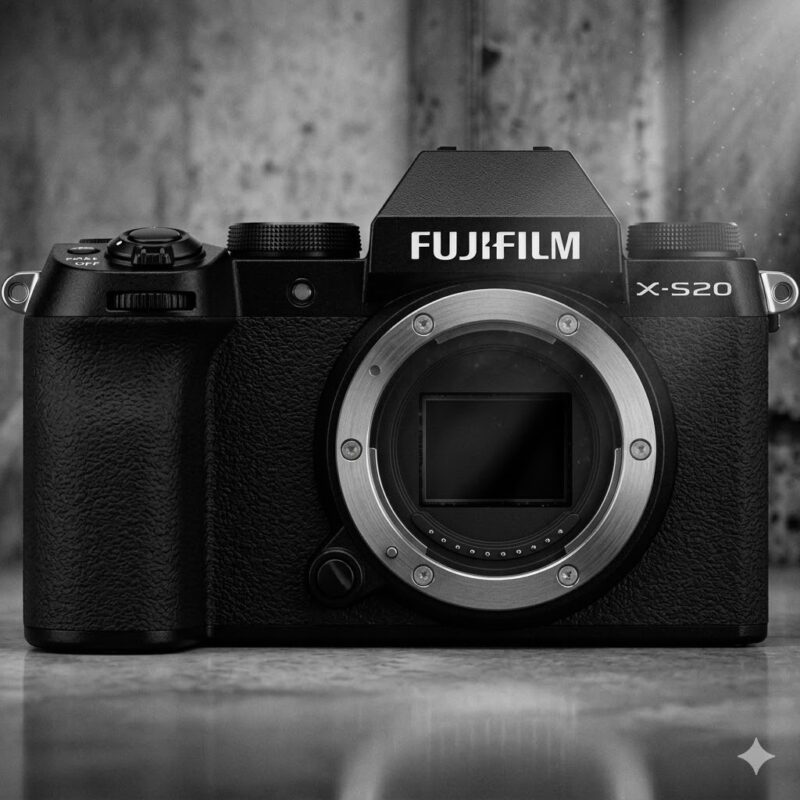
The X-S20 is noticeably more substantial than the X-S10 it replaces. The grip is deeper and more confident, which makes a real difference during long shooting sessions. The body is compact without feeling fragile, though it is worth noting upfront that there is no weather sealing at this price point, which remains a disappointment.
The controls are straightforward. A dedicated video record button, a mode dial with a custom video position, and a fully articulating rear screen make this feel like it was genuinely designed with solo creators in mind, not just adapted from a stills-first body.
Image Quality
The 26.1-megapixel BSI sensor paired with the X-Processor 5 delivers excellent results. Fujifilm has tuned the X-S20 toward forgiving, immediately usable output rather than clinical perfection, which suits most real-world shooting situations well.
The Film Simulations remain one of Fujifilm’s greatest strengths. Shooting Classic Chrome at golden hour in the old city produces JPEGs with such considered tonality that the raw file becomes almost optional. Eterna Cinema, borrowed from Fujifilm’s professional cinema division, gives video footage a filmic character that other manufacturers charge for through third-party LUT packs.
The camera offers 20 Film Simulations in total, including F-Log and F-Log2 profiles for maximum dynamic range in demanding lighting. Custom recipes can be saved and shared, which has built a thriving community of photographers trading their personal looks online.
Dynamic range is strong, noise is well-managed up to ISO 3200, and colour science is characteristically warm and pleasing. This is a camera whose JPEGs you will be proud to share directly from the card.
Video Performance
This is where the Fujifilm X-S20 earns its place in the market. The camera shoots 6.2K internally at up to 30fps, giving meaningful room to crop in post or deliver 4K with additional resolution headroom. More practically, 4K at 60fps is available with a 1.23x crop that is barely noticeable in real-world footage.
The seven-stop IBIS is genuinely effective. Walking shots that previously required a gimbal become usable handheld. It is not gimbal-level smoothness, but for travel documentary work or run-and-gun street videography, it transforms what one person can achieve solo.
USB-C power delivery means the camera can run indefinitely when plugged in, making it viable for long interview setups, live streaming sessions, or extended timelapses. This single feature makes it a serious contender for content creators who previously had to budget for external power solutions.
F-Log2 captures wide dynamic range that grades well in post, and the 10-bit 4:2:2 output over HDMI gives external recorders something genuinely high quality to work with.
Autofocus
Autofocus is the most improved area of the X-S20 compared to its predecessor, and also its most honest limitation relative to full-frame competitors.
The 425-point phase-detection system with subject tracking, including animal and bird recognition, performs reliably in good light. It locks quickly, hunts rarely, and tracks faces through moderate motion with genuine dependability. For portrait, street, and travel photography, the autofocus is more than adequate.
Where it falls short is in low light and with fast, unpredictable motion. Sports or wildlife shooting in dim conditions will challenge the system in ways that the Sony A7 IV or Canon R8 would handle more gracefully. This is an APS-C limitation as much as a Fujifilm one, and buyers should calibrate their expectations accordingly.
Battery Life
The jump from the X-S10’s 325-shot rating to the X-S20’s 750-shot CIPA rating is significant. In practice, a full day of mixed shooting rarely required a battery swap, which was not something you could say about earlier X-series bodies. The larger NP-W235 battery is the same one used in the X-T4 and X-T5, so spare batteries are widely available and reasonably priced.
Fujifilm X-S20: Pros and Cons
Pros:
- Exceptional Film Simulations and JPEG output straight from camera
- 6.2K internal video with F-Log2 support
- 750-shot battery life that actually holds up in the field
- Deep, ergonomic grip comfortable for long sessions
- Fully articulating screen ideal for self-shooting and low-angle work
- USB-C charging and continuous power delivery
- Strong value for the hybrid creator market
Cons:
- Single UHS-I SD card slot with no backup recording
- Autofocus falls behind Sony and Canon in low light conditions
- No weather sealing at this price point
- EVF resolution below class leaders
- 4K at 60fps requires a slight crop factor
Who Should Buy the Fujifilm X-S20?
The X-S20 is built for the hybrid creator who shoots both stills and video with equal seriousness, travels light, and wants the camera to solve problems rather than create them.
It is not the camera for the purist street photographer who wants a rangefinder experience. That is the X-Pro3. It is not for the wildlife photographer who needs relentless autofocus and weather sealing. That is the X-H2S. But for everyone between those poles, particularly YouTubers, travel photographers, and documentary filmmakers working solo, the X-S20 is a compelling and well-considered answer.
If you are coming from a smartphone or a beginner DSLR and want to step into serious hybrid shooting without buying into the full-frame tax, this is one of the best entry points available right now.
Final Verdict
The Fujifilm X-S20 is one of the best APS-C cameras you can buy in 2026. It does not try to be everything to everyone, and that restraint is exactly what makes it so capable at what it does.
The image quality is excellent, the video feature set is genuinely impressive for the price, the battery life has finally caught up with real-world demands, and the Film Simulations remain in a class of their own. The single card slot and the absence of weather sealing are real trade-offs, but for most buyers, they will not be dealbreakers.
If you shoot both stills and video, travel frequently, and want a camera that earns trust rather than requiring constant management, the Fujifilm X-S20 deserves a serious look.
Score: 8.6 / 10
Here are the two sections, ready to paste into your WordPress post wherever you want them:
Read More from AltBuzz
Read more from AltBuzz for camera rumors, leaked specs, and expert insights. AltBuzz delivers trusted and easy-to-understand photography content.
Subscribe AltBuzz YouTube Channel
Stay updated with camera rumors and early previews. AltBuzz shares the latest camera leaks and comparisons. Subscribe AltBuzz