
Sony a6100 vs Canon EOS M50 Mark II: Which Entry-Level APS-C Camera Wins in 2026?
Choosing your first serious camera is one of the most consequential decisions you can make as a photographer or content creator. Get it right and you have a tool that teaches you, grows with you, and produces results that motivate you to keep shooting. Get it wrong and you have an expensive disappointment that ends up in a drawer.
The Sony a6100 and Canon EOS M50 Mark II are two of the most frequently recommended entry-level APS-C cameras, and for good reason. Both offer genuine photographic capability at accessible prices, both are designed with beginner-friendly interfaces, and both come from manufacturers with strong support ecosystems.
But they are meaningfully different cameras, and the right choice depends on what you plan to shoot, how you expect to grow, and what you value in a shooting experience. This is the complete guide to making that decision.
Quick Verdict: Sony a6100 wins for autofocus, video quality, and future upgrade potential. Canon EOS M50 Mark II wins for usability, colour science for beginners, and overall ease of getting great shots quickly.
Sony a6100 vs Canon EOS M50 Mark II: Specifications Compared
| Feature | Sony a6100 | Canon EOS M50 Mark II |
|---|---|---|
| Sensor | 24.2MP APS-C BSI CMOS | 24.1MP APS-C CMOS |
| Processor | BIONZ X | DIGIC 8 |
| Video | 4K 30fps (with crop) / 1080p 120fps | 4K 25fps (with heavy crop) / 1080p 60fps |
| Stabilisation | Electronic only | Electronic only |
| Autofocus | 425-point phase detect with real-time tracking | Dual Pixel CMOS AF with face detection |
| Continuous Shooting | 11fps | 10fps |
| Battery Life | Approx 380 shots | Approx 305 shots |
| Screen | Tilting touchscreen | Fully articulating touchscreen |
| Viewfinder | 1.44 million-dot EVF | 2.36 million-dot EVF |
| Weather Sealing | No | No |
| Card Slots | Single SD UHS-I | Single SD UHS-I |
| Weight | 396g with battery | 387g with battery |
| Price (approx.) | $650 to $750 | $580 to $650 |
First Impressions and Design
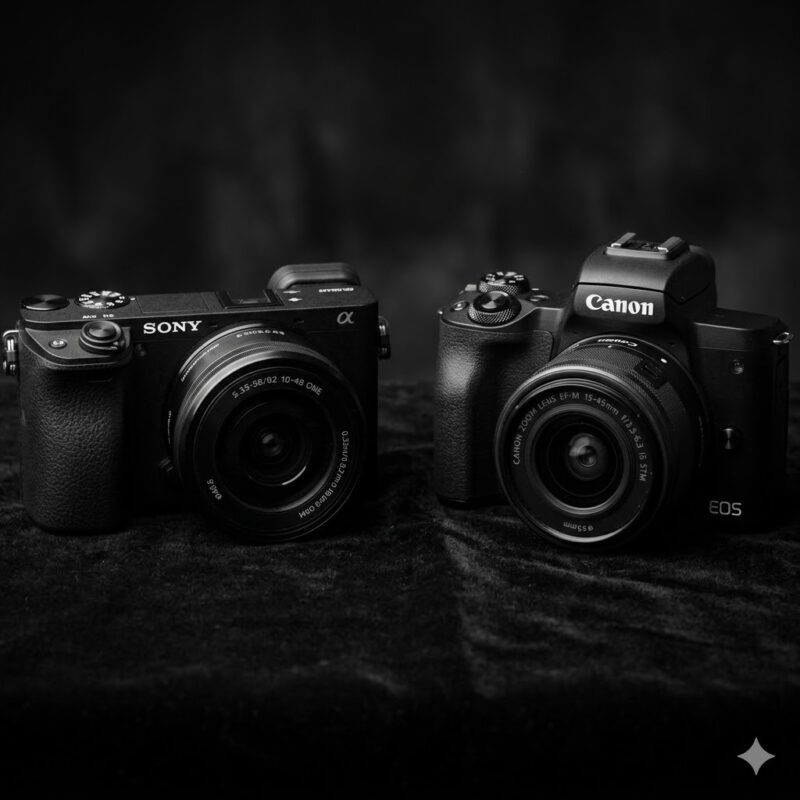
The Sony a6100 is a compact, no-nonsense body that prioritises function over form. The grip is modest but secure, the layout is dense with controls, and the overall impression is of a camera that takes photography seriously without trying to look impressive on a shelf. It is a tool first and a design object second.
The Canon EOS M50 Mark II has more personality. The rounded corners, the clean button layout, and the bright, responsive touchscreen give it an approachable quality that makes beginners feel welcome. Canon has always excelled at designing cameras that reduce anxiety for new shooters, and the M50 Mark II continues that tradition. The fully articulating screen is a genuine advantage over Sony’s tilting-only option, particularly for self-shooting content creators.
Both cameras are lightweight and portable. Neither has weather sealing. Both use a single SD card slot. At this level, the hardware similarities are significant, and the differences come primarily from sensor design, autofocus, and software.
Autofocus Performance
Sony’s real-time tracking autofocus, borrowed from higher-end bodies in the a6000 series and beyond, is the a6100’s most significant competitive advantage. The 425-point phase-detect system with AI subject recognition tracks faces, eyes, animals, and moving subjects with a reliability that is genuinely exceptional at this price point.
Real-time eye autofocus in particular is impressive. The camera identifies and locks onto eyes almost instantaneously, maintains tracking through movement and partial obstruction, and switches between subjects in frame smoothly. For portrait photographers, family photographers, or anyone shooting people in motion, this capability transforms what is achievable without technical expertise.
Canon’s Dual Pixel CMOS AF is one of the best contrast-detect autofocus systems ever made, and it remains a genuine pleasure to use for video. Tracking is smooth, face detection is reliable, and the touchscreen-based tracking interface allows you to tap a subject and have the camera follow it through the frame intuitively.
Where Canon falls behind Sony is in speed and reliability with fast-moving subjects and in challenging light. The Sony’s phase-detect architecture gives it a fundamental advantage in continuous tracking situations that Canon’s contrast-detect system cannot fully overcome, regardless of how refined the implementation.
For beginners who shoot mostly still subjects, portraits, or casual video, Canon’s autofocus is perfectly adequate. For anyone who shoots action, children, pets, or sports, Sony’s autofocus is meaningfully better.
Video Quality: An Honest Assessment
The video comparison between these two cameras requires some honesty about limitations on both sides.
The Sony a6100 shoots 4K at 30fps, but with a significant sensor crop that effectively narrows your field of view. This crop means you need wider lenses to achieve the same framing you would get in 1080p mode, which adds cost and complexity. The 4K output, however, is detailed and sharp when the crop is acceptable. The 1080p at 120fps slow-motion mode is genuinely useful for creative video work.
The Canon EOS M50 Mark II’s 4K mode is even more heavily cropped, to the point where many videographers simply avoid it and shoot in 1080p instead. The 1080p quality from the M50 Mark II is excellent and fully usable for YouTube, social media, and most content creation purposes, but the 4K limitation is a genuine weakness that Canon has been criticised for since the original M50.
For video creators who plan to use 4K regularly, the Sony a6100 is the more practical choice despite its own crop penalty. For creators who shoot primarily in 1080p or who prioritise video smoothness over resolution, either camera produces good results.
Neither camera has in-body stabilisation, which means handheld video on both bodies requires either a stabilised lens or a gimbal for professional-looking results.
Image Quality for Photography
At 24 megapixels, both cameras offer very similar resolution on paper, but the sensor designs differ in meaningful ways.
Sony’s BSI CMOS architecture gives the a6100 an advantage in low-light performance. The backside illumination design captures more light per pixel, which translates to cleaner high-ISO files and better dynamic range in challenging lighting. Street photography at night, indoor shooting without flash, and golden hour portrait work all benefit from this technical advantage.
Canon’s CMOS sensor in the M50 Mark II produces beautiful colour straight from camera. Canon’s colour science has a warmth and accuracy for skin tones that many photographers prefer without any post-processing. The JPEG output is pleasing, well-exposed, and consistent across a wide range of shooting situations.
For raw shooters who post-process their files, Sony’s sensor offers more technical headroom. For JPEG shooters who want great results straight from camera with minimal editing, Canon’s colour science is arguably more immediately pleasing for most subjects.
Ease of Use for Beginners
Canon has a longstanding reputation for making cameras that are easy to learn, and the M50 Mark II lives up to that reputation. The menu system is clearly organised, the guided shooting modes explain settings in plain language, and the touchscreen interface allows beginners to interact with the camera in a way that feels natural and intuitive. Canon’s Creative Assist mode overlays visual representations of how different settings affect the image, which is genuinely helpful for photographers who are still building their understanding of exposure.
Sony’s menu system has historically been one of its weaknesses, and while it has improved in recent generations, the a6100 still presents a steeper initial learning curve than the Canon. The dense button layout rewards users who take time to customise the controls, but the out-of-box experience can feel overwhelming for complete beginners.
For first-time camera buyers, the Canon’s usability advantage is real. For buyers who are willing to invest a few hours in learning their camera’s interface, the Sony’s initial complexity pays dividends in the long run.
Battery Life and Practical Shooting
The Sony a6100 offers approximately 380 shots per charge, which is above average for its class. Careful shooting technique can extend this further, and the USB charging via Micro-USB (a dated choice) means top-up charging from a power bank is possible in the field.
The Canon EOS M50 Mark II’s 305-shot CIPA rating is below the Sony’s and below the class average. A full day of active shooting will typically require a spare battery, which is an additional cost to factor into the purchase. Canon’s LP-E12 battery is affordable and widely available, which mitigates the inconvenience somewhat.
Lens Ecosystem Considerations
The Sony E-mount ecosystem is the largest APS-C lens mount in the world, with an enormous range of first-party and third-party options at every price point. This matters enormously for a beginner camera, because the lenses you buy now will continue to be useful as your photography develops and as you potentially upgrade to higher-end Sony bodies in the future.
The Canon EF-M mount is in a more complicated position. Canon has effectively discontinued the M-series system in favour of the RF-mount lineup, which means no new EF-M lenses are in development. The existing EF-M lens selection is limited, and while an adapter allows the use of Canon’s vast EF and EF-S DSLR lens library, the overall ecosystem future for M-mount is uncertain.
This is a significant consideration for anyone thinking beyond their first camera. Lenses are a long-term investment, and buying into an ecosystem that the manufacturer has deprioritised carries real risk if you plan to expand your kit over time.
Read More from AltBuzz
Read more from AltBuzz for camera rumors, leaked specs, and expert insights. AltBuzz delivers trusted and easy-to-understand photography content.
Sony a6100 vs Canon EOS M50 Mark II: Pros and Cons
Sony a6100 Pros:
- Class-leading real-time tracking autofocus with eye detection
- Better low-light performance from BSI CMOS sensor
- Larger and more future-proof E-mount lens ecosystem
- Better battery life at approximately 380 shots
- 1080p 120fps slow-motion video mode
- Clear upgrade path within Sony full-frame ecosystem
Sony a6100 Cons:
- 4K mode requires significant sensor crop
- Steeper learning curve for complete beginners
- Menu system less intuitive than Canon
- Tilting screen only, not fully articulating
- Older Micro-USB charging rather than USB-C
- Viewfinder resolution lower at 1.44 million dots
Canon EOS M50 Mark II Pros:
- Excellent beginner-friendly interface and guided modes
- Beautiful colour science and skin tone rendering
- Fully articulating screen for self-shooting
- Smooth Dual Pixel CMOS AF for video tracking
- Higher resolution viewfinder at 2.36 million dots
- Affordable and widely available spare batteries
Canon EOS M50 Mark II Cons:
- Heavily cropped 4K mode largely unusable in practice
- EF-M lens ecosystem discontinued with limited selection
- Lower battery life at approximately 305 shots
- Autofocus tracking less competitive for fast subjects
- No weather sealing
- Limited future upgrade path within Canon mirrorless ecosystem
Which Camera Should You Buy?
Buy the Sony a6100 if you want the best autofocus at this price, if you plan to grow your lens collection over time, if low-light photography is important to you, or if you want a camera with a clear upgrade path to full-frame. The Sony is the better long-term investment for most buyers.
Buy the Canon EOS M50 Mark II if you are a complete beginner who wants the most approachable, easy-to-use experience straight out of the box, if colour accuracy and beautiful JPEGs are your priority, or if you specifically need a fully articulating screen and a clear, intuitive touchscreen interface. Just be aware of the ecosystem limitations before committing.
Subscribe AltBuzz YouTube Channel
Stay updated with camera rumors and early previews. AltBuzz shares the latest camera leaks and comparisons. Subscribe AltBuzz
Final Verdict
The Sony a6100 is the stronger camera by most objective measures. Its autofocus is significantly better, its sensor performs more capably in low light, and its lens ecosystem is both larger and more future-proof. For buyers who want a camera that will grow with them and remain relevant as their skills develop, the Sony is the more intelligent purchase.
The Canon EOS M50 Mark II is not without merit. Its colour science is beautiful, its interface is the most beginner-friendly in this comparison, and for a photographer who shoots casually and values ease of use above all else, it produces results that will be genuinely satisfying. The ecosystem limitation is, however, a real concern for anyone who takes photography seriously.
If you can only buy one, buy the Sony a6100. But if you handle both in a shop and the Canon simply feels more natural to you, do not ignore that instinct entirely.
Sony a6100 Score: 8.5 / 10 Canon EOS M50 Mark II Score: 7.8 / 10