
The Leica Q3 is one of the finest compact cameras ever made. Since its June 2023 launch, it has sat at the top of the fixed-lens full-frame compact category with no serious challenger. Its 60MP sensor, 28mm Summilux f/1.7 lens, 8K video, and IP52 weather sealing deliver professional-grade results in a body small enough to carry everywhere.
Yet in June 2026, a growing number of photographers are pausing before buying a Q3. The Leica Q4 rumor cycle has accelerated this year. The Leica Society International’s April 2026 analysis named the Q4 as one of three cameras expected within the next 12 to 18 months. Community discussions on the Leica Forum, DPReview, and specialist Leica publications are building a picture of a camera that could represent the most significant generational jump in Q series history.
So the question stands: should you buy the Q3 today, or wait for the Q4?
This comparison blog answers that question directly. We examine every confirmed Q3 specification against every credibly rumored Q4 upgrade, assess where the improvements will matter most in real shooting conditions, and give photographers the honest framework they need to decide.
Why the Leica Q4 vs Q3 Comparison Is So Important in June 2026
The timing of this comparison matters. In June 2026, the Q3 is three years old. Leica’s historical release cadence places Q cameras roughly every three to four years. The Q4 has never been closer on the timeline than it is right now.
At the same time, the Q3 has never been easier to justify as a purchase. Its price has stabilized. Used copies in excellent condition appear regularly at $4,800 to $5,400. New copies remain available at $5,995. Neither of these prices will drop significantly when the Q4 eventually arrives, because Leica cameras retain their value in the used market far better than mass-market competitors.
This creates a genuine decision point. Photographers who want a Q camera in 2026 must weigh three to four more years of shooting a Q3 against waiting an unknown length of time for a Q4 that addresses the Q3’s specific limitations. This blog gives them the information to make that call.
Full Specification Comparison: Leica Q3 vs Leica Q4
| Specification | Leica Q3 (Confirmed, 2023) | Leica Q4 (Rumored, Est. 2027) |
|---|---|---|
| Sensor resolution | 60MP full-frame BSI CMOS | 64MP to 80MP+ full-frame BSI CMOS |
| Sensor architecture | Standard BSI | Next-generation BSI, improved read noise |
| Lens | 28mm Summilux ASPH f/1.7 | 28mm Summilux ASPH f/1.7 (possibly updated formula) |
| IBIS | None | Possible addition, community strongly expects it |
| Processor | Maestro IV | Maestro V (expected) |
| Autofocus | PDAF, basic face and eye detect | Expanded PDAF, reliable eye-tracking through movement |
| Video | 8K 30p, 4K 60p, 1080p 120p | 8K 60p possible, log workflow expansion expected |
| EVF | 5.76M dot OLED | Same or higher resolution |
| Rear screen | Tilting touchscreen | Fully articulating touchscreen (widely expected) |
| Weather sealing | IP52 | IP52 or better |
| Color science | Maestro IV rendering | Refined Maestro V rendering, richer midtones |
| Launch price | $5,995 | $6,800 to $7,500 estimated |
Sensor Upgrade: 60MP to 80MP and What Changes
The Resolution Case for the Q4
The Q3’s 60MP sensor was genuinely ahead of its time in June 2023. At that point, 60MP full-frame sensors existed only in a handful of bodies across all brands. By June 2026, however, the competitive landscape has shifted. Sony’s rumored A7R VI targets 67MP. Nikon’s Z8 successor discussions involve sensors above 60MP. Canon’s next high-resolution body points in a similar direction.
For Leica to maintain the Q4’s position as the finest fixed-lens full-frame compact camera at launch, the sensor must clearly exceed 60MP. The Leica Society International’s April 2026 analysis specifically described a “70 to 100MP” possibility. Community consensus among Leica Forum members leans toward 80MP as the most practically achievable target given BSI pixel pitch constraints at the full-frame format.
At 80MP, the Q4 would produce approximately 240-megabyte uncompressed DNG files. That is substantially larger than the Q3’s roughly 120-megabyte files. Storage costs increase accordingly, and processing power requirements rise. However, the printing headroom expands dramatically. An 80MP full-frame file supports sharp output at print sizes exceeding 60 x 90 inches at standard gallery viewing distances, which is territory that the Q3’s 60MP can approach but cannot fully reach.
Pixel Pitch and Low-Light Trade-offs at 80MP
Higher resolution on the same physical sensor size means smaller pixels. At 80MP full-frame, pixel pitch drops from the Q3’s approximately 4.4 micrometers to approximately 3.7 micrometers. Smaller pixels gather less light, which in theory creates a per-pixel high-ISO disadvantage relative to the Q3.
In practice, this trade-off is less significant than it sounds. Two factors offset the per-pixel disadvantage. First, the newer BSI architecture in the Q4 sensor improves photon conversion efficiency, partially compensating for the smaller pixel area. Second, when comparing output at matched print or screen sizes rather than at 100% pixel-peep level, the 80MP file downsampled to match the Q3’s output size will actually show equal or better noise characteristics because downsampling averages multiple pixels and reduces perceived noise.
Photographers who evaluate the Q4 at 100% zoom on a monitor will see slightly more per-pixel noise at high ISO than the Q3 shows. Photographers who evaluate output at matched delivery sizes will see equal or better results. For practical shooting purposes, the Q4’s low-light output at standard delivery dimensions will meet or exceed the Q3.
Dynamic Range at the New Sensor Generation
The Q3’s BSI sensor delivers approximately 14 stops of dynamic range at base ISO, which is exceptional for any compact camera. The Q4’s next-generation BSI architecture targets improvements in both base ISO dynamic range and shadow recovery latitude.
Leica cameras process DNG files through the Maestro pipeline, which means raw dynamic range is the primary performance metric. A Q4 sensor delivering 14.5 to 15 stops at ISO 50 base sensitivity would meaningfully improve shadow recovery in high-contrast scenes, particularly the interior-with-window architectural and travel shots that Q series photographers shoot regularly.
IBIS: The Most Debated Q4 Rumor
Why IBIS Matters on a Fixed-Lens Camera
In-body image stabilization addresses two distinct photography needs. For still photography, it extends the range of shutter speeds at which photographers can handhold the camera without motion blur from camera shake. For video, it provides smooth, flowing footage without the micro-jitter that appears in unstabilized handheld footage even when the camera appears steady.
The Q3 relies entirely on the Summilux lens’s optical stabilization for still photography and offers no meaningful stabilization for video beyond that optical system. As a result, Q3 video footage shot handheld requires careful, deliberate movement to avoid visible shake.
The competitive landscape in June 2026 makes the Q3’s lack of IBIS more conspicuous than it was at launch. The Panasonic Lumix L10, which launched this month at $1,499, includes optical stabilization plus electronic stabilization layered on top. The Sony A7C II, at $2,200, offers 7-stop IBIS. Even entry-level mirrorless cameras now typically include at least 5-stop sensor-shift stabilization.
A Q4 without IBIS in 2027 would face direct criticism from reviewers and community members in a way that the Q3 in 2023 did not.
The Engineering Challenge
Leica’s design team faces a specific challenge adding IBIS to the Q body. Sensor-shift IBIS requires mechanical clearance around the sensor element for the movement range of the stabilization system. The Q body is compact and densely packed. Adding IBIS without meaningfully increasing body size requires either a body size increase or a more compact IBIS mechanism than current implementations.
The Leica SL3 demonstrates that Leica can execute IBIS within its product ecosystem. The question is whether the engineering team can fit it into the Q’s smaller form factor without compromising the design language or the lens system alignment.
Community sentiment on the Leica Forum is divided roughly 60-40 in favor of IBIS inclusion, with the minority arguing that the Q line’s character as a deliberate, decisive shooting tool does not benefit from stabilization that encourages slower, more tentative shooting.
The Honest Prediction
IBIS is more likely to appear in the Q4 than not. The competitive pressure from the broader market has increased substantially since the Q3’s 2023 launch. Leica is aware of this pressure. The practical benefits for video-capable use of the Q4, particularly as more Q photographers incorporate video into their documentary and travel workflows, are real and growing.
Autofocus: The Q3’s Most Criticized Weakness
Q3 AF Performance in Real Use
The Q3’s phase detection autofocus acquires focus quickly for static subjects and handles face detection in moderate lighting conditions. These are the situations that Q series photographers encounter most often: deliberate street portraits, travel compositions, interior architectural shots, and quiet documentary moments.
The Q3 struggles in a specific set of circumstances. When subjects move laterally across the frame at moderate speed, continuous tracking breaks down and the camera fails to maintain confident subject lock. In lower light conditions below approximately EV 2, face detection becomes unreliable and the camera hunts before acquiring focus. During video recording, continuous AF tracking produces visible breathing as the lens searches for subject position.
For photographers who work in these challenging conditions regularly, the Q3’s AF limitations are a real daily frustration. For photographers who shoot deliberately and rarely need to track fast-moving subjects, the Q3’s AF is adequate for their actual work.
Q4 AF: What Maestro V Changes
The Maestro V processor, expected in the Q4, delivers faster neural network inference for subject detection. This improvement affects two specific capabilities that Q photographers care about most.
First, eye-tracking reliability through movement improves substantially. When a subject turns, partially occludes their face, or moves through mixed lighting, the Maestro V system maintains subject lock more confidently than Maestro IV because the detection network has been trained on more examples and runs faster inference cycles per second.
Second, low-light AF performance improves through better contrast signal amplification and faster hunting algorithms that recover from lost focus more quickly. The practical result is that photographers working in museum interiors, evening street scenes, or dimly lit venues will find the Q4’s AF decisive where the Q3 sometimes hesitates.
The AltBuzz Media Q4 analysis published earlier in 2026 describes the expected improvement directly: “A more refined PDAF array is expected, with improved subject detection for people, animals, and even vehicles. Eye-tracking that actually holds through movement is widely anticipated.”
For Q3 owners who find themselves frustrated by missed focus during candid street work or during video use, the Q4’s AF upgrade is the most compelling reason to consider waiting.
Video: From 8K 30p to 8K 60p?
What the Q3 Delivers
The Q3 records 8K video at 24 and 30fps, 4K at up to 60fps in 10-bit, and 1080p at 60 and 120fps. For a fixed-lens compact camera, this specification was remarkable at launch in 2023. The 8K capability arrived ahead of many dedicated hybrid mirrorless cameras.
However, the Q3’s video has specific limitations. There is no log profile beyond the Cinema mode, which limits grading flexibility compared to cameras offering V-Log or S-Log. The 8K is limited to 30fps, meaning 8K slow-motion at any multiple is not possible. Rolling shutter during fast panning at 4K and 8K is present at a level that careful camera operators can manage but not eliminate.
Q4 Video Expectations
Based on the trajectory of the broader camera market toward 8K 60fps as the flagship video benchmark by 2027, the Q4 is widely expected to offer 8K 60fps recording.
The Leica Society International’s April 2026 analysis describes this possibility directly, listing “possibly 8K video capability” as a Q4 expectation, which in context refers to 8K at higher frame rates than the Q3’s 30fps ceiling.
A proper log profile is the other video upgrade that Q photographers specifically request. Leica’s Cinema mode is a good start, but it does not provide the full grading latitude that log-plus-LUT workflows deliver. A Q4 with a proper L-Log or equivalent profile, combined with Real Time LUT preview capability similar to what the Lumix L10 offers at $1,499, would transform the Q4’s video workflow from capable to genuinely professional.
The absence of a headphone jack on the Q3 also limits professional audio monitoring during recording. Whether the Q4 addresses this depends on how Leica weighs video professional needs against the body’s compact design priorities.
Color Science: Maestro IV vs Maestro V Rendering
Where Leica’s Color Science Lives
Leica’s color rendering comes from two sources working together: the optical characteristics of the Summilux lens and the Maestro processor’s image rendering pipeline. Both contribute to the quality that photographers describe when they talk about “Leica color.”
The Summilux’s micro-contrast rendering, particularly in the transition zones between in-focus and out-of-focus areas, produces a dimensionality in images that photographers associate with certain analog film stocks. This is a lens characteristic, not a processor characteristic, and it will carry forward to the Q4 with the same Summilux formula.
The Maestro processor’s contribution comes in how it translates raw sensor data into finished JPEGs and DNG embedded previews. Maestro IV’s rendering has been praised specifically for skin tone accuracy and neutral color rendering. Shadows retain color rather than going muddy. Highlights transition naturally rather than clipping abruptly.
What Maestro V Could Improve
Maestro V’s improved rendering is expected to deliver what the AltBuzz Media Q4 analysis describes as “richer midtones” and “skin tones that look like skin rather than data.”
In practical terms, this means the midtone color separation that makes three-dimensional subjects, particularly human faces and textile patterns, look more naturally rendered in the JPEG output. Photographers who shoot JPEGs directly from the camera will notice this most. RAW shooters who process their own files will have more raw material to work with in the tonal midrange.
Dynamic range improvements in the sensor also feed into color rendering quality. When the sensor captures more tonal latitude, the Maestro processor has more information to work with when making rendering decisions. Shadows that retain color information in the capture become shadows that retain color information in the output.
Design Changes: What Might Look Different on the Q4
The Articulating Screen Question
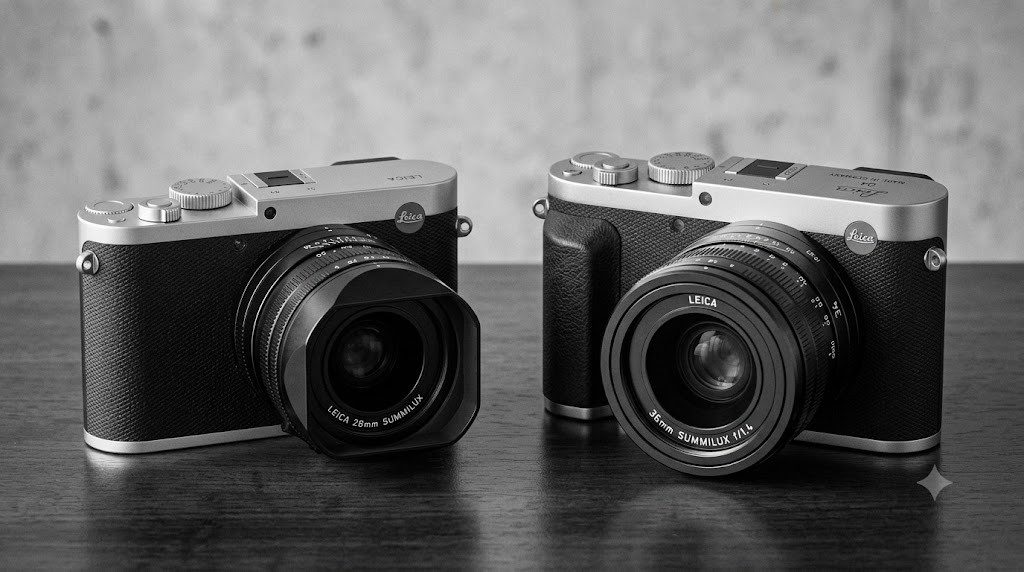
The Q3’s tilting touchscreen was a significant design addition over the Q2’s fixed screen. It allows photographers to shoot from slightly above or below eye level by tilting the screen up or down. However, it does not rotate forward for video selfie use or fully articulate to allow overhead shooting without raising the camera body high.
The Q4 is widely expected to add a fully articulating screen. This expectation is based both on community feedback and on the direction that the broader premium camera market has taken in 2025 and 2026. Virtually every new premium hybrid camera launched in the past 18 months features full articulation.
For Q series photographers who document their own travels, shoot video to camera, or work in tight spaces where overhead angles are necessary, full articulation is a meaningful quality-of-life improvement.
Weather Sealing Upgrade
The Q3’s IP52 rating protects against dust and water spray at limited angles. For photographers who shoot in rain or dusty urban and outdoor environments, IP52 provides reasonable confidence but is not equivalent to the full splash-proofing that cameras rated IP53 or higher offer.
The Q4 is expected to improve weather sealing to at least IP53, providing protection against water spray from any direction rather than only from the limited angles that IP52 covers. For documentary and travel photographers who regularly work in unpredictable weather, this upgrade matters in practical shooting conditions.
Body Size and Weight
The Q3 weighs 743 grams with battery and card. Adding IBIS, a larger sensor, and a more complex processor will increase the internal component volume. Whether this translates into a meaningfully larger or heavier body depends on how aggressively Leica optimizes the internal layout.
A reasonable expectation is a weight increase of 20 to 40 grams and minimal change to external dimensions, consistent with how other camera brands have integrated IBIS without dramatically changing body size.
Pricing: Q3 at $5,995 vs Q4 at an Estimated $7,000+
The Q Series Price Trajectory
Leica has raised Q series prices consistently with each generation. The Q launched at approximately $4,250. The Q2 arrived at $5,200. The Q3 launched at $5,995. Each generation added approximately $800 to $1,000 to the launch price.
The Q4, adding a higher-resolution sensor, a new processor, possible IBIS, improved weather sealing, and a fully articulating screen, provides more justification for a price increase than any previous Q generation step. A Q4 launch price of $7,000 to $7,500 is a credible projection, with some community estimates running as high as $8,000.
Tariff Impact on Leica Pricing in the US
One additional pricing factor is relevant in 2026. Leica publicly acknowledged in May 2025 that US tariffs had forced price increases across their product line. The Q3’s effective US price rose between $200 and $400 above its pre-tariff retail level based on retailer adjustments.
The Q4’s US price will face the same tariff environment. Photographers buying in the US should factor in that the Q4’s effective price may run above Leica’s stated MSRP by a similar margin to what the Q3 currently experiences.
Used Q3 Value After the Q4 Launches
Leica cameras retain their used market value exceptionally well compared to other brands. The Q2 still sells for $3,800 to $4,500 in the used market despite being seven years old and two generations behind the current model. This suggests the Q3’s used market value after the Q4 launches will remain relatively strong, perhaps declining to $4,000 to $4,500 from its current $4,800 to $5,400 used range.
Photographers who buy a Q3 today and sell it when the Q4 launches in 2027 or 2028 will not recover the full purchase price, but they will recover more of it than they would selling most other cameras after two years of use.
The Summilux Lens: Will It Change for the Q4?
This is one of the most technically interesting questions in the Q4 rumor cycle. The 28mm Summilux ASPH f/1.7 is arguably the finest fixed lens on any compact camera. Its optical formula has been refined over decades, and its rendering is what many Q series photographers consider the primary reason to own the camera.
However, sensor resolution creates optical demands. A lens that resolves all detail a 60MP sensor can capture may begin to show limitations at 80MP. Specifically, corner sharpness at wide apertures, chromatic aberration in high-contrast areas, and micro-contrast rendering at fine detail scales all become more visible as sensor resolution increases.
Leica would logically audit the Summilux formula when moving to an 80MP sensor and update the optical design if measurements reveal any resolution-limited weaknesses. This would not change the lens’s character, focal length, or maximum aperture. It would update the specific glass elements or coatings to ensure the optical formula extracts the full resolution potential of the new sensor.
Whether this updated formula would be noticeably different in field use to existing Q3 owners is uncertain. The most likely outcome is subtle corner sharpness improvement at wide apertures with no change to the character and rendering that Q photographers value most.
Real-World Shooting: Who Benefits Most From the Q4 Upgrade
Street and Documentary Photographers
For photographers who shoot candid street work and documentary reportage, two Q4 upgrades matter most. The improved autofocus tracking through movement means more confident candid portraits when subjects are in motion. The possible IBIS addition means smoother video clips for photographers who mix stills and video in their documentary projects.
The resolution increase from 60MP to 80MP will matter less to this audience than the AF and stabilization improvements, because street photographers typically work at standard delivery sizes for editorial and web use rather than at the maximum print dimensions where 80MP provides its clearest advantage.
Travel and Landscape Photographers
For travel and landscape photographers, all of the Q4’s major upgrades contribute. The higher resolution supports larger print sizes for gallery and editorial use. The dynamic range improvement helps in high-contrast landscape and architectural scenes. The improved weather sealing provides confidence in unpredictable outdoor conditions. The articulating screen enables more creative low and overhead angles for compositional variety.
This audience represents the strongest upgrade case from Q3 to Q4. Virtually every Q4 improvement is directly relevant to how travel and landscape photographers use the camera.
Portrait and Fine Art Photographers
Portrait photographers benefit most from the AF tracking improvements and the color rendering refinements in Maestro V. Reliable eye-tracking through subject movement increases the hit rate in candid and environmental portrait sessions. Richer midtone rendering in skin tones produces more naturally three-dimensional facial detail in both JPEG and DNG files.
Fine art photographers who produce large-format prints gain the most directly from the resolution increase. An 80MP full-frame file at the Q4’s expected quality level opens print sizes that the Q3 approaches but cannot fully sustain.
Should Q3 Owners Upgrade to the Q4?
This is the question most readers came to this blog to answer. Here is the direct, research-grounded response.
Upgrade if Any of These Apply
The Q3’s autofocus has actively caused you to miss shots during street, candid, or event work. The resolution of 60MP has specifically limited a project that required larger print dimensions. You use the Q3 for video work and you find the absence of a proper log profile and IBIS limiting on a regular basis. You have upgraded camera body within your budget available without financial stress.
If any of these conditions describe your shooting experience, the Q4 offers meaningful improvements that will change your practical results.
Wait and Shoot Your Q3 if These Apply
The Q3’s autofocus has not caused you significant problems in your typical shooting scenarios. You rarely print above 24 x 36 inches. You use video occasionally but not as a central part of your creative workflow. The $1,000 to $1,500 price increase from Q3 to Q4 represents a meaningful financial consideration relative to what you will actually gain.
If these conditions describe your situation, your Q3 will continue serving you exceptionally well through 2027 and beyond. Buy it now rather than waiting for a camera that is still at minimum 12 to 18 months from announcement.
Final Verdict: Leica Q4 vs Q3
The Leica Q4 will be a better camera than the Q3 in every measurable dimension. That statement is true of every Q generation relative to the one before it, and it will remain true for the Q4.
The more useful question is whether the Q4’s improvements are improvements you will use. For documentary photographers, the AF upgrade is transformative. For large-format print photographers, the resolution gain matters. For video-oriented hybrid photographers, IBIS and a log profile change the workflow entirely. For photographers who shoot primarily deliberate stills of relatively static subjects in good to moderate light, the Q3 already satisfies everything they need.
In June 2026, the Q4 does not yet exist. The Q3 does, and it is outstanding. If your photography needs a Q camera today, buy the Q3. If you can wait 18 to 24 months and the Q4’s specific improvements align with your actual shooting limitations, then wait.
Either decision is correct. The wrong decision is waiting indefinitely for a camera that may not arrive soon enough to justify the delay.
Read More from Altbuzz
This blog is part of our June 2026 camera comparison series. Related reading includes our full Leica Q4 rumor deep-dive, our Panasonic Lumix L10 vs LX100 II comparison, and our ongoing premium compact camera buyer’s guide for 2026.
Stay updated on every Leica announcement and rumor at altbuzzmedia.com. For rumor tracking, we recommend Leica Rumors and the Leica Society International for community analysis.
Subscribe to Altbuzz YouTube Channel
Full video breakdowns of both the Q3 and Q4 rumor analysis are available on the Altbuzz YouTube channel @AltBuzzMedia. Subscribe for real-time updates as the Q4 development signals emerge through the rest of 2026 and into 2027.