
Canon Cinema EOS C200 Mark II: The Rumored Cinema Camera That Never Arrived And Why It Still Matters
A Quick Note Before You Read
This blog covers a camera that Canon has never officially announced. The Canon Cinema EOS C200 Mark II does not exist as a confirmed product at the time of writing. Everything discussed here draws from leaked specifications, industry rumors, Canon Rumors community reporting, and informed speculation based on Canon’s current Cinema EOS lineup strategy. All rumored specifications are labeled clearly throughout. Read this as a deep-dive rumor analysis, not a product review of a shipping camera.
With that said, the story behind this camera is genuinely fascinating. The gaps it was supposed to fill remain real. And the reasons Canon may still need something like it in 2026 are worth understanding carefully.
Introduction: The Camera Canon Keeps Almost Making
Some cameras get announced and disappoint. Others get announced and exceed expectations. The Canon Cinema EOS C200 Mark II belongs to a rarer and stranger category: cameras that keep getting rumored, keep getting postponed, and keep refusing to either arrive or quietly disappear.
Rumors of a Canon Cinema EOS C200 Mark II have surfaced repeatedly since 2021, with sources suggesting announcement windows at NAB 2021, 2023, and beyond, without any official confirmation materializing from Canon at any of those events. Canon Rumors CO
The original Canon Cinema EOS C200 launched in June 2017. It brought Cinema RAW Light recording, Dual Pixel CMOS AF, and a compact Super 35 body to filmmakers at a price well below the C300 Mark II. It was a compelling camera with a frustrating limitation: you could shoot RAW Light or heavily compressed MP4, but nothing in between. No 10-bit 4:2:2 MP4. No ProRes. No middle ground for documentary and corporate shooters who needed more than compressed 8-bit but less than full RAW workflow.
That limitation defined the C200’s legacy and made the case for a successor. Filmmakers wanted a fixed version. Canon took years to respond. Now, in 2026, the question is whether a C200 Mark II still makes sense in a lineup that has been reshaped dramatically by the C70, C80, C400, and EOS R5 C.
This piece examines every angle. The original C200’s strengths and gaps, the history of successor rumors, the leaked specifications, what Canon’s lineup looks like now, and whether a C200 Mark II would still carve out a meaningful place if Canon ever decides to build it.
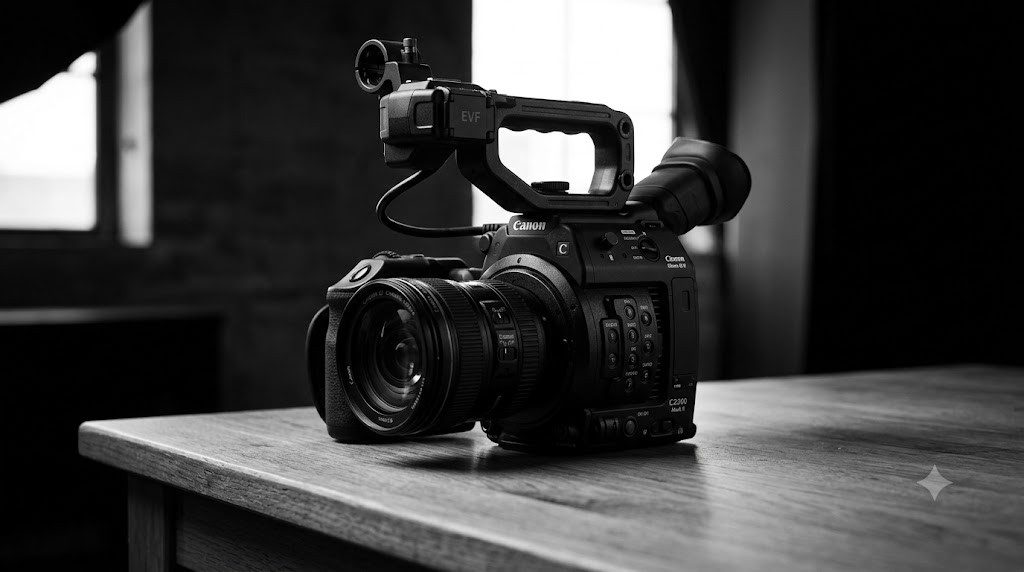
The Canon Cinema EOS C200: Where It Started
Original Launch and Positioning
Canon announced the EOS C200 on May 31, 2017, as part of the third generation of the Cinema EOS system. It launched at $7,499 for the full package including EVF, handle, and grip, and at $5,999 for the C200B body-only version. Wikipedia
Canon positioned the C200 between the entry-level C100 Mark II and the professional C300 Mark II. It offered a genuinely competitive sensor and a first-of-its-kind RAW Light format. On paper, it looked like the perfect middle-tier cinema camera.
The C200 uses a Super 35mm CMOS image sensor with Dual Pixel CMOS AF. It ships with dual DIGIC DV6 processors and captures up to DCI 4K. It shoots up to 60fps in 4K and 120fps in HD, and records to Cinema RAW Light, MP4, and MP4 proxy formats simultaneously. Videomaker
Those core capabilities remain impressive even by 2026 standards. The Dual Pixel CMOS AF system was class-leading at launch. The Cinema RAW Light format delivered practical raw workflow in a compact body for the first time at this price tier.
The Sensor: Super 35 and Dual DIGIC DV6
The EOS C200 features Canon’s 4K Super 35mm CMOS sensor with an effective pixel count of 8.85MP, along with the newly developed Dual DIGIC DV6 image processors. As a result, it delivers Cinema RAW Light recording at 4K DCI 50P internally. Canon Rumors
The Super 35 sensor format matches the established cinema standard used across professional production. This sensor size produces the depth of field rendering and cinematic characteristics that distinguish dedicated cinema cameras from hybrid mirrorless bodies.
The Canon C200 uses the same CMOS sensor as the C300 Mark II but features more advanced Dual Pixel Auto Focus, including touchable AF on the LCD screen. The dynamic range is similar to the C300 Mark II. Digitalfilmmaker
Sharing sensor technology with the C300 Mark II was a significant advantage. It meant filmmakers could confidently match footage between the two cameras on productions that used both. The consistency of color science, noise behavior, and dynamic range across both bodies reduced grading complexity on multi-camera shoots.
The Storage System
The C200 records Cinema RAW Light to CFast 2.0 cards and MP4 to dual SD card slots. The camera features dual DIGIC DV6 processors to handle internal data processing. B&H Photo Video
This dual-storage architecture was clever but also limiting. CFast 2.0 cards were expensive at launch and remained a premium media format throughout the C200’s production life. Photographers coming from the mirrorless world found the card costs an unexpected addition to the camera’s already significant purchase price.
The Codec Problem That Defined the C200
This is where the original C200 generated the most frustration among working filmmakers.
The C200’s users had to choose between a very low-end MP4 HD recording, or a middle-of-the-road 4K image, or dive into the extremely complicated and expensive RAW Light 4K recording. For documentary and corporate shooters who prefer everyday workhorse media like HD at 10-bit 4:2:2, the C200 did not compete with the C300 Mark II, even though they shared the same CMOS sensor. Digitalfilmmaker
That codec gap was the defining criticism. Canon built an exceptional sensor into a body that forced an all-or-nothing workflow choice. You either committed to full RAW Light with its storage demands, media costs, and post-production processing overhead, or you accepted heavily compressed 8-bit MP4 that fell below broadcast standards for many clients.
Professional filmmakers working in documentary, corporate video, and broadcast wanted a 10-bit 4:2:2 option that lived between those extremes. Canon did not provide one in the C200. That gap made the case for a Mark II successor from practically the day the original shipped.
The Rumor History: A Timeline of Almost-Announcements
The 2021 Window: NAB Speculation
The first serious successor rumor placed a Canon Cinema EOS C200 update announcement in or around April 2021, ahead of NAB Show that year. Canon Rumors
NAB Show, the National Association of Broadcasters annual event, is Canon’s traditional venue for Cinema EOS announcements. The April 2021 timeline made logical sense given the C200’s age at that point and Canon’s typical product cycle behavior.
The announcement did not happen. Canon launched other Cinema EOS products in 2021 but left the C200 line untouched.
The 2023 Window: Leaked Specifications Emerge
The most substantive C200 Mark II rumors surfaced ahead of NAB 2023. This time, Canon Rumors published specific leaked specifications rather than just a timeline prediction.
Leaked information suggested the Canon Cinema EOS C200 Mark II would share the same image sensor as the Cinema EOS C300 Mark III. It would also share the same connection ports as the C300 Mark III and maintain compatibility with C300 Mark III and C500 Mark II accessories. Additional rumored features included timecode SDI terminals and an easily interchangeable mount system allowing users to switch between EF and RF lens mounts. Canon Rumors
The interchangeable mount detail was the most surprising leaked specification. An EF-to-RF convertible system would give the C200 Mark II unique flexibility in productions that use a mix of Canon EF cinema glass and newer RF optics. No Canon Cinema EOS camera had ever shipped with that architecture before.
NAB 2023 came and went. Canon announced nothing resembling a C200 successor.
The 2024 Pivot: Canon Changes Direction
Canon sources told Canon Rumors that the Cinema EOS C200 is dead, and there will not be a Mark II version. The Cinema EOS C70 has been somewhat of a slow-burn success for Canon, becoming a favorite of many video shooters at a price point similar to the C200. Canon was instead focusing on a Cinema EOS C70 Mark II announcement in early Q4 of the same year, along with a possible second camera in a similar form factor. Canon Rumors
This was the most definitive statement from any source about the C200 Mark II’s fate. Canon had apparently decided that the C70 and C70 Mark II adequately served the market segment the C200 once occupied.
The 2025 and 2026 Picture
Canon sources indicated that new Cinema EOS products would arrive in Q4 of 2025, likely ahead of IBC in Amsterdam in September. One of the cameras would sit above the Cinema EOS C400 in the lineup but would not be a direct Cinema EOS C700 or C500 Mark II replacement. Sources noted that naming conventions may be changing and that Canon’s bread-and-butter Cinema EOS market remains indie and documentary filmmakers. Canon Rumors
This 2025 reporting suggests Canon is actively reshaping its Cinema EOS lineup structure rather than simply refreshing existing model numbers. A product positioned above the C400 but below the C500 and C700 tier could theoretically occupy the space a C200 Mark II was always supposed to fill, just under a different name.
The Rumored Specifications: What a C200 Mark II Could Carry
Everything in this section represents leaked and speculated specifications. Canon has not confirmed any of these details. Treat them as informed community analysis rather than confirmed fact.
The DGO Sensor From the C300 Mark III
The most credible and frequently repeated specification links the C200 Mark II to the C300 Mark III’s Dual Gain Output sensor.
The Canon EOS C300 Mark III features a 9.6MP Super 35 CMOS sensor with DIGIC DV7 processing. Wikipedia
The C300 Mark III’s DGO sensor is genuinely special technology. Dual Gain Output simultaneously reads each photosite at two different gain settings and combines both readings into a single output. This technique dramatically extends the effective dynamic range of the sensor beyond what conventional single-gain readout can achieve, reportedly producing over 16 stops of usable dynamic range.
Placing that sensor in a more accessible C200-tier body would represent a meaningful step forward. The original C200 used a C300 Mark II sensor and delivered C300 Mark II dynamic range in a smaller package. A C200 Mark II with a C300 Mark III DGO sensor would follow the same logic with a generation of advancement.
The Interchangeable EF and RF Mount System
Community discussion around the leaked C200 Mark II specifications noted the possibility of a removable mount conversion system that allows switching between EF and RF mounts, described not as a conventional adapter but as an integrated conversion mechanism built into the camera’s mount assembly. Canon Rumors
This feature addresses a genuine industry problem. Many production companies carry significant inventories of Canon EF cinema glass, including expensive CN-E prime and zoom lenses. Switching entirely to RF-mount productions requires either adapters or complete lens replacement. A camera that natively supports both mount standards removes that friction.
The Canon EF lens ecosystem includes decades of cinema-optimized glass. Keeping native EF compatibility while adding RF capability would make the C200 Mark II immediately usable across a broader range of production setups than any single-mount cinema camera could serve.
Codec Improvements: The Key Upgrade
The most important rumored improvement over the original C200 involves codec options. Community analysis consistently points to the C200 Mark II needing to fill the gap the original left: 10-bit 4:2:2 internal recording.
Early C200 Mark II rumors indicated the camera would support 4:2:2 10-bit RAW recording, 4K 60p capability, and 2K at up to 120fps. This would position the camera below the EOS C70 in the lineup while offering a more professional codec suite than the original C200 provided. Digital Camera World
Based on Canon’s codec evolution across the C70, C80, and C400, a C200 Mark II would likely include XF-AVC at 10-bit 4:2:2 as a standard internal option. This addresses the single most consistent criticism of the original camera and makes the successor immediately more competitive against Sony FX6 and Blackmagic URSA alternatives in the mid-tier cinema market.
Triple Base ISO: The Low-Light Architecture
Canon introduced triple base ISO on the C300 Mark III and C70, offering three native sensitivity points that the camera optimizes independently for low-noise output. A C200 Mark II inheriting the C300 Mark III DGO sensor would carry this capability by design.
Triple base ISO at typical points of ISO 800, ISO 2500, and ISO 12800 would give the C200 Mark II exceptional low-light performance across a wide range of shooting conditions. This matters enormously for documentary and event filmmakers who regularly work in venues with unpredictable and challenging light.
RF Mount and Cinema RF Glass Compatibility
If Canon launches the C200 Mark II with RF as its primary mount alongside the interchangeable EF option, the camera gains access to the growing Canon Cinema RF lens lineup. The RF 50mm T1.3, RF 85mm T1.3, and the Cine-Servo RF 17-120mm represent significant optical investments that many production companies have already made.
Native RF mount also enables faster and more accurate autofocus with DPAF II compared to EF glass on an adapter. For solo shooters and small crews where AF reliability directly affects capture success, this represents a practical production advantage.
Why Canon Keeps Hesitating: The Lineup Logic Problem
The C70 Fills Much of the Space
The Cinema EOS C70 has become a favorite of many video shooters and sits at and around the same price point as the C200. The form factor and image quality continue to impress in long-term reviews from real shooters. Canon Rumors
The C70 launched in 2020 with the DGO sensor, RF mount, 4K 120fps, 10-bit 4:2:2 recording, and a compact body that appealed to solo operators and small crews. It solved most of the problems that made a C200 Mark II seem necessary. Canon essentially built the camera the C200 should have been, just under a different model number.
By the time Canon began seriously considering a C200 II release, the C70 had already established itself as the answer to that market need. Launching a C200 Mark II too close in specification to the C70 risks cannibalizing C70 sales without adding genuine lineup diversity.
The C400 and C80 Change the Equation Further
The last Cinema cameras announced were the full-frame Canon Cinema EOS C70 and the Cinema EOS C400. Both cameras have been very well received, and Canon seems to have figured out how to differentiate products at similar price points of $7,999 and $5,499, doing both very well. Canon Rumors
The C80 and C400 announcements in 2024 further crowded the segment where a C200 Mark II would naturally land. Canon now has well-differentiated products across the indie and documentary filmmaking tier. Finding a unique value proposition for a C200 Mark II requires careful positioning that avoids stepping on both the C70 and C400.
The Naming Convention Shift
Sources noted that a new Cinema EOS camera positioned above the C400 would not be a direct C700 or C500 Mark II replacement, and that naming conventions may be changing as Canon reshapes Cinema EOS segmentation. Canon Rumors
Canon may be moving away from the numbered naming system that has defined Cinema EOS since the C100’s launch. If that shift happens, a spiritual successor to the C200 Mark II could arrive under a completely different product name, making it impossible to track through traditional rumor channels that search for “C200 Mark II” specifically.
What the C200 Mark II Would Need to Succeed in 2026
Internal 10-Bit 4:2:2 Recording as Standard
The original C200’s codec limitation must not repeat in any successor. A C200 Mark II launching in 2026 without standard 10-bit 4:2:2 internal recording would arrive already behind expectations. This is the minimum entry requirement for competitive positioning against the Sony FX6, Blackmagic URSA Cine 12K, and Canon’s own C70 and C80.
6K Oversampled 4K Output
The C300 Mark III delivers oversampled 4K output from its sensor, which produces cleaner, more detailed footage than cameras that capture exactly at 4K resolution. A C200 Mark II using the same DGO sensor should deliver the same oversampled output quality. Filmmakers delivering 4K content benefit from the additional resolution headroom during color grading and post-production finishing.
Genuine Low-Light Capability
The DGO sensor architecture with triple base ISO gives any camera using it exceptional low-light performance. A C200 Mark II should advertise usable high-ISO performance up to ISO 12800 minimum and native clean output at ISO 2500 as its practical working range in dark environments.
A Competitive Price Point
Canon dropped the price of the C200B significantly to $2,499 in January 2023, reflecting how much the market had shifted around the original camera. Wikipedia
A C200 Mark II priced above $7,000 at launch would immediately invite comparison to the C300 Mark III and face difficult questions about value. The sweet spot for a successor sits between $5,000 and $6,500, positioning it clearly below the C400 and clearly above the C70 while offering the DGO sensor as the key technical differentiator.
CFexpress Type B or CFexpress Type A Storage
CFast 2.0 is an aging storage standard. A 2026 cinema camera must support CFexpress Type B or at minimum dual CFexpress Type A slots to remain current with industry storage standards. The additional write speeds enable higher bitrate recording and longer continuous capture at maximum quality settings.
Canon’s Cinema EOS C200 Mark II vs. the Competition It Would Face
vs. Sony FX6
The Sony FX6 occupies a comparable position in Sony’s cinema lineup. It offers full-frame 12.1MP BSI-CMOS, ISO 80 to 102400, 4K 120fps, 4:2:2 10-bit internal recording, and excellent autofocus with real-time eye tracking.
A C200 Mark II with DGO Super 35 sensor would trade full-frame coverage for the DGO sensor’s dynamic range advantage. Canon’s Dual Pixel CMOS AF remains one of the best autofocus systems in cinema cameras, which would compete directly with Sony’s tracking performance. The interchangeable mount system would give Canon an advantage among production companies with existing EF glass investments.
vs. Blackmagic URSA Cine 12K
The Blackmagic URSA Cine 12K targets productions that need maximum resolution and RAW flexibility at a relatively accessible price. Its 12K sensor and BRAW codec offer enormous post-production headroom.
A Canon C200 Mark II would compete on ergonomics, autofocus capability, and ecosystem integration rather than raw resolution. Canon’s cinema ecosystem of body accessories, CN-E lenses, and broadcast connectivity gives it advantages in professional production environments where Blackmagic remains less established.
vs. Canon EOS R5 C
The EOS R5 C is a hybrid rather than a dedicated cinema camera, positioned differently from the dedicated Cinema EOS lineup. Digital Camera World
The R5 C gives photographers and videographers a hybrid body with full-frame raw video and stills capability. A dedicated C200 Mark II would differentiate through its cinema-specific feature set: proper ergonomics for handheld and shoulder-mount operation, dedicated XLR audio inputs, timecode, genlock, and the operational workflow that professional video crews expect from a dedicated cinema body.
The Original C200’s Lasting Legacy
Despite its codec limitations, the original C200 built a loyal following among filmmakers who embraced Cinema RAW Light and worked around the compression compromise.
Many documentary and corporate shooters bought the C200 at its initial price and reported not regretting it a single day, appreciating the image quality, autofocus performance, and compact body that made it practical for one-person and small crew productions. Digitalfilmmaker
The camera’s Dual Pixel CMOS AF was genuinely ahead of its competition at launch. Documentary filmmakers who needed reliable continuous AF in run-and-gun situations found the C200 one of the few cinema cameras that made them confident when shooting alone without a dedicated focus puller.
The EF lens mount on the EOS C200 offered compatibility with Canon’s existing broad range of DSLR lenses as well as the EF-mount CN-E cinema prime and zoom lenses, giving shooters access to a mature lens system from day one. B&H Photo Video
That lens compatibility built trust. Productions already running Canon glass could drop the C200 into existing workflows without accessory purchases or compatibility research. A C200 Mark II with dual EF and RF mount capability would preserve that trust while opening the door to the growing RF cinema lens library.
What Canon Has Actually Been Doing Instead
While the C200 Mark II rumor cycle continued, Canon built out the Cinema EOS lineup in a different direction.
The C70 launched in 2020 with the DGO Super 35 sensor in an RF-mount compact body priced around $5,499. The EOS R5 C arrived in 2022 as a full-frame hybrid with cinema raw capabilities in an R5-based body. The C80 and C400 launched in 2024, adding a compact full-frame body and a mid-tier Super 35 option respectively.
Canon has figured out how to differentiate products at similar price points and do them both very well, suggesting the company is thinking carefully about segmentation rather than flooding the market with overlapping capabilities. Canon Rumors
That careful segmentation thinking explains why the C200 Mark II keeps getting delayed or reconsidered. Canon engineers and product managers presumably revisit the question with each new lineup addition. Each time they do, the available space for a differentiated C200 Mark II gets a little narrower.
The 2025 IBC announcement window referenced by Canon Rumors sources may finally resolve this question. Either Canon introduces a product that serves the C200-tier need under a new name, or the segment gets absorbed into the C70 Mark II and C80 product lines permanently.
Should Canon Still Build the C200 Mark II?
The honest answer is: probably not under that name, but yes in spirit.
The original C200’s form factor served a specific type of filmmaker. Someone who wanted a dedicated cinema body with proper ergonomics, built-in EVF, rotating 4-inch monitor, on-body XLR inputs, and timecode capability, but did not need the full modular build of the C300 tier. That filmmaker still exists in 2026. They are shooting documentaries, corporate productions, branded content, and broadcast magazine segments.
The C200 is seven years old. The market has moved significantly, and the C70 now covers much of what the C200 served. However, the form factor of the R5 C and C70 is not appropriate for every scenario, and a more traditionally styled cinema body with an updated sensor and codec suite would be welcomed by many professional users. Canon Rumors
A C200 Mark II arriving with the DGO sensor, 10-bit 4:2:2 internal recording, dual mount compatibility, CFexpress storage, and a price around $5,500 to $6,500 would absolutely find buyers. The question is whether Canon believes enough buyers exist to justify the engineering investment against a lineup that already covers the segment reasonably well with existing products.
Quick-Reference: Rumored vs. Original Specifications
Original C200 Sensor: Super 35 CMOS, 8.85MP effective
Rumored C200 Mark II Sensor: DGO Super 35 CMOS from C300 Mark III, 9.6MP
Original C200 Processor: Dual DIGIC DV6
Rumored C200 Mark II Processor: DIGIC DV7 or later generation
Original C200 Dynamic Range: Up to 15 stops (Canon Log 3)
Rumored C200 Mark II Dynamic Range: 16 plus stops via DGO architecture
Original C200 Internal Codec: Cinema RAW Light, 8-bit MP4 only
Rumored C200 Mark II Codec: Cinema RAW Light, XF-AVC 10-bit 4:2:2, possibly ProRes
Original C200 Resolution: 4K DCI 60P RAW Light, 4K UHD 60P MP4
Rumored C200 Mark II Resolution: 4K 60P standard, 2K 120fps, possible 6K oversampled output
Original C200 Mount: EF only
Rumored C200 Mark II Mount: Interchangeable EF and RF
Original C200 Storage: CFast 2.0 plus dual SD
Expected C200 Mark II Storage: CFexpress Type B plus CFexpress Type A or dual CFexpress
Original C200 Price: $7,499 at launch, $5,999 C200B
Estimated C200 Mark II Price: $5,500 to $6,500 based on lineup positioning
Frequently Asked Questions
Is the Canon Cinema EOS C200 Mark II officially confirmed?
No. Canon has never officially announced or confirmed the C200 Mark II. All information in this blog comes from leaked specifications, rumor site reporting, and community analysis. Canon Rumors sources have at various points reported both that the camera was coming and that Canon had canceled it.
Why has it taken so long for a C200 successor to appear?
Canon’s Cinema EOS C70 effectively covered the market segment the C200 Mark II would have targeted, and Canon appears to have decided that launching a very similar camera would cannibalize C70 sales without adding meaningful lineup diversity. Canon Rumors
What Canon cinema cameras are currently available in 2026?
Canon’s current active Cinema EOS lineup includes the C70, C80, C300 Mark III, C400, C500 Mark II, C700, and EOS R5 C. The original C200 has been discontinued.
Could the C200 Mark II arrive under a different name?
Canon sources noted that naming conventions in the Cinema EOS lineup may be changing, meaning a spiritual C200 Mark II successor could arrive under a completely different product designation. Canon Rumors
What is Canon Cinema RAW Light and how does it differ from Cinema RAW?
Canon Cinema RAW Light records raw image data at approximately one-third to one-fifth the file size of standard Cinema RAW by applying a specific compression scheme that retains most of the grading flexibility of full RAW while dramatically reducing storage requirements. Wikipedia
Final Thoughts: The Ghost Camera That Still Has a Point
The Canon Cinema EOS C200 Mark II exists in a strange limbo. It has been rumored for six years and it has been pronounced dead at least once by credible sources. Also, it keeps resurfacing in community discussions precisely because the need it was supposed to answer has never fully disappeared.
Canon’s current Cinema EOS lineup is stronger than it has ever been. The C70 is exceptional. The C400 fills a thoughtful mid-tier position. The C80 serves compact full-frame production needs. Yet there remains a form factor and price tier that none of those cameras quite owns with the full feature set that working filmmakers need.
A C200 Mark II with a DGO sensor, proper 10-bit 4:2:2 recording, dual mount compatibility, and a sub-$6,500 price would be immediately compelling. It would update a beloved form factor with seven years of sensor and codec evolution. It would serve documentary and corporate filmmakers who need a dedicated cinema body without the size, weight, or cost of the C300 Mark III tier.
Whether Canon builds it under the C200 Mark II name, under a new designation, or not at all depends on decisions being made inside a company that has not historically been eager to communicate its Cinema EOS roadmap publicly. The IBC 2025 announcement window Canon Rumors referenced may have already resolved the question one way or another by the time you read this.
Either way, the conversation around this camera illuminates something real about what professional filmmakers need and what gaps remain in even a well-designed product lineup. That conversation was worth having regardless of whether Canon ever officially answers it.
Read More from Altbuzz
This article is part of our 2026 Cinema Camera Rumor and Review Series, where we track unannounced cameras, analyze lineup gaps, and give professional filmmakers early intelligence on where the industry is heading.
For confirmed camera reviews, our Hasselblad X2D 100C deep-dive review covers 100MP medium format still photography at the highest level. Our Leica Q3 technical review examines 60MP fixed-lens full-frame performance for street and travel photographers. If you are deciding between cinema-focused and hybrid camera systems, our premium camera buyer’s guide for 2026 walks through every major option across sensor formats and price tiers.
Stay updated on every Canon Cinema EOS announcement, leak, and rumor at altbuzzmedia.com. For dedicated Canon rumor tracking as news breaks, Canon Rumors remains the most active and reliable independent source for pre-announcement intelligence.
Watch on the Altbuzz YouTube Channel
Full video analysis of the Canon Cinema EOS lineup, including what the C200 Mark II rumor cycle means for filmmakers shopping in 2026, is available on the Altbuzz YouTube channel @AltBuzzMedia.
Video coverage includes a side-by-side breakdown of the C70, C80, and C400 to show exactly where a C200 Mark II would and would not fit, a history of Canon’s Cinema EOS naming strategy, and a watch list for upcoming Canon cinema announcements through the rest of 2026. Subscribe to get notified the moment any official Canon Cinema EOS news breaks, and join the community discussion on what Canon should build next.