
This Canon EOS R3 review arrives at an interesting moment in the camera’s life. Launched in November 2021 at $5,999, the R3 entered the professional mirrorless market as Canon’s most capable camera before the EOS R1 existed. Five years later, in June 2026, it continues selling. Used examples sell for $3,800 to $4,500. Forums discuss it actively. Professional photographers continue recommending it to colleagues. That level of continued relevance, five years after launch in a category that moves quickly, says something meaningful about what Canon built.
The Canon EOS R3 review space is full of opinions from 2021 and 2022. Most of those reviews evaluated the camera against the Sony A1 and Nikon Z9 at launch. This review takes a different approach. We evaluate the R3 through the lens of June 2026, examining what it still does extraordinarily well, where newer cameras have passed it, and whether buying or keeping one makes sense today.
Canon EOS R3 Review: Full Specifications
| Specification | Canon EOS R3 |
|---|---|
| Sensor | 24.1MP full-frame BSI stacked CMOS |
| ISO range | 100 to 102,400 (expandable to 50 to 204,800) |
| Autofocus points | 1,053 AF areas, 4,779 AF points |
| AF low-light limit | -7.5EV with f/1.2 lens |
| Burst rate (electronic) | 30fps standard, up to 195fps (firmware 1.21) |
| Burst rate (mechanical) | 12fps |
| Maximum shutter speed | 1/64,000 second (electronic) |
| IBIS | 5-axis, up to 8 stops |
| Eye Control AF | Yes, infrared LED system |
| EVF | 5.76 million dots, 0.76x magnification, 120fps |
| Rear screen | 4.15 million dot fully articulating touchscreen |
| Video | 6K RAW 60p, 4K 120p, Full HD 240p |
| Card slots | CFexpress Type B + UHS-II SD |
| Battery | LP-E19, approx. 620 shots (EVF), 860 shots (screen) |
| Body dimensions | 150 x 143 x 87mm |
| Weight | 822g body only, 1,015g with battery and card |
| Weather sealing | Extensive, equivalent to EOS-1D X Mark III |
| Launch price | $5,999 |
| Current used price (June 2026) | $3,800 to $4,500 |
Canon EOS R3 Review: Design and Build Quality
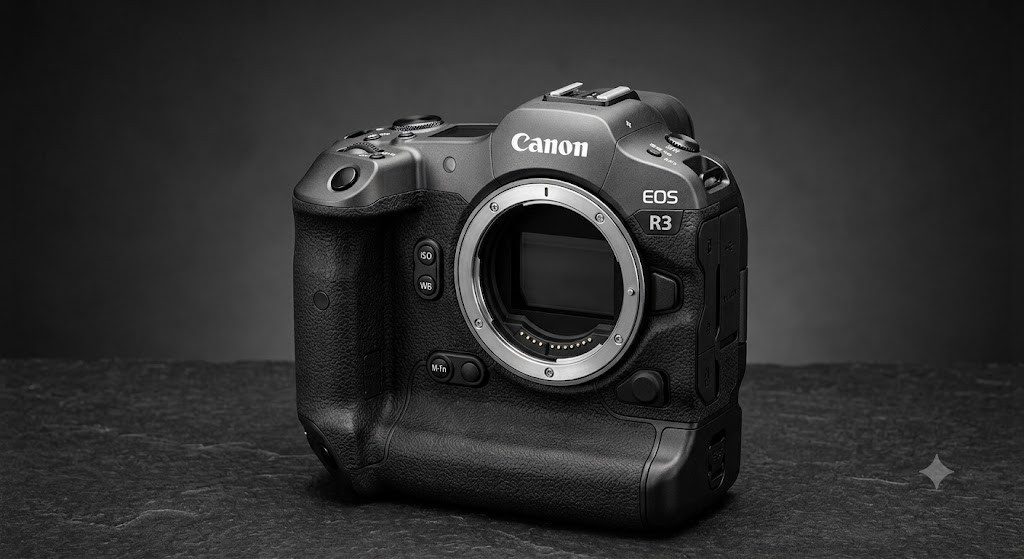
A Professional Body That Means Business
The Canon EOS R3 features an ergonomic design that prioritizes comfort and functionality, especially for users with larger hands. The build quality is robust, with a weather-sealed body ensuring durability against adverse conditions, a notable asset for outdoor professionals. Digital Camera World
Picking up the R3 for the first time, the camera communicates its purpose immediately. The integrated vertical grip extends the body downward, placing a second shutter release button, AF joystick, and multi-controller in a comfortable position for portrait-orientation shooting without any additional accessory. This design, borrowed from Canon’s legendary 1D series DSLR lineup, means the R3 handles identically whether you shoot horizontal or vertical frames.
The body measures 150 x 143 x 87mm and weighs 1,015 grams with battery and card. By mirrorless standards, this is substantial. Photographers who have used the R5 or R6 Mark II will notice the size difference immediately. However, the weight distributes naturally across the grip, and when paired with large RF telephoto lenses, the R3’s size becomes an advantage. Balance improves considerably compared to smaller-bodied cameras struggling to counterweight a 400mm prime.
Weather Sealing at the Professional Tier
The Canon R3’s magnesium alloy body is both dust and weather resistant, just like the EOS-1DX Mark III, with both cameras offering the same level of weather-proofing as each other. The Phoblographer
This is meaningful in practical terms. The 1DX Mark III earned its reputation for surviving conditions that would destroy lesser cameras. Pouring rain at a football match, dust-heavy motorsport environments, sand at beach volleyball, and cold temperatures at mountain wildlife locations all form part of the professional photographer’s working reality. The R3 handles all of these without requiring protective covers or special precautions beyond reasonable care.
Smart Controller: The Underrated Ergonomic Feature
The Smart Controller, inherited from the EOS-1D X Mark III, is a multifunction touchpad on the upper rear of the body. It allows photographers to move the AF area quickly without lifting their thumb from the multi-controller. At burst rates above 20fps, the ability to reposition the AF area without disrupting grip or shooting position becomes practically significant.
This feature distinguishes the R3’s ergonomics from the R5 and R6 bodies. Photographers who have used both consistently describe the Smart Controller as one of the features they miss most when switching to a smaller Canon body.
Canon EOS R3 Review: The 24MP Sensor Decision
Why Canon Chose 24MP Over Higher Resolution
The Canon EOS R3’s 24.1MP sensor was the most controversial specification at launch. For $6,000 it has relatively low resolution, while Canon’s own 45-megapixel EOS R5 costs more than $2,000 less. LensClear
Canon made a deliberate engineering choice. The stacked BSI CMOS architecture prioritizes readout speed over pixel count. By keeping the sensor at 24.1MP, Canon engineers achieved several performance advantages that higher-resolution designs cannot match at the same speed tier.
The 24MP output is sufficient for the R3’s primary professional audiences. Sports photographers delivering to editorial clients rarely need more than 24MP. Photojournalists who supply news agencies for web delivery work well within 24MP’s capabilities. Wildlife photographers who shoot in challenging light benefit from the sensor’s low-noise characteristics at high ISOs more than they would benefit from additional resolution at the cost of worse performance in the dark.
Sensor Performance in Real Shooting Conditions
The R3 can AF at -7.5EV. Especially with a wide aperture lens mounted, this camera autofocuses on reasonable contrast in incredibly dark environments, darker than seen successful AF in before. So dark that you will need a flashlight or night vision technology to navigate the scene. Digital Photography Review
Image quality at high ISO is where the 24MP sensor’s design philosophy pays dividends directly. The R3 delivers excellent low-light performance, supporting ISO settings up to 102,400 and maintaining minimal noise, making it suitable for night or indoor shooting. Digital Camera World
At ISO 3200, the R3 produces clean, printable files with excellent color fidelity. At ISO 6400, luminance noise becomes visible but color noise remains well-controlled. Usable results extend to ISO 12,800, and in specific contexts where subject recognition matters more than fine detail, ISO 25,600 images retain enough quality for digital delivery.
This camera can not only shoot in the dark but print ISO 128,000 and still look good. That claim is tested in real shooting, and while ISO 128,000 is not suitable for large-format print, digital delivery and social media use at this sensitivity produces results that would have seemed impossible from a professional sports camera five years earlier. SMotographers
Dynamic Range and Color Science
Canon’s color science through the DIGIC X processor delivers the accurate, neutral rendering that Canon photographers associate with the EOS-1 series. Skin tones reproduce naturally in JPEG output. Highlight rolloff transitions smoothly without the abrupt clipping that lesser cameras produce under mixed studio lighting.
Dynamic range at base ISO is strong, recovering approximately 4 stops of shadow detail without visible banding or color shift in post-processing. However, the R3 does not match the R5 Mark II or Sony A7R series bodies for dynamic range at measured comparison levels, a consequence of the speed-focused sensor architecture rather than any fundamental image quality weakness.
Canon EOS R3 Review: The Autofocus System
Dual Pixel CMOS AF: Still One of Canon’s Best Implementations
Autofocus is based on Canon’s Dual Pixel CMOS AF II technology, where every sensor pixel is split in two to enable phase detection anywhere in the frame. No fewer than 4,779 focus points are available, and the system is specified to operate in incredibly low light levels equating to -7.5EV with an f/1.2 lens. LensClear
This specification translates directly into real-world shooting confidence. The autofocus rarely struggles, even with low light. Subject and face detection AF works great. For photographers who come from earlier Canon mirrorless bodies, the R3’s AF system represents a dramatic reliability improvement across every shooting scenario. SMotographers
Subject detection covers humans with full body, face, and eye tracking, animals with eye detection for mammals and birds, and vehicles including race cars, motorcycles, formula cars, GT cars, rally cars, and off-road vehicles with helmet detection for motorsports. Deep learning technology is used, and helmet detection is featured. No competing camera at the R3’s 2021 launch offered this combination of subject categories. Digital Photography Review
Eye Control AF: Genuinely Useful When It Works
The really big news was Canon’s re-introduction of Eye Control AF. This employs an array of infrared LEDs to determine where you’re looking in the viewfinder, which is indicated by a circular blue cursor. LensClear
Eye Control AF is one of the most discussed features in any Canon EOS R3 review, and for good reason. When it works well, it transforms the shooting experience. Rather than using the joystick or touchpad to reposition the AF area before raising the camera to shoot, the photographer simply looks at the intended subject and the AF point moves there automatically.
This innovation has received enthusiastic praise, with users noting its adaptability to personal preferences. In practice, the calibration process takes several minutes and must be repeated when the photographer changes, which makes it less practical in multi-photographer environments or rental situations. Digital Camera World
It worked fine for testing, but didn’t function at all for a photographer friend with light blue eyes and an astigmatism. So if you’re interested in the feature, you may want to test it out before making a purchase, as the functionality seems to depend on your eye color and other factors. LensClear
This limitation is real and worth acknowledging honestly. Eye Control AF is a powerful feature for photographers whose eye physiology allows it to calibrate reliably. For those who cannot calibrate it successfully, the R3 falls back to its excellent standard joystick and Smart Controller AF area selection, which remains competitive with any professional body.
AF Performance at Maximum Burst Speed
The Canon R3 has a top burst speed that’s actually useful because of a great autofocus system and a faster processor to limit rolling shutter. This is the key point that separates the R3 from cameras that advertise high frame rates without the AF performance to justify using them. SMotographers
Many cameras can technically shoot fast burst rates in RAW format. The R3 can maintain reliable subject tracking across human athletes, birds in flight, and moving vehicles throughout those burst sequences. The combination of fast readout and reliable tracking is what makes the speed usable rather than just impressive as a specification.
At an indoor soccer game with decent lighting, a professional photographer using the R3 had only a few out-of-focus shots. In the context of fast indoor sport under mixed artificial lighting, this tracking reliability represents a real professional-grade performance level. LensClear
Canon EOS R3 Review: Burst Performance and Speed
30fps Standard and 195fps With Firmware
Firmware update 1.21 adds the ability to set a custom high-speed continuous at up to 195fps. The R3 was already plenty fast enough for sports and wildlife. But there are a few cases where that 195fps burst will be able to capture things that other cameras cannot, or at least that are very hard to capture with slower cameras. Photographing water droplets or a balloon popping is where the 195fps becomes genuinely useful. SMotographers
The standard 30fps electronic shutter burst with full AF and AE tracking is the primary continuous shooting mode for most professional use. At 30fps, the R3 generates 30 full-resolution 24MP RAW files per second. When shooting at 30fps, the R3’s buffer can record up to 540 JPEG or 140 RAW files, and unlike the R5 and R6 which demanded sufficient battery charge to unlock their top speeds, the R3’s big battery eliminates that limitation. Digital Camera World
The 140 RAW file buffer at 30fps translates to approximately 4.7 seconds of continuous shooting before the buffer fills and the burst rate slows. For most sports and wildlife photography sequences, this is more than sufficient. Peak action moments, including a goalkeeper’s save, a bird’s strike on prey, and a sprinter’s finish, typically resolve within two to three seconds.
The 1/64,000 Second Shutter Speed
The stacked architecture brings remarkable speed, including a world-record top shutter speed of 1/64,000 second, and the ability to combine flash with the silent electronic shutter at a sync speed of 1/180 second. LensClear
The 1/64,000 second electronic shutter speed serves specific practical purposes. Wildlife photographers who shoot fast-moving subjects under bright outdoor conditions at wide apertures, where even 1/8,000 second can result in overexposure at f/2.8 at base ISO, gain additional headroom to maintain their preferred aperture and ISO settings.
Flash sync at 1/180 second with the electronic shutter is a notable capability that competitors did not offer at launch. This enables photographers who use fill flash outdoors to maintain the silent electronic shutter without switching to the mechanical shutter and losing silent operation.
Rolling Shutter: Minimal at Professional Use Speeds
Limited rolling shutter distortion may actually make the R3’s top speeds useful. There was not as much rolling shutter distortion photographing moving people as seen on the Sony A1. SMotographers
The stacked sensor’s fast readout minimizes rolling shutter to the point where it is a non-issue for most professional sports and wildlife photography scenarios. Photographers who shoot fast-moving vehicles from panning positions at moderate distances will not notice rolling shutter artifacts in standard shooting conditions.
At 195fps, rolling shutter is more visible because the electronic shutter operates at shorter effective exposure increments. For standard 30fps sports shooting, the R3’s rolling shutter performance is competitive with the best rolling-shutter cameras available in 2026 without global shutter architecture.
Canon EOS R3 Review: In-Body Image Stabilization
8 Stops of Shake Compensation
The IBIS system can deliver 8 stops of shake reduction with supported lenses, more than any rival camera at launch. That allowed sharp shots handheld at low shutter speeds when shooting in low light. LensClear
Eight stops of IBIS from a professional speed body was exceptional at launch. In June 2026, the R3’s 8-stop IBIS remains competitive, though the Hasselblad X2D II 100C’s 10-stop system and several other newer cameras have raised the ceiling since 2021.
Practically, 8 stops of stabilization means a photographer who can handhold a 1/500 second shot cleanly without stabilization can theoretically handhold at 1/2 second with the R3’s IBIS active. In real shooting conditions with some subject motion involved, the effective range is closer to 4 to 6 stops of practical improvement. This still enables handheld shooting in museum lighting, blue hour outdoor environments, and dimly lit indoor event spaces that tripod-free photographers previously could not access.
Sync IS With Compatible RF Lenses
The R3 supports Sync IS in combination with optically stabilized RF lenses. When both the lens OIS system and the body IBIS work together, the effective stabilization rating increases beyond what either system achieves independently. With the RF 100-500mm f/4.5-7.1 L IS USM, Sync IS extends practical handheld use at focal lengths where camera shake is most problematic.
Canon EOS R3 Review: Electronic Viewfinder and Display
The 5.76 Million Dot OLED EVF
The EOS R3 is equipped with a 5.76 million dot viewfinder that offers 0.76x magnification and a choice of 60fps or 120fps refresh rate. It also provides a blackout-free view in burst mode, with a flickering frame around the edge providing visual feedback during continuous shooting. LensClear
The blackout-free EVF experience at 30fps changes how photographers interact with their camera during fast action. Traditional optical viewfinders in DSLRs go dark during each mirror flip, which creates a strobe-like effect at high burst rates that makes tracking moving subjects difficult. The R3’s blackout-free EVF shows continuous live view throughout the burst sequence.
From just a usability standpoint, the Canon R3’s electronic viewfinder is fantastic. The 0.76x magnification is larger than most mirrorless cameras offer, creating an immersive view that makes subject tracking more natural and comfortable during extended shooting sessions. Sony Rumors
The Fully Articulating 4.15 Million Dot Touchscreen
The R3 features a fully articulating 8.2cm, 4,200,000-dot touch-screen LCD. This display resolution is one of the highest available on any professional camera body at launch and remains impressive in 2026. The Phoblographer
The fully articulating design allows the screen to face forward for video use, tilt to extreme low or high angles for creative composition, and close flat against the body for transport protection. For professional photographers who combine stills and video on the same assignments, the articulating screen significantly increases creative flexibility without requiring additional hardware.
Canon EOS R3 Review: Video Performance
6K RAW at 60fps: Professional Cinema from a Hybrid Body
The R3 can record 6K RAW video at 60fps and up to DCI 4K 120p slow-motion video internally to a CFexpress card. The Phoblographer
6K RAW at 60fps was genuinely ahead of its time at the R3’s November 2021 launch. The combination of 6K resolution and RAW color science at 60fps gave photographers who incorporated video into their sports and wildlife work a tool that matched dedicated cinema cameras costing significantly more.
DCI 4K at 120fps enables 5x slow-motion at 24fps delivery, opening creative possibilities for sports highlight production, wildlife documentary work, and advertising content where slow-motion emphasis shots are standard. Full HD at 240fps extends this to extreme slow-motion at 10x reduction, useful for specific high-speed moments where 4K resolution is secondary to temporal precision.
Heat Management During Extended Video Recording
In terms of video alone, 2 hours and 12 minutes of 4K 25p recording on a single charge, in a single clip with no overheating, was achieved during testing. This is a significant practical advantage over the R5, which faced overheating criticism at launch during extended 4K recording sessions. Digital Camera World
The R3’s larger body provides more thermal mass and surface area to dissipate heat generated by the sensor and processor during sustained video recording. Photographers who use the camera for extended live event coverage, documentary work, or multi-angle sports production benefit from this thermal advantage daily.
Video Autofocus Quality
The Dual Pixel CMOS AF system’s video performance is one of the most consistent praise points across professional reviews. For video shooters, the autofocus capabilities carry over into video mode, maintaining lock on subjects while providing smooth transitions and minimal focus hunting. Digital Camera World
This video AF performance separates the R3 from traditional cinema cameras that require dedicated focus pullers or use less sophisticated contrast-detection systems. Solo video producers who shoot documentary, wedding, and event coverage use the R3’s video AF as a reliable single-operator tool in situations where a separate focus operator is not available.
Canon EOS R3 Review: Battery Life and Practical Endurance
The LP-E19 Battery Advantage
The R3 uses the same LP-E19 battery pack as the 1Dx Mark III, allowing owners of the DSLR to swap or share batteries. It is rated at 2700mAh, roughly one third more than the LP-E6NH for the EOS R5 and R6, and higher voltage too, allowing it to drive the recent RF super-telephoto’s autofocus systems faster. Digital Camera World
The LP-E19’s higher voltage rating is particularly important for professional telephoto photography. RF super-telephoto lenses, including the RF 400mm f/2.8 L IS USM and RF 600mm f/4 L IS USM, use high-voltage focus motors that respond faster and more precisely when powered by the LP-E19’s higher voltage output compared to the LP-E6NH used in smaller Canon bodies.
The Canon EOS R3 boasts a robust battery life, capable of shooting around 760 shots per charge, with real-world performance often exceeding 1,300 shots. For photographers who cover full-day sporting events, the R3’s battery endurance reduces the frequency of battery changes during critical moments. A sports photographer covering a full Premier League match can comfortably finish the game on a single battery and have reserve capacity remaining. Digital Camera World
Canon EOS R3 Review: Connectivity and Ports
Comprehensive Professional Connectivity
The R3 features built-in Wi-Fi, Bluetooth and GPS, and integrated USB Type-C, mini HDMI, headphone, microphone, N3 remote, and Ethernet ports. The Phoblographer
The built-in Ethernet port is specifically relevant for professional photojournalists who file images directly from field positions to editorial desks using wired network connections. Ethernet provides more reliable, higher-bandwidth transfer than Wi-Fi in crowded event environments where wireless spectrum congestion can degrade transfer speeds.
GPS integration allows the camera to embed location data in every image’s EXIF metadata automatically. Travel photographers, wildlife photographers who track subject locations, and photojournalists who need geographic attribution in their files benefit from built-in GPS without carrying an additional accessory.
The Canon Mobile File Transfer smartphone app enables wireless image transfer to a connected phone for immediate social media posting or editorial submission. This workflow has become standard for professional photographers who deliver content while still at the event location.
Dual Card Slots
Behind a door on the grip side are dual card slots supporting SD UHS-II and CFexpress Type B, and the R3 allows simultaneous recording to both cards from day one. Digital Camera World
Simultaneous dual-card recording provides backup redundancy for professional assignments where data loss would be unacceptable. Primary RAW files write to the CFexpress card for speed. JPEG copies write simultaneously to the SD card, which transfers wirelessly to a phone for immediate delivery without interrupting the primary RAW file writing process.
Canon EOS R3 Review: What It Does Not Do Well
Resolution Limitations for Commercial Work
The honest Canon EOS R3 review must acknowledge where 24MP shows its limits in 2026. Commercial photographers who deliver to advertising clients requiring large-format print output above approximately 40 x 27 inches at 300dpi will find the R3’s file size insufficient without upscaling.
Clients who request large-format billboard advertising, full-spread print advertisements at close viewing distances, and exhibition prints above standard sizes will need additional resolution. Photographers whose primary client base includes these deliverables should seriously evaluate the R5 Mark II’s 45MP alongside the R3 before committing to either body.
Eye Control AF Reliability Varies
Autofocus can occasionally exhibit drifting behavior, especially in complicated scenes or when using certain settings. This drifting behavior specifically affects Eye Control AF in high-contrast scenes where the infrared sensors have difficulty isolating the photographer’s eye reflection from competing bright light sources. Digital Camera World
Additionally, the physiological variation in Eye Control AF compatibility remains an unresolved limitation. Photographers with specific eye characteristics, including light iris color and certain astigmatism types, may find the feature unreliable. Before making a purchase decision specifically because of Eye Control AF, testing the feature personally is strongly advisable.
Size and Weight for Travel Photography
Some users cite the weight at 1,015g and size of 150 x 143 x 87mm as potential downsides, particularly compared to other mirrorless offerings like the smaller Sony A7 series. Digital Camera World
The R3 is not a travel camera. Photographers who need a lightweight daily companion for street, documentary, or personal travel work will find the R3’s 1,015 grams and substantial dimensions impractical outside of dedicated assignment scenarios with proper support equipment.
Furthermore, airline carry-on luggage weight limits become a meaningful consideration when the camera body alone consumes over a kilogram of the typical 7 to 10 kilogram carry-on allowance.
Canon EOS R3 Review: The Competition in June 2026
How the R3 Competes Against Newer Cameras
In June 2026, the R3 competes in a market where it faces more advanced options from all major brands. The Sony A1 II delivers 50MP at 30fps. The Canon R5 Mark II delivers 45MP at 30fps. The Canon R1 delivers 24MP with global shutter, which the R3 does not have.
Despite this competitive context, the R3 remains relevant for three specific reasons. First, its price has dropped to approximately $3,800 to $4,500 used, creating exceptional value for what the camera delivers. Second, its AF system, while outpaced by the R1 and R5 Mark II, remains more than capable for the sports and wildlife workflows that most professional photographers encounter daily. Third, the LP-E19 battery system, RF mount compatibility, and professional ergonomics mean R3 owners with established Canon RF systems have no friction costs associated with keeping and using it.
The Value Proposition at Used Prices
A Canon R forum user captured the community sentiment clearly: “Get a used R3. It’s not old tech at all.” At $3,800 to $4,500 used in June 2026, the R3 delivers professional sports body capability at a price that competed with entry-level professional bodies at launch. Digital Camera World
Photographers who are entering professional sports and wildlife photography and cannot justify the R5 Mark II at $4,299 new gain a capable, proven professional tool at the used R3’s current price. The R3’s 30fps burst, Dual Pixel CMOS AF II subject detection, 6K RAW video, and LP-E19 battery endurance all remain professionally relevant regardless of what newer bodies offer above it.
Canon EOS R3 Review: Is It Still Worth Buying in June 2026?
The Clear Answer for Different Buyer Profiles
For professional sports, wildlife, and photojournalism photographers who need 30fps burst, reliable subject tracking, professional body durability, and strong low-light performance, the Canon EOS R3 is absolutely worth buying at current used prices. Nothing in the professional speed category at $3,800 to $4,500 matches what the R3 provides.
For photographers who primarily need resolution above 30MP for commercial deliverables, the R3 is the wrong camera regardless of its other strengths. The R5 Mark II at $4,299 new is the more appropriate choice, delivering 45MP alongside comparable speed performance.
For existing Canon RF system users who own glass compatible with the R3’s LP-E19 battery system and professional RF lenses, the transition from any smaller Canon body to the R3 at its current used price is financially logical and practically beneficial.
For photographers comparing the R3 against waiting for the R3 Mark II, the honest advice is straightforward. If you need a professional speed body now, the R3 serves that need excellently today. If you can wait 12 to 18 months and the R3 Mark II’s rumored dual-resolution sensor genuinely appeals to your workflow, then waiting is a reasonable choice.
Final Verdict: Canon EOS R3 Review Score
The Canon EOS R3 launched in 2021 as a genuinely extraordinary camera. In June 2026, it remains an extraordinary camera at a price that has become considerably more accessible. Its 30fps burst rate, subject detection autofocus covering humans, animals, birds, and vehicles, 6K RAW video, 8-stop IBIS, and professional build quality with 1DX-equivalent weather sealing combine into a professional tool that fully satisfies the needs of sports and wildlife photographers who shoot at a professional pace.
Its limitations are real. 24MP resolution excludes it from large-format commercial work. Eye Control AF reliability varies by individual physiology. Its size and weight are appropriate for professional assignments rather than casual carry. These are not hidden problems or surprising discoveries. They are engineering trade-offs that Canon made deliberately and transparently in favor of speed, AF reliability, and low-light performance.
A magnificent camera and a delight to use. Its ultimate speed and autofocus performance set it apart and are strictly for the most demanding of photographers, given its price. That verdict from Amateur Photographer’s original review still holds in June 2026. The R3 remains a magnificent camera. At used prices considerably below its 2021 launch, it is now also a remarkable value for the professional photographer it was designed to serve. LensClear
Altbuzz Rating: 9.0 / 10
Read More from Altbuzz
For more Canon professional camera coverage from our June 2026 series, explore our full Canon EOS R3 Mark II vs R3 comparison blog, our Canon EOS RP Successor rumors analysis, and our top 5 incoming Sony cameras for 2026 and 2027 for competitive professional tier context.
Stay updated on every Canon EOS R3 development and used pricing movement at altbuzzmedia.com. For Canon-specific professional camera analysis, follow Canon Rumors at canonrumors.com and Amateur Photographer at amateurphotographer.com.
Subscribe to Altbuzz YouTube Channel
Full Canon EOS R3 hands-on video reviews, real-world sports and wildlife shooting tests, and ongoing comparisons with the R3 Mark II are live on the Altbuzz YouTube channel @AltBuzzMedia. Subscribe now for weekly Canon coverage and professional camera analysis through the rest of 2026.