
Introduction: The Camera Nikon Fans Have Waited Years For
Nikon fans have been asking the same question for years. When will Nikon release a true flagship APS-C mirrorless body?
The Nikon D500 launched in 2016 alongside the Nikon D5. It earned a reputation as one of the greatest crop-sensor cameras ever made. Wildlife photographers, sports shooters, and action photographers loved it. The D500 offered a rugged build, dual card slots, and the same 153-point autofocus system as the full-frame D5. It was a genuine flagship in a smaller format.
Nikon transitioned fully to mirrorless through the Z system. However, the company never released a true DX flagship to replace the D500. The Z50 and Z50 II filled some of that space. But neither camera matched the D500 in terms of build quality, dual card slots, or professional-grade specs.
That is where the Nikon Z90 enters the conversation.
Rumors about the Nikon Z90 have circulated for several years. In late 2025, those rumors became much more specific. Sources pointed to a 33MP APS-C sensor, AI-powered autofocus algorithms borrowed from Nikon’s full-frame lineup, and burst shooting speeds of 15fps or faster. The timeline suggests a possible announcement sometime in mid-2026.
This blog covers everything we currently know about the rumored Nikon Z90. We break down the expected specifications, explain the technology behind each feature, compare it to competing cameras, and explain why this camera matters so much to the photography world.
Disclaimer: Nikon has not officially confirmed the Z90 exists. All information in this article comes from leaks, rumor sites, patent filings, and industry analysis. Treat everything here as unconfirmed until Nikon makes an official announcement.
Table of Contents
- Background: Why the Nikon Z90 Matters
- Rumored Sensor Specifications
- Autofocus: AI-Powered and Deeply Learned
- Continuous Shooting and Buffer Performance
- Video Capabilities: What to Expect
- Body Design and Build Quality
- In-Body Image Stabilization
- Viewfinder and Display
- Battery Life and Card Slots
- Pricing and Release Date Rumors
- How the Z90 Compares to Rivals
- Who Should Buy the Nikon Z90
- Final Thoughts
1. Background: Why the Nikon Z90 Matters {#why-it-matters}
The Gap Nikon Left Open
When Nikon shifted from DSLR to mirrorless, the company prioritized full-frame cameras. The Z9, Z8, Z6 III, Z7 II, and Zf all target FX-format users. The DX lineup received the Z30, Z50, and Z50 II. All three of those bodies are solid entry-to-mid-range cameras. None of them qualify as professional-grade.
The professional APS-C space stayed empty for Nikon.
Meanwhile, competitors moved fast. Canon launched the EOS R7 with 32.5MP resolution, 30fps burst shooting, and strong weather sealing. Fujifilm released the X-H2S with a stacked sensor capable of 40fps. Sony updated the a6700 with EXPEED-equivalent autofocus pulled from the Alpha 7 series. Each of those cameras targeted photographers who want high performance without the cost or weight of a full-frame system.
Nikon watched from the sidelines.
Why APS-C Still Matters to Professionals
Some photographers assume full-frame is always the better choice. For certain types of photography, APS-C sensors offer real advantages.
Reach advantage: An APS-C sensor provides a 1.5x crop factor on Nikon’s DX format. A 400mm lens effectively delivers the angle of view of a 600mm full-frame equivalent. For wildlife and sports photographers, that reach is extremely valuable. It means achieving longer focal lengths without carrying heavier and more expensive glass.
Size and weight: APS-C cameras and matching lenses weigh less. A wildlife photographer spending eight hours in the field benefits greatly from a lighter kit. Reduced fatigue leads to better shooting.
Cost efficiency: A flagship APS-C body at $2,000 to $2,500 is significantly cheaper than a full-frame flagship at $3,500 to $7,000. Photographers can invest the savings into better lenses or more accessories.
These reasons explain why Canon’s R7 has sold very well. They also explain why the photography community continues to demand a Nikon equivalent.
The Legacy of the Nikon D500
The D500 launched with Nikon’s EXPEED 5 processor and the exact same 153-point Multi-CAM 20K autofocus module as the D5. It shot 10fps continuously. It offered dual XQD and SD card slots. The body used magnesium alloy with thorough weather sealing. Nikon even offered an optional MB-D17 vertical battery grip.
That combination created a camera that genuinely served professionals. Photojournalists, wildlife photographers, and action sports shooters bought the D500 and trusted it in demanding conditions.
The Z90 rumor exists because nothing in Nikon’s current mirrorless lineup fills that role. The Z50 II comes closest in terms of autofocus technology. But the Z50 II uses a single SD card slot, a body built with more plastic than metal, and no option for a vertical grip. It does not serve the same professional audience the D500 served.
2. Rumored Sensor Specifications {#sensor}
Resolution: 33 Megapixels on APS-C
The most consistent rumor across multiple sources points to a 33-megapixel APS-C sensor. Some earlier rumors mentioned a 32MP figure. Others suggested a 45MP option. The 33MP number appears in the most recent and most credible leaks from late 2025.
On an APS-C body, 33 megapixels delivers significant cropping flexibility. A photographer shooting birds in flight can crop the image heavily and still retain enough resolution for large prints or editorial use. The pixel density at 33MP on an APS-C chip sits notably higher than a 24MP full-frame sensor. That density gives APS-C shooters a sharpness advantage at equivalent print sizes when combined with the crop factor advantage.
For comparison, the Sony a6700 uses a 26MP sensor. Canon’s EOS R7 offers 32.5MP. The Fujifilm X-T5 tops the APS-C resolution chart at 40MP. A 33MP Nikon Z90 would sit comfortably in the middle of that range.
Hybrid CMOS Autofocus Architecture
Rumored sources describe the sensor as a hybrid CMOS autofocus design. This architecture embeds phase detection pixels directly onto the imaging sensor. Phase detection autofocus calculates subject distance and direction of focus shift simultaneously. This allows the system to move the lens to the correct focus position in one motion rather than hunting back and forth.
Nikon already uses hybrid CMOS AF in its full-frame bodies. The Z6 III’s partially stacked sensor combines this approach with faster readout speeds. The Z90 reportedly borrows from the same technology platform.
Stacked vs. Non-Stacked Sensor
Some sources describe the Z90 sensor as partially stacked. Others suggest a non-stacked design. This distinction matters significantly for performance.
A stacked sensor places a dedicated DRAM memory chip directly beneath the imaging sensor. This dramatically accelerates data readout speeds. Faster readout reduces rolling shutter distortion when photographing fast subjects with an electronic shutter. It also enables faster burst rates and better video framerates.
A non-stacked sensor reads data more slowly. This can cause visible distortion when subjects or the camera move quickly during electronic shutter capture. Non-stacked sensors are cheaper to manufacture, which helps keep the body price down.
The Z9 and Z8 both use stacked sensors. The Z6 III uses a partially stacked design. If Nikon wants the Z90 to genuinely compete with the Fujifilm X-H2S and Canon R7 Mark II, a stacked or partially stacked sensor seems necessary.
3. Autofocus: AI-Powered and Deeply Learned {#autofocus}
Deep Learning Subject Detection
The most talked-about feature in Z90 rumors is the autofocus system. Multiple sources describe AF algorithms borrowed directly from Nikon’s EXPEED 7 generation of cameras. The Z9, Z8, and Z6 III all use the same deep learning autofocus framework. That framework identifies and tracks subjects including people, animals, vehicles, and birds.
Deep learning autofocus works differently from traditional contrast or phase detection systems. The camera uses a neural network trained on millions of images to recognize and distinguish subject types. When you point the camera at a bird, the AF system does not just track contrast edges. It recognizes the shape of the bird’s body, identifies the head and eye region, and maintains tracking even when the subject partially disappears behind branches or other obstacles.
This approach works exceptionally well for wildlife photography. Birds in flight, animals running through brush, and sports athletes moving against complex backgrounds all challenge traditional autofocus systems. Deep learning handles these scenarios much better.
AI Dual Pixel CMOS AF
One specific rumor from a Chinese source via Camera Beta describes the system as AI Dual Pixel CMOS AF. This terminology suggests a system that combines on-sensor phase detection with AI-powered subject recognition and tracking. The AI layer adds intelligent prediction of subject movement on top of the raw speed of phase detection.
The result, in theory, is an autofocus system that does not just react to where a subject is now. It predicts where the subject will be in the next fraction of a second and pre-positions focus accordingly. For fast subjects like birds diving or athletes sprinting, that predictive capability makes a meaningful difference in keeper rates.
How This Compares to the Z50 II
The Nikon Z50 II already uses autofocus algorithms inherited from the Z9. So why would the Z90 represent a significant improvement?
The Z50 II uses a 26MP sensor with a specific implementation of that autofocus technology. The Z90 reportedly uses a newer sensor design that enables faster AF calculations. Additionally, a flagship body typically receives more processing resources dedicated to autofocus computation. The Z9 outperforms the Z50 II in tracking complex, fast-moving subjects not because the algorithm is fundamentally different but because more processing power runs it.
Furthermore, the Z90 as a professional body would likely receive ongoing firmware updates that expand subject detection categories and improve tracking reliability over time. Nikon has shown with the Z9 and Z8 that firmware updates can significantly improve AF performance after launch.
Low-Light Autofocus
Nikon’s EXPEED 7 generation introduced Starlight Mode on the Z6 III. This mode enables accurate autofocus in near-darkness at light levels as low as -8.5 EV. If the Z90 uses EXPEED 7 or a similar processor, low-light AF performance could be extraordinary by APS-C standards.
For wildlife photographers working at dawn or dusk, and for event photographers shooting in dimly lit venues, this capability matters enormously.
4. Continuous Shooting and Buffer Performance {#burst}
15fps Mechanical Burst
The most widely cited burst speed in Z90 rumors is 15fps with mechanical shutter. This figure appears consistently across multiple rumor sources. Some sources push the number higher, suggesting 20fps is possible with certain shooting modes.
At 15fps with a 33MP sensor, the camera captures approximately 495MP of data every second. That requires substantial processing power and significant buffer memory to sustain over multiple frames.
For comparison, the Canon EOS R7 shoots at 15fps with mechanical shutter and up to 30fps with electronic shutter. The Sony a6700 reaches 11fps with mechanical and 120fps with electronic at reduced resolution. The Fujifilm X-H2S hits 40fps with electronic shutter using its stacked sensor.
A 15fps mechanical burst on the Z90 would match Canon’s R7 directly. Whether Nikon adds a faster electronic burst mode depends on the sensor architecture.
Electronic Shutter Burst Rates
If Nikon uses a stacked sensor in the Z90, electronic shutter burst rates could reach 30fps or higher. Stacked sensor designs handle the rapid data readout required for high-speed electronic capture without excessive rolling shutter distortion.
Some optimistic rumor sources mention 20fps with full-quality RAW files using the electronic shutter. Others suggest the Z90 could match or exceed the Z50 II’s 30fps electronic burst speed with better subject tracking at those frame rates.
Buffer Depth and Write Speed
Buffer depth directly affects how long a photographer can maintain continuous shooting. If the buffer fills, the camera slows down and stops writing new frames until it processes the existing backlog.
A professional APS-C body needs substantial buffer depth. Sports and wildlife photographers routinely fire long bursts to capture peak action. Running out of buffer at a critical moment costs shots that cannot be recovered.
Rumored specs suggest dual card slots with CFexpress Type B and SD card support. CFexpress Type B cards support write speeds up to 1,700 MB/s. With 33MP RAW files weighing approximately 45-50MB each at 15fps, the camera generates roughly 675-750MB of data per second. CFexpress Type B can handle that load with room to spare, enabling theoretically unlimited burst depth as long as card write speed keeps pace.
5. Video Capabilities: What to Expect {#video}
4K/60p with Oversampling
Video rumors for the Z90 point to 4K/60p recording with oversampling from a higher-resolution read. Oversampled video uses more pixels than the final 4K output requires, then downsamples during processing. This process eliminates moire patterns and improves overall sharpness compared to line-skipped 4K.
The Nikon Z6 III delivers oversampled 6K/60p video in RAW format. The Z90 would sit below that tier, so a 4K/60p oversampled output makes sense as a capable but differentiated feature set.
Crop Factor for Video
One consideration for APS-C video is the potential for additional crop. Some cameras apply a further crop when shooting 4K, reducing the effective field of view. Rumor sources suggest the Z90 will minimize additional crop in 4K mode, potentially shooting with near-full-sensor coverage at 4K/30p and a modest crop at 4K/60p.
This matters to video shooters who use wide-angle lenses. An additional 1.5x APS-C crop on top of a video mode crop can push effective focal lengths uncomfortably long for environmental or documentary shooting.
Log Profiles and 10-Bit Recording
A professional video body needs Log profile recording. Log gamma curves capture more dynamic range by compressing the tonal range at capture time, leaving more headroom for color grading in post-production.
Nikon’s N-Log profile appears across the Z-series lineup. The Z90 would likely support N-Log recording internally. Some sources also suggest N-RAW or ProRes RAW external recording via HDMI, though this has not been confirmed.
10-bit internal recording in N-Log allows color gradients to render smoothly without banding. 8-bit recording can show visible posterization in heavily graded footage. For a camera targeting professional and serious enthusiast users, 10-bit internal video is essentially a requirement in 2026.
4K/120p Slow Motion
Some rumor sources mention 4K/120p for slow motion capture. Others suggest this frame rate arrives at a cropped resolution such as 1080p. High frame rate shooting generates heat rapidly and places heavy demands on the processor and storage system.
If the Z90 supports 4K/120p without overheating, it would surpass the Canon R7 in video capability and compete directly with the Sony a6700’s video feature set.
6. Body Design and Build Quality {#build}
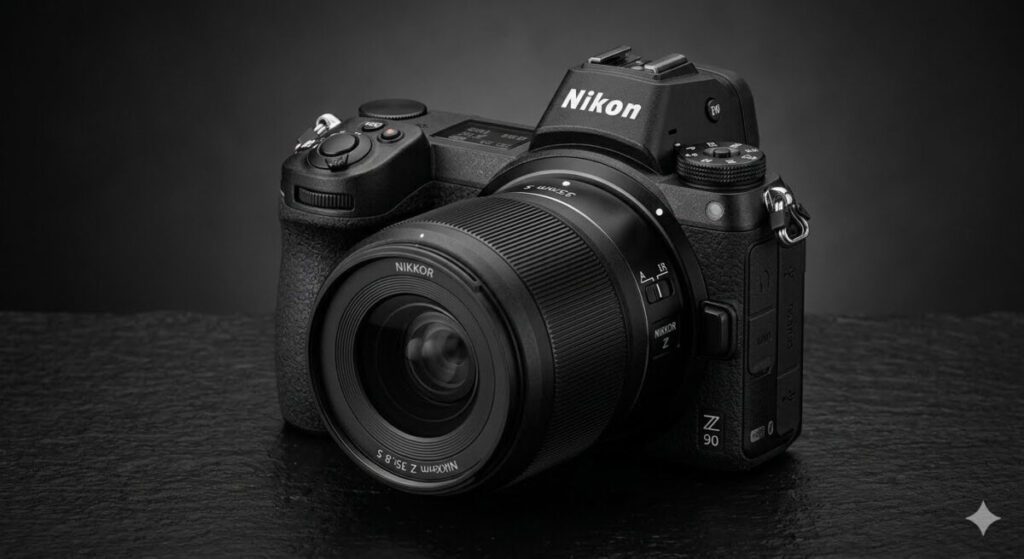
Magnesium Alloy Construction
Rumored sources consistently describe professional-grade build quality for the Z90. The body reportedly uses magnesium alloy construction throughout. This material offers a high strength-to-weight ratio. It resists impacts better than polycarbonate plastic while remaining lighter than steel.
The current DX Nikon bodies, including the Z50 II, use partially plastic construction. This keeps costs lower and weight down for entry-level users. However, professional photographers working in demanding environments need more robust protection for their investment.
Weather Sealing
Comprehensive weather sealing is a key differentiator between enthusiast and professional camera bodies. The Z90 reportedly receives thorough dust and moisture resistance throughout the body. This includes seals around all buttons, dials, card slots, and door openings.
Weather sealing matters in real-world shooting conditions. A wildlife photographer crouching in wet grass to capture ground-level bird images needs confidence that water will not damage the camera electronics. A sports photographer working in rain during an outdoor event needs the same reassurance.
Nikon’s Z9 and Z8 set the standard for weather sealing in the Z system. The Z90 would bring that level of protection to the APS-C segment for the first time in Nikon’s mirrorless lineup.
Ergonomics and Grip Design
The D500 featured a deep, comfortable grip designed for long shooting sessions with heavy telephoto lenses. The Z50 II’s grip is shallower and better suited for smaller lenses.
A Z90 targeting professional photographers would logically adopt the deeper grip design. Handling a 500mm f/5.6 PF lens for several hours requires a grip that securely supports the camera without strain. Rumor sources suggest the Z90 body will be notably larger and heavier than the Z50 II but still smaller and lighter than the Z8.
Dual Card Slots
The Z50 II uses a single SD card slot. This is one of the clearest ways it fails to meet D500-level professional requirements. Professional photographers depend on dual card slots for several reasons.
First, dual slots enable redundant backup recording. The camera writes each image to both cards simultaneously. If one card fails, every image is safe on the second card. This matters enormously for wedding photographers, journalists, and event shooters where reshooting is impossible.
Second, dual slots enable overflow recording. When the primary card fills, the camera switches automatically to the secondary card. This prevents missed shots during extended shooting sessions.
The Z90 reportedly offers dual slots accommodating CFexpress Type B and SD cards. This combination gives users the option to use fast CFexpress for burst shooting while SD handles overflow or video clips.
Vertical Battery Grip Compatibility
The D500’s MB-D17 vertical grip added significant value for portrait and telephoto shooters. A vertical grip rotates the primary controls to the side of the body, making vertical composition more comfortable during extended sessions.
Rumor sources suggest the Z90 will support an optional vertical battery grip. This feature alone signals Nikon’s intention to position the Z90 as a professional body rather than an enthusiast camera.
7. In-Body Image Stabilization {#ibis}
7-Stop IBIS
In-body image stabilization has become a standard feature on professional mirrorless cameras. The Z90 reportedly offers around 7 stops of shake compensation through its IBIS system.
Seven stops of stabilization means a photographer can handhold a shot at shutter speeds approximately 128 times slower than the reciprocal rule would normally allow. A 300mm lens on an APS-C body requires roughly 1/450s without stabilization to avoid motion blur from camera shake. With 7-stop IBIS, that same lens could theoretically produce sharp images at 1/3s or slower.
Synced IS with Z-Mount Lenses
Nikon’s Z-mount lenses with VR (Vibration Reduction) can work in concert with IBIS when attached to compatible bodies. This synced IS system divides the stabilization task between the lens and body, achieving better overall compensation than either system alone.
Long telephoto lenses benefit most from synced IS. The Z 100-400mm f/4.5-5.6 VR and Z 800mm f/6.3 VR both use lens-based VR. On a Z90 with IBIS, the two systems would communicate and coordinate to maximize stabilization effectiveness.
8. Viewfinder and Display {#evf}
5.76 Million Dot OLED EVF
Rumored specifications describe an upgraded electronic viewfinder with approximately 5.76 million dots using an OLED panel. The Z50 II uses a 2.36-million-dot EVF, which is quite basic by current standards.
A 5.76-million-dot EVF provides significantly more detail and clarity when composing shots. Fine details like individual feathers on a bird or the texture of an athlete’s uniform appear sharper in a high-resolution viewfinder. This helps photographers confirm focus accuracy before committing to a burst.
OLED technology offers deeper blacks, higher contrast ratios, and faster response times compared to LCD viewfinders. The result is a more immersive and accurate representation of the scene.
Fully Articulating Touchscreen
A rear LCD that fully articulates allows photographers to shoot from extremely high or low angles without lying on the ground or holding the camera overhead blindly. Wildlife photographers photographing ground-level subjects particularly benefit from this flexibility.
The Z50 II already offers a fully articulating screen. The Z90 reportedly continues this design choice while upgrading the panel resolution and touch response speed.
9. Battery Life and Card Slots {#battery}
EN-EL15 Battery Family
Nikon’s Z-system bodies use various battery types. The Z9 and Z8 use the EN-EL18d, a high-capacity battery designed for professional workloads. The Z6 III, Z7 II, and Z8 use the EN-EL15c.
The Z90 would likely use the EN-EL15c or a new version of it, given the body size constraints of an APS-C camera. Rumored battery life estimates exceed 500 shots per charge, which is reasonable for a mirrorless camera with an OLED EVF and active stabilization.
For professional use cases, 500 shots may prove limiting during a full day of wildlife shooting. A vertical grip that accepts a second battery would extend effective battery life to 1,000 shots or more.
USB Charging Support
All recent Z-system cameras support USB-C charging and power delivery. The Z90 would certainly continue this feature. USB charging allows photographers to top up the battery using a power bank while working in the field. This flexibility can extend a shooting day significantly without carrying multiple spare batteries.
10. Pricing and Release Date Rumors {#pricing}
Expected Price Range
Multiple rumor sources cite a price range of $2,000 to $2,500 USD for the Nikon Z90. This positions the camera above the Z50 II but well below the Z8.
That price point makes strategic sense. Canon’s EOS R7 sells for approximately $1,499. The Sony a6700 retails around $1,299. A Nikon Z90 at $2,000 to $2,500 would carry a significant premium over those competitors.
To justify that premium, Nikon needs to deliver genuinely superior autofocus performance, better video capability, more professional build quality, or some combination of all three. Based on the rumored specifications, the Z90 appears positioned to do exactly that.
Release Date Speculation
The most credible recent rumor from Camera Beta via Weibo describes a prototype with a 32 to 33MP sensor that is ready for production. The same source cites mid-2026 as the earliest possible release date.
Other industry analysts push the timeline further. Some suggest Nikon’s current focus on cinema cameras and full-frame body refreshes could delay the Z90 until late 2026 or even 2027. Respected analyst Thom Hogan has stated he does not expect Nikon to launch a high-end DX body until the company commits to its next APS-C sensor, which he believes has not yet happened.
This conflict between optimistic leakers and skeptical analysts is worth noting. Nikon has not commented on any Z90 rumors. Until an official announcement arrives, the mid-2026 timeline should be treated as hopeful speculation rather than confirmed fact.
11. How the Z90 Compares to Rivals {#comparison}
Nikon Z90 vs. Canon EOS R7
The Canon EOS R7 currently dominates the professional APS-C mirrorless segment. It offers 32.5MP resolution, 15fps mechanical and 30fps electronic burst speeds, and solid weather sealing. Canon’s Dual Pixel CMOS AF works reliably across most subject types.
A Z90 matching the rumored specs would likely exceed the R7 in autofocus sophistication, particularly for complex wildlife scenarios. Nikon’s deep learning subject detection system has proven more capable than Canon’s Dual Pixel AF in challenging conditions. The Z90 would also likely offer superior low-light AF performance if it inherits EXPEED 7-generation capabilities.
The R7 wins on current availability, a proven track record, and a more mature RF-S lens ecosystem. The Z90 would compete on raw technology and Nikon’s broader Z-mount lens selection for telephoto work.
Nikon Z90 vs. Sony a6700
The Sony a6700 offers class-leading autofocus pulled from the Alpha 7 series. Its 26MP BSI sensor handles high ISO noise well. The camera records 4K/60p with 10-bit color internally.
A Z90 at 33MP would offer a meaningful resolution advantage. Nikon’s autofocus has caught up with Sony in recent generations. The Z90’s rumored build quality would surpass the a6700’s partially plastic construction.
Sony benefits from an extensive APS-C E-mount lens ecosystem built over more than a decade. Nikon’s Z DX lens lineup remains limited. This gap represents the Z90’s biggest competitive challenge.
Nikon Z90 vs. Fujifilm X-H2S
The Fujifilm X-H2S uses a stacked sensor that enables 40fps burst shooting. Its autofocus system handles birds in flight well. Fujifilm’s film simulation modes deliver distinctive out-of-camera JPEG results that many photographers prefer to RAW processing.
A Z90 would likely deliver better low-light autofocus and potentially superior video specs. However, the X-H2S already establishes an extremely high bar for APS-C performance. Fujifilm’s XF lens ecosystem is also very mature for telephoto work, with the 150-600mm f/5.6-8 being a particularly popular wildlife lens.
12. Who Should Buy the Nikon Z90 {#audience}
Wildlife Photographers
Wildlife photographers represent the most natural audience for the Nikon Z90. The combination of APS-C crop factor, deep learning subject detection, 15fps burst shooting, and professional weather sealing creates an ideal toolkit for field work.
The 1.5x crop factor transforms the Z 400mm f/4.5 VR into an effective 600mm equivalent. Paired with the Z 100-400mm f/4.5-5.6 VR, the Z90 would give wildlife shooters a highly versatile and reach-extended system at significantly lower cost than equivalent full-frame setups.
Sports Photographers
Sports photographers shooting school athletics, amateur leagues, or outdoor events often cannot justify the cost of a Z8 or Z9. The Z90 at $2,000 to $2,500 would offer much of the flagship autofocus performance and burst speed at a fraction of the flagship price.
The weather-sealed body handles outdoor conditions reliably. The rumored 15fps or faster burst shooting captures peak action. AI tracking manages complex multi-athlete scenes across varied lighting.
Serious Enthusiasts and Advanced Amateurs
Many photographers do not need a full-frame camera. They shoot in conditions where the smaller sensor size is not a limiting factor. For those photographers, the Z90 would offer outstanding image quality, professional-grade autofocus, and durable construction at a price well below the Z8.
Existing Nikon DSLR Shooters
Nikon DSLR users still holding onto D500 or D7500 bodies represent a very specific and motivated audience for the Z90. These photographers understand the benefits of APS-C for wildlife and sports work. They know and trust Nikon ergonomics. The Z90 represents their most natural upgrade path into mirrorless without abandoning the APS-C format.
13. Final Thoughts {#conclusion}
The Nikon Z90 remains a rumor as of mid-2026. However, the rumors have grown more specific and more consistent over time. A 33MP APS-C sensor, EXPEED 7-generation autofocus, 15fps burst shooting, professional magnesium alloy construction, dual card slots, and 7-stop IBIS would combine into a camera that genuinely fills the gap left by the Nikon D500.
If Nikon delivers on these specifications at a price around $2,000 to $2,500, the Z90 would stand as the strongest APS-C mirrorless body ever made by the company. It would directly challenge the Canon R7, Sony a6700, and Fujifilm X-H2S while offering a level of autofocus sophistication none of those cameras currently matches.
The wait has been long. The expectations are high. The photography community will watch Nikon’s announcement calendar very carefully throughout the rest of 2026.
14. The Z-Mount Lens Ecosystem for APS-C Shooters
DX Native Lenses: The Current State
Nikon currently offers a small but growing set of Z DX lenses. These lenses are designed specifically for APS-C sensors. They tend to be smaller, lighter, and less expensive than their FX counterparts.
The current DX lens lineup includes the Z DX 16-50mm f/3.5-6.3 VR, Z DX 50-250mm f/4.5-6.3 VR, and Z DX 18-140mm f/3.5-6.3 VR. These cover the most common zoom ranges for everyday photography. However, serious wildlife and sports shooters need longer focal lengths.
Fortunately, FX Z-mount lenses work on DX bodies with the crop factor applied. The Z 100-400mm f/4.5-5.6 VR S becomes an effective 150-600mm equivalent on the Z90. The Z 400mm f/4.5 VR S reaches 600mm equivalent. The Z 800mm f/6.3 VR S becomes a staggering 1,200mm equivalent.
The Reach Advantage in Practice
Consider a wildlife photographer targeting birds in flight. On a full-frame Z8 with the Z 500mm f/5.6 PF, the photographer gets 500mm coverage. On a Z90 with the same lens, that coverage extends to 750mm equivalent.
Achieving 750mm on a full-frame body requires the Z 600mm f/4 TC VR S, which weighs 3.83kg and costs over $15,000. The Z 500mm f/5.6 PF weighs just 745 grams and costs around $3,800. The reach advantage of APS-C is not theoretical. It translates into real, practical cost and weight savings for telephoto specialists.
Third-Party Z-Mount Options
The Z-mount lens ecosystem has attracted third-party manufacturers including Sigma, Tamron, and Viltrox. Sigma has released several DN-series lenses in Z mount. Tamron recently announced Z-mount versions of popular telephoto zooms.
By the time the Z90 launches, the lens selection for Z-mount APS-C shooters should be noticeably broader than it is today. A camera body is only as useful as the lenses available for it, and Nikon’s ecosystem is developing in the right direction.
15. Technical Deep Dive: EXPEED 7 and AI Autofocus
How EXPEED 7 Powers the Autofocus System
Nikon’s EXPEED 7 processor debuted in the Z9 and subsequently appeared in the Z8 and Z6 III. This processor handles multiple tasks simultaneously. It processes sensor data to create images. It runs the autofocus detection algorithms. It manages in-body stabilization. It handles video encoding and recording.
On the Z9, EXPEED 7 processes the 45.7MP stacked sensor at full speed while running deep learning subject detection across the entire frame in real time. The processor identifies multiple subjects simultaneously, assigns priority based on user-selected AF area mode, and tracks all detected subjects frame to frame.
The Z90 with an equivalent or similar processor would run these same algorithms on a 33MP sensor. The smaller pixel count compared to the Z9 means the processor handles less raw data per frame. This could translate into faster calculation times, higher burst rates, or more processing headroom for AI detection algorithms.
Subject Detection Categories
Nikon’s current deep learning autofocus detects the following subject types across its EXPEED 7 cameras: people, dogs, cats, birds, airplanes, cars, motorcycles, bicycles, and trains. The Z6 III received improved bird tracking specifically for complex scenes and against high-contrast backgrounds through firmware updates.
The Z90, as a camera targeting wildlife and sports users, would likely launch with all these subject detection categories already refined. Future firmware updates could add new categories or improve tracking reliability for specific scenarios.
How AI Tracking Works Frame to Frame
When you activate tracking autofocus and begin a burst sequence, the camera does not simply lock onto a single point. It builds a multi-frame model of the subject. It notes the subject’s size, shape, movement direction, and speed. Using this model, it predicts where the subject will be in the next frame and pre-positions focus there.
For a bird banking sharply in flight, traditional autofocus would struggle. The sharp directional change creates a sudden movement that phase detection alone cannot always anticipate. Deep learning prediction accounts for the likely continuation of an arc trajectory, maintaining focus through the turn.
This is why Nikon’s Z9 and Z8 have earned praise from serious bird photographers. The system does not just react. It predicts. The Z90 reportedly brings this same predictive capability to the APS-C segment.
16. Video Workflow Considerations
N-Log and Color Science
Nikon’s N-Log gamma curve captures approximately 12 stops of dynamic range. This provides enough latitude to recover overexposed highlights and underexposed shadows during color grading. For event videographers, documentary makers, and content creators who color grade their footage, N-Log is an important tool.
The Z90’s 33MP sensor captures a wide tonal range. Paired with N-Log in 10-bit 4K, the resulting footage would handle the same demanding grading workflows that professional FX-body users currently rely on.
HDMI Output for External Recording
Professional video workflows often involve external recorders connected via HDMI. These recorders, such as the Atomos Shogun series, capture video signals from the camera and record them to their own storage at higher bitrates or in different codecs than the camera’s internal recording allows.
Nikon’s Z-series cameras output clean HDMI signals. The Z90 would likely continue this feature. If Nikon enables ProRes RAW output over HDMI, videographers could record to an Atomos recorder and work with the most flexible RAW video format available.
Overheating Concerns
Compact cameras running 4K/60p or higher framerates generate significant heat. Many cameras limit video recording times to prevent thermal damage to the sensor and processor.
The Z90 as a professional body would need to manage heat dissipation effectively to avoid recording time limits that disrupt professional workflows. Nikon has designed effective thermal management into the Z8, which can record 8K/30p for over two hours continuously. The Z90, recording at lower resolutions, should have more thermal headroom. However, specific recording time limits remain unknown pending official announcement.
17. Connectivity and Workflow Features
Wi-Fi 6 and Bluetooth
Fast wireless image transfer has become an important workflow feature for professional photographers. Sports and event photographers regularly transfer images wirelessly to editors during an event. The faster the wireless speed, the quicker editors can process and publish images.
Wi-Fi 6 offers significantly faster transfer speeds than the Wi-Fi 5 found in older camera bodies. If the Z90 includes Wi-Fi 6, it would support faster file transfers to connected devices, more reliable connections in environments with many wireless signals competing, and lower power consumption during wireless operation.
Bluetooth connectivity enables low-power remote triggering and constant connection to smartphones for GPS geotagging. Nikon’s SnapBridge app uses Bluetooth to maintain a persistent connection that automatically tags images with location data from the phone’s GPS.
USB-C and Tethered Shooting
Professional studio photographers and event shooters often shoot tethered, sending images directly to a laptop or tablet for immediate review by art directors or clients. USB-C connectivity on recent Nikon Z bodies supports tethered shooting through applications like Lightroom Classic and Capture One.
The Z90 would continue this capability, with USB-C providing both tethering and charging from the same port.
Mobile App Integration
Nikon’s NX MobileAir app enables camera control and image transfer from iOS and Android devices. For photographers working in remote locations, mobile app integration allows reviewing images on a larger screen, adjusting camera settings without touching the body, and sharing selected images directly from the field.
18. Nikon’s Strategic Position
Why Nikon Needs the Z90
Nikon’s mirrorless business has grown significantly since the Z9 launch in 2021. The Z9 demonstrated that Nikon could compete at the absolute top of the professional market. The Z8 brought that performance to a wider audience. The Z6 III and Zf expanded the lineup further.
However, Nikon’s DX lineup has stagnated. The Z50 II is a good camera, but it does not serve professional users. The Z30 targets beginners and content creators. There is no professional DX option.
This gap has cost Nikon sales. Wildlife and sports photographers who previously used D500 bodies have moved to Canon R7, Sony a6700, or Fujifilm X-H2S cameras because Nikon offered nothing comparable. Recapturing those users requires a body that genuinely competes.
Nikon’s APS-C Lens Commitment
Recent lens releases suggest Nikon is recommitting to the DX format. The company has added new DX zoom lenses to the lineup over the past two years. The development of a professional Z90 body would make those lens investments more meaningful. A professional body gives serious photographers a reason to invest in the DX lens ecosystem more deeply.
Nikon has also indicated awareness of the growing APS-C market. In financial briefings, the company acknowledged that APS-C cameras are gaining popularity relative to full-frame options across the industry. This market trend supports the business case for a Z90 investment.
19. Common Questions About the Nikon Z90
Will the Z90 Replace the Z50 II?
No. The Z90 would sit above the Z50 II in Nikon’s DX lineup. The Z50 II targets enthusiast users at a lower price point with a more compact body. The Z90 targets professional and advanced enthusiast users who need more rugged construction, faster performance, and dual card slots. Both cameras would remain in the lineup simultaneously.
Does the Z90 Compete with Full-Frame Cameras?
Not directly, but it overlaps with the lower end of the FX lineup for certain use cases. A wildlife photographer who primarily needs reach and speed would find the Z90 compelling compared to a Z6 III at a similar price. The Z6 III offers a full-frame sensor with better low-light performance and higher video resolution. The Z90 offers the crop factor advantage and potentially more professional APS-C specifications at a competitive price.
Can You Use D500 Lenses on the Z90?
Not directly. The Z90 uses Nikon’s Z mount, which differs from the F mount used by DSLR lenses including those designed for the D500. However, the FTZ II adapter allows F-mount lenses to work on Z-mount bodies. Wildlife photographers with large F-mount telephoto investments can use the FTZ II adapter to mount their existing glass on the Z90 without losing autofocus functionality.
When Will Nikon Officially Announce the Z90?
Nobody outside Nikon knows for certain. The most credible timeline suggests mid-2026 as the earliest possible announcement. Some analysts push that estimate to late 2026 or 2027. Watch Nikon’s official channels and established rumor sites for updates.
20. Summary: Everything We Know About the Nikon Z90
Here is a clean summary of all rumored specifications:
| Feature | Rumored Specification |
|---|---|
| Sensor | 33MP APS-C (DX) hybrid CMOS AF |
| Processor | EXPEED 7 or equivalent |
| Autofocus | AI deep learning subject detection |
| Burst Speed | 15fps mechanical, higher with electronic |
| Video | 4K/60p oversampled, 10-bit, N-Log |
| IBIS | ~7 stops |
| EVF | ~5.76 million dot OLED |
| Screen | Fully articulating touchscreen |
| Card Slots | Dual: CFexpress Type B + SD |
| Build | Magnesium alloy, professional weather sealing |
| Battery | EN-EL15c or similar, 500+ shots |
| Price | $2,000 to $2,500 USD |
| Release | Mid to late 2026 (unconfirmed) |
The Nikon Z90 represents the camera many Nikon users have waited years to see. Whether it arrives on schedule and delivers on the rumored specifications remains to be seen. But based on what we know today, the Z90 could become one of the most important camera launches in the APS-C market in years.
Stay tuned to official Nikon channels for any announcement. When the Z90 officially arrives, we will publish a full hands-on preview and deep technical analysis.
Read More from Altbuzz
For more Canon professional camera coverage from our June 2026 series, explore our full Canon EOS R3 Mark II vs R3 comparison blog, our Canon EOS RP Successor rumors analysis, and our top 5 incoming Sony cameras for 2026 and 2027 for competitive professional tier context.
Stay updated on every Canon EOS R3/Nikon Z90 development and used pricing movement at altbuzzmedia.com. For Canon-specific professional camera analysis, follow Canon Rumors at canonrumors.com and Amateur Photographer at amateurphotographer.com.
Subscribe to Altbuzz YouTube Channel
Full Canon EOS R3 hands-on video reviews, real-world sports and wildlife shooting tests, and ongoing comparisons with the R3 Mark II are live on the Altbuzz YouTube channel @AltBuzzMedia. Subscribe now for weekly Canon coverage and professional camera analysis through the rest of 2026.
External Resources
- Nikon Official Website – Official product announcements
- Nikon Rumors – Trusted source for Nikon leak coverage
- Digital Camera World: Nikon Z90 Coverage – Expert analysis and commentary
- DPReview APS-C Camera Comparisons – Specification comparisons across brands
Last updated: June 2026 | Category: Nikon Rumors | Tags: Nikon Z90, APS-C Mirrorless, Nikon D500 Successor, Camera Rumors 2026