
Nikon Z4: The Rumored Ultra-Compact Full-Frame Camera Built for Street Shooters
The Nikon Z4 has become one of the most talked about cameras in the photography world, even though it does not officially exist yet. Rumor sites and camera forums describe it as a small full-frame fixed-lens model with no built-in viewfinder, designed purely for photography rather than video. For street shooters who have watched Fujifilm, Ricoh, and Leica dominate the compact camera conversation, this rumored release feels like Nikon finally stepping into a fight it has avoided for years.
This article breaks down everything currently known about the Nikon Z4. We will cover the rumored design, sensor expectations, control layout, and how it might compare against established rivals. We will also look at the market forces pushing Nikon toward this decision and what street photographers should realistically expect if the camera arrives.
What Is the Nikon Z4 and Why Is It Generating Buzz
The Nikon Z4 name has not been confirmed by Nikon itself. Instead, it comes from a pattern of leaks first reported by Nikon Rumors, a site with a long track record of accurate Nikon leaks. According to these reports, Nikon is developing a compact full-frame camera with a fixed lens, built on design language borrowed from the Nikon ZR mirrorless cinema camera, a model we broke down in our Nikon ZR hands-on coverage shortly after launch.
What makes this rumor interesting is the target audience. Unlike the ZR, which leans toward video creators, this new model is reportedly aimed squarely at stills photographers. That distinction matters a lot for street shooters who want a camera that prioritizes quick handling over hybrid video features.
A New Direction for Nikon Compact Cameras
Nikon has not released a true premium compact camera in years. Its last serious attempt was the Coolpix A, a small APS-C fixed-lens camera launched back in 2013. That camera never found mainstream success, partly due to its high price and limited marketing push. The rumored Nikon Z4 appears to learn from that history by aiming for a full-frame sensor instead of APS-C, which would immediately place it in more premium territory.
The Compact Camera Boom Driving This Rumor
Compact camera sales have surged in recent years, and Nikon cannot ignore that trend any longer. CIPA shipment data referenced by Nikon Rumors shows compact fixed-lens cameras grew by 49 percent in shipped value during 2025 alone. Early 2026 numbers look even stronger, with shipments up over 100 percent year over year for the January through March period. This kind of growth explains why Nikon, Canon, and Panasonic are all reportedly working on new compact models at the same time, a trend also tracked closely by Digital Camera World in its ongoing rumor roundups.
Nikon Z4 Rumored Design and Build Quality
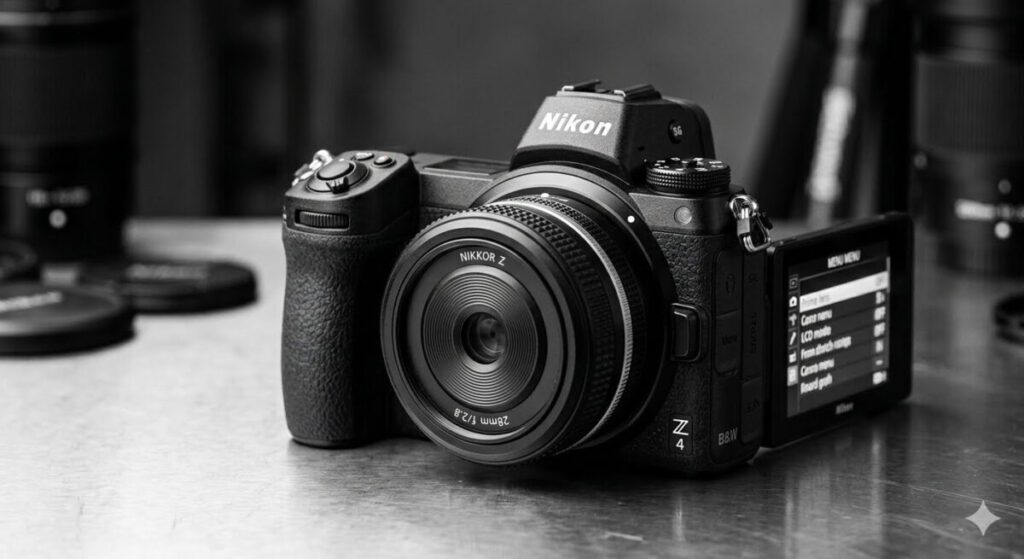
Early leaks describe a body that measures somewhere between 22 and 25 millimeters thick, excluding the lens. That places it in the same conversation as the Ricoh GR series, which has built its entire identity around extreme portability. A slim profile like this would let street photographers slip the camera into a jacket pocket without feeling weighed down.
Reports also mention three color options at launch: black, champagne, and a two-tone panda finish. This kind of color variety suggests Nikon wants the camera to appeal beyond traditional enthusiasts, possibly targeting a younger, style-conscious buyer similar to the audience that made the Fujifilm X100VI a cultural moment. Our own Fujifilm X100VI review covers exactly why that camera resonated so strongly with younger buyers.
No Viewfinder, Optional EVF Accessory
One of the most debated details so far is the apparent absence of a built-in viewfinder. Photographers who grew up composing through an optical or electronic finder have reacted strongly to this news. According to TechRadar, comment sections lit up with frustration after the rumor broke, with many readers calling a stills camera without a finder a hard pass.
However, rumors also point to a hotshoe that accepts an optional EVF accessory. This approach mirrors what Fujifilm and Ricoh have done in the past with bolt-on finders, giving photographers a choice rather than forcing one workflow on everyone. For street shooters who prefer shooting from the hip or using the rear screen, this tradeoff might matter less than it does for traditional photojournalists.
Tilt-Only OLED Screen
The rear screen is rumored to be a tilt-only OLED panel rather than a fully articulating display. A tilt screen suits street and travel photography well because it allows low-angle and waist-level shooting without drawing attention. It also tends to be more durable and faster to use than a flip-out screen, since there is no need to swing the panel outward before shooting.
Nikon Z4 Rumored Sensor and Image Quality
Perhaps the biggest headline detail is the full-frame sensor. Most compact fixed-lens cameras on the market today use either one-inch sensors or APS-C sensors. A full-frame sensor inside a body this small would be a genuine technical achievement and would instantly separate the Nikon Z4 from cameras like the Sony RX100 series or the Panasonic Lumix LX100.
Speculation suggests Nikon could reuse the 45-megapixel sensor already found in the Z8 and other higher-end Z-series bodies. A resolution that high would give street photographers enormous cropping flexibility, which matters when you cannot always get physically close to your subject. High resolution also pairs well with prime lenses, since you can simulate multiple focal lengths through cropping without losing too much detail.
No In-Body Image Stabilization
Despite the impressive sensor rumors, leaks suggest the Nikon Z4 will skip in-body image stabilization entirely. This omission helps explain how Nikon might achieve such a thin body, since IBIS mechanisms typically add bulk around the sensor. For street photography, the impact may be minor. Most street shooters use fast shutter speeds anyway to freeze motion, which reduces the practical need for stabilization in daylight conditions.
Low-light handheld shooting will likely suffer more without IBIS, though a wide aperture lens could help offset that limitation. We do not yet know the exact aperture rating Nikon plans to use, but competitors in this space typically offer something between f/1.7 and f/2.8.
No Video Recording
In a surprising twist, current rumors claim the Nikon Z4 will not record video at all. This would make it the rare modern camera built exclusively for stills. While this might disappoint hybrid shooters, it actually aligns well with the street photography crowd, many of whom never touch video features anyway. A photography-only design also allows Nikon to simplify the menu system and focus processing power purely on stills performance.
Nikon Z4 Controls and Handling for Street Photography
Street photography rewards cameras that respond instantly. Every second spent digging through menus is a missed moment. Rumors describe two physical dials on the Nikon Z4, with one serving a dual purpose depending on shooting mode. This kind of tactile control lets photographers adjust settings without lifting their eye from the scene or glancing down at a touchscreen.
Physical Dials and Tactile Operation
Dedicated dials remain a favorite feature among street and documentary photographers. They allow muscle memory to take over after a short learning period. If Nikon follows the Zf and Zfc playbook here, expect dials that control shutter speed, exposure compensation, or aperture directly, similar to a classic film camera layout.
Fast Startup and Minimal Friction
While Nikon has not confirmed exact startup times, the overall design philosophy described in leaks points toward a camera built for spontaneity. A street shooter often has only a second or two to raise the camera and capture a moment before it disappears. A compact body, simple controls, and a fixed lens all support that kind of quick, instinctive shooting style.
Nikon Z4 Lens Speculation: What Focal Length Could It Use
Nikon has not revealed any specific lens details yet, but history offers some useful clues. The discontinued Coolpix A used a 28mm f/2.8 lens, a focal length long favored by street and documentary photographers because it captures enough context without distorting faces up close. If Nikon repeats that formula, the Z4 would sit comfortably alongside the Ricoh GR IV, which also uses a 28mm equivalent lens.
Alternatively, Nikon could chase the Fujifilm X100VI formula instead, which uses a 23mm lens that translates to roughly 35mm in full-frame terms. A 35mm lens tends to feel more natural for everyday shooting, since it mimics how the human eye perceives a scene. Either choice would make sense for street photography, though the final aperture rating will matter just as much as the focal length itself.
Why a Fixed Lens Still Makes Sense in 2026
Some photographers question why anyone would choose a fixed lens camera when smartphones already offer multiple focal lengths in one device. The answer lies in sensor size and optical quality. A dedicated lens paired with a full-frame sensor produces shallower depth of field, cleaner low-light performance, and richer color rendering than any phone camera can currently match. A fixed lens also forces photographers to move their feet and compose more deliberately, a discipline that many street photographers actively seek out rather than avoid.
How a Fixed Lens Changes Shooting Habits
Switching to a fixed lens camera after years of zoom lenses takes some adjustment. You cannot zoom in on a distant subject, so you learn to anticipate moments and position yourself ahead of time. Many photographers find this constraint actually improves their work, since it removes the temptation to shoot from a lazy distance. Over time, a single focal length becomes second nature, almost like an extension of how you naturally see the world.
Building a Street Photography Workflow Around the Nikon Z4
Even though the Nikon Z4 remains unreleased, it is worth considering how a camera like this would fit into a real shooting workflow. Street photography rewards cameras that disappear into the background, both physically and operationally.
Carrying and Handling in Public Spaces
A camera under 25 millimeters thick can ride comfortably in a coat pocket or a small sling bag. This matters more than people realize, since a smaller camera draws less attention from strangers on the street. Many experienced street photographers prefer compact bodies precisely because they look less intimidating than a large mirrorless camera with an attached zoom lens. The rumored Nikon Z4 body size would fit neatly into this category, allowing photographers to blend into a crowd rather than stand out from it.
Battery Life and All Day Shooting
Nikon has not shared battery specifications, though a camera this small will likely use a compact battery cell. Street photographers who shoot for hours at a time should plan to carry a spare battery, especially once Nikon confirms official numbers. Smaller cameras often trade battery capacity for portability, a tradeoff most enthusiasts accept gladly in exchange for a lighter bag.
Editing and File Output Expectations
If the rumored 45-megapixel sensor turns out to be accurate, photographers should expect large file sizes, particularly when shooting in raw format. A high-resolution sensor gives excellent cropping flexibility, but it also demands faster memory cards and more storage space than lower-resolution alternatives. Anyone planning to adopt this camera for serious street photography work should budget for additional storage and a computer capable of handling large raw files smoothly.
Nikon Z4 vs Competitors: Fujifilm X100VI, Ricoh GR IV, Sony RX1R III, and Leica Q3
The compact fixed-lens segment is more competitive now than it has been in over a decade. Any new entry from Nikon will face direct comparison against four major rivals.
Where the Nikon Z4 Could Stand Out
The Fujifilm X100VI uses an APS-C sensor, not full-frame, so the Nikon Z4 would offer a meaningful resolution and depth-of-field advantage if the full-frame rumors hold true. The Ricoh GR IV also sticks with APS-C and skips a viewfinder entirely, making the Nikon Z4 directly comparable in that regard while potentially offering superior image quality. Check our Ricoh GR IV field test for a closer look at how that camera handles in real street shooting conditions.
Against the Sony RX1R III and Leica Q3, the comparison shifts toward price. The Leica Q3 currently retails around 8,000 dollars, putting it far out of reach for most enthusiasts. If Nikon can deliver a full-frame compact at a more accessible price point, it could capture buyers who admire the Leica look but cannot justify the cost. Our premium compact camera buying guide breaks down where each rival fits on price and value.
Where It Might Fall Short
The lack of IBIS, video, and a built-in viewfinder gives competitors clear talking points. Sony and Leica both include image stabilization in their compact models, and Fujifilm continues to push video capability further with each X100 generation. Nikon will need pricing and image quality to do the heavy lifting if these gaps remain in the final product.
Why Nikon Is Entering the Compact Camera Market Now
Nikon rarely moves first into a new category, and this rumored camera is no exception. The timing lines up closely with broader shifts happening across the entire camera industry.
Market Data Behind the Decision
According to CIPA shipment figures cited by Nikon Rumors, compact fixed-lens cameras shipped 2.44 million units in 2025, a 49 percent increase from the previous year. Early 2026 data shows that momentum accelerating even further. Regional growth has been especially strong in China, where unit sales jumped over 50 percent year over year. Numbers like these are difficult for any major manufacturer to ignore, and Nikon appears ready to claim a share of this growing market.
The Legacy of the Canceled Nikon DL Series
Nikon attempted a compact camera lineup once before with the DL series, announced in 2016 with one-inch sensors and optional viewfinders. The DL line was canceled before it ever reached retail shelves, reportedly due to development problems and a shrinking compact camera market at the time. A decade later, the market has reversed course, and Nikon seems determined not to repeat that same mistake. The rumored Z4 can be viewed as a long-delayed second attempt, this time backed by a full-frame sensor and a market that actually wants compact cameras again.
Nikon Z4 Release Date and Price Expectations
Nikon has not confirmed an official release date, and pricing remains pure speculation at this stage. Industry watchers expect an announcement sometime later in 2026, based on Nikon’s broader roadmap, which reportedly includes two confirmed camera releases this year alongside this rumored compact model.
Pricing will likely sit somewhere between premium APS-C compacts and the ultra-expensive Leica Q3. A figure in the 2,500 to 3,500 dollar range seems plausible given the full-frame sensor and Nikon’s typical pricing strategy for niche cameras. Until Nikon makes an official statement, treat every price figure circulating online as an educated guess rather than confirmed information.
Should Street Photographers Wait for the Nikon Z4
Anyone currently shopping for a compact camera faces a tough decision. The Fujifilm X100VI and Ricoh GR IV remain excellent choices today, but both have struggled with chronic stock shortages due to overwhelming demand. If you need a camera immediately, waiting for an unconfirmed Nikon release carries real risk.
That said, if your current camera still gets the job done and you are simply curious about upgrading later this year, watching how the Nikon Z4 story develops makes sense. The rumored full-frame sensor alone could justify the wait for photographers who prioritize image quality above all else. Street photographers who value a built-in viewfinder, however, may want to manage expectations carefully, since that feature appears unlikely to make the final cut.
It also helps to think about your personal shooting style before deciding. Photographers who already favor an optical viewfinder might feel limited by a screen-only design, even with an optional EVF accessory available. Meanwhile, photographers who already shoot mostly from the rear screen or use zone focusing techniques will likely adapt to this camera without much friction. Patience also gives Nikon time to refine the final specification sheet, since early rumors often shift before a product actually ships. Reliable leak sources frequently note that details like sensor resolution or lens speed can change right up until the official unveiling, so treat every number in this article as a moving target rather than a locked specification.
Nikon’s recent track record with the Zf and Zfc also offers some reassurance. Both cameras launched with strong build quality and a clear sense of purpose, suggesting Nikon understands what enthusiast photographers actually want from a niche product. If the Nikon Z4 receives that same level of attention, it could become one of the most compelling compact cameras released in years, even with the tradeoffs currently being rumored.
Frequently Asked Questions About the Nikon Z4
Is the Nikon Z4 officially confirmed?
No. Nikon has not announced this camera. Every detail in this article comes from rumor sites and industry leaks, not an official Nikon statement.
Will the Nikon Z4 have interchangeable lenses?
Current rumors point to a fixed lens design, similar to the Fujifilm X100VI and Ricoh GR IV. Photographers looking for interchangeable lens flexibility should consider the existing Nikon Z mirrorless lineup instead.
Does the Nikon Z4 record video?
Reports suggest this camera will skip video recording entirely and focus purely on stills photography. This would set it apart from most modern cameras, including Nikon’s own ZR model.
What sensor size will the Nikon Z4 use?
Leaks point toward a full-frame sensor, possibly the same 45-megapixel unit found in the Nikon Z8. A full-frame sensor in such a compact body would be a significant technical accomplishment for Nikon.
When will Nikon announce this camera?
No official date exists yet. Based on Nikon’s broader 2026 roadmap, an announcement could arrive sometime later this year, though delays remain possible given how early these rumors still are.
Final Thoughts on the Nikon Z4 Rumors
The Nikon Z4 represents Nikon’s most serious attempt yet at competing in the compact camera space. A slim full-frame body, dedicated dials, and a design built specifically for stills photography all point toward a camera that understands what street shooters actually want. At the same time, the missing viewfinder, lack of stabilization, and absence of video recording show that Nikon is making clear tradeoffs to hit that small form factor.
Nothing here is official yet, and rumors can shift quickly as more leaks emerge. We will keep tracking every update on this story as it develops.
Read More from Altbuzz
For more Nikon mirrorless coverage from our 2026 series, explore our Nikon Zf vs Zfc retro camera comparison, our Nikon ZR mirrorless cinema camera deep dive, and our Fujifilm X100VI vs Ricoh GR IV compact camera showdown for added context on this fast-growing segment.
Stay updated on every Nikon Z4 leak and pricing rumor at altbuzzmedia.com. For independent Nikon rumor tracking, follow Nikon Rumors at nikonrumors.com.
Subscribe to Altbuzz YouTube Channel
Full breakdowns of every Nikon Z4 leak, side-by-side comparisons with the Fujifilm X100VI and Ricoh GR IV, and ongoing compact camera coverage are live on the Altbuzz YouTube channel @AltBuzzMedia. Subscribe now for weekly camera rumor breakdowns and hands-on reviews through the rest of 2026.