
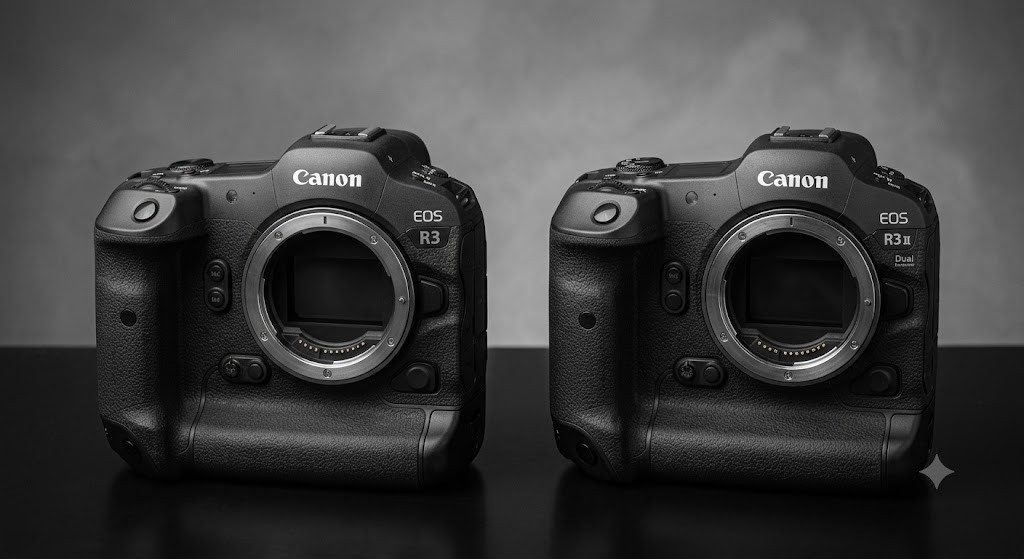
The Canon EOS R3 Mark II vs R3 debate is the hottest topic in professional Canon photography right now. The original EOS R3 launched in November 2021 as Canon’s fastest, most capable mirrorless camera before the R1 existed. Five years later, it shows its age against newer competition. The Canon EOS R3 was allegedly spotted being put through its paces at the Winter Olympics in Milan, Italy in 2026, confirming that its successor is actively in development. Fuji Rumors
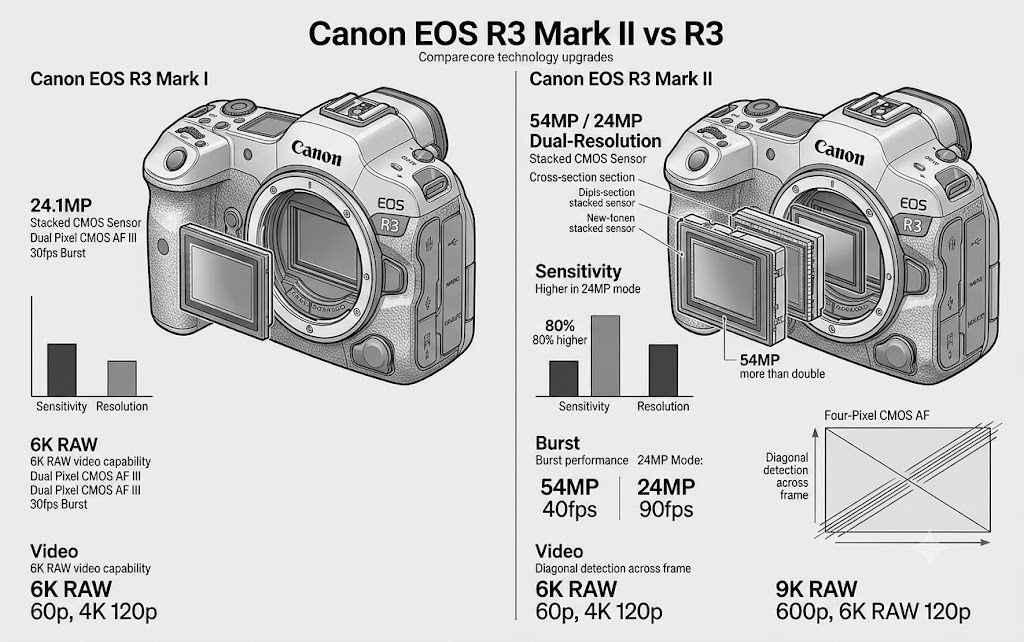
The rumored specifications for the R3 Mark II are extraordinary. In a first for the camera industry, the Canon EOS R3 Mark II is rumored to have a dual native resolution back-illuminated stackable CMOS sensor with both super-high-res 54MP and standard-res 24MP imagery available. Moreover, in 54MP mode the EOS R3 Mark II is said to shoot at 40fps, while the 24MP mode pushes that to a staggering 90fps. Fuji RumorsFuji Rumors
This blog places the Canon EOS R3 Mark II vs R3 directly side by side. We cover every specification category, identify every meaningful upgrade, highlight where the Mark II genuinely disappoints compared to expectations, and give professional photographers a clear framework for deciding what to do in June 2026.
Canon EOS R3 Mark II vs R3: Full Specs Comparison Table
| Specification | Canon EOS R3 (2021, Confirmed) | Canon EOS R3 Mark II (Rumored 2026) |
|---|---|---|
| Sensor resolution | 24.1MP | 54MP and 24MP dual native resolution |
| Sensor architecture | BSI stacked CMOS | BSI stackable CMOS, dual native resolution |
| Burst rate (electronic) | 30fps | 40fps at 54MP / 90fps at 24MP |
| Burst rate (mechanical) | 12fps | Approx. 12fps |
| Autofocus system | Dual Pixel CMOS AF III | Four-pixel CMOS AF, dual cross-type all pixels |
| Eye Control AF | Yes | Yes, improved calibration expected |
| Subject detection | Human, animal, vehicle, aircraft | Expanded, improved low-light tracking |
| Video | 6K RAW 60p, 4K 120p | 9K RAW 60p, 6K RAW 120p |
| Processor | DIGIC X | DIGIC X2 or X3 (expected) |
| IBIS | 5-axis, 8 stops | 5-axis, same or improved |
| Weather sealing | Professional grade, extensive | Same or better |
| Body design | Integrated vertical grip | Updated integrated vertical grip |
| Launch price | $5,999 | $6,500 to $7,000 estimated |
| Status | Available since 2021 | In development, announcement expected 2026 |
Sensor: The Canon EOS R3 Mark II vs R3 Resolution Gap Is Massive
From 24MP to a 54MP Dual-Resolution Design
The original EOS R3 uses a 24.1MP back-illuminated stacked CMOS sensor. Canon made a deliberate choice in 2021 to prioritize fast readout and low rolling shutter over pixel count. Consequently, the 24MP sensor produced fast data throughput that supported 30fps with full AF and AE tracking active.
The R3 Mark II changes this philosophy completely. The camera is rumored to have a dual native resolution back-illuminated stackable CMOS sensor with both super-high-res 54MP and standard-res 24MP imagery available. This architecture allows photographers to switch between two entirely different shooting modes in the same body, depending on whether they need maximum resolution or maximum speed. Fuji Rumors
Consequently, jumping from 24MP to 54MP is not a subtle change. At 54MP, the R3 Mark II produces files with more than double the pixel count of the original R3. Wildlife photographers who regularly crop heavily to isolate distant subjects gain an enormous resolution buffer. Additionally, commercial photographers who need large-format delivery files gain access to 54MP output from a professional speed body for the first time in Canon’s lineup.
The 24MP Speed Mode: Better Than the Original in Low Light
The original R3’s 24.1MP sensor was specifically tuned for speed. However, it showed limitations in shadow recovery at higher ISOs compared to the larger-pixeled R5’s sensor at base settings.
The lower resolution 24MP mode in the R3 Mark II reportedly uses an enhanced Bayer array that merges adjacent pixels, boosting sensitivity by approximately 80% compared to the original EOS R3. Translated into practical terms, this means the enhanced 24MP mode delivers roughly one full additional stop of light sensitivity. A scene that required ISO 3200 on the original R3 would need only ISO 1600 on the R3 Mark II’s enhanced 24MP mode to produce equivalent output noise. Fuji Rumors
For wildlife photographers shooting at dusk and sports photographers under stadium lighting, this improvement has immediate and direct impact on image quality from every challenging session.
Autofocus: Canon EOS R3 Mark II vs R3 AF Technology
The Original R3’s AF System in 2026 Context
The Canon EOS R3 uses Dual Pixel CMOS AF III. This system placed phase detection pixels across the full sensor area, delivering reliable continuous tracking across humans, animals, birds, vehicles, trains, and aircraft. At launch in 2021, its subject detection capability led the entire Canon lineup.
However, five years of development have introduced meaningfully better systems above the R3. The R3’s Eye Control AF takes a bit of getting used to and does not feel as slick as it does on the newer EOS R1 and R5 Mark II. Furthermore, the R3’s continuous tracking in very low light conditions, specifically below EV 2, shows more hesitation than the R1’s updated system demonstrates. Fuji Rumors
Four-Pixel CMOS AF: A Genuine Generational Leap
The rumored autofocus system uses a four-pixel CMOS AF design, with four photodiodes per pixel. This enables dual cross-type phase detection across all 54 million pixels, detecting motion horizontally, vertically, and diagonally. Fuji Rumors
Standard phase detection embeds dedicated AF pixels among imaging pixels, detecting light along one axis only. Cross-type AF pixels detect both horizontal and vertical axes. Four-pixel CMOS AF goes further by using four photodiodes per pixel location, enabling simultaneous detection in horizontal, vertical, and both diagonal directions.
The practical consequence is more robust subject tracking in exactly the scenarios that challenge the original R3. A bird banking through irregular foliage, a basketball player spinning toward the hoop, and a racing car turning a sharp corner all generate AF tracking conditions where diagonal phase detection performs meaningfully better than standard dual-axis systems.
Eye Control AF Improvements Expected
The original R3’s Eye Control AF required individual calibration sessions and could drift between shooting sessions. Many photographers found it useful but occasionally unreliable enough that they reverted to standard joystick AF point selection.
The R3 Mark II carries Eye Control AF forward with expected improvements in calibration accuracy and low-light eye-tracking sensitivity. Together with the four-pixel CMOS AF foundation beneath it, these improvements would create a shooting experience with no equivalent in any competing camera from Sony or Nikon.
Burst Performance: Canon EOS R3 Mark II vs R3 Speed Analysis
The R3’s 30fps Electronic Shutter Ceiling
The Canon EOS R3 delivers 30fps continuous shooting with full AF and AE tracking active using the electronic shutter. This speed was exceptional at launch and remains impressive today. Nevertheless, Sony’s A9 III delivers 120fps with global shutter, and the professional photography community has raised its expectations accordingly.
Additionally, the R3’s buffer depth limits sustained 30fps shooting. At full resolution with lossless compressed RAW, the buffer fills after approximately 150 to 200 frames before write speed forces the burst rate to slow. For most practical shooting scenarios this is adequate. For extended bird flight sequences or long aviation runway sequences, it becomes a real constraint.
40fps at 54MP: An Industry-Defining Achievement
In 54MP mode, the EOS R3 Mark II is said to shoot at 40fps. This deserves specific emphasis. No camera currently delivers 54MP at 40fps. Sony’s A1 II delivers 50MP at 30fps. Canon’s own R5 Mark II delivers 45MP at 30fps. Therefore, an R3 Mark II at 54MP and 40fps would lead every competing professional camera on the resolution-times-speed metric by a clear margin. Fuji Rumors
Commercial photographers who shoot moving subjects and need large-format files gain something that has never existed before: the ability to capture 54MP peak action frames at 40 per second. Advertising photographers working with athletes, vehicles, and wildlife gain full creative and technical flexibility from a single body.
90fps at 24MP: A Completely New Speed Category
The 24MP mode pushes burst rate to a staggering 90fps. Three times the burst rate of the original R3 in the same body is not a marginal improvement. At 90fps, the R3 Mark II captures ninety full-resolution images per second. Peak moments that resolve within 100 milliseconds, such as a tennis ball at racket contact or a hummingbird wing at full extension, fall within the burst sequence with near certainty. Fuji Rumors
Currently, photographers rely on precise timing and 20 to 30fps bursts to approach this level of coverage. The R3 Mark II at 90fps makes decisive moment capture statistically reliable rather than skill-dependent.
Video: Canon EOS R3 Mark II vs R3 Cinema Capabilities
The R3’s Original Video Specification
The Canon EOS R3 records uncropped 6K RAW video at 60fps and 4K at 120fps for slow-motion work. At the time of its 2021 launch, 6K RAW from a professional speed body was genuinely impressive. However, the R3’s video heat management limits sustained recording at maximum quality settings, particularly in warm outdoor environments where photographers have reported thermal throttling after extended sessions.
9K RAW at 60fps: Moving Into Cinema Territory
Video specs for the R3 Mark II are equally ambitious. The camera may offer in-camera 9K 60p RAW and 6K 120p RAW recording, with full-pixel autofocus enabled during capture. These specifications move the R3 Mark II beyond a capable hybrid body into genuine professional cinema territory. Fuji Rumors
9K at 60fps requires significant data throughput engineering. Recording at 9K 60p with full-pixel readout from a 54MP sensor demands a new generation processor and a dramatically revised internal recording pipeline. Canon would need either a new compressed RAW format or next-generation CFexpress write speeds to make 9K 60p RAW viable for sustained recording.
Additionally, full-pixel autofocus during 9K RAW capture means the four-pixel CMOS AF system remains active while the sensor outputs 9K video data simultaneously. This doubles the processing demand during recording and requires the next-generation DIGIC X processor to handle both streams without compromise to either autofocus reliability or recording quality.
6K 120fps RAW: The Slow-Motion Standard Redefined
The R3 Mark II may also offer 6K 120p RAW recording. Current professional cameras offer 4K at 120fps as their slow-motion ceiling. Canon’s 6K 120p RAW would provide noticeably more detail in slow-motion sequences, enabling significant reframing during editing without reducing output below standard 4K resolution. Fuji Rumors
Sports documentary producers, natural history filmmakers, and commercial directors who need the highest possible resolution in slow-motion footage would find this specification genuinely transformative. Nothing currently available in any camera category delivers 6K 120p RAW from a hybrid professional body.
Improved Heat Management for Sustained Recording
On the video side, the R3 Mark II is rumored to support 8K recording with improved heat management alongside advanced 4K oversampling for cinematic quality. Improved heat management addresses one of the original R3’s most practical limitations in a direct and specific way. Extended recording sessions without thermal throttling directly enables longer continuous coverage for documentary, event, and live sports video assignments. Fuji Rumors
Pre-Continuous Shooting Mode: Missing From the R3, Essential in the R3 Mark II
What Pre-Capture Changes for Sports and Wildlife
One of the most practically impactful features missing from the original EOS R3 is a pre-capture or pre-continuous shooting mode. Sony calls this Pre-Capture. Canon calls it Pre-Continuous Shooting in the R5 Mark II.
Pre-Continuous Shooting mode is something that is essential for subjects like kingfishers when your trigger finger just cannot be fast enough to capture the peak moment the bird will hit the water. This mode continuously buffers incoming frames to internal memory while the photographer shoots. When the shutter button is fully pressed, the camera saves frames that occurred before the physical press alongside subsequent frames. Fuji Rumors
At 90fps in the R3 Mark II’s 24MP mode, pre-continuous shooting would capture retroactive frames at three times the rate of the original R3’s maximum speed. Wildlife photographers waiting at a nest, sports photographers anticipating a dive save, and event photographers waiting for a spontaneous gesture would all benefit from this combination. The probability of capturing the precise decisive moment approaches certainty rather than remaining a matter of timing skill.
Where the Canon EOS R3 Mark II vs R3 Comparison Favors the Original
The Price Increase Is Real and Significant
The R3 Mark II is expected to retail between $6,500 and $7,000. The original R3 launched at $5,999. Consequently, the Mark II would cost approximately $500 to $1,000 more at launch. For professional photographers who manage tight equipment budgets, this increase is discouraging regardless of how well the specifications justify it. Digital Camera World
Furthermore, at $7,000, the R3 Mark II enters pricing territory directly adjacent to the EOS R1, which currently sells for approximately $6,299. Some photographers will reasonably question why they should buy the R3 Mark II when the R1 is available nearby on the price scale. Canon must communicate the R3 Mark II’s specific differentiation from the R1 clearly and convincingly at launch to prevent this perception from undermining the new camera’s value proposition.
No Global Shutter in the Most Credible Leaks
Canon Rumors notes that the R3 could be an experiment like the Sony A9 with global shutter, but this remains unconfirmed speculation. The most technically detailed rumor reports consistently describe a dual native resolution stacked sensor rather than a global shutter design. Fuji Rumors
Sony’s A9 III delivers global shutter at 24.6MP and 120fps. Sports photographers who shoot under LED stadium lighting depend on global shutter to eliminate the flickering band artifacts that rolling shutter sensors capture at certain shutter speed and lighting frequency combinations. The R3 Mark II, even at 90fps in 24MP mode, would still use a rolling shutter design if the dual-resolution stacked sensor rumors are accurate.
Photographers who specifically hoped the Canon EOS R3 Mark II vs R3 comparison would include global shutter as a headline upgrade should manage their expectations accordingly. The 90fps burst in 24MP mode dramatically reduces rolling shutter severity by shortening the readout window. However, it does not eliminate the physics of rolling shutter the way a true global shutter architecture achieves.
Buffer Depth Concerns at 90fps
Sustaining 90fps for more than two to three seconds presents a significant engineering challenge even with next-generation CFexpress Type B cards and a revised internal buffer. At 90fps in 24MP mode, the camera generates approximately 90 frames x 30MB per frame, equaling 2.7GB per second of continuous data.
Current CFexpress Type B cards sustain approximately 3.5GB per second write speed at peak, which technically accommodates this throughput. However, most CFexpress cards sustain peak speeds only for the first few seconds before thermal management reduces sustained write speeds below maximum. Canon’s buffer management algorithms and card slot thermal regulation will determine whether photographers can reliably sustain 90fps for three seconds or ten seconds before burst rate drops to a slower speed. This uncertainty is the most significant practical limitation in the current Canon EOS R3 Mark II vs R3 analysis.
Canon EOS R3 Mark II vs R3: Who Benefits Most From Upgrading?
Strongest Upgrade Cases in 2026
Sports photographers who have found the R3’s 30fps adequate but who need more resolution for large-format client deliverables are the clearest upgrade candidates. The R3 Mark II’s 54MP mode at 40fps resolves this specific dilemma directly. They gain resolution without sacrificing meaningful speed compared to the camera they currently use.
Wildlife photographers who shoot birds and mammals in challenging light benefit from both the enhanced low-light sensitivity of the 24MP mode and the improved four-pixel CMOS AF tracking accuracy. Together, these two upgrades address the two scenarios where the original R3 most frequently fell short in real field conditions.
Hybrid photographers who regularly deliver both stills and video content from the same assignment gain the most comprehensive upgrade of anyone. Moving from 6K RAW to 9K 60p RAW with full AF active during capture dramatically expands what a single R3 Mark II can deliver across a multi-media production day.
Photographers Who May Not Need the Upgrade
Canon Rumors notes that some sports shooters simply want more resolution but have no interest in a 5 series body and roll with the R1 instead, raising questions about who the R3 Mark II market actually is. Fuji Rumors
Photojournalists who deliver images primarily for web and social media use rarely need more than 24MP output. Their existing R3’s 30fps, subject detection depth, and professional build quality already meet every daily requirement in their specific workflow. Consequently, the Mark II’s resolution upgrade provides little practical benefit for this audience.
Similarly, R3 users who shoot primarily deliberate stills in controlled or good lighting, and who do not incorporate video professionally, gain fewer meaningful improvements from the Mark II than action-focused photographers do.
The Competitive Context: Canon EOS R3 Mark II vs R3 and the Wider Market
Against the Sony A1 II
In a market where Sony’s A1 II and Nikon’s Z9 II continue to push global shutter and AI-driven performance, the R3 Mark II could reestablish Canon’s position among sports, wildlife, and action shooters who prioritize Canon’s color science and RF lens ecosystem. Digital Camera World
The Sony A1 II delivers 50MP at 30fps with comprehensive AI subject detection. Compared to the rumored R3 Mark II’s 54MP at 40fps in high-resolution mode, the Canon wins on both resolution and speed in that mode. In the 24MP mode at 90fps, the R3 Mark II’s speed advantage over the A1 II becomes three-fold.
The A1 II’s competitive strengths remain its subject detection breadth, S-Cinetone video color science, and the Sony FE ecosystem’s extensive third-party lens depth. The R3 Mark II counters with Eye Control AF, the dual-resolution sensor’s unique versatility, and Canon’s Dual Pixel CMOS AF reliability for video autofocus specifically.
Against the Canon EOS R1
Canon Rumors notes that the R3 is in a bind about what Canon really wants it to be in a future model, whether it is a mini R1 or an integrated-grip R5. The R1 delivers 24.1MP at 30fps with global shutter capability and Canon’s most advanced autofocus system available. The R3 Mark II at 54MP and 40fps offers more resolution and a faster burst rate in high-resolution mode. FUJI X WEEKLY
However, the R1 offers global shutter and Canon’s ultimate reliability record built for flagship-level professional deployment. Photographers who specifically need global shutter for LED-lit environments will choose the R1 over the R3 Mark II. Photographers who need the resolution-plus-speed combination that neither the R1 nor the R5 Mark II currently offers will choose the R3 Mark II. These two bodies serve genuinely different primary purposes despite their superficial similarity in the professional tier.
Release Date and Pricing: What to Expect
The Timeline in June 2026
Canon Rumors confirmed that the EOS R3 Mark II was slated for a development announcement in the first week of February 2026, consistent with how Canon launched the original R3 and the EOS R1. Development announcements allow Canon to place prototype cameras in the hands of professional photographers at major events, gathering real-world feedback before final firmware is locked. Fuji Rumors
Reports indicate that prototype units may have been observed in professional use, suggesting that field testing could already be underway, though these claims remain unconfirmed and should be interpreted cautiously. Fuji Rumors
Based on Canon’s typical timeline between development announcement and commercial availability, ranging from six to twelve months, a retail launch in late 2026 or early 2027 is the most likely window. Photographers who plan to buy the R3 Mark II at launch should budget for late 2026 availability at earliest.
The Price Gap Between R3 Mark II and R3
The R3 Mark II is expected to retail between $6,500 and $7,000, sitting above the original R3’s $5,999 launch price. Used original R3 bodies in good condition currently sell for approximately $3,800 to $4,500 based on June 2026 market listings. Consequently, photographers who buy a used R3 today and sell when the Mark II launches will face a real but manageable financial gap between the two cameras. Digital Camera World
The most financially efficient upgrade path for current R3 owners is to continue using the camera through its remaining productive lifespan while saving toward the Mark II. The original R3 does not become a worse camera because the Mark II exists. It continues producing excellent professional results today and will continue doing so through 2026 and beyond.
Lens Ecosystem Considerations for R3 Mark II Photographers
Meeting the Resolution Demands of 54MP
Moving from 24MP to 54MP creates optical demands that not every RF lens was designed to satisfy. At 54MP, the camera reveals the limits of older optical formulas more clearly than 24MP output ever did. Specifically, corner sharpness at wide apertures, chromatic aberration in high-contrast areas, and diffraction softness at small apertures all become more visible at 54MP.
Photographers who use the R3 Mark II at full 54MP resolution should prioritize RF L lenses, designed and tested to resolve the maximum detail that current Canon sensors deliver. The RF 400mm f/2.8 L IS USM and RF 600mm f/4 L IS USM, already paired with the current R3 by professional wildlife and sports photographers, are optically capable of resolving 54MP performance at their optimal apertures.
Older RF lenses and particularly RF-S lenses designed for APS-C resolution will show more limitations when paired with the 54MP full-frame output. Testing each lens before committing it to critical assignments at full resolution is advisable.
AF Motor Speed Requirements at 90fps
At 90fps burst in 24MP mode, the R3 Mark II demands AF updates at 90 cycles per second. The RF mount’s 12-pin communication system, designed for high-bandwidth data exchange between camera and lens, provides the enabling infrastructure. However, the physical focus actuators inside each lens must also respond fast enough to execute 90 meaningful corrections per second.
The RF 400mm f/2.8 L IS USM’s nano USM ring-type motor delivers the fastest focus actuator response available in Canon’s telephoto lineup. For R3 Mark II users who specifically engage 90fps mode with reliable continuous AF at telephoto distances, this lens represents the most capable native pairing available.
Final Verdict: Canon EOS R3 Mark II vs R3 in June 2026
The Canon EOS R3 Mark II vs R3 comparison points overwhelmingly in one direction. The Mark II, based on its June 2026 rumor profile, delivers a collection of genuinely unprecedented capabilities that the original R3 cannot approach.
The dual native resolution sensor is an industry first. No competing body offers two distinct resolution modes with different sensitivity profiles and burst rates in the same sensor design. The four-pixel CMOS AF system delivers dual cross-type phase detection across all 54 million pixels simultaneously, which no competing AF architecture currently matches. The 90fps burst in 24MP mode triples the original R3’s maximum electronic shutter speed. The 9K 60p RAW video specification exceeds every competing hybrid professional camera currently in production.
The original Canon EOS R3 served an outstanding professional photography generation with distinction from 2021 through 2026. The Mark II does not merely improve on it. It reimagines what a professional speed camera needs to be in 2026, when resolution demands from clients, large-format printing, and digital delivery have grown considerably beyond what 24MP satisfied five years ago.
For current R3 owners who have felt constrained by 24MP resolution when delivering commercial work, the Canon EOS R3 Mark II vs R3 decision is straightforward. The Mark II wins on every specification that matters for the professional workflows where the R3 showed its limits.
For photographers entering the Canon professional system for the first time in late 2026, the R3 Mark II sets a benchmark that nothing in any competing brand currently surpasses.
Altbuzz Comparison Verdict: Canon EOS R3 Mark II wins on every professional photography metric. The original R3 remains excellent for photographers whose current work does not demand what the Mark II offers.
Read More from Altbuzz
For more Canon professional camera coverage from our June 2026 series, explore our Canon EOS R Pro concept analysis, our Canon EOS RP Successor and R8 Mark II comparison blog, and our breakdown of the Sony A1 IIH rumor analysis for direct competitive context.
Stay updated on every Canon EOS R3 Mark II announcement at altbuzzmedia.com. For real-time Canon professional rumor tracking, follow Canon Rumors at canonrumors.com, Photo Rumors at photorumors.com, and Daily Camera News at dailycameranews.com.
Subscribe to Altbuzz YouTube Channel
Full Canon EOS R3 Mark II vs R3 comparison videos, specification breakdowns, and announcement-day analysis are coming to the Altbuzz YouTube channel @AltBuzzMedia the moment Canon confirms the camera. Subscribe now and never miss a Canon professional camera update through the rest of 2026.