
Canon makes excellent professional cameras. The EOS R1 stands at the absolute peak of the brand’s mirrorless lineup. The EOS R5 Mark II delivers high resolution and speed in a body that commercial photographers use on paid assignments daily. The EOS R3 serves photojournalists and sports photographers who need reliability above all else.
However, none of these cameras carries the label “Canon EOS R Pro.” That name does not exist in Canon’s current catalog. It has never appeared in a confirmed Canon roadmap. Yet the concept of a dedicated Canon professional mirrorless camera, one that sits above the R5 in resolution, matches the R3 in speed, and targets the specific workflows of working commercial and sports photographers, is exactly what the Canon rumor community has been discussing intensely throughout 2026.
This blog examines what a Canon EOS R Pro would need to be. We draw from confirmed Canon lineup information, the most credible R3 Mark II and R5 Mark III rumors circulating in June 2026, Canon’s stated strategic priorities, and the competitive landscape that forces Canon’s hand. Everything described here is rumor-level analysis and community speculation rather than confirmed Canon product announcements.
Understanding Canon’s Current Professional Full-Frame Lineup
The Three-Tier Professional Structure
Before examining where an EOS R Pro might sit, mapping Canon’s existing professional full-frame lineup establishes the context clearly.
The EOS R1 serves as the ultimate pro sports, news, and wildlife camera with a 24.1MP full-frame CMOS sensor, approximately 30fps electronic shutter, 5-axis IBIS, uncropped 6K 60p RAW, 4K 120p, and Full-HD 240p in 10-bit. It is Canon’s flagship. Its price reflects that position at approximately $6,299. The Phoblographer
The EOS R5 Mark II delivers a 45MP full-frame back-illuminated stacked CMOS sensor, approximately 30fps electronic shutter, 5-axis IBIS, 8K 60p RAW, and 4K 120p with C-Log 2. It serves commercial photographers who need high resolution alongside serious speed. Its $4,299 price positions it as the high-resolution professional tier. The Phoblographer
The EOS R3, announced in 2021, fills the speed-focused professional middle tier with a 24.2MP back-illuminated stacked sensor. It launched before the R1 and was widely considered a stop-gap body until the flagship arrived. By June 2026, it is approaching five years old.
The Gap a Canon EOS R Pro Would Fill
Each of these three bodies serves a distinct primary purpose. The R1 leads on speed and reliability. The R5 Mark II leads on resolution. The R3 sits in an awkward middle position that the R1’s arrival has made harder to justify.
Digital Camera World notes directly that the R3 sits in a strange position in Canon’s lineup now that the R1 is here. Once the placeholder product until an official flagship was announced, some feel it is a lame duck given that the actual flagship outclasses it in every way. However, many of the innovations of the R3 made their way into the R1 and the R5 Mark II. Yahoo!
A Canon EOS R Pro, in concept, would address this by redefining the professional tier below the R1. It would combine meaningful resolution, such as 40 to 45MP, with the kind of burst performance and subject tracking that working professionals need, creating a single body capable of covering commercial stills, sports photography, and photojournalism without requiring photographers to choose between resolution and speed.
The Canon EOS R3 Mark II: The Most Likely “R Pro” in Reality
Why the R3 Mark II Is the Center of This Story
The closest camera to a “Canon EOS R Pro” that actually exists in Canon’s rumor pipeline is the EOS R3 Mark II. It represents the most direct continuation of Canon’s professional speed tier below the R1.
The Canon EOS R3 Mark II is expected to arrive ahead of the 2026 Winter Olympics, serving as a refined successor to the original R3. While the first R3 was considered a stop-gap between Canon’s professional lineup before the R1 was officially announced, some of its innovations made their way into the R1 and R5 Mark II. Digital Camera World
This framing matters. The R3 Mark II is not merely an incremental update to the original R3. It represents Canon’s opportunity to reposition the professional speed tier now that the R1 exists as a confirmed ceiling. The R3 Mark II can be what the original R3 could not fully be: a camera with its own clear identity within a mature Canon professional lineup.
R3 Mark II Specifications: Community Expectations and Analysis
Digital Camera World articulates the most coherent R3 Mark II specification wish: a 45MP full-frame sensor with two crop modes at 1.3x providing 30MP and 1.6x providing 24MP, delivering more reach without resolution compromise. This would give wildlife photographers the resolution flexibility to crop aggressively while the crop modes simulate a longer effective focal length at still-useful resolution levels. Yahoo!
This specification direction is technically achievable based on Canon’s existing sensor portfolio. The R5 Mark II’s 45MP back-illuminated stacked sensor already exists and delivers exactly the speed-plus-resolution combination the R3 Mark II audience needs. Combining that sensor with the R3’s professional ergonomics, weather sealing, and vertical integrated grip design would produce a camera that neither the R1 nor the R5 Mark II currently offers.
Canon’s EOS R system roadmap for 2026 focuses on refinement, speed, and feature trickle-down. Faster sensors, more intelligent autofocus, and smoother hybrid workflows appear to be the priorities across the professional tier. Digital Camera World
For the R3 Mark II specifically, these priorities translate into several expected features. First, the DIGIC X3 processor would replace the original R3’s older processing engine, enabling faster AI inference for subject detection and higher throughput for the larger sensor data. Second, updated subject detection algorithms would carry the breadth of the R1’s category recognition across humans, animals, birds, insects, vehicles, trains, and aircraft down to the R3 Mark II’s price tier. Third, pre-capture capability, if added, would give sports and wildlife photographers the retroactive frame capture that Sony’s A1 II already offers at this performance level.
Global Shutter: The Most Debated R3 Mark II Feature
Digital Camera World specifically proposes that the Canon EOS R3 Mark II could be where the company debuts its first global shutter sensor, testing the waters with the sensor technology before doubling down on it in the R1 Mark II. Global shutter, it notes, does come with a number of compromises. Digital Camera World
This proposal is technically and strategically compelling. Sony introduced global shutter in the A9 III at the consumer level. Canon has not yet offered global shutter in any Alpha-equivalent body. An R3 Mark II with global shutter at 24 to 26MP would allow Canon to demonstrate the technology in a professional context while managing the light sensitivity trade-offs at a resolution where larger pixels partially compensate for the per-pixel light-gathering reduction that global shutter architecture introduces.
The strategic logic extends further. By testing global shutter in the R3 Mark II, Canon would gather field data from professional photographers before committing the technology to the R1 Mark II, where any significant compromise would face immediate and intense scrutiny from the brand’s most demanding users.
Photographers who shoot under stadium LED lighting, where global shutter eliminates the flickering bands that rolling shutter sensors capture at certain shutter speeds, would benefit most immediately. Sports photographers covering Premier League matches, Olympic indoor athletics, and concert performances under artificial lighting face this limitation daily with current Canon bodies.
Canon EOS R5 Mark III: The Resolution-First Professional Path
Why the R5 Mark III Is Part This Conversation
The Canon EOS R5 Mark III represents the other dimension of what a “Canon EOS R Pro” concept would need to address: resolution-first professional photography. Commercial photographers, fine art photographers, and fashion photographers who currently use the R5 Mark II are already asking what comes next.
As of 2026, attention is increasingly turning toward the Canon EOS R5 Mark III. While Canon has not officially announced the model, early rumors and industry speculation provide insight into potential release timing, technological direction, and market positioning. Digital Camera World
The R5 Mark III occupies a specific role in this analysis. Rather than replacing the R3 Mark II as the professional speed camera, the R5 Mark III would push the resolution ceiling further while maintaining the speed advantages that the R5 Mark II’s stacked sensor already delivers.
Resolution Expectations for the R5 Mark III
The R5 Mark II’s 45MP sensor was competitive at launch in 2024. By the time the R5 Mark III arrives, likely in 2027 or 2028, the competitive landscape will have shifted. Sony’s A7R VI carries 67MP in June 2026. Fujifilm’s GFX lineup pushes toward 100MP in medium format. Nikon’s high-resolution lineup continues evolving.
For the R5 Mark III to represent a clear upgrade over the R5 Mark II, a sensor in the 60 to 67MP range would provide the necessary resolution step. This aligns with Canon’s historical pattern of meaningful resolution increases between R5 generations while maintaining the speed characteristics that separate the R5 from the resolution-only R models.
Canon’s product cycle patterns for high-end mirrorless bodies suggest a three to four year gap between major R5 iterations, placing the R5 Mark III in a 2027 to 2028 window. This timeline is consistent with Canon’s deliberate, measured approach to flagship camera development. Digital Camera World
What a True Canon EOS R Pro Would Need to Deliver
The Specification Mandate
If Canon were to create a camera explicitly marketed as the “EOS R Pro,” its specifications would need to justify that designation against every competing professional body on the market in 2026. This means competing directly with the Sony A1 II at $7,000 and, eventually, the rumored A1 IIH. It means competing with the Nikon Z9 II’s expected capabilities. It means offering something that neither the R1 nor the R5 Mark II currently provides in a single package.
The most logical specification for a camera carrying the “Pro” designation would be a 45MP back-illuminated stacked sensor delivering approximately 40 to 50fps burst at full resolution, combined with the R1’s professional body construction, weather sealing, and ergonomics. This specification would satisfy both the resolution needs of commercial photography and the speed needs of sports and wildlife work simultaneously.
Currently, no Canon camera delivers 45MP at 40+ fps. The R5 Mark II delivers 45MP at 30fps. The R1 delivers 24.1MP at 30fps. Neither body reaches the combination. A hypothetical EOS R Pro bridging these two parameters would represent the most technically significant Canon launch since the original R5.
Autofocus: Beyond the R1’s Already Excellent System
Canon’s Dual Pixel CMOS AF II in the R1 is the most reliable subject tracking system the brand has ever produced. It detects subjects across an extraordinary range of categories and maintains tracking through partial occlusion, lighting changes, and rapid direction reversals.
A Canon EOS R Pro camera would carry this system forward with additional AI training data accumulated since the R1’s launch. Specifically, improved tracking at extreme distances for wildlife photographers using 400mm and 600mm lenses would be the most practically impactful enhancement. Additionally, better multi-subject discrimination in complex scenes, such as team sport photography where multiple athletes occupy the frame simultaneously, would benefit photojournalists and sports shooters.
The DIGIC X3 processor’s faster inference speed would also reduce the latency between subject detection and AF adjustment, producing higher tracking accuracy during rapid acceleration phases, such as a sprinter’s start or a bird’s sudden change of direction.
Professional Video at the R Pro Tier
A Canon EOS R Pro targeting working commercial photographers could not ignore video. The current professional standard for commercial production is 8K RAW at meaningful frame rates. The R5 Mark II delivers 8K 60p RAW. The R1 delivers 6K 60p RAW.
A hypothetical EOS R Pro would need to match or exceed the R5 Mark II’s 8K 60p RAW capability while adding the professional audio and connectivity features that commercial productions require. Specifically, full-size HDMI output for direct monitoring, dual CFexpress Type B slots for simultaneous RAW video and proxy recording, built-in cooling for sustained video recording without thermal throttling, and 12-bit RAW output to external recorders would complete the professional video specification.
Canon’s EOS R6 V, announced May 13, 2026 at $2,499, demonstrates Canon’s direction for professional video integration. It records 7K RAW with built-in cooling, open gate recording, full-size HDMI, and full-size SD card slots. A Canon EOS R Pro above the R6 V would extend this capability to higher resolution with a larger sensor and greater dynamic range. Sony Rumors
Canon’s Professional Strategy in June 2026
The V-Series and Cinema EOS Parallel
Canon’s 2025 and early 2026 launches focused heavily on video. Canon’s camera launches in 2025 were all for video-centric products: the Canon PowerShot V1 compact, the EOS R50 V vlogging camera, the EOS R6 Mark III hybrid, and the EOS C50 cinema camera. Digital Camera World
This video emphasis reflects Canon’s broader strategic push to capture the professional hybrid and cinema market rather than compete purely on stills specification. An EOS R Pro, if it arrives, would need to demonstrate that Canon has not abandoned the stills-first professional photographer who builds careers on editorial sports photography, commercial portraiture, and fine art work where video is secondary.
The R3 Mark II represents Canon’s most direct answer to this audience in the near term. Its expected professional body construction, speed focus, and professional AF system position it specifically for photographers who do not want a video-centric body but who do need professional-grade stills performance from their camera system.
Canon vs Sony at the Professional Tier in 2026
Canon faces its most serious professional-tier competition from Sony in June 2026. The Sony A1 II at $7,000 delivers 50MP at 30fps with the most comprehensive AI subject detection in any mirrorless camera. The Sony A9 III delivers 120fps global shutter at 24.6MP. Together, these two bodies cover the professional speed and professional resolution categories more completely than any other brand’s professional lineup.
Canon’s EOS R system is entering a new phase in 2026 and 2027 focused on refinement, speed, and feature trickle-down. The priorities for this cycle are faster sensors, more intelligent autofocus, and smoother hybrid workflows. Digital Camera World
This strategic direction suggests Canon will respond to Sony’s professional-tier strength not by matching individual specifications but by delivering the combination of capabilities that professional photographers actually use simultaneously. A Canon EOS R Pro delivering 45MP at 40fps with global shutter would achieve this. It would surpass the Sony A1 II on resolution while matching or approaching its burst rate, and the global shutter would eliminate the rolling shutter concern that remains present in the A1 II’s stacked sensor architecture.
Deep Dive: The Canon RF Lens Ecosystem and the R Pro Connection
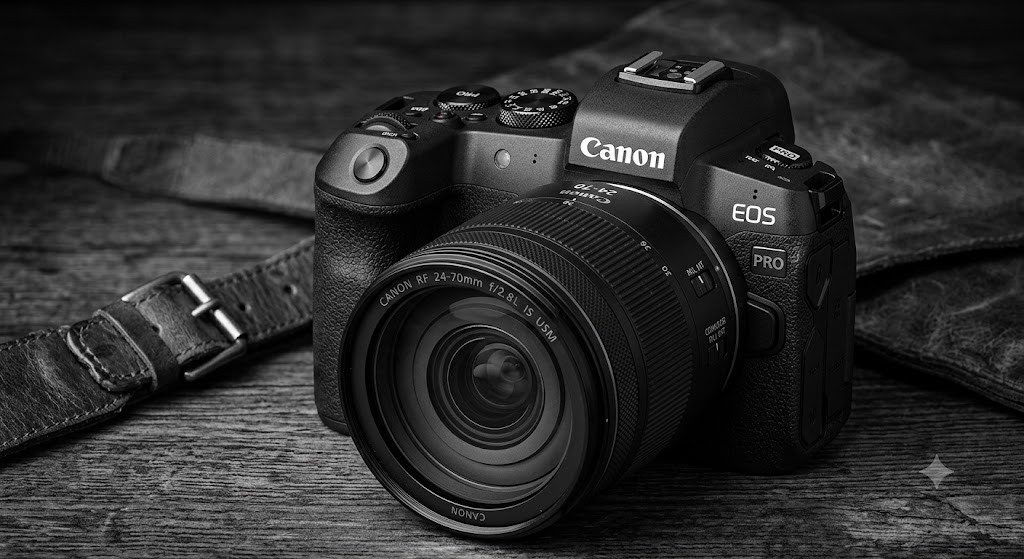
Why the RF Mount Matters at the Professional Tier
A Canon EOS R Pro’s value depends significantly on the RF lens ecosystem that surrounds it. Professional sports and wildlife photographers do not evaluate camera bodies in isolation. They evaluate entire systems.
The Canon RF mount is one of the most modern and versatile mirrorless lens ecosystems on the market. Designed for high-speed communication between the camera and the lens, RF optics deliver improved autofocus accuracy, edge-to-edge sharpness, and advanced video performance. techradar
The RF mount’s 12-pin communication system enables faster data transfer between camera and lens than competing mount designs. This higher-bandwidth communication allows the camera body’s AF processor to receive focus position feedback from the lens more frequently per second, which directly improves tracking reliability during fast continuous shooting.
For a Canon EOS R Pro at 40 to 50fps, this communication bandwidth advantage becomes even more critical. At higher burst rates, the AF system must update subject position predictions more frequently between frames. The RF mount’s faster communication cycle supports this more effectively than older mount designs that were not engineered for these throughput requirements.
The Super-Telephoto Ecosystem for Professional R Pro Users
Professional sports and wildlife photographers who adopt an EOS R Pro would pair it primarily with Canon’s super-telephoto RF primes. The RF 400mm f/2.8 L IS USM and RF 600mm f/4 L IS USM represent the current pinnacle of Canon’s professional telephoto range.
Canon’s RF lens roadmap for 2026 is in its consolidation phase, with industry reporting and reliable roadmap leaks indicating additional professional telephoto releases later in 2026, possibly aligned with major global sporting cycles. LensClear
An EOS R Pro launch timed with a new professional super-telephoto lens, such as a rumored RF 200-600mm zoom or an updated RF 800mm prime, would create a complete professional package announcement that gives the camera maximum commercial impact at launch.
Build Quality and Ergonomics: What Professional Photographers Demand
The Professional Body Standard
A Canon EOS R Pro would meet or exceed the build standards of the EOS R1. This means a fully magnesium alloy and polycarbonate composite body with comprehensive weather sealing against dust and moisture ingress. Professional photographers work in conditions ranging from tropical humidity to sub-zero cold, from dusty motorsport circuits to rain-soaked football touchlines. The body must perform reliably in all of these environments without special handling procedures.
The integrated vertical grip design of the EOS R3 and R1 eliminates the bolt-on grip that many professional photographers find less ergonomically satisfying than a native vertical configuration. A Canon EOS R Pro would almost certainly adopt this integrated design, providing eye-level AF joystick positioning in both landscape and portrait orientations without requiring any accessory change.
Dual CFexpress Type B slots would be standard. Professional photographers who shoot paid assignments cannot accept single-card failure risk. Simultaneous backup recording to both cards, or primary-to-first-card-and-overflow-to-second configuration, protects against the catastrophic data loss that single-slot designs make possible.
Battery and Power Management
The LP-E19 battery, which powers the EOS R3 and R1, delivers approximately 430 shots per charge in standard use and sustains much higher shot counts when battery grip configurations allow dual-battery operation. An EOS R Pro would use the same battery format, maintaining accessory compatibility with existing professional battery grips, USB-C charging adapters, and power pack solutions that professionals have already invested in.
USB-C Power Delivery charging at 45W or higher would allow photographers to top up battery charge from laptop power banks during extended field assignments. This capability becomes increasingly important for photographers who work at locations where traditional power outlets are unavailable.
Pricing: What a Canon EOS R Pro Would Cost
The Professional Tier Price Reality
Professional Canon cameras have never been cheap. The EOS R1 launched at approximately $6,299. The EOS R5 Mark II launched at $4,299. The EOS R3 launched at $5,999 in 2021.
A Canon EOS R Pro, positioned between the R5 Mark II and the R1 in terms of specification and capability, would logically price in the $5,000 to $6,500 range. At $5,500, it would undercut the R1 by approximately $800 while offering meaningfully higher resolution. At $6,000, it would approach the R1’s territory and require clear differentiation through sensor resolution or burst performance capabilities that the R1 does not match.
This pricing window places the hypothetical EOS R Pro directly against the Sony A1 II at $7,000. For photographers comparing the two systems, the EOS R Pro would need to justify a lower price through superior Dual Pixel CMOS AF II video reliability, the RF mount ecosystem’s advantages, or a more favorable resolution-to-speed ratio than the A1 II currently delivers.
Who the Canon EOS R Pro Is Designed For
The Working Professional Audience
A camera carrying the Canon EOS R Pro designation targets photographers who depend on their camera for primary income and whose clients demand consistent, professional-grade results under unpredictable conditions.
Sports photographers covering national leagues, Olympic events, and international competitions need the combination of fast burst rates, reliable subject tracking, and professional body durability that separates a professional tool from an enthusiast one. These photographers currently choose between the R1’s speed and the R5 Mark II’s resolution. An EOS R Pro delivering both would eliminate that compromise.
Commercial photographers who shoot product, fashion, and advertising content need high resolution for large-format delivery and creative cropping flexibility. They also need autofocus reliable enough for moving subjects and environments where the controlled studio conditions cannot be guaranteed. An EOS R Pro at 45MP or higher would serve this audience without sacrificing the AF performance they need for environmental and lifestyle commercial work.
Photojournalists who cover conflict, politics, and breaking news need speed, reliability, and body durability above all else. Many currently use the R3 for its speed focus and professional build. An R3 Mark II, which is the most realistic version of an “EOS R Pro” concept, would directly serve this audience with updated technology in a body design they already know and trust.
Who Does Not Need an EOS R Pro
Hobbyist photographers and enthusiasts who shoot for personal satisfaction rather than professional income do not need the EOS R Pro’s capability level or its price. The EOS R5 Mark II, the R6 Mark III, or the R8 Mark II all deliver excellent image quality for personal photography at much lower investment levels.
Content creators who prioritize video over stills will find Canon’s video-specific lineup, including the C50, R6 V, and the upcoming Nikon ZR competitors, better suited to their specific workflow than a stills-focused professional body.
Timeline: When Could a Canon EOS R Pro Actually Arrive?
Reading Canon’s Product Cadence
Canon does not rush professional body announcements. The EOS R3 took three years to update with the Mark II reportedly still in development. The EOS R5 Mark II arrived four years after the original R5. A hypothetical EOS R Pro, as a genuinely new product category rather than an update to an existing line, would require extensive development time.
Canon’s EOS R roadmap for 2026 to 2027 focuses on refinement and speed, suggesting that the next two years bring updates to existing lines rather than entirely new camera categories. Digital Camera World
The most realistic near-term version of an “EOS R Pro” concept is the R3 Mark II, which multiple sources place in a 2026 to 2027 window. Beyond that, the R5 Mark III in 2027 to 2028 would push the resolution ceiling further at the professional tier. A camera explicitly branded and positioned as “EOS R Pro” remains a concept for 2028 at earliest, if Canon chooses to use that designation at all.
What to Watch For as Signals
FCC certification registrations are the most reliable early signal for any Canon camera launch. Canon typically files for regulatory approval three to six months before announcement. Photographers who monitor Canon Rumors for FCC registration news will receive the earliest credible signal of any new professional body approaching announcement.
Additionally, Canon’s pattern of launching professional bodies aligned with major sporting events means the 2028 Summer Olympics in Brisbane, Australia, would be a natural target for any next-generation professional Canon launch that follows the R3 Mark II.
Canon EOS R Pro vs the Current Professional Competition
Against the Sony A1 II
The Sony A1 II at $7,000 delivers 50MP at 30fps with the most comprehensive AI subject detection on the market. It has no peer in terms of the resolution-speed combination it offers.
A Canon EOS R Pro at 45MP and 40 to 50fps would challenge the A1 II directly on burst performance while offering Canon’s proven Dual Pixel CMOS AF II video reliability, which many commercial production directors prefer over Sony’s phase detection video AF for interview and continuous coverage scenarios.
Canon’s global shutter ambitions for the R3 Mark II tier would also differentiate the EOS R Pro from the A1 II’s rolling-shutter stacked sensor, giving sports photographers shooting under LED stadium lighting a clear reason to prefer the Canon system.
Against the Nikon Z9 II
The rumored Nikon Z9 II targets Canon and Sony’s professional tier with updated specifications that Canon Rumors and Digital Camera World both track. Based on available signals, the Z9 II improves on the original Z9’s already strong 45.7MP sensor with faster burst rates and AI autofocus improvements.
A Canon EOS R Pro competing with the Z9 II would rely primarily on Dual Pixel CMOS AF II’s tracking reliability advantage, the RF mount’s communication bandwidth, and whatever sensor architecture Canon selects. The Z9 II’s primary advantage is Nikon’s established professional reputation with photojournalists who built their careers on Nikon bodies. Canon’s advantage is the larger RF lens ecosystem and the longer established mirrorless professional track record dating from the original R5.
Final Assessment: The Canon EOS R Pro in June 2026
The Canon EOS R Pro does not exist yet. It may never exist under that specific name. However, the professional photography demand it represents is very real. Working photographers who need 45MP resolution, 40fps burst performance, global shutter capability, and professional body construction in a single Canon body represent a genuine market that Canon’s current lineup does not fully serve.
The R3 Mark II is the nearest term answer to this demand. Its expected professional body design, updated sensor, and global shutter potential position it as the closest thing to an “EOS R Pro” that Canon’s 2026 to 2027 roadmap actually contains. Following it, the R5 Mark III pushes the resolution dimension further with the same professional capability foundation.
Whether Canon ultimately produces a camera explicitly branded as “EOS R Pro” depends on whether the company decides that professional photography needs a specific marketing category separate from its existing speed and resolution tiers. Given Canon’s history of clear, function-based product naming, a specific “Pro” designation seems unlikely. Instead, the professional promise of an EOS R Pro will arrive distributed across the R3 Mark II and R5 Mark III as they update and refine Canon’s professional full-frame tier.
Both cameras, when they arrive, will be worth the wait. Canon’s professional camera engineering has never been stronger. The results, under whatever names they carry, will demonstrate that clearly.
Altbuzz Anticipation Rating: 9.1 / 10
Read More from Altbuzz
For more Canon and professional camera coverage from our June 2026 series, explore our deep-dive on the Canon EOS RP Successor and R8 Mark II rumors, our Sony A1 IIH analysis, and our top 5 incoming Sony cameras guide. We also cover the Nikon ZR full review for photographers comparing professional cinema-adjacent bodies across brands.
Stay updated on every Canon professional camera announcement at altbuzzmedia.com. For dedicated Canon tracking, follow Canon Rumors at canonrumors.com, Canon Watch at canonwatch.com, and Digital Camera World’s Canon coverage at digitalcameraworld.com.
Subscribe to Altbuzz YouTube Channel
Full Canon professional camera breakdowns, R3 Mark II speculation videos, and R5 Mark III analysis are coming to the Altbuzz YouTube channel @AltBuzzMedia as Canon’s professional roadmap develops through the rest of 2026 and into 2027. Subscribe now and never miss a Canon professional update.