
The Sony A7 V is one of the most anticipated full-frame mirrorless cameras of 2025. It was officially released on December 2, 2025, and builds on the enormous success of the A7 IV. Sony positions it as the ultimate hybrid stills and video camera for enthusiasts and professionals.
Sony A7 V Full Review: Specs, Performance & Verdict
The Sony A7 V is the fifth generation of Sony’s mainstream full-frame Alpha series. It brings a new partially stacked 33MP sensor, a revised BIONZ XR2 processor with an integrated AI unit, blackout-free 30fps burst shooting, and a greatly improved video feature set. Meanwhile, the body remains familiar and comfortable.
In this review, we break down everything the Sony A7 V offers in the real world.
Release Date and Market Position
Sony announced the A7 V on December 2, 2025, with availability by the end of December 2025. The launch price is $2,899 USD — $400 more than the A7 IV’s original price.
The A7 V sits in the enthusiast/prosumer full-frame mirrorless segment. Its key competitors include the Canon EOS R6 Mark III, Nikon Z6 III, and Panasonic Lumix S1 II. Each of these cameras offers a similar all-around hybrid approach. Sony’s edge comes from its autofocus reputation, E-mount lens ecosystem, and the new partially stacked sensor technology.
Sony A7 V Specifications Table
| Feature | Details |
|---|---|
| Sensor Type | Full-frame (35.9 x 23.9mm) Partially Stacked Exmor RS CMOS |
| Resolution | 33.0 Megapixels effective |
| Processor | BIONZ XR2 with integrated AI Processing Unit |
| ISO Range | 100–51200 (Extended: 50–204,800) |
| Autofocus System | 759-point Phase Detection + 425 Contrast Detection, covers ~94% of frame, down to -4 EV |
| Stabilization | 5-axis IBIS, up to 7.5 stops |
| Video Recording | 4K 60p (full-frame, 10-bit 4:2:2, 7K oversampled), 4K 120p (APS-C crop), 1080p 240p |
| EVF | 3.69M-dot OLED, 0.78x magnification, 120fps refresh rate |
| LCD Screen | 3.2-inch, 2095K dots, 4-axis tilting touchscreen |
| Burst Shooting | 30fps (electronic, blackout-free), 10fps (mechanical) |
| Battery | NP-FZ100 — ~630 shots (EVF) / ~750 shots (LCD) |
| Storage | Dual slots: CFexpress Type A + SD UHS-II |
| Connectivity | Wi-Fi 6 (6GHz), Bluetooth 5.0, USB-C (dual) |
| Weight | 695g (with battery and card) |
| Launch Price | $2,899 USD |
Sensor and Image Quality Performance
A New Kind of Sensor
The Sony A7 V introduces a 33MP partially stacked Exmor RS CMOS sensor — a first for the A7 series. Partially stacked means extra readout circuitry is placed above and below the sensing layer. This dramatically increases readout speed compared to conventional BSI sensors.
The result: approximately 4.5 times faster readout than the A7 IV. This reduces rolling shutter in video, enables 30fps burst shooting, and improves overall responsiveness.
Real-World Image Quality
In practice, 33MP delivers excellent detail. Files are sharp, with smooth gradations and accurate colors. The improved auto white balance (powered by deep learning) handles mixed and challenging lighting conditions more reliably than the A7 IV.
Sony claims up to 16 stops of dynamic range — an improvement over the A7 IV’s 15 stops. Shadow recovery is impressive, and highlights roll off smoothly. This is very useful for landscape, architecture, and event photography.
Low-Light Performance
Low-light performance is a strong point of the A7 V. The new sensor and processor combination handles high ISO noise better than the previous generation. ISO 3200 and 6400 produce clean, detailed images. Even ISO 12800 remains usable with moderate noise reduction.
The extended ISO reaches up to 204,800. While extremely high ISOs introduce noticeable noise, the A7 V pushes further before images become unusable compared to the A7 IV.
Color Science
Sony has traditionally lagged behind Canon and Fujifilm in perceived color accuracy. The A7 V narrows this gap significantly. Skin tones look more natural. Auto white balance is more consistent. For photographers who previously shot Sony and adjusted skin tones heavily in post, the A7 V requires less correction.
Autofocus Performance
The Most Important Upgrade
Autofocus is arguably the biggest improvement the Sony A7 V makes over the A7 IV. The new BIONZ XR2 processor integrates the AI processing unit directly — something previously reserved for Sony’s flagship cameras. This brings the same advanced subject recognition found in the A9 III and A1 II.
AF System Details
The system uses 759 phase-detection points covering approximately 94% of the sensor area. It works in light as dim as -4 EV, which is impressive for real-world low-light shooting.
Subject detection now recognizes six subject categories: humans (face and eye), animals, birds, insects, airplanes, and cars and trains. A new Auto subject recognition mode can identify multiple subject types simultaneously — you no longer have to pre-select whether you’re shooting a person or an animal.
Tracking Accuracy
In real-world use, the A7 V’s tracking is excellent. Subjects stay in focus through obstacles, partial occlusion, and changes in direction. The camera makes autofocus calculations 60 times per second, making it fast and reactive.
Video autofocus is another area where Sony excels. The A7 V maintains smooth, natural-looking focus transitions during video recording. It rarely hunts or creates distracting focus pulls.
Real-World Usability
For event, wedding, portrait, and wildlife photography, the autofocus is dependable and requires minimal manual adjustment. You can largely trust the camera to handle focus while you concentrate on composition and timing.
Video Capabilities
Maximum Resolution and Frame Rates
The Sony A7 V is a serious hybrid video camera. Key video modes include:
- 4K 60p — Full-frame, 10-bit 4:2:2, oversampled from 7K for excellent sharpness
- 4K 120p — APS-C/Super 35 crop, useful for slow-motion and fast-paced content
- 1080p 240fps — For high-speed slow-motion footage
The jump to 4K 120p in Super 35 crop is one of the most useful upgrades for video-focused users. It allows for cinematic slow-motion without an external recorder.
Log Profiles and Color
The A7 V supports S-Log2 and S-Log3, as well as S-Cinetone for a more cinematic look straight out of the camera. These options give videographers flexibility in both run-and-gun situations and controlled productions.
Stabilization in Video
IBIS is rated at 7.5 stops for stills. In video, it works with both IBIS and electronic stabilization (Active and Dynamic modes). These modes introduce a slight crop to the image. However, the results are very stable and practical for handheld video shooting. The A7 V also uses a unique Sigma-shaped graphite heat-sink to manage thermal load during extended video sessions.
Audio
The A7 V supports 24-bit internal audio recording and up to 4-channel audio with compatible external microphones. A new audio reference microphone assists with noise reduction. There is a wind-noise reduction setting for the internal mic. The camera features both a 3.5mm microphone input and a 3.5mm headphone output for audio monitoring.
Design, Build Quality, and Handling
A Familiar Body
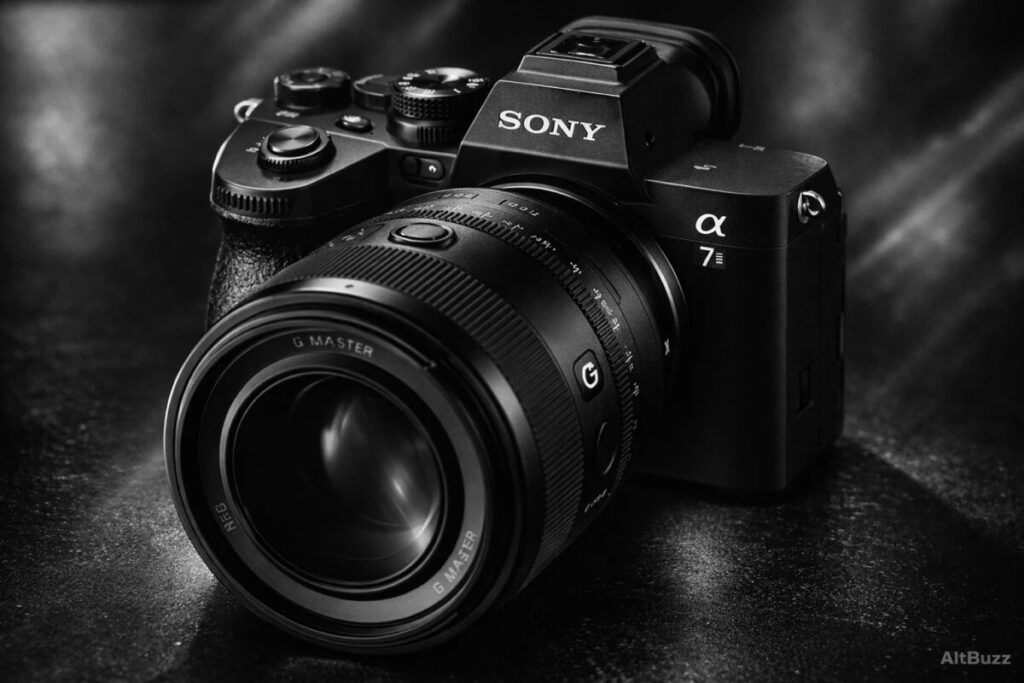
Externally, the Sony A7 V looks nearly identical to the A7 IV. If you place them side by side without looking at the nameplate, telling them apart is very difficult. Sony chose not to change the formula significantly — and for good reason. The A7 IV’s ergonomics were already very well regarded.
Build and Materials
The body is constructed from magnesium alloy. It features comprehensive dust and moisture sealing across all seams and the battery cover. This makes it suitable for shooting in light rain and dusty environments. It is not fully waterproof but is well-protected for outdoor use.
Grip and Ergonomics
The grip on the A7 V is slightly deeper than the A7 IV. This makes the camera more comfortable to hold, especially for extended shooting sessions with heavier lenses. The weight of 695g with battery and card is on the heavier side for a mirrorless camera, but it feels reassuringly solid.
Button Layout and Screen
All dials, controls, and custom buttons carry over from the A7 IV. The control layout is logical and well-organized. Two USB-C ports are now included — one for charging and data transfer, one for additional connectivity.
The 4-axis tilting LCD is a practical improvement. It tilts up, down, and sideways, making it more versatile for vlogging, waist-level shooting, and overhead shots.
Battery Life and Connectivity
Battery Performance
The Sony A7 V uses the same NP-FZ100 battery as its predecessors. However, the BIONZ XR2 processor uses power more efficiently. Ratings are:
- ~630 shots with the EVF (up 21% from the A7 IV)
- ~750 shots with the LCD (up 29% from the A7 IV)
This is genuinely good battery performance for a modern mirrorless camera. Real-world testing confirms strong all-day battery life. Wedding and event photographers can shoot a full day with two batteries comfortably.
A new Monitor Low Bright mode automatically dims the screen when the camera is idle, extending battery life further.
Charging
USB-C charging is supported. Dual USB-C ports allow for flexible charging arrangements. No external battery charger is included in the box.
Wireless Connectivity
The Sony A7 V features Wi-Fi 6 (including 6GHz band support) and Bluetooth 5.0. Wi-Fi performance is significantly faster than the A7 IV. FTP file transfer via the 6GHz band is noticeably quicker, which is practical for news, sports, and event photographers who need to deliver images quickly.
4K 30p live streaming via USB is supported natively.
Real-World Use Cases
Photography Use Cases
The Sony A7 V is a true all-rounder for stills.
Wedding and event photography — 30fps burst shooting with reliable AF is ideal for capturing peak moments. The pre-capture feature (recording 0.03–1.0 second before the shutter is pressed) adds an extra safety net for unpredictable moments.
Portrait photography — Excellent face and eye detection combined with fast, accurate AF makes portrait sessions smooth and efficient. The 16-stop dynamic range helps preserve detail in difficult lighting.
Wildlife photography — Bird and animal detection is vastly improved over the A7 IV, with 30–50% faster recognition. The 30fps burst with a buffer of up to 85 RAW files (with CFexpress Type A) is capable for fast-moving subjects.
Landscape photography — 33MP resolution with strong dynamic range produces detailed files. Composite RAW mode allows multi-exposure blending for lower noise in landscape and nighttime shots.
Video Use Cases
Hybrid content creators — 4K 60p full-frame footage is sharp, smooth, and well-suited for YouTube, social media, and documentary work. S-Cinetone makes footage look polished with minimal color grading.
Vloggers — The 4-axis tilting screen, reliable video AF, and IBIS make the A7 V a practical vlogging camera. The 4K 120p crop mode adds creative slow-motion options.
Commercial video — S-Log3 combined with 10-bit 4:2:2 color gives enough latitude for professional color grading.
Everyday Shooting Strengths
The Sony A7 V handles nearly any shooting scenario you put it in. It is fast, reliable, and produces professional-quality results. However, it is not the smallest or lightest camera in this class. It is best suited to photographers who prioritize performance over pocketability.
Pros and Cons
Pros
- New 33MP partially stacked sensor with 4.5x faster readout
- Blackout-free 30fps burst shooting — a class-leading feature at this price
- Exceptional AI autofocus — 759 PDAF points, -4 EV sensitivity, six subject types
- 16 stops of dynamic range
- 7.5 stops IBIS — one of the best in class
- 4K 60p full-frame, 7K oversampled — excellent video quality
- 4K 120p in APS-C crop for slow-motion
- Strong battery life (~750 shots LCD)
- Wi-Fi 6 (6GHz) for fast wireless transfer
- Comprehensive weather sealing
- Comfortable, well-designed body with improved grip
Cons
- $2,899 is a significant price increase over the A7 IV
- Physically nearly identical to the A7 IV — limited design evolution
- No open-gate recording or internal RAW video
- Maximum video resolution is 4K (no 6K or 8K)
- CFexpress Type A cards are expensive and less widely available
- Only one SD card slot — the second slot requires CFexpress Type A
- No built-in ND filter
- Slightly heavier than some competitors
Final Verdict
The Sony A7 V is a remarkable upgrade over its predecessor. The new partially stacked sensor and integrated AI processor represent a genuine leap in performance. Burst speed, autofocus, video quality, and battery life are all improved meaningfully.
At $2,899, it is priced competitively against the Canon EOS R6 Mark III and Nikon Z6 III. Each of these cameras has its strengths, but the Sony A7 V makes a compelling case with its burst rate, AF reliability, and E-mount lens ecosystem.
Who should buy it:
- Photographers who shoot events, weddings, sports, or wildlife and need fast, reliable AF
- Hybrid shooters who want excellent stills and strong 4K video in one body
- Sony A7 IV users ready for a major performance upgrade
- Those who value the Sony E-mount ecosystem’s lens selection
Who should skip it:
- Shooters who prioritize compact size and weight over performance
- Video professionals who need open-gate, internal RAW, or 6K+ resolution
- Budget-conscious buyers — the A7 IV now offers strong value at a reduced price
- Users not invested in Sony’s ecosystem who may prefer Canon or Nikon’s color science
The Sony A7 V earns its place as one of the best do-it-all full-frame cameras on the market in 2025 and 2026.
Read More from AltBuzz
Read more from AltBuzz for camera reviews, detailed specs, and expert insights. AltBuzz delivers trusted and easy-to-understand photography content.
Subscribe AltBuzz YouTube Channel
Stay updated with camera reviews and comparisons. AltBuzz shares hands-on camera content regularly.