
Canon EOS M50 Mark II vs Sony ZV-E10: Full Comparison, Specs and Verdict
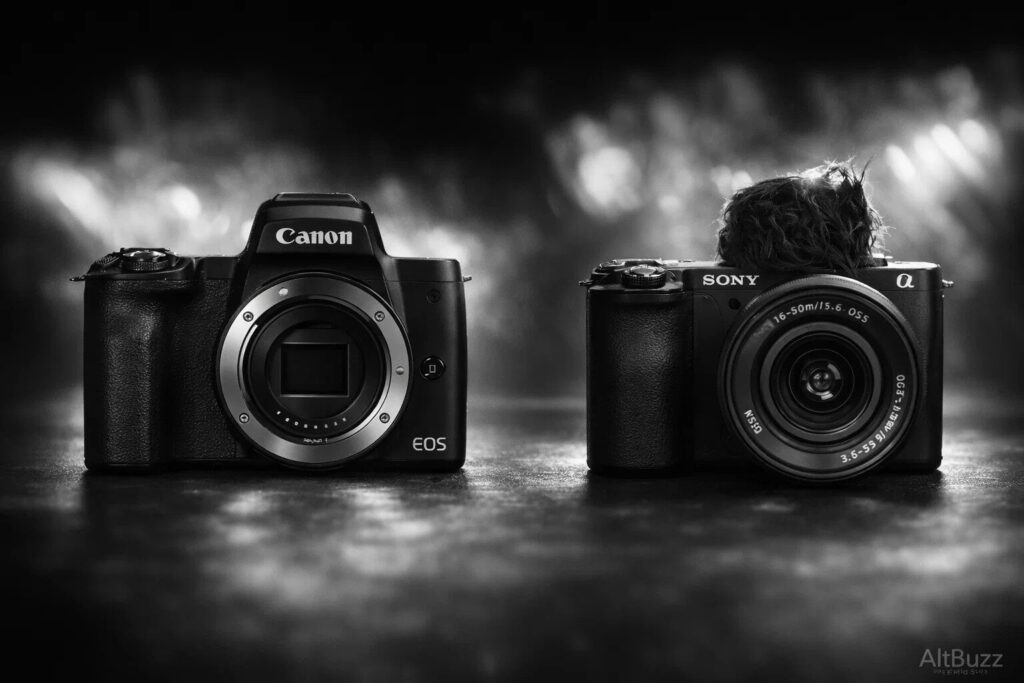
Imagine standing in a camera store with $750 and a clear creative goal: a compact APS-C mirrorless camera that handles both photography and video reliably for content creation, vlogging, and everyday photography. Two cameras sit side by side. The Canon EOS M50 Mark II on the left. The Sony ZV-E10 on the right. Both target exactly this buyer with precision. Both use APS-C sensors. Both include fully articulating touchscreens. Both prioritize creator-friendly features alongside genuine photographic capability.
Yet these two cameras make surprisingly different technical decisions despite their shared market position and nearly identical price points. Canon emphasizes autofocus performance through Dual Pixel technology, a familiar dual-screen vlogging design, a built-in electronic viewfinder that distinguishes it from many competitors, and tight Canon ecosystem integration that makes the transition from any previous Canon camera seamless. Sony, by contrast, prioritizes video-first specifications with crop-free 4K at 30fps, a directional vlogging microphone borrowed directly from the ZV compact line, access to the industry’s most diverse and mature APS-C mirrorless lens ecosystem, and superior battery life that extends shooting days without interruption.
This comparison covers every significant technical aspect of both cameras in thorough detail, explaining what each specification means during real content creation and photography workflows rather than in isolated lab conditions. By the end, you will understand with clarity which camera serves your specific creative and photographic needs better, and the reasons behind that conclusion will be grounded in practical reality rather than marketing language.
Understanding the Target Audiences
Canon EOS M50 Mark II Background
Canon launched the M50 Mark II in October 2020 as a direct evolutionary successor to the original M50 that launched in 2018. The update introduced vertical video streaming capability specifically for live streaming to platforms that favor the vertical format, improved Eye Detection AF performance, enhanced processing for wireless connectivity, and minor DIGIC 8 processing refinements. The physical body remained essentially identical to the original M50, reflecting Canon’s confidence in the ergonomic design rather than a need for fundamental revision.
The M50 Mark II targets beginner photographers and content creators who want reliable autofocus with face and eye tracking capability, an optical composition option through the built-in viewfinder, and straightforward operation within the well-established Canon ecosystem. Canon designed it primarily for YouTubers building their first dedicated camera setup, student photographers learning image-making fundamentals, and first-time mirrorless buyers who want a recognizable and well-supported brand with extensive tutorial resources available online.
Sony ZV-E10 Background
Sony launched the ZV-E10 in August 2021 as an interchangeable-lens extension of the ZV compact camera philosophy. Sony recognized that ZV-1 and ZV-1F users who appreciated the creator-focused feature set were ready to upgrade to an interchangeable lens system that provided better image quality and creative flexibility while maintaining the simplified creator-friendly operational approach that the ZV line established.
The ZV-E10 targets video content creators specifically, applying the vlogging-focused ZV design language to an APS-C sensor body with the full flexibility of the Sony E-mount lens system. Sony built the ZV-E10 around video-first feature priorities throughout every specification decision, and the resulting camera reflects that priority hierarchy clearly in its 4K capabilities, microphone design, autofocus video performance, and battery life.
Full Specifications Comparison Table
| Feature | Canon EOS M50 Mark II | Sony ZV-E10 |
|---|---|---|
| Sensor Type | APS-C CMOS, 24.1MP | APS-C Exmor CMOS, 24.2MP |
| Processor | DIGIC 8 | BIONZ X |
| ISO Range | ISO 100 to 25,600 (expandable to 51,200) | ISO 100 to 32,000 (expandable to 51,200) |
| Autofocus System | Dual Pixel CMOS AF, 143 AF zones | Fast Hybrid AF, 425 phase-detect points |
| Eye Detection | Human eye detection | Human and animal eye detection |
| Stabilization | None | None |
| Video Recording | 4K UHD 25fps with 1.56x crop, 1080p 60fps | 4K UHD 30fps full pixel, 1080p 120fps |
| 4K AF During Recording | Contrast-detect only | Full phase-detect Eye AF |
| Built-in Microphone | Standard stereo | Directional 3-capsule cardioid |
| Microphone Input | 3.5mm jack | 3.5mm jack |
| Viewfinder | 2.36M-dot OLED EVF | None |
| LCD Screen | 3.0-inch fully articulating touchscreen, 1.04M dots | 3.0-inch fully articulating touchscreen, 921K dots |
| Burst Shooting | 10fps with AF | 11fps with AF |
| Battery | LP-E12, approx. 305 shots | NP-FW50, approx. 440 shots |
| Storage | Single SD UHS-I slot | Single SD UHS-I slot |
| Connectivity | Wi-Fi, Bluetooth, Micro-USB | Wi-Fi, Bluetooth, Micro-USB |
| Lens Mount | Canon EF-M | Sony E-mount |
| Dimensions | 116.3 x 88.1 x 58.7mm | 115.2 x 64.2 x 44.8mm |
| Weight | 387g with battery and card | 343g with battery and card |
| Launch Price | Approx. $699 USD body only | Approx. $749 USD body only |
Sensor and Fundamental Image Quality
Resolution at Practical Parity
Both cameras use 24MP APS-C sensors with the M50 Mark II at 24.1MP and the ZV-E10 at 24.2MP. This resolution parity means neither camera holds a meaningful advantage in still image detail, maximum print size capability, or cropping flexibility. Both produce files with sufficient resolution for A2 prints, comfortable social media cropping, and standard editorial publication use at 24 megapixels of maximum capture.
Despite equal megapixel counts, the sensors use different underlying architectures from Canon and Sony that produce subtly different rendering characteristics affecting color, tonality, and noise behavior. These differences emerge most clearly in challenging lighting conditions and in RAW file comparisons rather than in casual daylight JPEG shooting.
Dynamic Range Difference
The Sony ZV-E10’s Exmor sensor delivers approximately 12.8 stops of dynamic range at base ISO. The Canon M50 Mark II produces approximately 11.7 stops at base ISO under equivalent measurement conditions. This difference of approximately one full stop is meaningful in real-world shooting situations that photographers encounter regularly.
In high-contrast scenes such as bright skies above shadowed subjects, sun-backlit portrait subjects with bright environments behind them, and mixed natural and artificial light interior shooting, the ZV-E10 recovers more shadow and highlight detail before tonal clipping becomes visible and unrecoverable in editing. For photographers who shoot RAW and edit images in Lightroom or Capture One, the ZV-E10’s approximately one-stop dynamic range advantage translates into noticeably more post-processing flexibility in challenging situations.
For content creators who deliver JPEG images directly to social media or H.264 video to YouTube without editing RAW files, this dynamic range difference is considerably less visible in finished output. Processing pipelines that compress and resize images for web delivery reduce the perceptibility of dynamic range differences substantially compared to examining full-resolution RAW files.
Low-Light ISO Performance
The ZV-E10 handles high ISO noise more cleanly than the M50 Mark II across the ISO range that photographers use regularly in real shooting conditions. At ISO 1600, ZV-E10 files show fine, controlled luminance grain with good detail retention in subject textures, edges, and tonal transitions. At the same setting, the M50 Mark II shows more luminance noise in shadow regions alongside marginally reduced fine detail in hair strands, fabric textures, and background detail.
At ISO 3200, the ZV-E10 maintains acceptable image quality for web-size delivery and moderate prints while the M50 Mark II requires more aggressive noise reduction processing to achieve comparable output cleanliness. At ISO 6400, the ZV-E10 remains usable for casual sharing and small prints while the M50 Mark II shows noise levels that most photographers consider the practical limit for acceptable results.
This consistent pattern across the ISO range reflects the underlying sensor architecture difference, with the ZV-E10’s Exmor design providing better noise management throughout the usable ISO range.
Canon Color Science and JPEG Rendering
Canon’s color processing through the DIGIC 8 processor delivers the warm, natural color rendering that Canon photographers have associated with the brand for decades. Skin tones appear particularly flattering under Canon’s processing pipeline, with a slight warmth that makes portrait subjects look healthy and appealing without appearing artificially tanned or orange-shifted. This color characteristic is immediately recognizable to anyone familiar with Canon’s imaging output and contributes meaningfully to the appeal of Canon cameras for portrait and people photography.
Sony’s BIONZ X processing delivers accurate, slightly cooler and more neutral color rendering that prioritizes technical accuracy over flattering warmth. Sony’s processing pipeline is highly regarded for its consistency across varying lighting conditions and for producing clean, accurate results that respond predictably to color grading in post-production. For video creators who apply color grades in editing, Sony’s more neutral baseline provides a cleaner starting point than Canon’s more processed-looking output.
Autofocus System Comparison
Canon M50 Mark II Dual Pixel AF
The M50 Mark II uses Dual Pixel CMOS AF with 143 zones and Eye Detection that Canon improved in the Mark II update compared to the original M50. The Dual Pixel architecture splits every photosite on the sensor into two separate phase-detect elements, enabling the camera to calculate focus direction and required adjustment from a single reading rather than an iterative search. This phase-detect foundation makes focus acquisition fast, directed, and confident in good to moderate lighting conditions.
In still photography, Eye Detection on the M50 Mark II finds human eyes reliably and holds focus through moderate subject movement, head turns, and changing distances. Face tracking during portrait sessions works confidently across a range of distances and angles from full-face to roughly three-quarter profile. The system performs at a level that satisfies beginner photographers who want automatic precise focus on people without manually selecting focus zones for every shot.
The overall performance in still photography autofocus is strong and represents one of the M50 Mark II’s most consistent practical advantages over cameras at this price using purely contrast-detect systems. For the portrait, family, and event photography that constitutes the majority of beginner camera use, Dual Pixel AF with Eye Detection delivers reliable and confidence-inspiring results.
M50 Mark II AF During Video Recording
This is where the M50 Mark II’s autofocus story becomes complicated and significantly less favorable. When recording in 4K mode, the M50 Mark II disables Dual Pixel CMOS AF entirely and reverts to contrast-detect autofocus instead. This means the camera’s headline autofocus feature, the primary technical advantage used in marketing materials and comparisons, becomes completely unavailable during the video recording format that receives the most attention from the content creator audience the camera targets.
The contrast-detect system that operates during 4K recording produces noticeably more hunting, slower acquisition, and less reliable tracking than the Dual Pixel system that operates during stills shooting and 1080p video. For creators who specifically want to record in 4K and benefit from confident face and eye tracking during recording, this limitation is a significant real-world disappointment.
During 1080p recording, Dual Pixel AF operates normally and performs smoothly and reliably with confident face and eye tracking. For creators who record primarily in 1080p, this limitation matters less. For those who specifically prioritize 4K output, the autofocus regression in 4K mode is a genuine and important practical constraint.
Sony ZV-E10 Phase-Detect Coverage
The ZV-E10 uses Fast Hybrid AF combining 425 phase-detect points with contrast-detect refinement across a wide frame coverage area. This system handles both human and animal eye detection during stills and video recording simultaneously without restrictions or mode-based degradation. Animal eye detection for dogs, cats, and birds adds practical capability for pet owners, wildlife casual shooters, and nature photographers who photograph non-human subjects alongside people.
The higher phase-detect point count and broader frame coverage compared to the M50 Mark II’s 143 zones gives the ZV-E10 more flexibility in subject placement across the frame without losing tracking confidence when subjects move toward frame edges. Subjects can occupy any position within the 84% frame coverage area and receive reliable phase-detect tracking throughout.
ZV-E10 AF During 4K Video
Critically, the ZV-E10 maintains full phase-detect Eye AF operation during 4K recording at 30fps without any degradation, restrictions, or switching to slower contrast-detect fallback modes. Real-time Eye AF tracks subjects smoothly, confidently, and accurately during 4K video recording at all movement speeds and lighting conditions the camera handles competently in stills mode.
For content creators whose video output specifically targets 4K delivery on YouTube or other platforms, this unrestricted 4K Eye AF capability represents a fundamental practical advantage over the M50 Mark II’s contrast-detect 4K autofocus. Creators who self-film in 4K and move around during recording will find the ZV-E10’s tracking significantly more reliable and consistent than the M50 Mark II’s in this specific and increasingly common use case.
Low-Light Autofocus Comparison
Both cameras focus reliably down to approximately EV minus 2 in still photography mode. In video recording under progressively lower light, the ZV-E10’s phase-detect system maintains tracking with less hunting behavior than the M50 Mark II’s Dual Pixel system under equivalent conditions. For indoor filming without supplementary lighting, in evening outdoor environments, or in naturally lit rooms without bright artificial light supplements, the ZV-E10’s tracking stability in dim conditions provides a consistent practical advantage for creators who film in varied and uncontrolled lighting situations.
Video Capabilities Comparison
The M50 Mark II 4K Crop Problem in Detail
The Canon M50 Mark II records 4K UHD at up to 25fps but applies a 1.56x crop to the sensor image during 4K recording. This crop compounds with the APS-C sensor’s 1.6x factor relative to full-frame to produce an effective total focal length multiplier of approximately 2.5x in 4K mode. In concrete terms, a 22mm lens behaves as a 55mm equivalent during 4K recording. A 15mm lens becomes a 38mm equivalent. Wide-angle footage, which forms the compositional foundation of most vlogging and travel content, becomes genuinely challenging to achieve without a very wide dedicated lens.
The practical consequence for self-filming creators is significant. At arm’s length with a typical kit lens in 4K mode, the narrow field of view frames primarily the face without environmental context, producing a tight, somewhat claustrophobic framing that lacks the spacious and immersive quality that good vlogging composition requires. Achieving appropriately wide vlogging shots in 4K on the M50 Mark II requires purchasing an ultrawide lens specifically for this purpose, adding cost to the total system.
Additionally, the 25fps 4K recording frame rate rather than 30fps matters for creators who produce content for North American audiences where 30fps is the dominant delivery standard for YouTube and social media video. Converting 25fps to 30fps delivery introduces subtle motion rendering artifacts that most viewers do not consciously notice but that technically minded creators find objectionable.
Sony ZV-E10 4K: The Practical Standard
The Sony ZV-E10 records 4K UHD at up to 30fps using full-pixel readout without any additional crop beyond the standard APS-C focal length multiplication. Full-pixel readout reads every pixel on the sensor and downsamples computationally to 4K resolution, which produces sharper and more detailed footage than pixel-binning or line-skipping approaches. The field of view during 4K recording matches exactly what the photographer sees during stills shooting, eliminating compositional surprises when switching between modes.
Real-time Eye AF operates at full capability during 4K recording without any switching, fallback, or degradation. The 30fps frame rate matches the North American content delivery standard directly. For self-filming creators who move around while recording in 4K, the standard kit lens provides adequate wide-angle coverage without requiring additional lens purchases specifically for video composition.
1080p Slow Motion Comparison
The Sony ZV-E10 records 1080p at up to 120fps, enabling 4x slow-motion playback at standard 30fps timelines. This slow-motion speed is genuinely transformative for lifestyle and travel content, food preparation videos, fashion content, outdoor adventure footage, and any application where slowing time reveals detail or creates visual rhythm that normal frame rates cannot. At 4x reduction, ordinary movement becomes visually compelling and production quality immediately improves.
The Canon M50 Mark II records 1080p at up to 60fps, enabling 2x slow-motion. While 2x slow-motion provides some creative utility, it represents half the slow-motion magnitude available on the ZV-E10. For creators who use slow-motion regularly as a visual storytelling tool, the gap between 4x and 2x is significant enough to affect content production quality and creative ambition.
Directional Microphone Advantage on ZV-E10
The Sony ZV-E10 includes a built-in three-capsule directional microphone using the same cardioid front-facing design found in the ZV-1F and ZV-1 compact cameras. This microphone emphasizes sound arriving from directly in front of the camera, primarily the presenter’s voice, while reducing sound arriving from the sides and behind the camera, including ambient noise, passing vehicles, background crowd noise, and environmental distractions.
In practical outdoor filming, cafe environments, busy street settings, and interior spaces with reverberant acoustics, the directional microphone captures voice with notably better clarity and presence than the standard stereo microphone on the M50 Mark II, which records ambient sound from all directions equally without front-facing emphasis. For creators who film in challenging acoustic environments regularly, the ZV-E10’s directional microphone reduces dependence on external microphone accessories and provides better results when using only in-camera audio.
Both cameras include a 3.5mm microphone input for connecting external microphones when professional audio quality is required, which places both cameras on equal footing for creators who already use or intend to use external audio solutions.
Screen and Viewfinder Comparison
Both Screens Articulate Fully
Both the M50 Mark II and ZV-E10 include fully articulating touchscreens that rotate to face forward for self-filming, angle overhead for above-subject compositions, tilt downward for low-angle perspectives, and fold inward for screen protection during transport. This shared full articulation means both cameras handle the complete range of self-filming and creative composition angles equally well from a screen flexibility standpoint.
The M50 Mark II’s 1.04M-dot screen is marginally sharper than the ZV-E10’s 921K-dot panel, providing a somewhat more detailed and accurate live view and image review experience. In practical shooting, this resolution difference is minor and rarely determines purchase preference. Both screens are adequate for accurate composition, exposure assessment, and playback review in daily use.
Built-in EVF: The M50 Mark II Exclusive
The Canon M50 Mark II includes a 2.36M-dot OLED electronic viewfinder that the ZV-E10 lacks entirely. For photographers who compose through a viewfinder in bright outdoor conditions where rear screen glare and reflections compromise visibility, the M50 Mark II’s EVF provides a significant ergonomic and practical advantage that no amount of screen brightness adjustment can replicate on the ZV-E10.
Eye-level composition with the camera braced against the face also physically stabilizes the camera against the body, reducing the micro-shake that arm-length screen shooting introduces at shutter speeds where in-camera or lens stabilization has not fully corrected movement. Without optical or in-body image stabilization in either camera, this physical stabilization from body contact during eye-level shooting makes a measurable difference in sharpness for handheld stills at borderline shutter speeds.
For photography-focused buyers who regularly shoot outdoors in direct sunlight, at sporting events, in varied outdoor landscapes, or in any condition where rear screen visibility is inconsistent, the M50 Mark II’s EVF is a daily quality-of-life feature that genuinely improves compositional confidence and practical shooting ease. For indoor studio-style creators who film primarily in controlled environments where screen visibility is consistent, the EVF absence on the ZV-E10 creates no meaningful practical inconvenience.
Lens Ecosystem Comparison
Canon EF-M Discontinued Status
The M50 Mark II uses the Canon EF-M mount, which Canon officially confirmed in 2023 will receive no new lenses going forward. The existing EF-M lens lineup covers key focal lengths including the 11-22mm f/4-5.6 IS STM ultrawide, 15-45mm f/3.5-6.3 IS STM kit zoom, 22mm f/2 pancake prime, 28mm f/3.5 macro, 32mm f/1.4 STM portrait prime, and 55-200mm f/4.5-6.3 IS STM telephoto. These lenses adequately serve the most common hobbyist photography focal length needs.
The EF-M to EF adapter allows mounting Canon’s extensive EF and EF-S DSLR lens library with full Dual Pixel AF compatibility on most lenses, which significantly expands the optical options available to M50 Mark II users. However, the confirmed absence of future native EF-M lens development means the ecosystem will not grow, which matters for photographers planning to invest significantly in new glass over coming years.
Sony E-Mount: The Industry’s Broadest APS-C Ecosystem
The Sony ZV-E10 uses the Sony E-mount, one of the most extensively supported mirrorless lens mounts in the photography industry by any measure. Native E-mount lenses span from ultrawide fisheye to 600mm telephoto with options from Sony, Sigma, Tamron, Zeiss, Samyang, Viltrox, Tokina, and numerous other manufacturers at virtually every price point from budget to professional. The breadth of choice at every focal length and price tier is unmatched among APS-C mirrorless systems.
Sigma’s Art, Contemporary, and Sports series lenses cover E-mount extensively. Tamron’s well-regarded 17-28mm f/2.8, 28-75mm f/2.8, and 17-70mm f/2.8 Di III-A VC zoom lenses provide high-quality professional-grade optics at mid-range prices for E-mount APS-C shooters. Sony’s own line of E-mount APS-C lenses, while not as extensive as the full-frame lineup, covers essential focal lengths with compact, well-optimized designs.
Full-Frame Upgrade Path
Beyond APS-C-specific E-mount lenses, the ZV-E10 mounts the complete Sony full-frame E-mount lens lineup without adapters, functioning at the APS-C crop factor equivalent on the smaller sensor. This means investing in Sony full-frame E-mount lenses like the FE 50mm f/1.8, FE 85mm f/1.8, FE 20mm f/1.8 G, or FE 24-70mm f/2.8 GM II creates a lens collection that carries forward completely and without compromise to any future Sony full-frame body the photographer upgrades to.
This upgrade path represents a significant long-term value consideration for photographers who plan to move to full-frame Sony bodies in the future. Every dollar invested in E-mount glass on the ZV-E10 remains invested and fully usable after a body upgrade, which is a financial and practical continuity advantage the discontinued EF-M system cannot offer.
Battery Life Comparison
ZV-E10 Battery Advantage
The Sony ZV-E10 wins the battery comparison clearly and by a meaningful margin. The NP-FW50 delivers approximately 440 shots per charge under CIPA standards, providing comfortable coverage of a full day of moderate photography or a substantial video recording session on a single battery for most shooting scenarios.
The NP-FW50 is a mature Sony battery that powers numerous Sony cameras across multiple generations, making spare batteries widely available at various prices from Sony and third-party manufacturers. For photographers upgrading from an older Sony APS-C body, existing NP-FW50 batteries carry forward directly without additional investment.
M50 Mark II Battery Limitations
The Canon M50 Mark II’s LP-E12 delivers approximately 305 shots per charge. For moderate shooting days, this covers typical needs with some margin remaining. For intensive full-day photography sessions, travel days where the camera stays out continuously, event coverage, or video recording sessions that consume additional power, carrying at least one spare LP-E12 becomes a practical necessity rather than a precaution.
The 44% battery capacity difference between these cameras represents a genuine practical distinction that affects daily shooting logistics. A ZV-E10 photographer who begins the day with a full battery can often complete the entire day’s shooting without changing batteries. An M50 Mark II photographer in equivalent circumstances should carry a spare as a matter of course to avoid interruptions at critical shooting moments.
Real-World Use Cases
For YouTube and Video Content Creation
The Sony ZV-E10 edges ahead convincingly for dedicated YouTube and video content creation workflows. Crop-free 4K at 30fps with full Eye AF operation during recording addresses the M50 Mark II’s most significant practical video weakness directly. The directional microphone improves in-camera audio quality without any external accessories. The 120fps 1080p slow-motion capability adds visual production value that 60fps cannot deliver. Superior battery life reduces on-set interruptions during long recording sessions. The broader E-mount ecosystem provides more compact and affordable wide-angle options for achieving good vlogging compositions without purchasing dedicated ultrawide lenses specifically to overcome a 4K crop factor.
For creators who prioritize video quality and production value above all other features, the ZV-E10’s technical video package makes it the more capable and more practical dedicated video tool in this comparison.
For Beginner Photography and Learning
The Canon M50 Mark II holds clear ground in traditional photography applications. Dual Pixel AF with Eye Detection provides reliable, automatic precise focus that beginners appreciate immediately when photographing people without technical expertise. The built-in EVF enables accurate composition in bright outdoor conditions that would compromise screen-only shooting. Canon’s color science and JPEG rendering produces flattering portrait results with minimal adjustment. The familiar Canon menu structure and the enormous library of YouTube tutorials, photography courses, and Canon-specific learning resources available online provide extensive support for beginners building their photography foundations.
For photographers who split time evenly between still photography and casual video, the M50 Mark II’s EVF, reliable still AF, Canon color rendering, and well-rounded feature balance create a comfortable and capable mixed-use camera.
For Travel Photography
Both cameras travel well physically. At 387 grams and 343 grams respectively, both qualify as genuinely portable mirrorless bodies that fit in small shoulder bags without burdening the traveler. The M50 Mark II’s EVF provides consistent outdoor compositional accuracy in the direct sunlight that travel photography commonly encounters. The ZV-E10’s superior battery life extends shooting capability on long travel days away from charging access. The E-mount’s broader lens selection gives ZV-E10 users more compact travel lens options at various price points.
For travel photographers who film video extensively during trips, the ZV-E10’s practical 4K video without crop complications and 120fps slow-motion capability provide better video documentation results. For travel photographers who primarily shoot stills with occasional video clips, the M50 Mark II’s EVF and Dual Pixel still AF serve the primary use case as effectively.
For Vlogging and Self-Filming Content
Both cameras include fully articulating screens that enable forward-facing self-filming. The ZV-E10’s directional microphone captures voice more cleanly in outdoor and ambient environments. The ZV-E10’s 4K video without crop allows standard lenses to provide adequate wide-angle field of view at self-filming distances. The M50 Mark II’s Dual Pixel AF provides smooth and confident face tracking during 1080p recording but reverts to contrast-detect tracking in 4K mode. For vloggers who record primarily in 1080p, both cameras perform comparably in self-filming scenarios. For those who specifically record in 4K, the ZV-E10’s combination of full-pixel readout and persistent Eye AF during 4K recording provides a clear practical advantage.
Canon EOS M50 Mark II vs Sony ZV-E10: Full Pros and Cons
Canon EOS M50 Mark II Strengths
The built-in 2.36M-dot OLED EVF provides compositional accuracy and camera stability in bright outdoor conditions that the ZV-E10 cannot offer without an accessory viewfinder. Dual Pixel CMOS AF with Eye Detection delivers reliable and confident people-focused autofocus in still photography that beginners appreciate from the first shooting session. Canon’s color science produces warm, flattering JPEG output particularly well-suited to portrait and people photography in natural light. The familiar Canon menu structure and extensive tutorial ecosystem make the learning curve manageable for first-time camera buyers. The 10fps burst rate with AF tracking handles moderate action competently.
The EF-M to EF adapter opens access to Canon’s comprehensive DSLR lens library with full AF compatibility, providing extensive optical flexibility despite the discontinued native mount. The M50 Mark II’s established and well-documented online presence as a popular creator camera provides substantial community support, troubleshooting resources, and accessory availability that newer cameras sometimes lack.
Canon EOS M50 Mark II Weaknesses
The 1.56x 4K crop factor significantly narrows the field of view during 4K recording, requiring dedicated ultrawide lenses to achieve standard vlogging compositions. The loss of Dual Pixel AF during 4K recording reverts the camera to contrast-detect tracking precisely when the creator audience most wants reliable face tracking during video. The 305-shot battery life falls short for intensive full-day use without carrying a spare battery. The LP-E12 battery is smaller capacity than many competing APS-C camera batteries and drains faster than the ZV-E10’s NP-FW50 in comparable use scenarios.
The EF-M mount discontinuation limits long-term native lens ecosystem development and eliminates a clear upgrade path to a full-frame Canon body within the same lens mount system. The 1080p maximum slow-motion of 60fps provides only 2x slow-motion compared to the ZV-E10’s 4x capability at 120fps. The standard stereo microphone performs adequately but lacks the directional focusing capability that the ZV-E10’s three-capsule design provides in ambient environments.
Sony ZV-E10 Strengths
Crop-free 4K at 30fps with full phase-detect Eye AF operation throughout recording eliminates both of the M50 Mark II’s most significant video limitations in a single specification. The directional three-capsule microphone delivers better in-camera voice recording quality in ambient environments without requiring external microphone accessories. The 440-shot battery life provides confident all-day coverage on a single charge for most shooting scenarios. The 120fps 1080p slow-motion enables 4x slow-motion that significantly expands creative production capability.
The Sony E-mount system provides access to the broadest and most diverse APS-C mirrorless lens ecosystem available, with a clear and direct upgrade path to full-frame Sony bodies that carries every lens investment forward without replacement. The higher dynamic range sensor provides greater RAW editing flexibility in challenging high-contrast shooting conditions. Superior high-ISO noise performance extends usable sensitivity further than the M50 Mark II in low-light situations that content creators frequently encounter.
The lower 343-gram body weight reduces carry fatigue for all-day shooting and travel use. The ZV-E10’s broader third-party lens support through Sigma, Tamron, and Viltrox provides more affordable alternatives at every focal length than the EF-M system’s limited third-party options.
Sony ZV-E10 Weaknesses
The complete absence of any built-in viewfinder limits compositional accuracy and camera stability in bright outdoor conditions where rear screen visibility suffers. JPEG color rendering from BIONZ X processing is accurate but lacks the warm, flattering character of Canon’s DIGIC 8 output for portrait photographers who shoot primarily JPEG without post-processing adjustment. The Sony E-mount adapter solution for legacy lens compatibility is less seamless than Canon’s EF-M to EF adapter integration. The slightly higher launch price of $749 versus the M50 Mark II’s $699 represents a marginal cost difference that budget-sensitive buyers may weigh carefully.
Final Verdict: Canon EOS M50 Mark II vs Sony ZV-E10
The conclusion in this comparison is clearer than in many camera matchups at similar price points.
Choose the Canon EOS M50 Mark II if you value the built-in electronic viewfinder for all-condition outdoor compositional accuracy and camera stability, if you shoot roughly equally between stills and casual video and want a balanced generalist tool, if Dual Pixel AF in still photography and 1080p video provides sufficient autofocus capability for your primary subjects, if Canon’s warm color science and extensive learning ecosystem support your beginner photography journey, and if the familiar Canon brand and community resources matter to your learning approach.
Choose the Sony ZV-E10 if video quality is your primary creative priority and you specifically record in 4K for delivery to YouTube or other platforms, if crop-free 4K with full Eye AF during recording eliminates your two most important M50 Mark II objections simultaneously, if 120fps slow-motion adds genuine creative value to your content production, if better battery life removes logistical planning from your shooting days, if access to the E-mount’s industry-leading lens ecosystem and full-frame upgrade path represents a smarter long-term investment for your photographic future, and if the directional microphone improves your in-camera audio quality without requiring external accessories.
For the dedicated content creator and vlogger whose primary output is video delivered to online platforms, the Sony ZV-E10 represents the stronger and more purposeful technical package in 2024. For the photographer who treats their camera primarily as a photography tool and uses video as a meaningful but secondary feature, the Canon M50 Mark II’s EVF, reliable still AF, and balanced handling make it the more comfortable, more photographically capable, and better-supported daily companion.
Read More from AltBuzz
For camera comparisons that go beyond specification tables into real-world shooting implications and honest buying guidance, visit AltBuzz. AltBuzz covers mirrorless cameras, content creation gear, and photography equipment with technical depth and practical honesty for photographers and creators at every experience level.
Subscribe to the AltBuzz YouTube Channel
Stay updated with the latest camera comparisons and reviews. AltBuzz delivers practically grounded and technically detailed content that makes every gear decision straightforward and well-informed. Subscribe to AltBuzz on YouTube and stay current with every major camera comparison that affects your buying decisions.