
Sony ZV-E10 II Full Review: Specs, Performance & Verdict
The Sony ZV-E10 II arrived in July 2024 and immediately changed the conversation around affordable vlogging cameras. It is Sony’s second-generation APS-C interchangeable lens vlogging camera, and it corrects nearly every complaint that photographers and creators had about the original ZV-E10. This is not a minor refresh. It is a ground-up rethink of what a creator-focused camera should deliver.
If you are a vlogger, a content creator, or someone looking for a reliable hybrid camera under $1,000, the Sony ZV-E10 II deserves your full attention. This review covers everything you need to know before buying.
Release Date and Market Position
Sony officially announced the Sony ZV-E10 II on July 10, 2024. It replaced the original ZV-E10, which launched back in 2021 and was hampered by an outdated sensor and a weak battery.
The ZV-E10 II retails at $999 body-only or $1,099 with the updated 16-50mm F3.5-5.6 OSS II power zoom lens. That is a $300 increase over its predecessor. However, the upgrades more than justify the price bump. The camera is available in black and white finishes.
It sits directly below the Sony a6700 in the lineup and shares the same core sensor and processor, making it arguably the best value entry point into Sony’s current APS-C ecosystem.
Sony ZV-E10 II Specifications
| Feature | Details |
|---|---|
| Sensor | 26MP APS-C BSI Exmor R CMOS |
| Processor | BIONZ XR |
| ISO Range | 100 – 32,000 (expandable to 102,400) |
| Autofocus Points | 759-point phase detection |
| Burst Rate | 11 fps |
| Video | 4K up to 60fps, 10-bit 4:2:2 |
| Slow Motion | 1080p up to 120fps |
| Stabilization | No IBIS, Active SteadyShot (electronic) |
| Shutter | Electronic only (no mechanical shutter) |
| LCD Screen | 3-inch fully articulating touchscreen, 1.04M dots |
| Viewfinder | None |
| Microphone | Built-in 3-capsule directional mic |
| Audio Input | 3.5mm microphone jack |
| Connectivity | Wi-Fi, Bluetooth, USB-C |
| Battery | NP-FZ100 (~610 shots CIPA) |
| Memory Card | Single UHS-II SD slot |
| Dimensions | 114.8 x 67.5 x 54.2mm |
| Weight | 377g (body only) |
| Lens Mount | Sony E-Mount |
| Special Features | CineVlog mode, S-Log3, S-Cinetone, tally light |
| Price | ~$999 (body only) |
Sensor and Image Quality
The Sony ZV-E10 II uses the same 26MP BSI CMOS sensor found in the Sony a6700 and the professional Sony FX30. This is a significant step up from the original ZV-E10, which used an older, slower 24MP chip that required a heavy crop just to deliver 4K at 30fps.
The new sensor reads at much higher speed. It delivers 4K footage from a 5.6K oversampled area, which reduces moiré, sharpens fine details, and keeps rolling shutter very manageable for a camera in this price range. For still photography, you get clean, detailed 26MP files with strong color accuracy. Dynamic range is solid at base ISO, and highlights roll off naturally. Low-light stills up to ISO 3200 remain clean and usable.
The BIONZ XR processor enables 10-bit color capture across all recording modes, which makes a real difference in post-production. S-Log3 now becomes practical with the added bit depth, reducing banding and preserving more tonal information in shadows and highlights. S-Cinetone is also available directly, giving you a cinematic look straight from the camera without any grading. Sony also allows users to upload up to 16 custom LUTs via the Creators’ App, baking looks directly into footage on capture.
Autofocus Performance
The Sony ZV-E10 II inherits the 759-point phase detection AF system from the a6700 family. In practical terms, this is the best autofocus system available in any camera at this price point. Real-Time Eye AF for humans and animals works reliably, even when subjects are partially obscured or backlit. Face tracking is fast and confident.
Subject recognition covers people, animals, and objects. The camera also includes focus breathing compensation, which uses connected Sony lenses to maintain consistent framing as focus shifts. For vloggers filming themselves, this is genuinely useful.
One limitation worth noting is that the advanced subject detection modes are not always accessible in all shooting modes. Some reviewers found that Auto mode unlocked the best tracking behavior, while manual shooting modes offered slightly less flexibility. This is a minor point for most users but worth knowing for those who shoot in manual frequently.
Burst shooting tops out at 11fps. The buffer is modest, but for most content creators, this is more than enough.
Video Capabilities
Video is where the Sony ZV-E10 II truly earns its price. For a camera under $1,000, the video spec list is remarkable.
The camera records 4K at up to 60fps with 10-bit 4:2:2 color internally. That is cinema-level color depth available in a palm-sized body. For slow motion, full HD at 120fps is supported. The rolling shutter performance at 4K is very controlled thanks to the fast sensor readout.
The dedicated CineVlog mode offers a 2.35:1 widescreen crop with a cinematic look, designed for quick-turnaround content that already looks finished without editing. It is a fun, practical addition for social media creators.
The three-capsule directional microphone is genuinely useful. You can manually select front pickup, rear pickup, or omnidirectional recording. An automatic mode detects context and switches accordingly. A wind reduction muff is included in the box. A 3.5mm microphone input accepts external mics for upgraded audio quality.
For stabilization, the camera relies on Active SteadyShot (electronic), which comes with a crop factor but delivers smooth results for walking shots. There is no IBIS. Shooters who need optical stabilization should pair the camera with an OSS-equipped lens. Sony also offers Catalyst Browse desktop software, which uses gyroscope metadata for post-stabilization, and it works very well.
Design and Handling
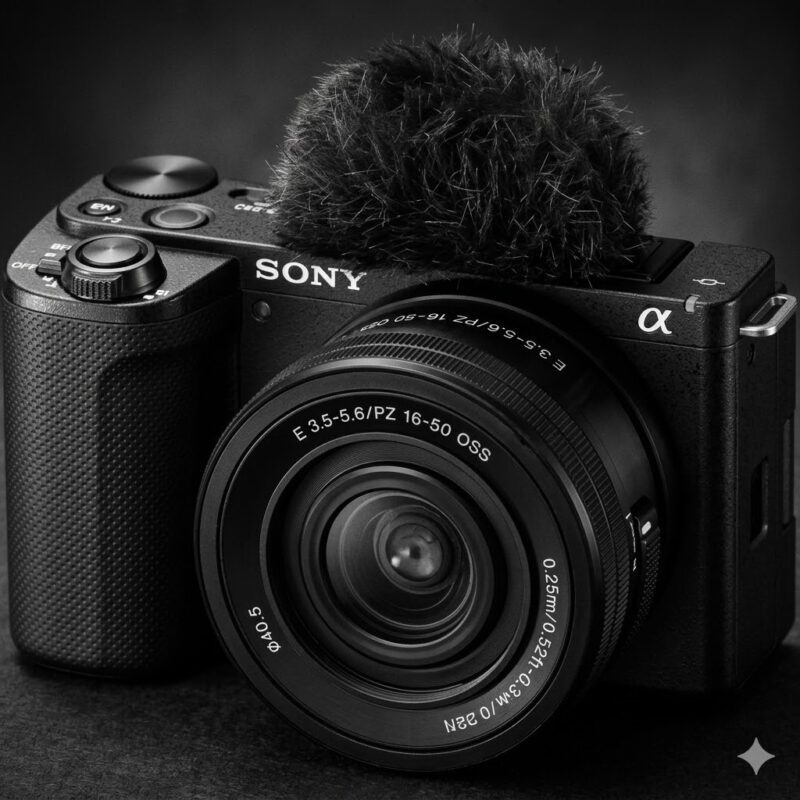
The Sony ZV-E10 II is compact but has grown slightly from its predecessor to accommodate the larger battery. Dimensions are 114.8 x 67.5 x 54.2mm. Weight is 377g, making it extremely portable.
The grip is deeper than before, giving a more secure hold. That extra depth also enabled the NP-FZ100 battery upgrade, which was the single most important physical change on this camera. The button layout is clean and beginner-friendly. Touch menus are responsive, and the new Sony menu system is far more logical than older generations.
The rear 3-inch LCD fully articulates and supports vertical orientation for TikTok and Instagram Reels. When recording, an integrated tally light creates a red border around the screen, so you always know when you are live. There is no electronic viewfinder. In bright outdoor light, finding a good angle for the LCD can be a challenge, but this is a known limitation of the ZV category.
The Multi-Interface (MI) shoe supports digital audio accessories without a cable, which is cleaner for on-camera mic setups.
Battery and Connectivity
The upgrade from the NP-FW50 to the NP-FZ100 battery is the most immediately impactful change on the Sony ZV-E10 II. The original ZV-E10 would exhaust its battery in roughly 40 minutes of active video recording. The ZV-E10 II delivers approximately two hours of continuous 4K recording and around 610 stills per charge. This transforms it from a camera that requires battery management into one you can use all day.
USB-C charging is standard. You can shoot while plugged in, which is ideal for desk or livestream setups. The camera is UAC and UAV compliant, meaning it works as a plug-and-play webcam without additional software.
Wi-Fi and Bluetooth allow connection to Sony’s Creators’ App for remote control, image transfer, and LUT management. The single UHS-II SD card slot is fast enough to handle the camera’s maximum bitrates without bottlenecks.
Real-World Use Cases
Vlogging and Self-Recording — The articulating screen, directional microphone, face tracking, and tally light make this camera built from the ground up for vlogging. It excels indoors and in controlled environments.
YouTube and Social Media Content — 10-bit 4K at 60fps gives content creators serious post-production flexibility. CineVlog mode speeds up the delivery workflow for those who want minimal editing.
Travel Video — Light weight, compact dimensions, and excellent battery life make the ZV-E10 II a strong travel companion. The lack of weather sealing is a consideration for outdoor use.
Still Photography — The 26MP sensor delivers solid results. However, the lack of a mechanical shutter limits flash sync options, and the absence of IBIS means handheld stills in low light require faster shutter speeds or higher ISOs. The ZV-E10 II is primarily a video camera that also shoots good stills, not the other way around.
Livestreaming — Webcam-compatible out of the box. Clean HDMI output allows direct connection to a capture card or monitor.
Pros and Cons
Pros
- 26MP BSI sensor shared with the a6700 and FX30
- 4K 60fps with 10-bit 4:2:2 internal recording
- 759-point phase detection AF with real-time Eye AF
- NP-FZ100 battery delivers approximately two hours of 4K recording
- Three-capsule directional microphone with wind muff included
- Fully articulating touchscreen with vertical mode support
- CineVlog mode for cinematic-looking content out of camera
- S-Log3 and S-Cinetone for grading flexibility
- Excellent lens ecosystem via Sony E-mount
- Built-in tally light for recording indication
Cons
- No mechanical shutter (electronic only)
- No in-body image stabilization
- No electronic viewfinder
- Price increased by $300 over original ZV-E10
- Active SteadyShot crops the frame when stabilization is active
- Single card slot only
- Some advanced subject detection limited in manual modes
Final Verdict
The Sony ZV-E10 II is the most complete vlogging camera available under $1,000. It addresses almost every weakness of the original model: the sensor is faster, the battery lasts all day, the video is 10-bit 4K at 60fps, and the autofocus is class-leading.
It is not designed to be a stills-first camera. The lack of a mechanical shutter and no IBIS are real limitations for photographers. But for vloggers, YouTubers, and social media creators, this camera offers capabilities that were once reserved for cameras twice the price.
If you are building a video-first kit and want Sony’s excellent E-mount lens ecosystem behind you, the Sony ZV-E10 II is the right starting point. It is compact, capable, and built for creators who need to move fast without sacrificing quality.
Read More from AltBuzz
Read more from Altbuzz for camera reviews, rumors, and detailed specs. AltBuzz delivers trusted and easy-to-understand photography content.
Subscribe AltBuzz YouTube Channel
Stay updated with camera reviews, rumors, and comparisons. Subscribe Altbuzz for regular camera content covering the latest gear, specs, and hands-on insights.