
The Panasonic Lumix L10 arrived in June 2026 and immediately sparked one question across every photography forum, YouTube comment section, and camera community thread: is it actually worth upgrading from the LX100 II?
That question deserves a detailed, honest answer. The LX100 II launched in 2018 and served its audience loyally for nearly eight years. It delivered a fast Leica zoom, a Multi-Aspect Four Thirds sensor, and physical exposure controls in a compact body. For many photographers, it became the camera they reached for every single day.
The Lumix L10 carries that same philosophy forward. However, the gap between these two cameras is not a gap of incremental improvements. It is a gap of nearly a decade of computational photography, autofocus engineering, video technology, and sensor design. Understanding exactly where the L10 improves on the LX100 II, and where the older camera still holds its own, helps photographers make a confident buying decision in 2026.
This comparison blog examines every meaningful difference between the Panasonic Lumix L10 and the LX100 II, from sensor and lens to autofocus, video, build, price, and real-world usability.
Why the Panasonic Lumix L10 vs LX100 II Comparison Matters Right Now
June 2026 is a significant moment for Lumix compact camera history. Panasonic chose not to release a proper LX100 III after the LX100 II. Instead, the company waited until it had something genuinely new to offer. The Lumix L10 represents that offer, built around the 25th anniversary of the LUMIX brand.
Many LX100 II owners are still shooting with their cameras today. The LX100 II has aged gracefully because its core formula, a fast Leica zoom plus a Four Thirds sensor plus physical dials, remains compelling even by 2026 standards. However, the autofocus system, video specification, and computational features of the LX100 II now look dated against a market that has moved forward considerably.
The L10 is also not just a spiritual successor. It is a direct replacement in Panasonic’s lineup, positioned at the same premium compact enthusiast audience. Panasonic built it to make LX100 II owners seriously consider upgrading. This comparison explores whether the company succeeded.
Quick Specs: Panasonic Lumix L10 vs LX100 II Side by Side
| Specification | Panasonic Lumix L10 (2026) | Panasonic LX100 II (2018) |
|---|---|---|
| Sensor | 20.4MP Multi-Aspect Four Thirds BSI CMOS | 17MP Multi-Aspect Four Thirds BSI CMOS |
| Lens | Leica DC Vario-Summilux 10.9-34mm f/1.7-2.8 (24-75mm eq.) | Leica DC Vario-Summilux 10.9-34mm f/1.7-2.8 (24-75mm eq.) |
| Autofocus | Phase Hybrid AF, 779 points, AI subject detection | Contrast-detection AF, no subject recognition |
| Image Stabilization | Power O.I.S. (optical) | Power O.I.S. (optical) |
| Video | 5.6K 60p, 4K 120p, 10-bit, V-Log | 4K 30p, 8-bit, no log profile |
| Viewfinder | 2.36M dot OLED EVF | 2.76M dot OLED EVF |
| Rear Screen | Fully articulating 3-inch 1.84M dot touchscreen | Fixed 3-inch 1.24M dot touchscreen |
| Real Time LUT | Yes | No |
| Dynamic Range Boost | Yes | No |
| Battery Life (CIPA) | Approx. 380 shots | Approx. 340 shots |
| Weight (with battery) | 508g | 392g |
| Launch Price | $1,499 | $997 |
Sensor Comparison: 20.4MP vs 17MP
The Resolution Difference in Real Terms
The Lumix L10 uses a 20.4MP Multi-Aspect Four Thirds BSI CMOS sensor. The LX100 II uses a 17MP sensor of the same physical format and aspect ratio design. On paper, 20.4MP versus 17MP sounds like a modest improvement. In practice, the difference is more meaningful than the numbers suggest.
First, the resolution increase gives the L10 approximately 20% more pixels in each linear dimension. This translates to meaningfully better cropping flexibility. A photographer who frequently crops from a wider frame to isolate a specific subject will find the L10’s extra resolution provides a noticeable buffer.
Second, and more importantly, the sensor architecture changed significantly between 2018 and 2026. The LX100 II uses an older generation BSI design that delivers solid but no longer competitive dynamic range. The L10’s sensor comes directly from the Lumix GH7, a camera released in 2024 that earned strong reviews specifically for its dynamic range performance.
Dynamic Range Boost: A Generation-Defining Feature
The L10 includes Dynamic Range Boost, which is Panasonic’s dual-gain sensor readout system. This technology reads each pixel at two different gain settings simultaneously and merges the results to produce wider tonal latitude in high-contrast scenes.
The LX100 II has no equivalent. Its sensor reads at a single gain setting, and photographers who expose for shadows risk blown highlights. Those who expose for highlights lose shadow detail. Dynamic Range Boost largely solves this problem.
For travel and street photographers who shoot in mixed lighting conditions, such as interiors with windows, shaded city streets next to bright walls, or golden hour landscapes, Dynamic Range Boost is not a minor feature. It changes how the camera handles the light that those scenes actually contain.
High ISO Performance
The LX100 II produces clean results up to approximately ISO 1600. Between ISO 3200 and ISO 6400, luminance noise becomes noticeable and color noise begins to affect image quality. Beyond ISO 6400, the LX100 II struggles considerably.
The L10’s newer BSI architecture and more advanced noise reduction algorithms improve this meaningfully. Fstoppers’ field testing of the L10 reports dynamic range that rivals the Sony RX-series at equivalent settings, which suggests high-ISO performance gains over the LX100 II of approximately one full stop. At ISO 3200, the L10 delivers what the LX100 II delivered at ISO 1600.
For photographers who shoot in available light indoors, at evening events, or during the blue hour, this improvement translates directly into more usable images.
Lens Comparison: Same Name, Different Era
The Shared Focal Range
Both cameras carry a Leica DC Vario-Summilux 10.9-34mm f/1.7-2.8 lens covering a 24-75mm equivalent range on the Four Thirds sensor. At first glance, this appears identical. The names match. The focal range matches. The maximum apertures at each end match.
However, the two lenses are not the same optical formula. The L10’s lens was designed and optimized for the newer, higher-resolution 20.4MP sensor. The LX100 II’s lens was designed for the 17MP sensor of its era.
Optical formulas that perform well at 17MP sometimes reveal limitations when paired with higher-resolution sensors. Panasonic addressed this by updating the glass design for the L10, ensuring the lens resolves the full detail potential of the newer sensor without corner softness or chromatic aberration issues that would undermine the resolution advantage.
Aperture Ring: Manual Control on Both
Both cameras feature a manual aperture ring on the lens barrel. This is one of the most appreciated physical control elements across both generations. Photographers who set aperture by feel rather than by menu navigation will find the experience consistent between the two cameras.
The L10’s aperture ring uses a slightly more refined detenting mechanism than the LX100 II, according to hands-on reports from Photo Rumors and DPReview preview coverage. The clicks feel more deliberate and less likely to shift accidentally during camera movement.
Autofocus Macro
Both cameras offer close-focus macro capability. The L10 focuses as close as approximately 3cm at the wide end. The LX100 II’s minimum focus distance is approximately 3cm at the wide angle position as well, matching the L10 on this specification.
For photographers who use their compact camera for detail shots of food, flowers, products, or architectural elements, both cameras serve this use case. Neither gives up meaningful ground to the other on close-focus capability.
Autofocus: The Single Biggest Generational Leap
This section covers the most dramatic difference between the two cameras. The autofocus gap between the LX100 II and the Lumix L10 is not a gap of degrees. It is a gap of technology generations.
LX100 II Autofocus: Contrast Detection Only
The LX100 II uses a contrast-detection autofocus system. Contrast detection works by analyzing pixel contrast values in the sensor output and moving the lens until contrast reaches a maximum, at which point the system infers that focus is achieved.
This approach is inherently slower than phase detection because it requires the lens to search through focus positions rather than directly calculating where focus should be. The LX100 II’s AF is adequate for static subjects in good light. It slows noticeably in lower light. It hunts during video recording. And it cannot track moving subjects reliably during continuous shooting.
There is also no subject recognition of any kind in the LX100 II. Face detection exists as a basic mode, but it is slow and unreliable compared to modern implementations. Eye detection is absent entirely.
Lumix L10 Autofocus: 779-Point Phase Hybrid AF from the S1R
The Lumix L10 pulls its autofocus system from the Lumix S1R, a professional full-frame mirrorless camera. This Phase Hybrid AF system combines phase detection and contrast detection to achieve fast, accurate focus acquisition with direct calculation rather than searching.
The 779 focus points cover the sensor densely. Phase detection pixels embedded in the sensor measure the phase difference between incoming light rays and calculate focus distance directly. This allows near-instantaneous focus lock in good light and much faster acquisition in challenging conditions.
Subject recognition covers humans (face and eye detection), animals (cats and dogs), and vehicles. The system detects faces across the frame, even at angles and in partial profile, and locks onto the nearest visible eye. This works across a wide range of lighting conditions.
Fstoppers’ review reported a 100% hit rate when tracking a subject walking directly toward the camera. For photographers who shoot candid portraits, street photography, children, or pets, this is transformative compared to the LX100 II’s contrast-only system.
Continuous Tracking: Night and Day
During continuous shooting, the LX100 II cannot reliably maintain focus on a moving subject. Photographers typically use single-shot AF and time their shots manually to maximize hit rates. This works for experienced photographers but limits shooting speed and spontaneity.
The L10’s continuous AF tracking maintains subject lock while the subject moves across the frame. As a result, photographers can concentrate on composition rather than managing the AF point manually. For travel, documentary, and family photography, this difference alone justifies serious consideration of the upgrade.
Video: The Most Dramatic Upgrade on the Spec Sheet
LX100 II Video: 4K 30p at 8-Bit
The LX100 II records 4K video at up to 30fps in 8-bit color. At the time of its 2018 launch, 4K 30p was a strong specification for a compact camera. In 2026, it represents the minimum baseline rather than a competitive advantage.
8-bit color stores 256 tonal values per channel. This is adequate for casual video and direct delivery to YouTube or social media. However, it provides limited latitude for color grading. Aggressive corrections to highlights or shadows in 8-bit footage produce visible banding artifacts and color channel breakage. The LX100 II also lacks any log profile, recording only in standard gamma curves that limit the dynamic range captured in video files.
Lumix L10 Video: 5.6K 60p, 10-Bit, V-Log, Real Time LUT
The L10’s video specification is not a marginal improvement over the LX100 II. It represents an entirely different category of video capability.
At the resolution tier, 5.6K open-gate capture at 60fps in 10-bit produces files with substantially more detail than the LX100 II’s 4K 30p. Downsampling 5.6K to 4K output averages multiple sensor pixels per output pixel, reducing noise and eliminating moiré in a way that native 4K from the LX100 II cannot replicate.
At the frame rate tier, 4K 120fps on the L10 provides slow-motion at 5x reduction to 24fps. The LX100 II cannot shoot slow-motion 4K at any frame rate. For content creators who use slow-motion sequences for travel videos, product demos, or artistic emphasis, this capability simply does not exist on the older camera.
At the color depth tier, 10-bit recording on the L10 stores 1,024 tonal values per channel versus the LX100 II’s 256. This four-fold increase in tonal data directly improves color grading flexibility. Skin tones retain smoothness through aggressive correction. Highlights roll off naturally rather than clipping abruptly.
V-Log adds the professional workflow dimension. The L10 records flat, low-contrast V-Log footage that captures 13+ stops of dynamic range in the file. Editors apply a LUT in post to restore contrast and color. The LX100 II has no log equivalent whatsoever.
Real Time LUT: A Feature the LX100 II Could Never Have
Real Time LUT is one of the most practically useful features in the L10 for working content creators and hybrid shooters. The camera loads a custom LUT from the LUMIX Lab app and applies it as a preview overlay in the EVF and rear screen during recording.
LX100 II owners have never had anything like this. The only creative preview available on the older camera is its Photo Style mode, which applies a basic picture profile. Real Time LUT enables the kind of on-set color confidence that previously required a dedicated external monitor.
Display and Interface Comparison
Rear Screen
The LX100 II uses a fixed 3-inch touchscreen at 1.24 million dots. It does not tilt. It does not articulate. Photographers who want to shoot from low angles, overhead positions, or any non-eye-level perspective must hold the camera out and guess at framing, or use the EVF at uncomfortable body angles.
The L10’s fully articulating 3-inch touchscreen at 1.84 million dots resolves this completely. The screen rotates 180 degrees forward for selfie and vlogging use and tilts to any angle for creative composition. The higher resolution also makes focus confirmation and image review noticeably sharper.
EVF
Interestingly, the LX100 II actually holds a small edge on EVF resolution. Its viewfinder provides 2.76 million dots versus the L10’s 2.36 million dots. In practice, both viewfinders use OLED technology and both look excellent in use. The difference is not something most photographers will notice unless they place the two cameras side by side in a controlled comparison.
The L10’s EVF refresh rate is higher, which makes a more meaningful difference for photographers who track moving subjects or pan across scenes. The smoother preview reduces eye fatigue during extended shooting sessions.
LUMIX Lab App Integration
The LX100 II was built before Panasonic’s LUMIX Lab app reached its current capabilities. The older camera supports basic wireless transfer via the app but cannot use Magic LUT generation, Real Time LUT loading, or the in-app RAW editing tools that version 3.0 introduces.
The L10 is fully integrated with LUMIX Lab 3.0. Photographers can generate custom LUTs from reference images, transfer RAW files wirelessly for mobile editing, and use the wired connection option for faster transfers of large 5.6K video files.
Build Quality and Size
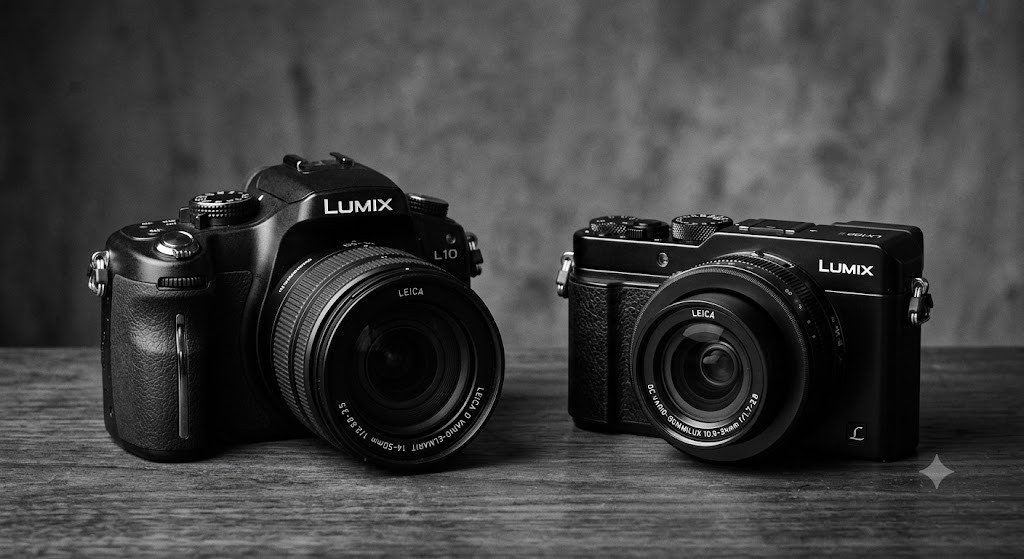
The Weight Difference
The LX100 II weighs 392 grams with battery and card. The Lumix L10 weighs 508 grams. That is a 116-gram difference, which is roughly the weight of a set of car keys and a phone together.
This weight increase reflects the L10’s larger feature set, the more complex optical formula in the updated lens, and the more sophisticated internal electronics. For photographers who valued the LX100 II’s relative lightness, the L10 will feel noticeably heavier. For photographers who shoot with a dedicated camera bag rather than a jacket pocket, the difference is less significant.
Materials and Construction
Both cameras use metal body construction with magnesium alloy reinforcement. The L10 offers a more premium feel in the hand according to multiple hands-on reviewers, which reflects Panasonic’s investment in the anniversary positioning of the camera.
Neither camera is weather-sealed. Both require care in light rain and dusty conditions. For photographers who regularly shoot in challenging weather, neither the L10 nor the LX100 II is a fully reliable tool without additional weather protection.
Battery Life and Practical Endurance
The LX100 II is rated at approximately 340 shots per CIPA standard. The L10 improves this to approximately 380 shots. In real-world use, both cameras will exceed their CIPA ratings during typical casual shooting and fall below them during heavy burst shooting or extended video recording.
For photographers who plan full-day shooting sessions, carrying a spare battery remains advisable for both cameras. The L10’s USB-C charging capability, however, allows top-up charging from portable power banks in a way that the LX100 II’s proprietary charging solution does not fully support.
Price Comparison: Is the L10’s Premium Justified?
Purchase Price Gap
The LX100 II launched at $997 in 2018. By mid-2026, used LX100 II units sell for approximately $400 to $600 depending on condition. The Lumix L10 launches at $1,499 new. This creates a substantial price gap when comparing a new L10 against a used LX100 II.
The question each photographer must answer individually is whether the L10’s improvements justify paying $900 to $1,100 more than a used LX100 II in good condition.
Where the Premium Goes
The $900 to $1,100 gap between a used LX100 II and a new L10 buys the following specific upgrades: phase hybrid autofocus with subject tracking, 5.6K 60p video with 10-bit and V-Log, Dynamic Range Boost, a fully articulating touchscreen, Real Time LUT workflow, AI face and eye detection, and 4K 120p slow-motion capability.
For photographers who use video seriously, or who rely on continuous AF for their shooting style, or who need the dynamic range advantage for high-contrast light situations, the L10’s premium is justified. For photographers who shoot mostly static subjects in controlled or good lighting and rarely use video beyond casual clips, the LX100 II remains a capable tool that does not urgently need replacing.
Who Should Upgrade from the LX100 II to the L10?
Strong Upgrade Candidates
Travel content creators who shoot video alongside photography will benefit most immediately. The jump from 4K 30p 8-bit to 5.6K 60p 10-bit V-Log is the single most impactful upgrade the L10 offers, and it directly improves every aspect of the video output that travel content requires.
Photographers who struggle with the LX100 II’s autofocus during candid or moving subject work are also strong upgrade candidates. The phase hybrid AF with subject detection changes the reliability ceiling completely. Candid family photography, street portrait work, pet photography, and documentary shooting all benefit from the L10’s AF system in ways the LX100 II simply cannot match.
Photographers who regularly face high-contrast lighting situations, specifically interiors with windows, outdoor scenes with strong shadows, or mixed indoor-outdoor environments, will use Dynamic Range Boost regularly and will notice the improvement in every challenging scene.
Photographers Who Should Consider Waiting or Skipping
Photographers who shoot primarily static subjects in controlled or good light, using the LX100 II mostly for travel snapshots and personal documentation, will not notice the autofocus or dynamic range improvements enough to justify $1,499 for a new body.
Photographers who specifically prefer the LX100 II’s lighter 392-gram weight for all-day carry should also consider whether the 116-gram weight increase disrupts their preferred shooting experience. Weight is personal. For some photographers, 116 grams matters. For others, it does not.
Finally, photographers who are considering whether to invest in an interchangeable lens system rather than another fixed-lens compact should evaluate whether $1,499 spent on an entry mirrorless body plus one or two lenses might serve them better than the L10. Both paths are valid, but they lead to different photographic experiences.
Panasonic Lumix L10 vs LX100 II: Verdict
The Panasonic Lumix L10 is not just a better LX100 II. It is a fundamentally more capable camera that addresses every meaningful limitation of the older model simultaneously. The autofocus system, the video specification, the dynamic range, the screen flexibility, and the workflow integration all improve in ways that are immediately visible in real-world use.
The LX100 II remains a good camera in June 2026. Used copies at $400 to $600 offer genuine value for photographers who want the Leica zoom compact experience at a low entry price. Nothing that launched in 2026 makes the LX100 II bad. It simply shows its age against a camera designed for the current decade.
For photographers who shoot video, rely on continuous AF, work in challenging light, or create content for social media and online delivery, the Lumix L10 is the clear choice. The premium over a used LX100 II is real, but the capability difference more than justifies it.
The Lumix L10 is what the LX100 II always wanted to become. Eight years was worth the wait.
Read More from Altbuzz
For more camera comparison coverage from June 2026, explore our full breakdown of the best fixed-lens compact cameras for travel in 2026 and our deep-dive into the Panasonic Lumix L10 full review. We also compare the L10 against the Fujifilm X100VI and the Ricoh GR IV in our premium compact buyer’s guide.
Stay current with every major camera launch and rumor at altbuzzmedia.com.
Subscribe to Altbuzz YouTube Channel
Hands-on video comparisons of both cameras and full review coverage of the Lumix L10 are live now on the Altbuzz YouTube channel @AltBuzzMedia. Subscribe for ongoing camera content updated throughout 2026.