
Eight years is a long time to wait. The original Panasonic Lumix LX100 launched in 2014 and immediately became a favorite among photographers who wanted a serious, enthusiast-grade compact with physical exposure controls, a fast Leica lens, and a Four Thirds sensor. The LX100 II followed in 2018 but offered only incremental changes. Since then, Lumix fans have waited for a genuine generational leap.
That leap is finally here. Panasonic announced the Lumix L10 on May 12, 2026, to mark the 25th anniversary of the LUMIX brand. The camera ships June 17, 2026, at $1,499 for Black and Silver variants, and $1,599 for a limited Titanium Gold Special Edition.
The L10 is not called the LX100 III. Panasonic chose a new name, a new design language, and a significantly upgraded feature set that puts the camera in a different league entirely from its predecessors. This blog covers everything photographers need to know before they decide whether the Lumix L10 belongs in their bag.
What Is the Panasonic Lumix L10?
The Lumix L10 is a fixed-lens compact camera built around a 20.4MP Multi-Aspect Four Thirds BSI CMOS sensor and a Leica DC Vario-Summilux 10.9-34mm f/1.7-2.8 lens (equivalent to 24-75mm on a full-frame camera). It shoots 5.6K video, supports V-Log, records in 10-bit color depth, and offers Phase Hybrid AF with 779 detection points pulled directly from the Lumix S1R platform.
Panasonic describes it explicitly as “a fully modernized version of its LX100 camera.” That description is accurate as far as it goes. However, the L10 is substantially larger and heavier than the LX100 series, and it brings features that the older cameras never approached.
The body weighs 508 grams with battery and card. For some photographers, this is the main point of hesitation. For others, the expanded feature set more than justifies the size increase.
Sensor: The Multi-Aspect Four Thirds BSI CMOS
What Multi-Aspect Means
The L10 uses a Four Thirds sensor with a design concept Panasonic originally introduced in the LX100: multi-aspect ratio shooting. The lens image circle is sized to cover multiple crop formats rather than just the standard 4:3 frame.
This means photographers can shoot in 4:3, 3:2, 1:1, or 16:9 aspect ratios without any loss of image area. Every ratio uses the full 20.4MP sensor output. A 16:9 widescreen shot captures the same width as a 4:3 shot, not a cropped version of it.
Social media photographers and videographers benefit most from this. A photographer who delivers content in multiple aspect ratios can shoot once and crop in post with full resolution in every format.
Four Thirds vs 1-Inch: Why Size Matters Here
Most premium compacts in this price range use either 1-inch sensors (approximately 116mm²) or APS-C sensors (approximately 366mm²). The Four Thirds sensor measures approximately 225mm², making it roughly 94% larger than a 1-inch sensor.
This size difference translates directly into light-gathering advantage. Compared to the Sony RX100 VII’s 1-inch sensor, the L10’s Four Thirds sensor delivers approximately 1.5 stops of practical advantage. That is the difference between a clean ISO 3200 image and one already showing noticeable noise.
Sensor Performance Expectations
The 20.4MP BSI CMOS sensor comes directly from the Lumix GH7, a camera with a well-documented track record. Fstoppers’ field review reports that the dynamic range rivals the Sony RX-series and Ricoh GR IV. The sensor also supports Dynamic Range Boost, Panasonic’s dual-gain readout system, which provides wider tonal latitude in high-contrast scenes.
ISO range runs from ISO 100 to ISO 25600. Photographers shooting in available light at ISO 3200 to ISO 6400 will find usable results. Beyond that, noise reduction becomes noticeable and output quality drops faster than a larger sensor would in the same conditions.
The Leica DC Vario-Summilux Lens
Why the Lens Matters More Than the Sensor
In a fixed-lens compact camera, the lens defines the entire optical character of every image the camera produces. The Leica DC Vario-Summilux 10.9-34mm (24-75mm equivalent) f/1.7-2.8 is a genuinely impressive piece of glass.
At 24mm equivalent, the f/1.7 maximum aperture is one of the fastest available on any compact zoom lens. At 75mm equivalent, f/2.8 maintains excellent low-light capability at the telephoto end. The Summilux name carries specific optical quality implications. The lens features a precision-machined metal barrel and a manual aperture ring, giving photographers direct tactile control over depth of field without menu navigation.
Focal Length Versatility
The 24-75mm equivalent range covers the three most useful focal lengths for street, travel, and documentary photography in a single zoom. The 24mm end gives wide-angle perspective for environmental context and expansive landscape framing. The 50mm equivalent produces the natural perspective most photographers find easiest to pre-visualize. The 75mm end compresses perspective for portrait work and creates subject separation that wider focal lengths cannot match.
The lens also supports autofocus macro shooting from as close as approximately 3cm at the wide end. For travel photographers who document food, textures, and architectural details alongside wider environmental work, this makes the L10 a genuinely versatile all-in-one tool.
Autofocus: 779-Point Phase Hybrid AF
Professional AF in a Compact Body
Most compact cameras use contrast-detection autofocus, which is slower and less reliable during continuous tracking. The Lumix L10 pulls the Phase Hybrid AF system directly from the Lumix S1R, a professional full-frame mirrorless camera.
The 779-point coverage across the sensor creates dense AF point distribution enabling subject tracking even when the subject moves significantly within the frame. Fstoppers’ review reported a 100% hit rate when tracking a subject walking directly toward the camera, which is a demanding test of continuous AF reliability.
The AI subject recognition system covers humans (face and body detection), animals (cats and dogs), and vehicles. Face and eye detection works across the full sensor area, enabling reliable portrait autofocus in candid and fast-moving situations.
Video: 5.6K, 4K 120p, V-Log, and Real Time LUT
The Headline Video Specifications
The Lumix L10 targets photographers who also shoot video for social media, personal projects, and travel content. Its video specification is genuinely competitive with dedicated hybrid cameras costing significantly more.
At the top of the hierarchy, the camera records 5.6K open-gate video at up to 60fps in 10-bit. For slow-motion work, 4K at 120fps provides 5x slow-motion at 24fps delivery. Full HD at 240fps adds extreme slow-motion capability for dramatic emphasis shots.
10-Bit Color and V-Log
Internal 10-bit recording stores 1,024 tonal values per color channel rather than the 256 values in 8-bit. This additional data depth makes a significant difference during color grading. Skin tones respond better to warming or cooling adjustments. V-Log is Panasonic’s logarithmic picture profile, capturing 13+ stops of dynamic range in a flat, low-contrast recording.
Real Time LUT: A Practical Workflow Advantage
The Lumix L10 supports Real Time LUT, allowing photographers and videographers to load custom LUTs directly into the camera and see the applied color grade in the viewfinder while shooting. A dedicated LUT button switches the preview on and off. Through the LUMIX Lab app version 3.0, the Magic LUT feature uses AI color analysis to generate a custom LUT from any reference image uploaded to the app.
This workflow is particularly useful for photographers who deliver content with consistent color grades. They can confirm on set that their footage matches their reference look rather than discovering problems during editing.
Why Shoot 5.6K for 4K Delivery
When the camera downsamples 5.6K data to produce 4K output, each output pixel is computed from multiple input pixels. This averaging reduces noise, eliminates moiré patterns, and produces a noticeably cleaner result than native 4K capture from the same sensor. A 5.6K frame also contains enough pixels to reframe to 4K output without quality loss, giving editors cropping and stabilization flexibility.
Design and Build Quality
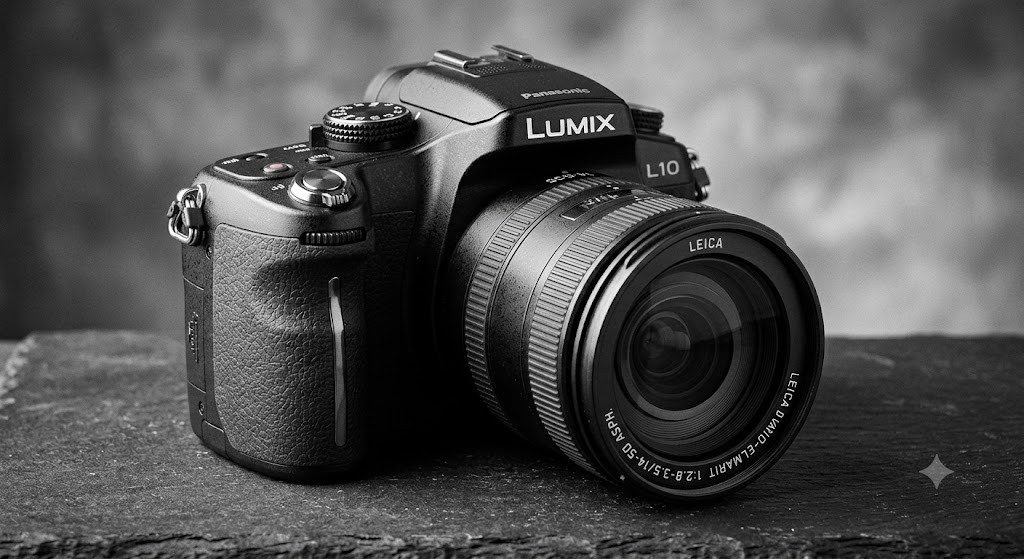
Metal Construction and Color Options
The L10’s body uses metal and magnesium alloy construction. Three color options celebrate LUMIX’s 25th anniversary. Black and Silver are the standard production variants at $1,499. The Titanium Gold Special Edition costs $1,599 and ships in limited quantities from July 2026.
Physical Controls
A shutter speed dial occupies the top plate. An aperture ring surrounds the lens barrel. An exposure compensation dial sits within reach of the right thumb. These controls allow photographers to set exposure without entering any menus, following the “classic” camera control approach that works extremely well in practice.
A 2.36 million dot OLED EVF provides a bright, high-contrast viewfinder image for outdoor shooting. The fully articulating rear monitor uses a free-angle design that rotates 180 degrees for selfie and overhead shooting positions. One noteworthy omission: the L10 lacks a headphone jack. Video shooters who monitor audio through headphones will find this limiting, though photographers shooting primarily stills and casual video will not notice its absence.
Optical Image Stabilization
The L10 uses optical image stabilization built into the lens rather than sensor-shift IBIS. For a fixed-lens camera, lens-based stabilization is entirely appropriate and technically effective. Power O.I.S. provides smooth footage during walking and handheld movement. Combined with electronic image stabilization, the camera can deliver stabilized footage suitable for travel vlogs and documentary work without a gimbal.
LUMIX Lab 3.0 App
The LUMIX Lab app version 3.0 launches May 20, 2026, alongside the L10 announcement. RAW editing now comes to the mobile app, enabling photographers to process L10 RAW files on a smartphone without a computer. This matters significantly for travel photographers who need to deliver edited images quickly from remote locations.
Magic LUT, powered by AI color analysis, is the standout new feature. Upload any reference image with a look you want to replicate, and the app generates a custom LUT matching its tonal and color characteristics. A wired phone connection option enables faster file transfers compared to wireless, which matters when moving large 5.6K files from camera to phone.
Pricing and Competition
Value Relative to Competitors
At $1,499, the Lumix L10 sits $400 below the Fujifilm X100VI at launch pricing. The X100VI has a fixed 23mm equivalent lens, while the L10 offers a 24-75mm equivalent zoom. The X100VI is smaller and arguably more elegant in design, but the L10 offers considerably more shooting versatility.
The Sony RX100 VII, at around $1,300, uses a 1-inch sensor with a significantly smaller image area than the L10’s Four Thirds sensor. The L10 wins on image quality at equivalent settings and on low-light performance.
The Ricoh GR IV targets a different audience: photographers who want a pocketable tool with APS-C image quality and minimal zoom versatility. The L10 cannot match it for pocketability but offers zoom flexibility and a physically larger sensor image circle.
The Fujifilm X100VI Comparison
The X100VI’s fixed 23mm equivalent prime is optically exceptional at its single focal length. It renders bokeh in a specific way, handles edge sharpness at wide apertures with characteristic charm, and defines the aesthetic of the camera’s output.
The L10’s zoom covers more ground but cannot match a dedicated prime’s optical character at any specific focal length. For photographers with a strong attachment to a specific focal length perspective, the X100VI’s singularity is a feature, not a limitation. For photographers who want to shoot at multiple focal lengths without carrying multiple cameras, the L10 makes more practical sense.
Who Should Buy the Lumix L10?
Ideal Buyers
Travel photographers who want versatility without an interchangeable lens kit are the primary audience. The 24-75mm zoom handles everything from landscape wide shots to portrait compression in a single package. The 5.6K video capability handles travel vlog and documentary needs without a separate video camera.
Content creators who deliver social media content and need both photo and video quality in a compact, stylish body will find the L10’s LUT workflow, 4:2:2 10-bit video, and Real Time LUT preview genuinely useful.
Experienced photographers upgrading from an older LX100 or LX100 II gain a generation’s worth of improvements across sensor, autofocus, video, and build quality in the same general camera philosophy.
Who Should Look Elsewhere
Photographers who prioritize absolute portability should look at the Ricoh GR IV or the Sony ZV-1 II instead. The L10 weighs 508 grams, which is substantial for a fixed-lens compact.
Photographers who shoot primarily at a single focal length and want the optical excellence of a prime should consider the Fujifilm X100VI. Video professionals who need a headphone jack for audio monitoring should note the L10’s omission and consider alternative tools.
The L10 in Panasonic’s Broader 2026 Strategy
Panasonic launched the L10 as part of its 25th LUMIX anniversary. DPReview reports suggest there may be up to three Panasonic cameras coming this year for the anniversary celebration, and the L10 is the first. The strong commercial reception, with reports of Panasonic being “overwhelmed by orders,” suggests the company has genuine appetite to continue investing in the compact category.
The L10 also aligns with a broader market trend: compact cameras are experiencing a strong commercial resurgence in 2026. Sensor quality improvements, computational photography features, and the growing appetite for capable photography tools among content creators have all contributed to this revival. Panasonic sat out this trend for eight years. The L10 marks the company’s intention to compete seriously in the premium compact segment going forward.
Final Verdict: Is the Lumix L10 Worth $1,499?
Yes, for the right photographer. The Lumix L10 delivers a combination of features that nothing else in its price range currently matches: a Leica-branded zoom covering 24-75mm at f/1.7-2.8, a 20.4MP multi-aspect Four Thirds sensor with dual-gain DR technology, 5.6K 60p video with V-Log and Real Time LUT, 779-point Phase Hybrid AF from Panasonic’s professional full-frame system, and a metal body with an OLED viewfinder.
That is an impressive package at $1,499. The size is larger than some compact camera buyers prefer, and the lack of a headphone jack limits audio monitoring for video work. However, for the photographer who wants a versatile, well-built camera with serious photo and video capability in one body, the Lumix L10 is a compelling answer.
Panasonic waited eight years to follow the LX100 II. The L10 justifies that wait.
Read More from Altbuzz
Explore more of our 2026 camera coverage at altbuzzmedia.com. Related deep-dives include our analysis of the Leica Q4 rumors and the Hasselblad X3D 180C rumor coverage. Our best compact cameras for travel in 2026 guide compares the Lumix L10 alongside the Fujifilm X100VI, Ricoh GR IV, and Sony ZV-1 II.
Subscribe to Altbuzz YouTube Channel
Camera reviews, spec breakdowns, and hands-on first-look videos live on the Altbuzz YouTube channel @AltBuzzMedia. Subscribe for upcoming coverage of the Lumix L10 in real shooting conditions and ongoing updates across the 2026 camera release calendar.