
Contax T2 Digital: The Camera Fans Keep Wishing For
Search for “Contax T2 Digital” and you will find forums full of hopeful photographers. They want a modern digital camera that captures the same magic as the original titanium classic. This article looks at that dream honestly. There is no confirmed Contax T2 Digital in development. Contax stopped making cameras years ago. What follows is a clear look at the original T2, why the digital version keeps coming up in conversation, and which real cameras come closest to answering that wish today.
This piece treats the Contax T2 Digital as community speculation rather than a sourced rumor. Readers deserve honesty about what is real and what is fan hope. Let’s dig into the full story.
Why the Contax T2 Digital Keeps Coming Up
Photographers bring up the Contax T2 Digital in forums almost every year. The pattern usually looks the same. Someone owns a Contax T2. They love the Zeiss lens and the titanium body. Then they ask where they can find something similar in a digital format.
This question makes sense once you understand the original camera. Kyocera released the Contax T2 in 1990 under the Contax brand, a name tied to Zeiss optical heritage. The camera used a Carl Zeiss Sonnar T* 38mm f/2.8 lens inside a titanium body. It built a reputation for sharp images, quiet operation, and a design that still turns heads decades later.
Kyocera exited the camera business entirely in 2005. The Contax name went dormant after that point. No company currently owns active plans to revive it as a digital shooter. Yet the T2’s reputation only grew stronger over time, fueled by film photography’s resurgence and a handful of celebrity sightings that pushed used prices well past their original value.
That combination explains the Contax T2 Digital search term. Fans want the lens quality and design language they already love, minus the cost and hassle of shooting film.
A Quick History of the Real Contax T2
Understanding the original camera helps frame what a Contax T2 Digital would need to deliver.
Kyocera introduced the Contax T2 as a follow-up to the original Contax T, a manual-focus compact from 1984. The T2 added autofocus while keeping the same titanium construction and Zeiss lens heritage. It arrived at the top of the point-and-shoot market, aimed at photographers who wanted something more serious than a typical consumer compact.
The lens stood out immediately. Carl Zeiss designed the Sonnar T* 38mm f/2.8 formula using five elements across four groups. This lens delivered sharp, contrasty images with a rendering style that many photographers still describe as distinct even compared to modern optics.
Build quality matched the lens. The titanium shell felt dense and premium in the hand. A retracting lens barrel protected the glass when not in use, and a bright viewfinder with parallax correction made composing shots straightforward. Kyocera later expanded the lineup with the T3, which added a slightly wider 35mm lens and updated electronics.
Contax also produced other cameras worth noting here, since some fans confuse them with a digital T2. The TVS Digital arrived as a 5-megapixel compact with a 35 to 105mm equivalent zoom lens, a genuinely digital Contax compact, but a very different camera from the T2 in both concept and lens design. The Contax i4R, released in 2004, marked one of the brand’s final digital efforts before Kyocera closed the division in 2005.
What a Contax T2 Digital Concept Might Include
Since no real product exists, this section stays firmly in concept territory. It reflects what fans across forums and comment sections consistently ask for, not confirmed specifications.
Most requests center on a fixed prime lens somewhere between 35mm and 40mm equivalent, echoing the original T2’s field of view. Fans want a sensor large enough to deliver meaningful depth of field control and strong low-light performance, likely APS-C or larger given where the rest of the compact camera market has moved.
A titanium or metal body shows up constantly in these discussions. Photographers associate that material directly with the T2’s premium feel, and any digital successor would likely need a similar build to satisfy long-time fans of the brand.
Many also mention wanting Zeiss glass specifically, given the lens formula’s reputation. Whether any company could secure that partnership today remains an open question, since Zeiss now works primarily with brands like Sony on select lens lines rather than reviving dormant partnerships from decades past.
A hybrid or optical viewfinder appears in wishlist threads too, since the original T2 offered a bright, simple viewfinder that many photographers still prefer over composing purely through a rear screen.
None of this reflects an announced product. It reflects a consistent pattern of requests from photographers who miss what the original camera offered and want it translated into a digital format.
Why No Company Has Made This Camera Yet
A few practical reasons explain why the Contax T2 Digital remains a wishlist item rather than a real release.
Contax itself no longer exists as an active manufacturer. Kyocera sold off the camera business in 2005, and the Contax name has sat dormant since. Reviving a dead brand requires licensing, tooling, and investment that most companies avoid unless a name carries enormous ongoing brand equity, and camera brand loyalty rarely translates into that kind of guaranteed return.
The market for premium fixed-lens compacts has also narrowed considerably since the T2’s era. Fewer companies compete in this space today compared to the 1990s and early 2000s, when nearly every major brand fielded multiple compact models. Companies that remain in this space, such as Fujifilm and Ricoh, already have established product lines that serve similar photographer needs without reviving a competitor’s old brand name.
Zeiss lens partnerships also add complexity. Zeiss currently licenses its optical designs to select partners rather than working broadly across the market the way it did during the Kyocera era. Any brand hoping to recreate that Sonnar rendering would need a fresh agreement, which adds cost and negotiation that few companies see as worthwhile for a niche compact camera.
Cameras That Fill the Contax T2 Digital Gap Today
Rather than waiting for a camera that may never arrive, many photographers turn to real cameras already on the market. These options do not carry the Contax name, but they answer many of the same needs.
The Fujifilm X100 series stands out as the closest modern equivalent in spirit. It pairs a fixed prime lens with an APS-C sensor inside a compact, retro-styled body. The hybrid viewfinder adds a feature the original T2 never had, giving photographers more flexibility when composing shots. Readers curious about this camera’s full specifications can visit the Fujifilm official product page.
The Ricoh GR series offers another strong alternative, particularly for photographers who prioritize a smaller, pocketable body over an integrated viewfinder. Ricoh’s GR cameras use a fixed wide-angle lens and a APS-C sensor, delivering sharp images in a genuinely pocket-sized shell that echoes the T2’s portability. Full details are available on the Ricoh Imaging website.
The Sony RX1 series takes a different approach entirely, pairing a full-frame sensor with a fixed lens in a compact body. This camera costs considerably more than the T2 ever did, but it appeals to photographers chasing the absolute best image quality in a fixed-lens package. Specifications are listed on the official Sony site.
None of these cameras carries the Contax name or uses a Zeiss Sonnar lens formula exactly matching the T2. Each one, however, solves the core problem that drives the Contax T2 Digital search in the first place: a serious, well-built compact camera with a lens worth trusting.
Comparing the Real T2 to Modern Alternatives
A side-by-side look helps frame how far modern cameras have come, even without carrying the Contax name.
| Feature | Contax T2 (1990) | Fujifilm X100V | Ricoh GR III |
|---|---|---|---|
| Format | 35mm film | Digital APS-C | Digital APS-C |
| Lens | 38mm f/2.8 Zeiss Sonnar | 23mm f/2 | 28mm f/2.8 |
| Body material | Titanium | Magnesium alloy | Aluminum and magnesium |
| Viewfinder | Optical, parallax corrected | Hybrid optical/electronic | None built-in |
| Autofocus | Active AF | Hybrid AF with face detection | Contrast and phase detection |
| Weight | 348g | 478g | 257g |
| Current price | Around $2,000 used | Around $1,400 new or used | Around $900 new |
This table shows why photographers keep circling back to modern alternatives. The Fujifilm and Ricoh options both deliver stronger technical performance than the original T2 ever could, even though neither carries the same brand history or lens pedigree.
Should Fans Keep Hoping for a Contax T2 Digital?
Hope costs nothing, and camera history has surprised people before. Still, photographers should approach this wish with realistic expectations.
Brand revivals do happen in the camera industry occasionally, but they usually come from companies that already hold the rights and see a clear business case. Contax sits in a more complicated position, since Kyocera fully exited the camera business rather than selling the brand to another active manufacturer the way some other defunct names have changed hands.
Photographers who want the closest experience available today should look at what Fujifilm, Ricoh, and Sony already offer. These companies actively develop and support their compact camera lines, unlike a dormant brand with no current manufacturing capability.
For now, the Contax T2 Digital remains exactly what it has always been: a well-loved fan concept built from genuine appreciation for a classic camera, rather than a confirmed product with a release date.
How the Contax T2 Became a Cultural Icon
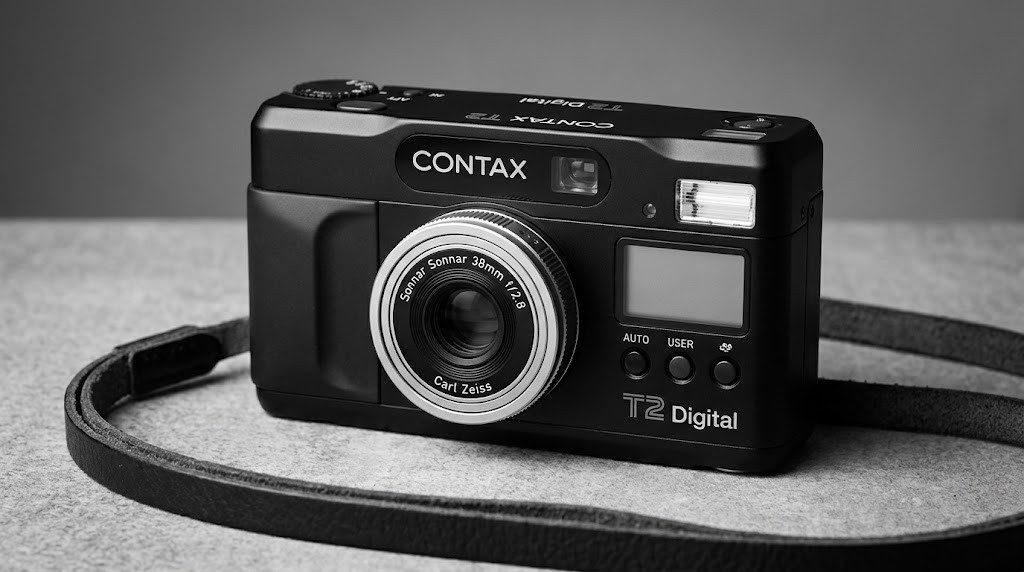
Understanding the hype around the Contax T2 helps explain why so many people now search for a digital version.
Celebrity sightings played a major role in pushing the T2 into mainstream awareness well beyond photography circles. Musicians, actors, and models were photographed carrying the camera throughout the 2010s, turning it into a recognizable status symbol alongside its reputation among working photographers. Social media accelerated this effect, with images shot on the T2 circulating widely and driving new interest from people who had never previously considered a film camera.
Supply and demand did the rest. Kyocera manufactured a limited number of these cameras over the production run, and thirty years of use has taken its toll. Many units have failed, been lost, or need expensive repairs that specialized technicians can no longer easily perform. Fewer working examples remain each year, while demand has only grown alongside the broader film photography revival.
This combination created a feedback loop. Rising prices increased visibility, increased visibility drove more demand, and limited supply kept pushing the price higher still. A camera that once retailed for a few hundred dollars now regularly sells for close to two thousand dollars in good condition.
That same cultural momentum explains why people want a digital equivalent. They want the design language, the lens character, and the cultural cachet, without needing to source and maintain an aging film camera that could fail at any time.
Deeper Look at Modern Alternatives
Beyond the three cameras already mentioned, a few other options deserve consideration for photographers chasing the Contax T2 experience in digital form.
The Leica Q series takes the fixed-lens compact concept to a premium extreme, pairing a full-frame sensor with a Summilux 28mm f/1.7 lens in a body built with the same attention to materials that Leica applies across its lineup. This camera costs significantly more than any option discussed so far, but it appeals to photographers who want top-tier image quality alongside genuine luxury build quality.
Older used options also deserve a mention for budget-conscious buyers. The original Sony RX100 series, while smaller in sensor size than the RX1, offers a genuinely pocketable body with a versatile zoom lens at a fraction of the cost of premium fixed-lens compacts. It will not match the T2’s rendering character, but it provides a capable, affordable entry point into serious compact photography.
Photographers who specifically want the tactile, mechanical feel of a clamshell lens cover, one of the T2’s most beloved design touches, may find that few modern digital cameras replicate this exact mechanism. Most modern compacts use a simple lens cap or a retracting barrel without the same satisfying clamshell action, which remains one design element that has not carried over into the current market.
What Would Need to Happen for This Camera to Become Real
Turning the Contax T2 Digital from concept into reality would require several pieces to align.
A company would need to acquire rights to the Contax name, likely from whatever entity currently holds any residual trademark interests following Kyocera’s exit from the camera business. This step alone involves legal and financial complexity that has apparently not seemed worthwhile to any manufacturer over the past two decades.
A fresh optical partnership with Zeiss would also need to happen, assuming fans want a genuine link to the original Sonnar lens heritage rather than simply a Zeiss-branded lens made under a different arrangement. Zeiss has shown willingness to partner with active manufacturers, but reviving a specific historical lens formula for a dormant brand represents a different kind of commitment.
Manufacturing capability and distribution would need to be built essentially from scratch, since no current infrastructure exists to produce cameras under the Contax name. This would put a hypothetical Contax T2 Digital in a similar position to an entirely new camera company launching from zero, rather than an established manufacturer simply adding a new model to an existing lineup.
Given all of these hurdles, the realistic path forward likely remains what it has been for years. Existing manufacturers continue refining their own fixed-lens compact lines, and photographers continue finding satisfaction in cameras that capture the same spirit without carrying the Contax badge.
How Photographers Talk About This Camera Online
Forum threads and comment sections reveal consistent themes whenever the Contax T2 Digital comes up.
Many photographers frame the request around convenience rather than nostalgia alone. They already own and love a Contax T2, but shooting film means paying for development, waiting for scans, and accepting the risk of an aging electronic shutter failing mid-roll. A digital equivalent would remove these friction points while, in their view, preserving the character they already appreciate.
Others focus purely on the design language rather than the film versus digital debate. They admire the titanium body, the compact proportions, and the understated styling, and simply want those design choices applied to a modern sensor and processor. For this group, brand history matters less than the physical object itself.
A smaller group specifically chases the Zeiss Sonnar rendering, having read enough comparisons and sample photos to believe that particular lens formula produces a look no modern optic fully replicates. This group tends to be the most skeptical that any current alternative truly satisfies their want, since even excellent modern lenses render images differently than five-element vintage formulas from decades ago.
Recognizing these different motivations helps explain why no single modern camera fully satisfies everyone chasing this idea. Some fans would be delighted with a Fujifilm X100V. Others feel nothing short of an actual revived Contax lens formula would count as the real thing.
Frequently Asked Questions
Does the Contax T2 Digital actually exist? No. There is no confirmed digital version of the Contax T2. The idea circulates as fan speculation and community wishlist discussion rather than an announced product.
Why did Contax stop making cameras? Kyocera, the company behind Contax, exited the camera business entirely in 2005 and sold off related assets. The Contax name has remained dormant since that point.
Did Contax ever make a digital camera? Yes. Contax released digital models including the TVS Digital and the i4R before Kyocera closed the division in 2005. Neither of these cameras matches the T2’s fixed 38mm Zeiss Sonnar lens concept.
What is the closest camera to a Contax T2 Digital today? The Fujifilm X100 series comes closest in spirit, offering a fixed prime lens on an APS-C sensor inside a compact, retro-styled body. The Ricoh GR series offers a similar concept in a smaller, more pocketable shell.
Is the original Contax T2 still worth buying in 2026? Prices for a serviced Contax T2 now sit around two thousand dollars, driven by scarcity and collector demand. Photographers who plan to shoot it regularly and enjoy film photography may still find it worthwhile, though the price gap compared to modern digital alternatives has grown significantly.
Final Thoughts
The Contax T2 Digital represents a genuine desire from photographers who love what the original camera delivered decades ago. That desire has not translated into an actual product, and no current evidence suggests one is coming. Contax remains dormant, and reviving it would require resources most companies choose not to spend on a niche compact camera market.
Photographers chasing that same experience today have real options. The Fujifilm X100 series, the Ricoh GR line, and the Sony RX1 series all deliver strong fixed-lens performance in well-built bodies. None of them carry the Contax name, but each answers the same underlying need that keeps the Contax T2 Digital search alive year after year.
More From Altbuzz
Altbuzz covers camera history, current releases, and honest rumor coverage across every major brand. Readers who enjoyed this look at the Contax T2 Digital concept can find more detailed camera coverage on the Altbuzz website, including deep dives into cameras that fill this same niche today.
Altbuzz also shares hands-on video reviews and camera news updates regularly. Subscribe to the Altbuzz YouTube channel for more honest breakdowns like this one, along with coverage of real upcoming camera releases as they get announced.