
Street photographers are a demanding audience. They do not want a camera that slows them down. They do not want a camera that calls attention to itself. They do not want a camera that fights them for control of the exposure triangle. Above all else, they want a camera that disappears into the act of making pictures.
The Fujifilm X-E5, released August 28, 2025, understands this instinctively. It arrived as the long-awaited successor to the X-E4, a camera discontinued in 2023 that left a dedicated community of street and travel photographers without a natural upgrade path for over two years. The X-E5 fills that gap with confidence, bringing the 40MP X-Trans CMOS 5 HR sensor, 7-stop in-body image stabilization, a brand-new dedicated Film Simulation dial, and AI-powered subject detection autofocus into the smallest, most discreet body in Fujifilm’s current interchangeable-lens lineup.
However, the X-E5 arrives at a price that demands scrutiny. At $1,699 body only, it costs double what the X-E4 launched at. That price point raises a legitimate question: does the X-E5 deliver twice the camera?
This review answers that question in full. After months of shooting the X-E5 through street sessions, travel assignments, portrait work, and video tests, here is everything photographers need to know before committing to one of the most interesting cameras Fujifilm has ever made.
Fujifilm X-E5: Full Specifications at a Glance
| Specification | Fujifilm X-E5 |
|---|---|
| Sensor | 40.2MP APS-C X-Trans CMOS 5 HR |
| Sensor size | 23.5 x 15.7mm |
| Processor | X-Processor 5 |
| Autofocus | Hybrid AF, 425 points, AI subject detection |
| Subject detection | Animals, birds, cars, bikes, planes, trains |
| IBIS | 5-axis, up to 7 stops |
| Video | 6.2K 30p, 4K 60p, 1080p 240p |
| Film simulations | 20 including Reala Ace |
| Film Simulation dial | Yes (new for X-E line) |
| Viewfinder | 0.5-inch OLED EVF, 3.69M dots |
| Rear screen | 3-inch tilting touchscreen, 1.62M dots |
| Storage | Single SD UHS-II |
| Battery | NP-W126S |
| Weight | 445g with battery and card |
| Body dimensions | 121.3 x 72.9 x 32.7mm |
| Weather sealing | Light rain resistance (with WR lenses) |
| Colors | Black, Silver |
| Launch price | $1,699 body only |
| Released | August 28, 2025 |
Design and Build: The X-E Spirit in 2025 Form
What the X-E5 Looks Like in Your Hands
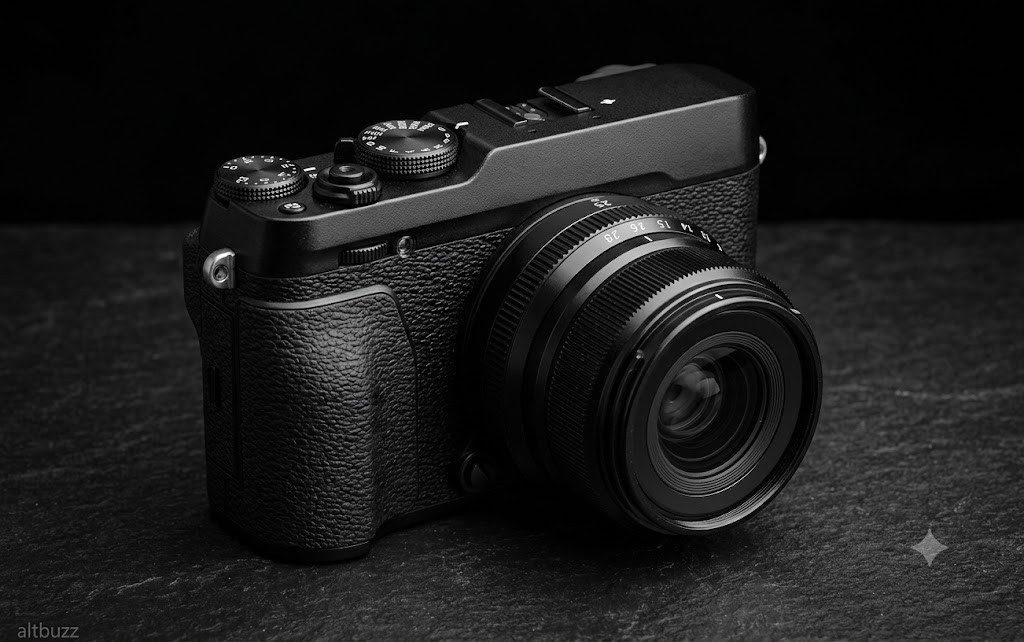
Pick up the X-E5 and the first thing that registers is how right it feels. The rangefinder-inspired body sits naturally in one hand. The small grip on the front face, a subtle but important addition over the X-E4’s completely gripless design, provides just enough friction to hold the camera securely without requiring a death grip.
The top plate carries three dials in a row. From left to right: shutter speed, Film Simulation, and exposure compensation. This layout is both immediately logical and deeply satisfying to use. The shutter speed dial moves with confident clicks between marked positions. The exposure compensation dial adjusts in third-stop increments with equally defined detents. And the Film Simulation dial, the headline new physical feature of the X-E5, sits prominently in the center of this triumvirate.
The body measures 121.3 x 72.9 x 32.7mm. This is compact, but not pocketable in the strict sense. A jacket pocket accepts it comfortably. A trouser pocket does not. For all-day carry, most photographers use a wrist strap or a small shoulder bag, which is entirely appropriate for a camera of this class.
Metal Construction and Finish Quality
Tom’s Guide’s review calls out the X-E5’s “beautiful build quality” and “premium build quality” among the camera’s core strengths. Both assessments are accurate. The body uses a magnesium alloy chassis with a textured leatherette covering on the front and rear panels. The finish resists fingerprints better than smooth metal bodies and feels warm in cold conditions rather than the uncomfortably cold sensation that bare metal produces.
The top plate is bare aluminum, which polishes slightly with use over time and gives the silver variant a particularly attractive aged-camera aesthetic. The black variant maintains its appearance more uniformly.
Size Comparison With Fujifilm Siblings
Compared to the X-T50, the X-E5 is meaningfully more compact. Compared to the X-100VI, it is slightly larger due to the interchangeable lens mount. For photographers who come from the X-E4 and remember its extraordinary compactness, the X-E5 will feel marginally larger and heavier.
Photography Blog confirms the weight figures: 445g with battery and card, compared to the X-E4’s 364g. That 81g difference is noticeable but not prohibitive. Most photographers who handle both cameras back to back settle quickly into the X-E5’s weight without complaint.
The Film Simulation Dial: Finally on an X-E Camera
Why This Feature Changes the Shooting Experience
The Film Simulation dial is the most talked-about physical addition to the X-E5, and the discussion is justified. For photographers who shoot Fujifilm JPEGs directly from the camera, the ability to select a simulation by physical feel without looking at the screen or navigating any menu is genuinely transformative.
Moment’s review describes the experience well. Because it is a physical knob, the selected simulation is readable even when the camera is off. When the camera powers on, that selection is already active. There is no wait. There is no confirmation. The camera simply starts producing the color output the photographer chose.
The dial provides positions for six directly selectable simulations plus a Custom slot and three User modes, giving photographers up to nine directly accessible settings through a single dial. The standard six selections can be any simulation from the library of 20, configured through the menu during setup.
The Full Film Simulation Library in June 2026
The X-E5 carries 20 film simulations including Reala Ace, which was introduced in 2024 and has quickly become a community favorite for its accurate, natural-toned color rendering particularly suited to documentary and street photography. The full library includes Provia/Standard, Velvia/Vivid, Astia/Soft, Classic Chrome, Pro Neg Hi, Pro Neg Std, Classic Neg, Reala Ace, Nostalgic Neg, Acros (with yellow, red, and green filter variants), Sepia, and multiple toning options.
For photographers who have built their visual style around specific Fujifilm simulations, the X-E5 delivers all of them accessible with a direct physical control. For photographers new to Fujifilm, the dial encourages experimentation in a way that menu-based selection never quite achieves. Rotating through Classic Neg, Nostalgic Neg, and Classic Chrome in rapid succession during a street session reveals each simulation’s character in direct comparison.
JPEG Output Quality: Still Fujifilm’s Strongest Argument
The X-E5’s JPEG output, particularly through the film simulations, remains one of the most compelling arguments for choosing Fujifilm over any competing APS-C system. The color rendering, noise structure, and tonal character of Fujifilm JPEGs produce images that photographers describe as immediately usable without editing.
DPReview’s in-depth review confirms this: “it continues Fujifilm’s tradition of offering pleasing colors and does a decent job of retaining details even while reducing noise at higher ISOs.” For photographers who want a finished image directly from the camera rather than a raw file requiring post-processing, the X-E5 delivers this more consistently than any competing APS-C camera.
The 40MP X-Trans CMOS 5 HR Sensor: Resolution Meets Character
Shared Sensor, Familiar Excellence
The X-E5 uses the same 40.2MP X-Trans CMOS 5 HR sensor as the X-T5 and X-H2. This is confirmed by Photography Blog and DPReview. In practical terms, it means the X-E5 delivers identical raw image quality to Fujifilm’s flagship APS-C stills bodies.
DPReview’s technical analysis is explicit: “The X-E5’s Raw detail capture is identical to Fujifilm’s other 40MP cameras, and it outperforms the 24MP Nikon Z5II and 26MP Sony a6700.” For photographers who previously dismissed the X-E line as a compromise on image quality compared to the X-T series, the X-E5 eliminates that distinction entirely.
What 40MP Actually Gives You
At 40.2MP, the X-E5 produces files measuring 7,728 x 5,152 pixels. These files support significant cropping for subject isolation without resolution loss, large-format print output up to approximately 36 x 24 inches at 300dpi without upscaling, and multiple reframes from a single capture for different delivery formats.
For street photographers, the cropping flexibility is particularly valuable. Shooting wide and cropping tight is a legitimate creative approach that the X-E5’s resolution enables without visible quality compromise. A photographer who captures a candid moment at 23mm and wants to isolate a specific expression within the frame can crop to approximately 50% of the image area and retain a 10MP file, more than sufficient for web delivery and moderate print use.
High ISO Performance: Honest Assessment
The X-E5’s high ISO performance is strong for an APS-C camera. DPReview notes that base ISO noise performance is “on par with the rest of the current-gen APS-C competition” and “a bit cleaner than the X-E4.” However, the full-frame Z5II delivers roughly one stop of advantage in noise performance due to its larger sensor area, which is the expected physical consequence of the sensor size difference.
In practical shooting terms, the X-E5 produces clean files at ISO 1600 and usable results at ISO 3200. At ISO 6400, luminance noise becomes visible but color noise remains well-controlled through Fujifilm’s noise reduction algorithms. At ISO 12800, noise is present but manageable in shadow areas where detail was already limited by the lighting conditions.
The X-Trans Advantage and Workflow Consideration
The X-Trans color filter arrangement continues to produce the color rendering character that defines Fujifilm’s visual identity. However, photographers who process raw files in Adobe Lightroom should be aware that Lightroom’s X-Trans demosaicing algorithm occasionally produces slightly softer fine detail than dedicated software like Capture One for Fujifilm or Iridient X-Transformer.
This is not a new consideration for Fujifilm shooters. It is worth noting for photographers switching from Bayer-sensor cameras who may notice the difference in their first raw editing sessions.
IBIS: A First for the X-E Line and a Game Changer
Seven Stops Changes Everything
The X-E4 had no image stabilization of any kind. The X-E5’s 5-axis IBIS rated at 7 stops is therefore not an incremental improvement over its predecessor. It is a categorical change in what the camera can do.
As the ts2.tech review reports directly: “Photographers report being able to shoot down to around 1/4-second exposures handheld with good keeper rates, something impossible on the unstabilized X-E4.” Similarly, Alik Griffin’s review notes comfortable handheld shooting “down to around 1/8-second shutter speed” in practical use.
For street photographers working in dim interiors, evening city scenes, or museum environments where flash is prohibited, these extended shutter speeds open creative possibilities that the X-E4 simply could not offer. A photographer who previously needed ISO 6400 to maintain a safe 1/60s shutter speed can now drop to ISO 800 at 1/8s with reliable stability, producing significantly cleaner files from the same scene.
Continuous and Shoot-Only IBIS Modes
Moment’s review highlights a practical detail worth noting: the X-E5 offers two distinct IBIS operating modes. Continuous IBIS keeps stabilization active at all times, including during composition through the viewfinder or screen. Shoot-Only IBIS activates stabilization only during the actual capture moment, which extends battery life at the cost of slightly less stabilized live view framing.
For photographers who regularly use the EVF for extended street sessions, Shoot-Only mode represents a meaningful battery life improvement. Continuous mode is preferable for video recording and for shooting in very challenging handheld conditions where stabilized live view helps with composition accuracy.
Video Stabilization Benefits
For video shooters, IBIS transforms the X-E5’s handheld footage quality. Combined with Fujifilm’s electronic image stabilization, the camera produces noticeably smoother footage than the X-E4 ever could. Walking shots, documentary handheld coverage, and vlog-style clips benefit directly from the combination.
Fstoppers’ review notes that “quick pans should be avoided” due to the high-resolution sensor’s rolling shutter characteristics. This is an accurate assessment. The X-Trans CMOS 5 HR is a standard BSI design without stacking, which means electronic shutter readout is slower than on partially stacked competitors. Fast panning during video produces visible rolling shutter artifacts that careful camera movement management can minimize but not eliminate.
Autofocus: 425-Point AI Subject Detection
What the System Covers
The X-E5 uses Fujifilm’s Intelligent Hybrid AF system with 425 focus points distributed across the full APS-C sensor area. Phase detection AF pixels embedded in the sensor enable fast, direct focus acquisition rather than the searching behavior of contrast-only systems.
Subject detection covers an impressively wide range. Photography Blog’s review confirms detection of animals, birds, cars, bikes, planes, and trains alongside the standard human face and eye detection. This breadth reflects the X-Processor 5’s AI deep learning classification capability, which categorizes subjects in real time and prioritizes tracking based on detected category.
Face and Eye Detection in Real Street Shooting
For street photography use cases, face and eye detection reliability in challenging conditions matters most. The X-E5’s system handles forward-facing and three-quarter-profile faces well in good to moderate light. In lower light below approximately EV 3, detection confidence drops and the system occasionally loses subject lock during movement.
DPReview’s analysis confirms that the X-E5’s AF performance is “identical to Fujifilm’s other 40MP cameras” given the shared processor. Compared to Sony’s A7 series or Canon’s Dual Pixel CMOS AF II, the X-E5’s tracking in challenging continuous scenarios shows more hunting. For deliberate street shooting at a measured pace, this is acceptable. For photographers who shoot fast-moving subjects continuously, this limitation becomes more relevant.
Single Shot vs Continuous AF
Single-shot AF in good light is fast and decisive. The X-E5 acquires focus quickly on subjects with adequate contrast, and face detection locks immediately when a clear face enters the detection zone. This suits the deliberate, unhurried street shooting style the camera is designed for.
Continuous AF during video recording is competent but not exceptional. Fstoppers’ review notes that specific conditions, such as recording with the XF 23mm f/2.8 in low light, produce occasional hunting. Photographers who use the X-E5 primarily for video with continuous AF should test their specific lens and lighting combination before depending on it for critical capture.
Video: 6.2K, 4K 60p, and Practical Hybrid Capability
The Headline Video Specifications
The X-E5 records video in formats that a photographer-first camera has no business offering at this price point. 6.2K open-gate capture at 30fps produces oversampled 4K output with exceptional detail. 4K at 60fps enables standard and moderate slow-motion use. 1080p at 240fps adds extreme slow-motion for creative emphasis shots.
F-Log2 is available for flat, wide-dynamic-range capture with maximum grading latitude in post-production. This is a genuinely professional color science option that positions the X-E5 as a capable hybrid tool beyond its street photographer primary identity.
Practical Video Limitations
The X-E5 is not a video-first camera, and several practical limitations reflect this. There is no headphone jack for audio monitoring during recording. The battery (NP-W126S) drains more quickly during 4K 60fps recording with IBIS active than during stills shooting. Tom’s Guide specifically identifies “weak battery life” as one of the X-E5’s key weaknesses.
The tilting rear screen, while functional for overhead and low-angle video compositions, does not articulate fully forward for vlogging to camera. Creators who want to frame themselves directly while recording will need an external monitor mounted above or to the side.
For photographers who occasionally shoot video but do not build their creative workflow around it, the X-E5’s video capability is more than sufficient. For dedicated video creators who need audio monitoring, fully articulating screens, and sustained recording without battery anxiety, the X-S20 at approximately $1,299 is a more purpose-built choice.
The Viewfinder: EVF Design and the OVF Simulation Mode
3.69 Million Dot OLED EVF
The X-E5’s electronic viewfinder uses a 0.5-inch OLED panel at 3.69 million dots. This represents a significant resolution advantage over competing compact mirrorless cameras at similar prices and delivers a sharp, high-contrast viewing experience appropriate for precise manual focus work, critical composition decisions, and shooting in bright sunlight where the rear screen becomes difficult to see.
The EVF magnification of 0.66x provides a comfortable, expansive view that suits extended street shooting sessions without eye fatigue.
The OVF Simulation Mode: Gimmick or Genuine Tool?
Tom’s Guide describes the X-E5’s EVF modes that “simulate the experience of using an OVF” as “a little gimmicky” but “enjoyable to use.” This is a fair assessment. Fujifilm’s OVF simulation mode reduces the EVF to show a brightline framefinder-style overlay on an unprocessed live view, mimicking the optical viewfinder experience of a film rangefinder camera.
For photographers with a history of film rangefinder shooting, this mode creates a genuine emotional connection to a shooting style the camera’s design already evokes aesthetically. For photographers without that background, the standard EVF mode is simply the better choice.
Real-World Street Photography: What the X-E5 Feels Like in Use
The Decisive Moment, Revisited
After several months of street shooting with the X-E5 through various city environments, markets, and documentary projects, a clear pattern emerges. The camera earns trust quickly. It does not obstruct the photographic process. Instead, it recedes into the background while the physical controls provide immediate access to every creative decision.
Reaching for the Film Simulation dial to switch from Classic Neg to Acros mid-session takes one second and zero cognitive load. Adjusting exposure compensation with a half-turn of the thumb dial takes another second. The camera is ready before the moment passes.
This intangible quality matters enormously for street photography. A camera that forces a photographer to navigate menus or buttons removes attention from the scene. The X-E5, with its three top dials and Film Simulation dial, keeps the photographer’s focus outside the camera rather than inside it.
The XF 23mm f/2.8 R WR Pairing
The X-E5 launched alongside the XF 23mm f/2.8 R WR as a recommended pairing, and the combination is compelling. At 35mm equivalent on APS-C, the 23mm covers the most versatile street focal length. At f/2.8, it is not the fastest prime available for the mount, but the weather resistance (WR designation) extends the camera’s usability into light rain conditions.
The combination weighs approximately 575g total. Carry it all day without strap fatigue. Mount it on a wrist strap for complete discretion. For street documentary work, this pairing represents one of the finest compact APS-C systems currently available at any price.
Adapting Leica M-mount lenses is another popular approach, as Alik Griffin’s review specifically highlights. The X-E5’s rangefinder body styling, combined with its precise manual focus magnification tools, makes it a natural host for classic Voigtlander, Zeiss, and Leica M glass. The results combine the vintage optical character of M-mount lenses with the X-Trans sensor’s distinctive color rendering.
Battery Life: The Elephant in the Room
Honest Numbers
The X-E5 uses the NP-W126S battery, shared with the X-E4 and many older Fujifilm bodies. This is a smaller, lower-capacity battery than the NP-W235 used in the X-T5 and X-H2. The practical consequence is that the X-E5’s battery life is the single most consistent complaint in published reviews.
Tom’s Guide lists “weak battery life” explicitly as a core negative. Fstoppers’ review notes that “4K/60, IBIS, AF-C tracking sensitivity, and Boost IS settings chew through the NP-W126S” compared to cameras with the newer and larger battery.
In standard street photography use, at modest burst rates with occasional review and mixed IBIS use, the X-E5 delivers approximately 300 to 380 shots per charge. Full-day shooters who expect 500+ shots from a single battery will need to carry at least one spare.
The NP-W126S is widely available and affordable. Fujifilm also supports USB-C charging from power banks, which provides a practical top-up option during day-long shoots. Carry a spare battery and a small power bank and battery anxiety disappears.
Price Justification: Is the X-E5 Worth $1,699?
The Double-Price Question
The X-E4 launched at $849 in 2021. The X-E5 launches at $1,699 in 2025. That is a $850 price increase, or exactly double the predecessor’s launch price. Tom’s Guide specifically notes this doubling as a factor that “prevents the X-E5 scoring as highly as its siblings.”
The price increase has a clear technical explanation. The 40MP X-Trans CMOS 5 HR sensor, IBIS mechanism, updated processor, improved EVF panel, and UHS-II card support all add manufacturing cost. Furthermore, the X-E5 launched into a more expensive supply chain environment than the X-E4 did in 2021, with component costs, logistics, and tariff factors all elevated compared to that period.
Whether the price is justified depends on what the photographer needs. Compared to the X-T50, which launched at approximately $1,299 with the same sensor and processor, the X-E5 costs $400 more for a more compact body, a different physical control layout, and the rangefinder design language. That premium makes sense for photographers who specifically want the X-E experience. It makes less sense for photographers who prioritize features over form factor.
Value Compared to the X-T50
The X-T50 is the most directly comparable camera. Both use the 40MP X-Trans CMOS 5 HR sensor. Both use the X-Processor 5. Both include IBIS. Both carry the Film Simulation dial. The X-T50 adds a slightly larger grip, an ISO dial, and a somewhat more conventional control layout. The X-E5 offers a more compact and discreet body with rangefinder styling.
For photographers who want the smaller body and the rangefinder aesthetic, the $400 premium for the X-E5 over the X-T50 is justifiable. For photographers who are indifferent to form factor, the X-T50 delivers identical image quality at a lower price.
Fujifilm X-E5 vs Key Competitors
Against the Sony A6700
The Sony A6700 at approximately $1,299 offers a partially stacked 26MP sensor, faster continuous AF tracking, 4K 120fps, and Sony’s subject detection breadth. However, it lacks film simulations, produces a fundamentally different color character in JPEG output, and offers a more conventional camera body design without the X-E5’s tactile control appeal.
Photographers who prioritize color character, physical controls, and discreet body design will prefer the X-E5. Photographers who prioritize raw autofocus speed, 4K 120fps, and value-per-feature will lean toward the A6700.
Against the Fujifilm X100VI
The X100VI at $1,599 offers a fixed 23mm equivalent lens on the same sensor and processor. It is smaller and lighter than the X-E5 but lacks interchangeable lens flexibility. For photographers who have found the 23mm focal length to be their primary perspective, the X100VI’s fixed lens is not a limitation. For everyone else, the X-E5’s interchangeable lens mount opens the system.
Final Verdict: Fujifilm X-E5 Review Score
The Fujifilm X-E5 is the finest camera Fujifilm has ever put inside the X-E body. The 40MP X-Trans CMOS 5 HR sensor delivers flagship APS-C image quality. The 7-stop IBIS changes what handheld shooting in available light feels like. The Film Simulation dial finally brings direct physical simulation control to the X-E line. The rangefinder body remains one of the most pleasurable camera designs currently in production.
Its limitations are real and worth acknowledging directly. Battery life demands a spare. The price at $1,699 represents a significant jump from its predecessor. The rear screen resolution is lower than the X-E4’s. Video use is competent but not the camera’s strongest suit.
However, none of these limitations change the core assessment. For street, travel, and documentary photographers who want a compact, discreet, physically satisfying camera that produces outstanding images and earns trust during long shooting days, the Fujifilm X-E5 is simply one of the best options available in June 2026.
It is not the most feature-rich APS-C camera at its price. It is, however, one of the most enjoyable cameras to use. In the end, that distinction matters just as much.
Altbuzz Rating: 8.7 / 10
Read More from Altbuzz
For more of our June 2026 camera coverage, explore our Nikon ZR review, our top 5 best affordable cameras of 2026 guide, and our upcoming Fujifilm X-E5 vs X-T50 comparison.
Stay updated on every Fujifilm announcement, review, and buying guide at altbuzzmedia.com. For dedicated Fujifilm community coverage, FujiRumors at fujirumors.com and Fuji X Weekly at fujixweekly.com remain the most reliable ongoing sources.
Subscribe to Altbuzz YouTube Channel
Our full Fujifilm X-E5 hands-on video review, film simulation comparison, and real-world street photography session are live on the Altbuzz YouTube channel @AltBuzzMedia. Subscribe for weekly Fujifilm content and ongoing 2026 camera coverage updated every week.