
The Nikon ZR arrived in October 2025 and immediately changed the conversation around affordable cinema cameras. Before the ZR, accessing REDCODE RAW footage meant spending $6,000 minimum on a dedicated RED cinema body, building a rig around it, and accepting a workflow that demands dedicated post-production infrastructure. The Nikon ZR delivers 12-bit REDCODE RAW internally at $2,199 body only. That sentence still sounds too good to be true in June 2026, but every review published since launch confirms it.
This is the most significant product to emerge from Nikon’s 2024 acquisition of RED Digital Cinema. The ZR is Nikon’s first Z Cinema series camera and the first consumer-accessible camera in history to offer professional RED color science in a body weighing approximately 540 grams. It records 6K at 60fps internally, features dual base ISO with 15+ stops of dynamic range. Also, it fits on a gimbal without a counterweight adjustment. And it launched at a price that makes Sony’s FX3 look expensive.
This Nikon ZR review examines everything photographers and filmmakers need to know before buying. We cover the sensor and format choices, video codec performance, autofocus behavior, build and ergonomics, audio system, workflow implications, competitive positioning, and honest assessment of who this camera is and is not designed to serve.
Nikon ZR At a Glance: Full Specifications
| Specification | Nikon ZR |
|---|---|
| Sensor | 24.5MP full-frame CMOS (35.9 x 23.9mm) |
| Sensor maker | Sony Semiconductor Manufacturing |
| Maximum resolution | 6,048 x 3,402 pixels |
| Native ISO | ISO 100 to 51,200 (expandable to 204,800) |
| Dual native ISO (R3D NE) | ISO 800 and ISO 6,400 |
| Dynamic range | 15+ stops |
| Video | 6K 60fps 12-bit REDCODE RAW (R3D NE) internal |
| 4K | 4K 120fps internal |
| Image processor | Expeed 7 |
| Stabilization | In-body image stabilization (IBIS) |
| Viewfinder | None |
| Rear screen | 4-inch fully articulating LCD, 3.07M dots, 1000 nits, DCI-P3 |
| Audio | 32-bit float internal audio |
| Storage | CFexpress Type B / XQD + microSD UHS-I |
| Connectivity | Wi-Fi 802.11b/g/n/a/ac, Bluetooth 5.0 |
| Body dimensions | 134 x 80.5 x 49mm |
| Weight | Approx. 540g body only |
| Launch price | $2,199 body only |
| Released | October 24, 2025 |
What the Nikon ZR Actually Is
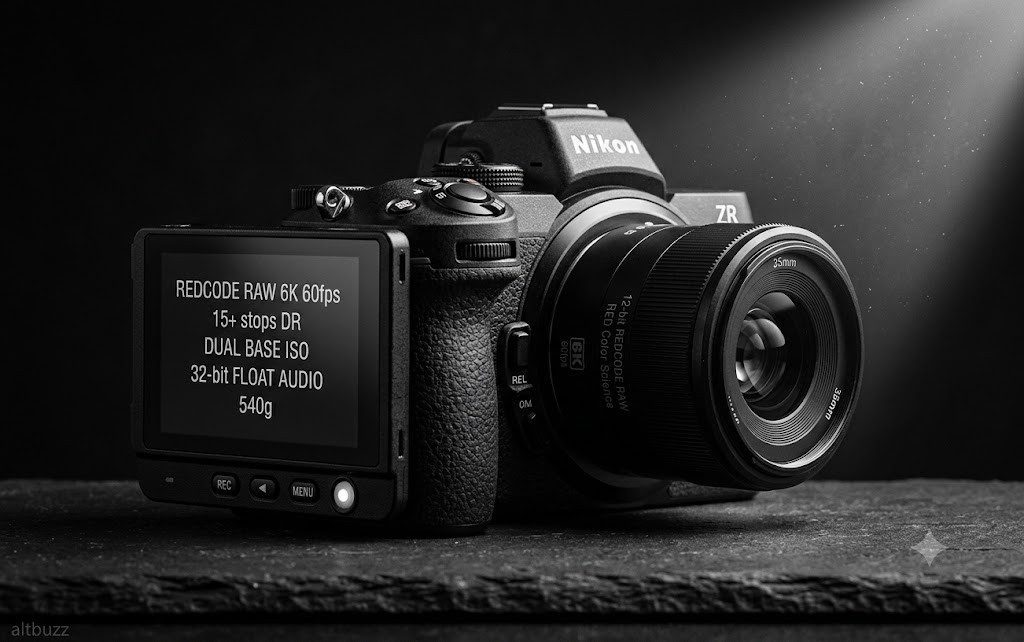
Born From the RED Acquisition
Nikon acquired RED Digital Cinema in 2024. That acquisition gave Nikon access to RED’s proprietary REDCODE RAW codec, RED’s color science pipeline, RED’s color gamut (REDWideGamutRGB), and RED’s established reputation among professional cinematographers.
The Nikon ZR is the first camera to combine all of that RED heritage with Nikon’s own optical expertise, Expeed 7 processor, Z-mount lens system, and subject tracking autofocus technology. As Digital Camera World’s review describes it, the ZR “adds RED’s renowned color science to achieve professional cinema-grade footage for the first time in a consumer-level video-centric camera.”
The ZR sits within Nikon’s new Z Cinema series. That series also includes RED’s own V-RAPTOR XE, announced simultaneously in September 2025. Together, these two products form a two-tier cinema lineup: the ZR at $2,199 for accessible cinema production, and the V-RAPTOR XE at a significantly higher price for large-format, high-end production.
How the ZR Relates to the Z6 III
The Nikon ZR is based heavily on the Nikon Z6 III announced in June 2024. Both cameras share the same 24.5MP partially stacked full-frame sensor, the same Expeed 7 processor, and similar autofocus architecture. However, the ZR adds several significant differentiators that place it in a separate product category.
The ZR adds 12-bit REDCODE RAW (R3D NE) recording, RED color science, Log3G10 gamma curve, REDWideGamutRGB gamut, dual base ISO optimized for cinema use, and a redesigned body without an optical viewfinder. The 4-inch 1000-nit articulating monitor replaces the EVF, reflecting the camera’s orientation toward video production workflows where an external monitor or the large on-body screen serves better than a traditional eye-level viewfinder.
Video Performance: The Core Reason This Camera Exists
REDCODE RAW at 6K 60fps Internally
The ZR’s defining capability is internal 12-bit REDCODE RAW recording at 6K resolution and up to 60fps. Previously, REDCODE RAW required external recorders or dedicated RED cinema bodies. The ZR puts this codec inside a $2,199 body.
REDCODE RAW (R3D NE) compresses raw sensor data using RED’s proprietary wavelet compression algorithm. The result is a file format that retains significantly more color and tonal information than conventional camera codecs while remaining more manageable in file size than uncompressed RAW formats. For colorists working on professional projects, REDCODE RAW provides maximum grading latitude with excellent workflow integration in DaVinci Resolve, Adobe Premiere, and Final Cut Pro via RED’s plugin ecosystem.
At 6K 60fps, the ZR generates substantial data throughput. Recording requires a CFexpress Type B or XQD card rated for the sustained write speed this demands. Filmmakers who invest in high-speed CFexpress Type B storage will find the ZR sustains recording reliably at maximum specifications.
4K 120fps for Slow-Motion Production
Beyond the headline 6K R3D NE capability, the ZR records 4K at 120fps internally. This specification opens slow-motion at 5x reduction to 24fps or 4x reduction to 30fps, which covers the most commonly used slow-motion ratios in narrative and documentary production.
For wedding videographers who capture ceremony moments, commercial directors who need slow-motion for product sequences, and documentary filmmakers who document physical performances, 4K 120fps in a $2,199 body represents exceptional value. Competing cameras at similar prices from Sony and Blackmagic either lack 4K 120fps or require external recording to achieve it.
RED Color Science: What It Actually Means
RED color science is not merely a marketing designation. It refers to a specific calibrated color pipeline that RED developed over 15 years of cinema camera production. REDWideGamutRGB is a color gamut significantly wider than Rec.2020, capturing color information beyond what any current display can reproduce and providing future-proofing for wider-gamut delivery standards.
Log3G10 is RED’s logarithmic gamma curve paired with REDWideGamutRGB. Together, they define how the ZR captures and encodes tonal and color data. Nikon’s official specification confirms Log3G10 and REDWideGamutRGB support, meaning colorists can apply standard RED IPP2 (Image Processing Pipeline 2) grades directly to ZR footage in DaVinci Resolve without any adaptation.
The practical outcome is that ZR footage, when processed through RED’s standard pipeline, produces the cinematic rendering associated with RED cameras costing many times more. Amateur Photographer’s review describes the ZR as offering “renowned RED colour science” and confirms that color matching is “possible when the ZR is used alongside RED cinema cameras.” For productions that mix ZR footage with larger RED bodies, color consistency is achievable without complex manual matching.
Dynamic Range: 15+ Stops
Nikon officially rates the ZR at 15+ stops of dynamic range. This figure applies in the cinema recording modes that leverage the camera’s dual native ISO design.
In practice, 15 stops of dynamic range places the ZR among the most capable cameras for high-contrast scene capture. Interior spaces with windows, exterior scenes with bright sky and shadowed foreground, and stage performances with dramatic lighting contrast are all situations where 15 stops of captured latitude becomes visible in the final grade. Highlights retain detail at levels that standard hybrid mirrorless cameras clip. Shadows hold color and tonal information deep into the darkness.
Dual Base ISO: Understanding the Cinema-Specific Design
What Dual Base ISO Means
When recording in R3D NE mode, the Nikon ZR operates at two base ISO sensitivities: ISO 800 and ISO 6400. This dual native ISO design, common in Sony’s cinema camera range (FX3, FX6, FX9) and in RED’s own bodies, fundamentally changes how the camera handles different lighting conditions.
ISO 800 provides the cleanest, lowest-noise output for standard and well-lit shooting conditions. This is the primary ISO setting for daylight exterior work, studio production, and any situation where adequate light is available.
ISO 6400 is a true second native ISO rather than an amplified version of ISO 800. At this setting, the camera reads pixel data through a different gain circuit that provides clean sensitivity at a level that standard single-base-ISO cameras struggle to match without introducing significant noise. For interior documentary work, evening event coverage, and low-light narrative production, ISO 6400 native allows the ZR to capture clean footage where competing cameras show visible noise.
Practical Low-Light Performance
The ZR’s full ISO range extends from ISO 100 to 51,200, with expansion to ISO 204,800. In R3D NE recording mode, the dual native ISO structure means photographers switch between ISO 800 and ISO 6400 as base points and add stops above those bases as needed.
Multiple published reviews confirm strong low-light performance consistent with full-frame cameras in this category. The combination of full-frame sensor size, 15+ stops of dynamic range, and dual native ISO creates a low-light capability substantially ahead of APS-C cinema alternatives at similar prices.
Autofocus: Nikon Z6 III Foundation With Cinema Refinements
Phase Detection AF Across the Frame
The ZR inherits the Z6 III’s subject-detection autofocus architecture, which uses phase detection pixels distributed across the full sensor area. This system detects humans (face and eye), animals (dogs, cats, birds), and vehicles for continuous tracking during video recording.
For cinema cameras, autofocus quality varies enormously across the market. Many traditional cinema cameras either lack autofocus entirely or offer only rudimentary contrast-detection systems that hunt during recording. The ZR brings Nikon’s full mirrorless AF capability to the cinema camera category, enabling reliable face-tracking during handheld documentary interviews, subject lock during run-and-gun production, and continuous tracking during multi-subject scenes.
Digital Camera World’s review specifically highlights the autofocus as a differentiator, confirming that the ZR’s AF reliably covers the face-detection and eye-tracking scenarios that solo filmmakers and documentary crews depend on.
Cinematic Video Mode
The ZR includes a dedicated Cinematic Video mode that applies preset settings optimized for the RED cinematic look without requiring manual color science configuration. For filmmakers who want the RED aesthetic immediately without building a custom LUT pipeline, Cinematic Video mode provides an accessible starting point.
More experienced colorists will bypass Cinematic Video mode and work directly with R3D NE files in their preferred grading software. Both workflows are valid, and the camera supports both without forcing photographers into either approach.
Body Design: Built Without a Viewfinder for a Reason
The Viewfinderless Philosophy
The ZR has no electronic viewfinder. This is the most significant departure from Nikon’s standard mirrorless body design and the element most likely to generate questions from photographers who are new to dedicated cinema camera design.
Cinema cameras traditionally do not include eye-level viewfinders. Productions use the camera’s built-in monitor, an external monitor mounted above the camera, or a director’s viewfinder for composition. The ZR follows this convention deliberately. By removing the EVF, Nikon freed design space for the 4-inch monitor and reduced the overall body dimensions to something smaller and lighter than an equivalent stills camera would permit.
The result is a body measuring 134 x 80.5 x 49mm, comparable in size to a standard mirrorless camera body despite the cinema-focused feature set. At 540 grams, the ZR is lighter than the Sony FX3 and substantially lighter than larger cinema bodies with equivalent raw recording capability.
The 4-Inch Monitor: A Genuine Differentiator
The ZR’s 4-inch fully articulating rear screen is the most impressive display on any camera in its price class. At 3.07 million dots, 1000 nits brightness, and DCI-P3 color coverage, it provides accurate color preview for grading decisions and remains readable in bright outdoor conditions that would make dimmer screens invisible.
1000 nits puts the ZR’s screen in the territory of professional external monitors. Many external monitors used in production environments are rated at 1000 to 1500 nits for outdoor legibility. The ZR’s built-in screen effectively eliminates the need for an external monitor in most solo and small crew production scenarios, which reduces rig complexity and total kit cost.
The fully articulating design allows the screen to face forward for solo recording, tilt to overhead angles for crowd-level shots, and close flat against the body for transport protection.
Gimbal Compatibility
Amateur Photographer’s review specifically notes that the ZR offers “a gimbal friendly body,” which reflects deliberate engineering choices rather than accidental compatibility. The body dimensions, weight distribution, and IBIS deactivation mode for gimbal use are all designed around handheld and gimbal-mounted production workflows.
For solo filmmakers and documentary crews who regularly work with DJI RS or Zhiyun gimbals, this compatibility matters practically. A camera that requires extensive counterweighting or balancing adjustments every time a lens changes disrupts production flow. The ZR’s size and weight distribution minimizes these adjustments.
Audio: 32-Bit Float Internal Recording
What 32-Bit Float Changes
The ZR records internal audio at 32-bit float depth. This is a specification that professional audio recorders began offering several years ago and that very few cameras have adopted. The ZR’s 32-bit float audio is one of the most practically valuable features in the camera for solo filmmakers and documentary crews.
Standard camera audio records in 16-bit or 24-bit integer format. At these bit depths, audio clipping is irreversible. If a subject speaks louder than the recording level allows, the clipped audio cannot be recovered in post-production. Solo operators who cannot monitor and adjust audio levels continuously, such as a one-person documentary crew who is also directing and operating the camera, regularly deal with clipped audio that ruins otherwise usable takes.
32-bit float audio captures such a wide dynamic range that clipping is virtually impossible regardless of the recording level set on the camera. Even audio recorded at the wrong level can be corrected fully in post-production without audible artifacts. For solo creators, this is not a marginal benefit. It eliminates an entire category of production mistakes that previously required reshoots.
Input Options and the ME-D10 Shotgun Microphone
The ZR includes a 3.5mm stereo microphone input and a 3.5mm headphone output for monitoring. The digital hotshoe accepts Nikon’s ME-D10 shotgun microphone, which is available as an optional accessory and provides directional audio capture mounted directly on the body without a cable.
This audio input setup covers documentary interview, vlogging, event, and run-and-gun production needs without requiring a separate audio mixer or recorder for most scenarios. Productions that demand multi-channel audio or XLR inputs will still need an external audio solution, but the ZR’s built-in capability handles a wider range of professional audio scenarios than most cameras at this price point.
What the ZR Does Not Do: Honest Limitations
No Built-In Viewfinder
Covered above, but worth reiterating for stills photographers considering the ZR. If you need an eye-level viewfinder for any significant part of your shooting workflow, the ZR is not the right camera. The 4-inch monitor is excellent but does not replace the eye-level shooting experience for street, documentary still, or candid photography.
Limited Stills Capability
The ZR is a cinema camera. Its stills capability exists but is not the reason to buy it. The 24.5MP sensor produces good stills files, but the camera’s menu system, shooting modes, and physical design all prioritize video production. Photographers who need a primary stills camera should look at the Z6 III instead.
microSD as the Second Card Slot
The ZR’s dual card configuration pairs CFexpress Type B / XQD as the primary slot with microSD UHS-I as the secondary slot. For professional video recording, only the primary CFexpress slot provides the sustained write speed that 6K R3D NE requires. The microSD slot serves as backup storage for proxy files, still images, or lower-resolution video.
This means a single point of failure exists for primary R3D NE recording. Cinematographers who require simultaneous redundant recording of their primary footage will need to plan accordingly.
Rolling Shutter
The ZR’s sensor, shared with the Z6 III, is a partially stacked BSI CMOS design rather than a fully stacked or global shutter sensor. As a result, rolling shutter distortion appears during fast horizontal panning or during fast-moving subject capture with electronic shutter operation.
For controlled production environments, careful panning speed management minimizes rolling shutter artifacts. For run-and-gun work with rapid, unpredictable camera movement, rolling shutter remains a consideration that the ZR does not fully solve.
Pricing and Value Assessment
Body and Kit Pricing in June 2026
The Nikon ZR launched at $2,199 body only in October 2025. Bundle options include a kit with the NIKKOR Z 24-70mm f/4 lens. A complete professional bundle available at Best Buy includes the ZR body, NIKKOR Z 50mm f/1.4 lens, camera bag, microphone, memory cards, and additional accessories at approximately $3,195.
These prices have held relatively stable through the first eight months after launch. Nikon has not significantly discounted the body, which suggests healthy demand has not required price reductions to move inventory.
Value Against Direct Competitors
The comparison that every ZR review raises is Sony’s FX3, which launched at $3,899 in 2021 and remains in Sony’s lineup at a lower current price. The FX3 offers full-frame video with S-Log3 and Sony’s cinema color science in a compact body. However, it cannot record 12-bit RAW internally at any resolution and does not offer a RED color science pipeline.
The Blackmagic Pocket Cinema Camera 6K Pro shoots BRAW 12-bit RAW at 6K, directly comparable to the ZR’s R3D NE capability. Its Micro Four Thirds sensor is smaller than the ZR’s full-frame sensor, which affects low-light performance and depth of field characteristics. At approximately $1,995, it prices below the ZR but offers no IBIS, a significantly smaller sensor, and no Nikon Z-mount lens compatibility.
Against these alternatives, the ZR offers the unique combination of full-frame sensor size, IBIS, 12-bit RED RAW, dual base ISO, 4-inch 1000-nit monitor, and 32-bit float audio at $2,199. No competing camera at or below this price combines all of these capabilities.
Who Should Buy the Nikon ZR?
Ideal ZR Buyers
Independent filmmakers who produce documentary, short film, and narrative content represent the core audience. The ZR delivers professional cinema codec capability and RED color science in a body that works handheld, on a gimbal, and in tight production environments without a full cinema rig.
Wedding and event videographers who want cinema-quality footage for premium clients will find the ZR’s combination of dual base ISO, 32-bit float audio, and RED color science genuinely elevates the production quality ceiling for one-person operations.
Content creators who have outgrown 8-bit hybrid mirrorless cameras and want to step into professional video production without a $6,000 investment in a traditional cinema body now have a credible entry point.
Photographers who already own Nikon Z-mount glass gain an immediate advantage. The ZR uses the same Z-mount as every other Nikon mirrorless camera, meaning an existing collection of NIKKOR Z lenses transfers directly without any adapters.
Who Should Choose Something Else
Photographers who shoot primarily stills with occasional video should choose the Z6 III instead. The Z6 III shares the ZR’s sensor and processor, adds an EVF, and provides a more balanced stills-and-video experience at a similar price point.
Filmmakers who need global shutter for fast-motion work should look at the Sony A9 III or wait for the FX3 II, which reportedly addresses rolling shutter more aggressively than the ZR’s partially stacked sensor allows.
Budget-focused beginners who want to learn video fundamentals do not need the ZR’s capabilities at this stage. The Sony ZV-E10 II or Fujifilm X-M5 at $600 to $800 provide better starting points before investing in a cinema-focused tool.
Final Verdict: Nikon ZR Review Score and Recommendation
The Nikon ZR is, without question, one of the most disruptive camera launches in recent years. It delivers 12-bit REDCODE RAW at 6K 60fps, RED color science, dual base ISO with 15+ stops of dynamic range, 32-bit float audio, and a 4-inch 1000-nit DCI-P3 monitor in a 540-gram body at $2,199.
That combination was simply not available at any price before October 2025. The ZR did not just fill a gap in the market. It created an entirely new category: professional cinema codec in a consumer-accessible body.
Its limitations are real. No viewfinder. Rolling shutter under fast movement. Limited stills optimization. A single primary card slot for R3D NE recording. However, none of these limitations undermine the core proposition. For filmmakers who want RED-quality cinema footage at an accessible entry point, the Nikon ZR delivers exactly what it promises.
In June 2026, eight months after its launch, the ZR continues to impress every filmmaker who uses it seriously. Its impact on the cinema camera market will be felt for years. The ZR is genuinely one of the most important cameras Nikon has ever released.
Altbuzz Rating: 9.2 / 10
Read More from Altbuzz
For more camera coverage from our June 2026 series, explore our breakdown of the top 5 incoming Sony cameras for 2026 and 2027, our best affordable cameras of 2026 guide, and our upcoming Nikon ZR vs Sony FX3 detailed comparison.
Stay updated on every major camera launch and review at altbuzzmedia.com. For ongoing Nikon Z Cinema series coverage, Nikon Rumors at nikonrumors.com and Digital Camera World at digitalcameraworld.com provide the most reliable ongoing coverage.
Subscribe to Altbuzz YouTube Channel
Our full Nikon ZR hands-on video review and RED RAW workflow breakdown are live on the Altbuzz YouTube channel @AltBuzzMedia. Subscribe for weekly camera content, real-world footage tests, and ongoing Z Cinema series coverage through 2026.