
Fujifilm GFX100RF vs Sony RX1R III: Two Very Different Answers to the Same Question
Both the Fujifilm GFX100RF and the Sony RX1R III arrived in 2025 chasing the exact same idea. Pack the largest possible sensor into the smallest possible fixed-lens body, then charge a genuinely premium price for the privilege. Beyond that shared ambition, these two cameras take almost completely different technical paths to get there, making this one of the most interesting head to head comparisons in the current premium compact market.
This article compares the Fujifilm GFX100RF and Sony RX1R III directly across sensor size, resolution, autofocus, lens design, video capability, and price. We will look at where each camera clearly wins, where the tradeoffs genuinely matter, and which type of photographer each one actually serves best. By the end, you will know exactly which camera deserves your money, assuming you can justify spending this much on a fixed-lens compact in the first place.
Fujifilm GFX100RF vs Sony RX1R III: Quick Overview
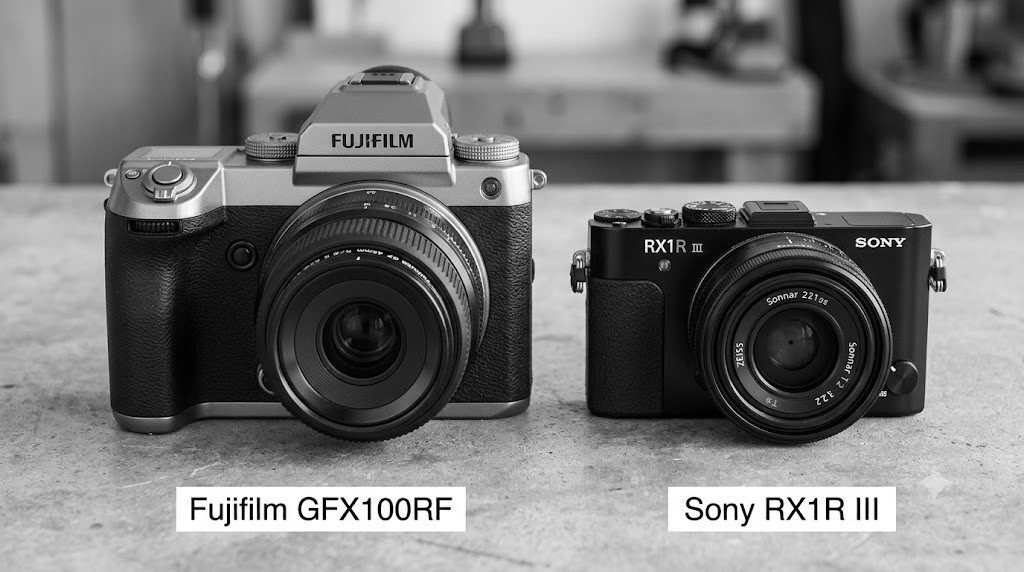
Before diving into individual categories, it helps to understand the fundamental philosophy separating these two cameras.
Medium Format vs Full Frame
The single biggest distinction between these cameras comes down to sensor format. According to Fujifilm’s official specifications, the GFX100RF uses a medium format sensor approximately 1.7 times larger than a standard 35mm full-frame sensor. The Sony RX1R III, according to Sony’s official press release, sticks with a traditional 35mm full-frame sensor instead. This single decision cascades into nearly every other difference between these two cameras.
Two Completely Different Lens Philosophies
Fujifilm built the GFX100RF around a 35mm f/4 lens, equivalent to 28mm in full-frame terms, according to Fujifilm’s official announcement. Sony instead equipped the RX1R III with a ZEISS Sonnar T* 35mm f/2 lens, according to Sony’s own official specifications. This creates a genuinely significant gap in maximum aperture, with Sony offering two full stops more light gathering capability at f/2 compared to Fujifilm’s f/4.
Sensor Size and Resolution Compared
Resolution numbers alone do not tell the full story here, since sensor physical size plays an enormous role in how these numbers actually translate to image quality.
Fujifilm’s Medium Format Resolution Advantage
The GFX100RF’s 102-megapixel GFX 102MP CMOS II sensor, confirmed through Fujifilm’s official specifications, delivers substantially more resolution than the RX1R III’s sensor, while also benefiting from a physically larger sensor surface. This combination gives the GFX100RF a genuine advantage in fine detail capture and dynamic range, particularly useful for large format prints or aggressive cropping.
Sony’s Full Frame 61 Megapixel Sensor
The RX1R III uses a 60.2-megapixel full-frame Exmor R sensor paired with Sony’s BIONZ XR processing engine, according to Sony’s official press materials. This is a genuinely impressive resolution figure for a full-frame chip, even though it falls considerably short of the GFX100RF’s medium format resolution. Sony rates this sensor at 15 stops of dynamic range, a strong figure that still trails Fujifilm’s larger sensor advantage in absolute terms.
What This Resolution Gap Actually Means in Practice
The practical difference between 102 megapixels and 61 megapixels matters most for photographers who regularly crop aggressively or print at extremely large sizes. For typical use cases like web publishing, standard print sizes, or social media sharing, both sensors deliver more than sufficient resolution, making this gap less decisive than the raw numbers might initially suggest.
Lens Speed and Optical Design
Beyond sensor size, the actual lens attached to each camera creates real, practical differences in everyday shooting.
Sony’s Faster Aperture Advantage
The RX1R III’s f/2 maximum aperture gives Sony a genuine edge in low light situations and shallow depth of field portrait work. Sony states it optimized the lens position and imaging surface at the micron level specifically to maximize this ZEISS-branded optic’s performance within such a compact body.
Fujifilm’s Compact, Purpose Built Optic
Fujifilm’s f/4 lens trades some low light versatility for genuinely remarkable size efficiency. The lens extends only 30 millimeters from the camera body despite covering a considerably larger medium format image circle, a genuine engineering achievement given the physical constraints medium format optics typically demand. Fujifilm accomplished this partly by adopting a leaf shutter system rather than a traditional focal plane shutter, shortening the lens’s back focus distance and freeing up space for a smaller overall assembly.
Step Crop Shooting vs the Aspect Ratio Dial
Both cameras offer creative framing flexibility, though through different mechanisms entirely. Sony’s Step Crop Shooting function lets photographers digitally simulate 35mm, 50mm, and 70mm focal lengths using dedicated buttons or dials, adjustable even after the fact when shooting RAW. Fujifilm’s Aspect Ratio Dial instead focuses on changing the overall image shape across nine options rather than simulating different focal lengths, giving each camera a genuinely distinct creative approach to the same fixed-lens limitation.
Autofocus Performance Compared
Autofocus has historically separated premium compact cameras more than almost any other category, and both companies clearly prioritized this area for their 2025 flagships.
Sony’s Extensive Phase Detection Coverage
The RX1R III features up to 693 densely arranged phase-detection autofocus points covering approximately 78 percent of the image frame for still photography, according to Sony’s official product page. This system also includes AI-based subject recognition capable of tracking human bodies, heads, and eye position even when a subject’s face is not directly visible to the lens.
Fujifilm’s AI Driven Subject Detection
Fujifilm equipped the GFX100RF with an AI-driven autofocus system capable of detecting faces, eyes, animals, birds, vehicles, and airplanes. While genuinely capable, medium format autofocus systems have historically lagged behind full-frame equivalents in raw tracking speed, a gap that likely persists here given the physical challenges of focusing a larger sensor and image circle quickly.
A Clear Edge for Sony in Fast Moving Subjects
Given Sony’s extensive experience refining phase-detection autofocus across its entire Alpha lineup, Sony likely holds a meaningful edge for photographers prioritizing fast, reliable autofocus performance, particularly for candid street photography or subjects in unpredictable motion.
Stabilization: A Weakness for Both Cameras
Neither camera fully solves the stabilization question, though each approaches the problem differently.
Sony’s Notable Omission
The RX1R III lacks in-body image stabilization entirely, a notable gap for a camera at this premium price point. Photographers relying on slower shutter speeds handheld will need to compensate through technique or a faster shutter setting instead.
Fujifilm’s Digital Workaround
The GFX100RF addresses this challenge differently, relying on five-axis digital stabilization rather than mechanical in-body stabilization. Digital stabilization generally cannot match the effectiveness of true mechanical IBIS, though it does provide at least some compensation that Sony’s RX1R III lacks entirely.
Video Capability Compared
Video performance separates these two cameras clearly, revealing different priorities behind each design.
Fujifilm’s Genuinely Capable Video Specs
According to Fujifilm’s official press release, the GFX100RF supports 4K30P recording at 4:2:2 10-bit color depth, alongside F-Log2 support delivering over 13 stops of dynamic range for color grading flexibility. This represents a genuinely capable video toolkit for a camera primarily marketed toward stills photography.
Sony’s More Modest Video Focus
Sony has not disclosed full video specifications for the RX1R III as extensively as Fujifilm, though the inclusion of twelve Creative Looks applicable to both stills and video suggests some hybrid ambition. Confirmed specifications include 4K 30p 10-bit recording alongside FHD 120p slow motion, broadly comparable to Fujifilm’s offering, though this remains a camera built primarily for stills rather than serious video production work.
Build Quality, Size, and Weight
Physical handling differences matter enormously for a category defined entirely by portability.
Sony Claims the Overall Size Crown
The RX1R III is the smallest full-frame fixed-lens camera currently on the market, and also the lightest camera among its direct comparison group despite its larger sensor and attached lens.
Fujifilm Matches a Different Weight Class Entirely
The GFX100RF weighs approximately 735 grams according to Fujifilm’s official specifications, genuinely remarkable given its considerably larger medium format sensor. This puts the GFX100RF’s weight roughly on par with the Leica Q3, a full-frame camera with a notably smaller sensor than Fujifilm’s medium format chip. In direct comparison, Sony’s RX1R III remains lighter still, but Fujifilm closes that gap remarkably given the sensor size difference involved.
Design Philosophy: Dials vs Recessed Controls
According to Sony’s official press materials, the RX1R III features a magnesium alloy body with dials and the Multi-Interface Shoe embedded flush into the top plate for a streamlined profile. Fujifilm’s GFX100RF takes a more traditional approach, milling its body from a single block of aluminum and maintaining classic dial-based operation, appealing more directly to photographers who prefer tactile, visible physical controls over a minimalist recessed design.
Price Comparison
At this premium tier, price differences matter considerably less in absolute terms but still shape the overall value proposition.
Sony’s Higher Launch Price
The RX1R III launched at 5,099.99 dollars in the United States, notably higher than the RX1R II it replaced, according to Sony’s official pricing announcement.
Fujifilm’s Comparatively Lower Price for More Resolution
The GFX100RF launched at 4,899.95 dollars according to Fujifilm’s official announcement, meaning Fujifilm actually undercuts Sony’s price by roughly 200 dollars while offering a considerably larger sensor and higher resolution. This pricing dynamic genuinely favors Fujifilm on pure value grounds, assuming a buyer prioritizes resolution and sensor size over autofocus speed and aperture.
Which Camera Should You Actually Buy
Choosing between these two ultimately depends on which specific priorities matter most for your own photography.
Choose the Fujifilm GFX100RF If Resolution Matters Most
Photographers who prioritize maximum resolution, dynamic range, and cropping flexibility, particularly for landscape, travel, or large format print work, should lean toward the GFX100RF. Its medium format sensor and genuinely novel Aspect Ratio Dial offer creative possibilities Sony simply cannot match at this size and price point.
Choose the Sony RX1R III If Autofocus and Aperture Matter Most
Photographers who prioritize fast, reliable autofocus tracking and a faster maximum aperture for low light or shallow depth of field work should lean toward the RX1R III instead. Its combination of speed and portability makes it one of the fastest focusing large-sensor prime lens cameras currently available, a genuine advantage for street photographers working in unpredictable, fast moving conditions.
Both Cameras Share the Same Fundamental Limitation
Regardless of which camera you choose, both share the same core tradeoff inherent to any fixed-lens system. Neither offers interchangeable lenses, meaning your creative flexibility remains permanently tied to a single focal length. Photographers who anticipate needing multiple lenses for varied assignments should look elsewhere entirely, regardless of how impressive either sensor performs.
Final Verdict: Fujifilm GFX100RF vs Sony RX1R III
Both the Fujifilm GFX100RF and Sony RX1R III represent genuinely impressive engineering achievements, proving that large sensor photography no longer requires a bulky interchangeable lens system. Fujifilm wins decisively on resolution, sensor size, and overall value at a lower price point, while Sony wins clearly on autofocus speed, maximum aperture, and outright portability. Neither camera gets stabilization fully right, and both demand a genuinely premium budget most casual photographers will never justify.
For photographers who already know exactly which tradeoff matters most to their specific work, this comparison should make the decision considerably easier. For everyone else, the honest answer is that both cameras excel at slightly different things, and neither one is objectively wrong.
Read More from Altbuzz
For more premium compact camera coverage, check our full Fujifilm GFX100RF review, our Leica Q3 versus Sony RX1R III comparison, and our best fixed-lens cameras of 2026 buying guide for additional context on this competitive category.
Follow every premium compact camera comparison and release at altbuzzmedia.com.
Subscribe to Altbuzz YouTube Channel
Full side-by-side comparisons between the Fujifilm GFX100RF, Sony RX1R III, and other premium fixed-lens cameras are live on the Altbuzz YouTube channel @AltBuzzMedia. Subscribe now for weekly camera comparisons and gear breakdowns through the rest of 2026.