
Leaptic Cube Full Review: 8K Modular Action Camera Tested
The Leaptic Cube is one of the most ambitious action camera launches of 2026. Dreame Technology unveiled it at CES 2026 in January. It delivers 8K video at 30fps from a 1/1.3-inch CMOS sensor. Additionally, it uses a modular detachable design that separates the camera unit from its display body.
Dreame is primarily known for robot vacuum cleaners and home appliances. Entering the action camera market against GoPro, DJI, and Insta360 is a bold move. However, the Leaptic Cube’s specifications are genuinely impressive and the modular concept offers real creative advantages that no competitor currently matches.
Release Date and Market Position
When Did Dreame Announce the Leaptic Cube?
Dreame announced the Leaptic Cube at CES 2026 in Las Vegas on January 7, 2026. The camera attracted significant attention at the Central Hall booth. Furthermore, early pre-order deposits of $5 secured an early bird price of around $269 before final retail pricing was confirmed.
What Is the Final Retail Price?
The Leaptic Cube retails at $439.99 for the 64GB Standard Set. The 128GB Standard Set costs $459.99. Additionally, North American shipping is planned for 2026 with European and Asian markets to follow with confirmed local pricing closer to launch.
How Does It Compare to GoPro and Insta360?
At $440, the Leaptic Cube sits alongside the Insta360 GO Ultra at $449 and above the GoPro Hero 13 Black. This premium positioning demands that the 8K sensor and modular design justify the cost difference. Furthermore, Dreame enters with more ambitious specifications than most competitors but without the established brand recognition and accessory ecosystem that GoPro and Insta360 have built over many years.
Who Is the Leaptic Cube For?
The Leaptic Cube targets content creators, adventure athletes, and action sports filmmakers. It also appeals to professional video operators who need flexible mounting options in physically tight spaces. Additionally, the AI ecosystem integration with Dreame’s AI Glasses and AI Ring positions it specifically for creators who want a hands-free and fully connected capture workflow.
What Makes This Different From Other Action Cameras?
The modular split design is the key differentiator. The camera module separates completely from the display body. This allows the camera to sit in mounting positions that are physically impossible for integrated action cameras. Furthermore, the 30-meter wireless range between the two modules creates creative separation that no competing product offers at this price.
Specifications Table
| Feature | Details |
|---|---|
| Sensor | 1/1.3-inch CMOS |
| Still Resolution | 50MP |
| Dynamic Range | 13.5 stops |
| Lens | 155-degree f/2.8 super-wide with nano-coating |
| Processor | 4nm Qualcomm 8-core AI chip (48 TOPS) |
| Max Video | 8K at 30fps |
| 4K Video | 4K/60fps HDR, 4K/120fps slow motion |
| Open Gate | FreeFrame 3840 x 2880 (4:3) |
| Low-Light | 4K Hyper-Night dedicated mode |
| Stabilization | GyroSteady AI, 45 and 360-degree leveling |
| Action Body Screen | 2.27-inch touchscreen |
| Wireless Range | 30 meters (camera to body) |
| Wireless Protocol | ProSync proprietary NearLink |
| Camera Battery | 500mAh, approximately 90 minutes |
| Body Battery | 1450mAh, approximately 130 additional minutes |
| Total Runtime | Up to 220 minutes combined |
| Fast Charge Camera | 0 to 80% in 12 minutes |
| Fast Charge Body | 0 to 80% in 18 minutes |
| Internal Storage | 64GB or 128GB |
| Mounting | Magnetic rear surface |
| Pendant Tilt | Adjustable 15 degrees |
| AI Features | Voice control, scene recognition, auto-enhancement |
| Colors | Midnight Black, Arctic White |
| Price | $439.99 (64GB), $459.99 (128GB) |
Sensor and Image Quality
What Size Is the Leaptic Cube Sensor?
The Leaptic Cube uses a 1/1.3-inch CMOS sensor. Dreame claims this is the largest sensor in an action camera of this physical size category. A larger sensor captures more light per individual pixel. As a result, dynamic range improves noticeably and noise performance at higher sensitivities becomes meaningfully better.
What Dynamic Range Does It Offer?
The claimed 13.5-stop dynamic range is a significant figure for an action camera. Most action cameras struggle with washed-out skies and crushed shadows in high-contrast outdoor scenes. The Leaptic Cube’s wider dynamic range should preserve both highlight and shadow detail simultaneously. This is a meaningful practical advantage for outdoor content creators in mixed lighting conditions.
How Do 50MP Stills Work?
Still images capture at 50 megapixels. This substantially exceeds what most action cameras deliver for still photography. High-resolution stills allow creators to extract usable photographs directly from shooting sessions. Furthermore, 50MP files support significant cropping for composition adjustments in post-production without resolution loss.
What Is P-Log Recording?
The Leaptic Cube supports 10-bit P-Log capture for professional color grading workflows. This preserves maximum tonal information throughout the entire dynamic range of the image. Colorists can then adjust the footage extensively in post-production without losing highlight or shadow detail in the process. Additionally, P-Log enables the Leaptic Cube to participate in professional video production pipelines that standard action cameras cannot serve at all.
Why Does 8K Matter for 4K Delivery?
8K delivery is still impractical for most platforms and audiences. However, 8K capture offers meaningful benefits even when the final output is 4K. The extra resolution provides a substantial digital zoom buffer. Additionally, it delivers better detail preservation after stabilization cropping and higher-quality frame grabs from video footage compared to native 4K capture.
How Does Active HDR Help?
Active HDR mode combines multiple exposures in real time to widen the captured dynamic range further. It works at 4K at 30fps. This mode preserves highlight and shadow detail in outdoor sports environments like forest trails, snow slopes, and beach settings. Furthermore, Active HDR footage requires less color correction in post-production, saving significant editing time.
AI Processing System
What AI Chip Does the Leaptic Cube Use?
The Leaptic Cube runs a 4nm Qualcomm 8-core AI processor capable of 48 TOPS of computing power. This chip handles real-time 8K video encoding while simultaneously running all AI features. As a result, the camera manages both high resolution and computational photography without sacrificing frame rate or creating thermal throttling issues.
How Does Scene Recognition Work?
The AI system automatically identifies the current shooting scenario from sensor data. It recognizes situations including nighttime cityscapes, fireworks displays, fast sports action, and standard daylight landscapes. Furthermore, it adjusts exposure, color balance, and detail rendering automatically based on the detected scene type. This reduces manual mode switching during dynamic shooting situations considerably.
What Is Automatic Post-Capture Enhancement?
After recording stops, the AI system refines color, skin tones, contrast, and pixel-level detail automatically. This is not a basic global filter applied to the entire image equally. It operates at the pixel level to produce footage that looks professionally finished. Additionally, this approach benefits creators who want high-quality output without investing significant time in post-production editing workflows.
How Does Voice Control Work?
Creators can control the Leaptic Cube with natural spoken commands. Commands trigger recording start and stop, switch between shooting modes, and mark highlight moments during longer sessions. Furthermore, voice control proves especially valuable when the camera sits in a mounting position where physical button access is physically impossible or dangerous during activity.
What Is the AI Ecosystem Integration?
The Leaptic Cube connects wirelessly to Dreame’s AI Glasses. These glasses project a live viewfinder feed into the user’s field of vision. The AI Ring device allows gesture-based camera control for completely hands-free operation. Together, these create a fully connected and hands-free recording ecosystem that is genuinely new territory for any action camera category.
Video Capabilities
What Is the Headline Video Mode?
The headline video capability is 8K recording at 30 frames per second. This is the highest resolution currently available in an action camera at this physical size. The 4nm Qualcomm processor handles encoding demands in real time without throttling. However, 8K at 30fps is primarily useful for cropping, reframing, and extracting stills rather than high-frame-rate motion capture.
What Does 4K HDR at 60fps Offer?
For smooth motion capture with dynamic range, 4K HDR at 60fps is the practical workhorse mode. This delivers cinematic-quality footage in standard delivery formats. Additionally, Active HDR mode expands tonal latitude further for shooting in challenging mixed-light outdoor environments like forests, beaches, and mountain landscapes.
How Useful Is 4K Slow Motion at 120fps?
The 4K at 120fps mode enables high-quality slow-motion footage at five times normal playback speed at 24fps. This frame rate unlocks genuinely cinematic slow motion for sports, water activities, and dynamic action sequences. Furthermore, maintaining 4K resolution at 120fps is a technical achievement that distinguishes the Leaptic Cube from several direct competitors in the action camera category.
What Is FreeFrame Mode?
FreeFrame mode captures video at 3840 x 2880 resolution in 4:3 open-gate format. This wider capture area allows creators to choose the final delivery crop orientation during post-production rather than at the time of shooting. Consequently, the same footage can produce a standard 16:9 horizontal video or a 9:16 vertical social media clip from a single recorded file.
What Is Hyper-Night Mode?
The dedicated 4K Hyper-Night mode optimizes the sensor, processing pipeline, and exposure behavior for nighttime shooting specifically. AI processing enhances brightness and stabilizes the image in very dark environments. This addresses a traditional weakness of action cameras in after-dark applications. Examples include night skiing, concert footage, and urban nighttime content creation.
How Good Is the Stabilization?
Dreame’s GyroSteady AI stabilization offers two horizon-leveling modes. The 45-degree mode handles typical activity movement. The 360-degree mode maintains a level horizon even during barrel rolls and extreme tilts. However, like all digital stabilization systems, active stabilization applies a crop to the captured frame. Users should account for this in their composition and field-of-view planning.
Design and Build
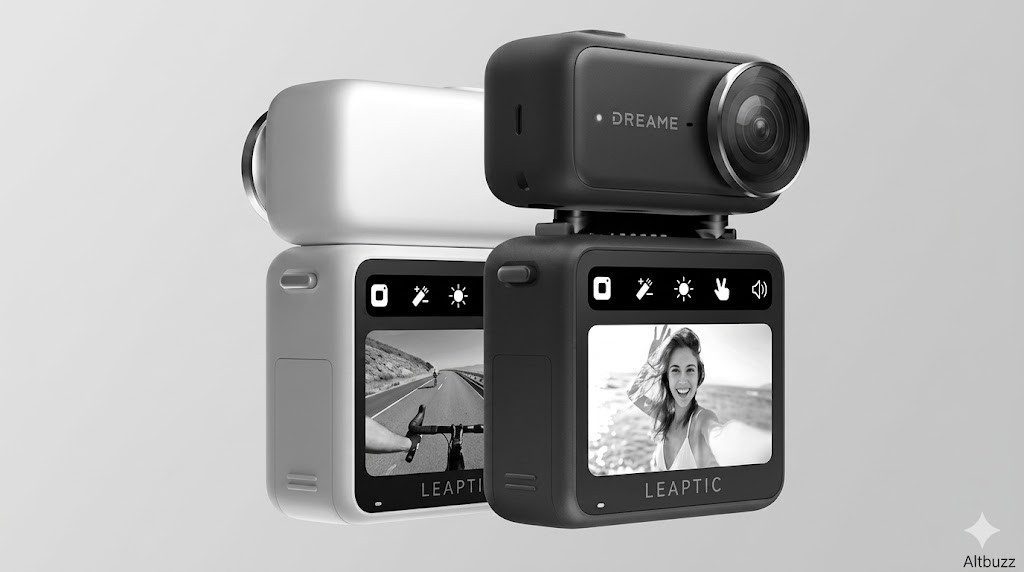
How Does the Modular Design Work?
The Leaptic Cube separates into two distinct components. The camera module is a thumb-sized unit with a magnetic rear surface. The main Action Body contains the 2.27-inch touchscreen display, additional battery capacity, and primary physical controls. Furthermore, the camera module can operate wirelessly up to 30 meters from the Action Body.
Why Does the Modular Approach Matter?
When the camera module separates from the Action Body, it becomes small enough to fit in extremely tight spaces. Helmet vents, bicycle handlebars, pet collars, and car interiors all become viable mounting locations. Additionally, the creator can hold the Action Body comfortably while the camera sits in a mounted position, providing live preview feedback without physical contortion.
What Is the Magnetic Mounting System?
The camera module has a magnetic rear surface for attaching to metal surfaces or compatible mounts. The included magnetic pendant clips the camera at chest level for hands-free POV recording. Furthermore, the pendant’s 15-degree adjustable tilt allows shooting angle optimization without repositioning the entire camera unit each time.
How Big Is the Action Body Screen?
The 2.27-inch touchscreen on the Action Body is noticeably larger than screens found on most competing action camera display units. It shows live preview, recording status, and access to all camera settings through a touch interface. Additionally, three dedicated physical buttons for shutter, power, and quick mode switching reduce dependence on the touchscreen during active shooting.
What Does the Camera Module Weigh?
Specific weight figures were not confirmed at announcement. However, Dreame describes the camera module as thumb-sized and substantially lighter than a traditional action camera body. The complete unit with Action Body remains portable enough for everyday carry and wearable use during physical activity.
Are There Color Options?
The Leaptic Cube is available in Midnight Black and Arctic White. Both finishes use the same internal specification. The Arctic White version photographs particularly well in bright outdoor environments and shows up clearly in POV footage where the camera appears in frame.
Battery and Connectivity
How Long Does the Camera Module Battery Last?
The camera module alone contains a 500mAh battery rated for approximately 90 minutes of recording. Real-world testing at 1080p resolution suggests approximately 40 to 50 minutes under demanding high-resolution recording conditions. However, the 12-minute fast charge reaching 80% makes quick recharging between shooting sessions genuinely practical during full-day activities.
What Does the Action Body Add?
Connected to the Action Body, total runtime reaches approximately 220 minutes. This represents a very substantial improvement over the camera module working alone. Additionally, the Action Body’s 1450mAh battery charges to 80% in just 18 minutes. This charging speed is nearly three times faster than the previous generation action body required.
What Is ProSync Wireless?
Dreame uses a proprietary NearLink ProSync wireless system for communication between the camera module and the Action Body. This system provides significantly greater range and connection stability than standard Bluetooth. Furthermore, the 30-meter operational range allows creative separation between the camera mounting position and the operator position during challenging recording scenarios.
Is There External Storage?
The Leaptic Cube uses internal storage only at either 64GB or 128GB capacity. There is no microSD slot on the camera module itself. This decision keeps the tiny camera module physically small and waterproofing-friendly. However, it means creators must offload footage to free space rather than simply swapping cards during a shoot.
Real-World Use Cases
Adventure Sports and Extreme Action
Cyclists, snowboarders, surfers, and climbers benefit from the modular design’s flexible mounting options. The camera module fits into positions where standard action cameras cannot physically go. Furthermore, GyroSteady AI stabilization keeps footage smooth during high-intensity activity without manual stabilization management.
Travel and POV Content Creation
The magnetic pendant positions the camera at chest level for immersive POV footage. The 155-degree field of view captures wide environmental context alongside the primary subject in the frame. Additionally, the lightweight camera module reduces physical fatigue during all-day travel shoots compared to carrying a larger integrated action camera.
Professional Video Production B-Roll
For professional video operators who need flexible B-roll capture, the Leaptic Cube offers 8K resolution, P-Log recording, and modular mounting flexibility that standard action cameras cannot match. Furthermore, the open-gate FreeFrame mode provides delivery format flexibility that benefits multi-format production workflows across horizontal and vertical platforms.
Hands-Free and Wearable Recording
Connected to the AI Ring and AI Glasses ecosystem, the Leaptic Cube enables fully hands-free recording control. Users trigger recording with a finger gesture, monitor framing through the glasses display, and focus entirely on the activity rather than any camera management. This capability is genuinely new in the action camera category.
Pet and Animal Filming
The tiny camera module attaches to pet harnesses and collars for authentic animal-perspective footage. The wide 155-degree lens captures broad environmental context from ground level and animal height perspectives. Additionally, the lightweight design means animals do not notice or resist the camera during movement.
Pros and Cons
Pros
The 1/1.3-inch CMOS sensor is the largest in an action camera at this physical size, delivering better dynamic range and low-light performance than smaller-sensor competitors. 8K at 30fps capture provides substantial reframing and detail advantages even when delivering final content at 4K resolution. The 4K at 120fps slow-motion mode delivers cinematic-quality high-frame-rate footage for sports and action content. Additionally, the modular detachable design enables unique mounting configurations that no integrated camera can achieve. The 30-meter wireless ProSync range between camera and display body is a significant practical creative advantage. Ultra-fast 12-minute fast charge on the camera module supports demanding all-day shooting schedules effectively. Furthermore, P-Log and 10-bit recording make the Leaptic Cube genuinely useful for professional video production workflows alongside dedicated cinema cameras.
Cons
Detailed waterproofing ratings for the bare camera module without housing are not fully confirmed at launch. At $440, the price requires strong real-world image quality performance to justify against GoPro Hero 13 and Insta360 GO Ultra alternatives. Dreame lacks the established ecosystem of accessories, mounts, mounting hardware, and community support that GoPro and Insta360 have built over many years. Additionally, 8K recording is limited to 30fps, which prevents high-frame-rate capture at maximum resolution. The modular design adds operational complexity compared to simple all-in-one action cameras during fast-paced shooting situations. Furthermore, Dreame’s track record in imaging hardware is completely unproven and real-world image quality requires independent long-term testing to confirm all published specifications.
Final Verdict
The Leaptic Cube is a technically impressive debut in the action camera category. The 8K sensor, modular split design, AI processing pipeline, and extended device ecosystem all push the category in a genuinely new and interesting direction. Dreame has produced a camera that challenges established brands on specification at every level.
However, specifications alone do not make a great action camera. Real-world durability, long-term reliability, firmware update quality, and accessory ecosystem development all matter enormously in this competitive category. The Leaptic Cube needs to prove all of these qualities over time through real use.
For early adopters who prioritize resolution, modular flexibility, and AI-driven workflow automation, the Leaptic Cube is a compelling and exciting option worth serious consideration. For photographers who prioritize proven reliability and established accessory support, waiting for extended real-world reviews before committing financially is the wiser approach.
Read More from AltBuzz
Read more from Altbuzz for camera reviews, rumors, and detailed specs. AltBuzz delivers trusted and easy-to-understand photography content.
Subscribe AltBuzz YouTube Channel
Stay updated with camera reviews, rumors, and comparisons. AltBuzz shares regular camera content.