
Leica Q3 43 vs M11-P: Which Leica Should You Buy in 2026?
The Leica Q3 43 vs M11-P debate splits the Leica community in two. One camera hands you everything in a single purchase. The other hands you the purest rangefinder experience Leica sells. In our ranking of all 12 current Leica cameras, the Q3 43 took #1 and the M11-P took #2, and the gap between them came down to one question: what do you actually want a Leica to do for you?
I have used both cameras extensively, so this comparison comes from real shooting, not a spec sheet. Below, I break down the lens, focusing, handling, image character, workflow, and total cost of each camera. I also walk through real shooting scenarios, a buying guide for M11-P lenses, and a decision framework you can use today. By the end, you will know which camera fits how you shoot.
Leica Q3 43 vs M11-P: The Quick Answer
Choose the Leica Q3 43 if you want one camera that works the moment you unbox it. It pairs a 60MP sensor with a built-in APO-Summicron 43mm F2 lens, autofocus, and real macro capability.
Choose the Leica M11-P if the optical rangefinder experience is the whole point. It delivers a 60.3MP sensor, a sapphire-crystal display, 256GB of memory, built-in Content Credentials, and full M-lens compatibility. You buy the lenses separately and focus manually.
If you cannot decide, ask yourself one question. Do you want to take pictures, or do you want to practice a craft while taking pictures? The Q3 43 answers the first. The M11-P answers the second.
Leica Q3 43 vs M11-P at a Glance
| Feature | Leica Q3 43 | Leica M11-P |
|---|---|---|
| Sensor | 60MP | 60.3MP |
| Lens | Built-in APO-Summicron 43mm F2 | Interchangeable M-mount (sold separately) |
| Focusing | Autofocus and manual focus | Manual focus through optical rangefinder |
| Viewfinding | Electronic | Optical rangefinder |
| Macro capability | Yes, built in | Depends on the M lens you buy |
| Digital cropping | Extends well past native focal length | Available, with lens choice as the main tool |
| Memory | Standard card storage | 256GB built-in |
| Display | Rear screen | Sapphire-crystal display |
| Content Credentials | Not listed in our notes | Built in |
| Exterior | Premium build, simple controls | Quiet P-series finish, no front red dot |
| Our ranking | #1 | #2 |
Why These Two Cameras Define Leica in 2026
Leica sells a wide lineup, but these two cameras represent two opposite philosophies. The Q3 43 argues that a great camera should arrive complete. The M11-P argues that a great camera should demand your attention and reward it.
Both cameras share a 60MP-class sensor, so image resolution does not separate them. Everything else does. That makes this comparison unusually clean. You choose a shooting philosophy, not a megapixel count.
These two cameras also sit at the top of our ranking for a reason. Most of the other Leica models ask you to accept a limit. The Q3 asks you to accept 28mm. The Monochrom cameras ask you to accept black and white forever. The M11-D asks you to give up the rear screen. The M EV1 asks you to give up the optical rangefinder. The Q3 43 and the M11-P ask for far less, and they each deliver a different version of the complete Leica experience.
How We Compared the Q3 43 and the M11-P
I judged both cameras on the same question that drives our full ranking: which camera makes the strongest case for owning a Leica today? That question rewards more than raw specifications. I weighed the lens situation, the focusing experience, the handling, the image character, the workflow, and the total price against what you receive.
I also kept the comparison fair by separating two kinds of strengths. Some strengths belong to the camera itself, like the sensor, the build, and the controls. Others belong to the system around it, like lens choice and accessories. The M11-P wins more often on system strengths. The Q3 43 wins more often on package strengths. Keep that distinction in mind as you read.
Lens and Focal Length: Fixed 43mm vs Any M Lens
The lens is the biggest difference between these two cameras. It shapes what you shoot, what you spend, and how you think about the whole system.
What the Q3 43 Lens Delivers
The Q3 43 carries an APO-Summicron 43mm F2 lens built permanently onto the body. That lens is exceptional, and Leica built the camera around it. You never worry about matching a lens to the sensor, because Leica already did that work for you.
43mm is not just a number sitting between 35 and 50. It changes what the camera does well day to day. Street work, environmental portraits, travel, and quiet documentary details all fall naturally into this focal length. For many photographers, 43mm is easier to live with than 28mm, because it shows the subject without pushing you to step in close.
The lens also gives the camera real macro capability. Most fixed-lens cameras force you to carry a second tool for close-up work. The Q3 43 handles it without a single accessory.
What the M11-P Lens System Offers
The M11-P gives you the whole M-mount world. You can mount wide-angle glass, 35mm lenses, 50mm lenses, portrait lengths, vintage M lenses, modern APO designs, and fast Summilux and Noctilux options. The lens becomes part of how you build the image.
That freedom is a genuine advantage. It is also a genuine cost. The M11-P ships as a body only, so you must choose, buy, and learn at least one lens before the camera becomes useful. Many new M owners spend weeks deciding which focal length to buy first, and some change their minds after a month of shooting.
The Problem of Choosing Your First M Lens
Choosing a first lens sounds exciting, and it becomes a real hurdle in practice. A 35mm lens suits general street and travel work. A 50mm lens suits portraits and a tighter, calmer view. A wide-angle lens suits architecture and landscapes. Each choice shapes the camera, and each choice costs real money.
The Q3 43 removes this hurdle entirely. Leica made the choice for you, and the choice is a good one. If you dislike spending time on gear research, that single fact may decide the whole comparison.
Lens Verdict
The Q3 43 wins on simplicity and clarity of decision. The M11-P wins on creative range. If you love experimenting with focal lengths and vintage character, the M11-P gives you far more room to play. If you want to stop deciding and start shooting, the Q3 43 wins.
Focusing: Autofocus vs the Optical Rangefinder
Focusing defines the shooting experience on each camera more than any other feature. It also creates the sharpest divide between the two.
Autofocus and Manual Focus on the Q3 43
The Q3 43 gives you autofocus when you want it and manual focus when you do not. That flexibility makes the camera forgiving. You can track a moving subject in a crowd, then switch to manual focus for a careful composition. The camera supports both styles without making you choose a side.
The Rangefinder Experience on the M11-P
The M11-P forces you to focus manually through an optical patch. The experience is easy to describe and hard to explain. Manual focusing through a rangefinder demands an attention that autofocus never asks for. It runs slower, deliberately so, and it never gets old.
You line up two images inside the viewfinder, and the moment they merge, you know the focus is right. That simple action connects you to the subject in a way that a focus point on a screen does not. High-end autofocus mirrorless cameras have not replicated that simplicity, no matter how good their sensors get.
What Manual Focus Costs You
I will not romanticize the rangefinder past what it is. Manual focus costs you missed shots. Fast subjects, children, pets, and unpredictable street moments all challenge a rangefinder shooter. You can improve with practice, and many photographers learn to pre-focus and work a scene patiently. But you will still miss frames that autofocus would have caught.
Focusing Verdict
Choose the Q3 43 if you shoot fast, unpredictable subjects. Choose the M11-P if you shoot slowly and value the ritual of focusing. Neither approach is better. They serve different photographers.
Image Quality: Two 60MP Sensors, Two Different Results
Both cameras deliver 60MP-class files, so you will not find a dramatic resolution gap. The M11-P uses a 60.3MP sensor, and the Q3 43 uses a 60MP sensor.
The real image-quality difference comes from the lens. The APO-Summicron on the Q3 43 gives you a controlled, precise look from a single optimized design. Leica tuned the lens and the sensor to work together, so the results stay consistent from shot to shot.
The M11-P gives you whatever look you choose to mount. A vintage lens produces a very different image from a modern APO lens on the same body. A fast Noctilux creates a dreamy, shallow-focus look. A modern Summicron creates a crisp, clean image. The M11-P becomes a different camera with every lens you attach.
For photographers who want a consistent, reliable look, the Q3 43 delivers. For photographers who treat the lens as a creative variable, the M11-P gives you far more control over character.
Digital Cropping on the Q3 43
The Q3 43 offers digital cropping that extends well past its native focal length. A 60MP file gives you plenty of pixels to spare. Cropping to a slightly tighter view still leaves you with a large, detailed image. A modest crop gives you a view close to 50mm, and a deeper crop reaches into short-telephoto territory while keeping a file size that suits most uses.
That flexibility stretches the single lens further than its fixed focal length suggests. You still lose some resolution as you crop, so treat it as a creative tool and not a replacement for the right lens.
Cropping on the M11-P
The M11-P also gives you a 60.3MP file to crop, and you can use it the same way. The difference is that M11-P owners usually solve framing problems by changing lenses, not by cropping. That habit keeps the full resolution intact, but it asks you to carry more gear.
Shooting Experience: Street, Travel, Portraits, and Documentary Work
Specifications only tell part of the story. Here is how each camera performs in the situations where Leica owners actually shoot.
Street Photography
The Q3 43 handles street work with ease. Autofocus lets you react quickly, and the 43mm view fits naturally into busy environments. You raise the camera, the lens finds focus, and you capture the moment.
The M11-P rewards a patient street photographer who pre-focuses and works the scene deliberately. You set your distance, wait for the subject to enter the frame, and press the shutter. That approach produces a calm, intentional style of photography, and many photographers love it. Both cameras produce outstanding results, but the Q3 43 forgives more mistakes.
Travel Photography
Travel favors the Q3 43. You carry one camera, one lens, and no decisions. You can walk all day with a light bag and still handle landscapes, street scenes, food, and portraits.
The M11-P demands lens choices before every trip. Carrying several M lenses adds weight and complexity, and you risk leaving the right lens at the hotel. If you travel light and shoot often, the Q3 43 fits better.
Environmental Portraits
The 43mm focal length shines for environmental portraits. It captures the subject and their surroundings without noticeable distortion, and it lets you stand at a comfortable, natural distance from your subject.
The M11-P can match this with a 35mm or 50mm lens, and many portrait photographers prefer the fast aperture options available in the M system. A fast M lens can isolate a face beautifully. This category is close, and your preference for lens character will decide it.
Quiet Documentary Details
Both cameras suit documentary work. The M11-P offers a discreet look thanks to its quieter P-series exterior, which drops the front red dot that advertises what you carry. In sensitive situations, that low profile helps you blend in.
The Q3 43 offers real macro capability for close detail work. You can photograph textures, objects, and small scenes without switching tools. Pick the M11-P for discretion and the Q3 43 for versatility.
Low-Light and Evening Shooting
Both cameras handle evening work well, but they do it differently. The Q3 43 pairs an F2 lens with autofocus, so you can focus quickly even as the light drops. The M11-P lets you mount a very fast M lens and focus by eye through the rangefinder, which works well when you know your technique. If you want to shoot wide open in dim rooms, the M system offers faster glass, but the Q3 43 makes the process easier.
Build Quality, Controls, and Design
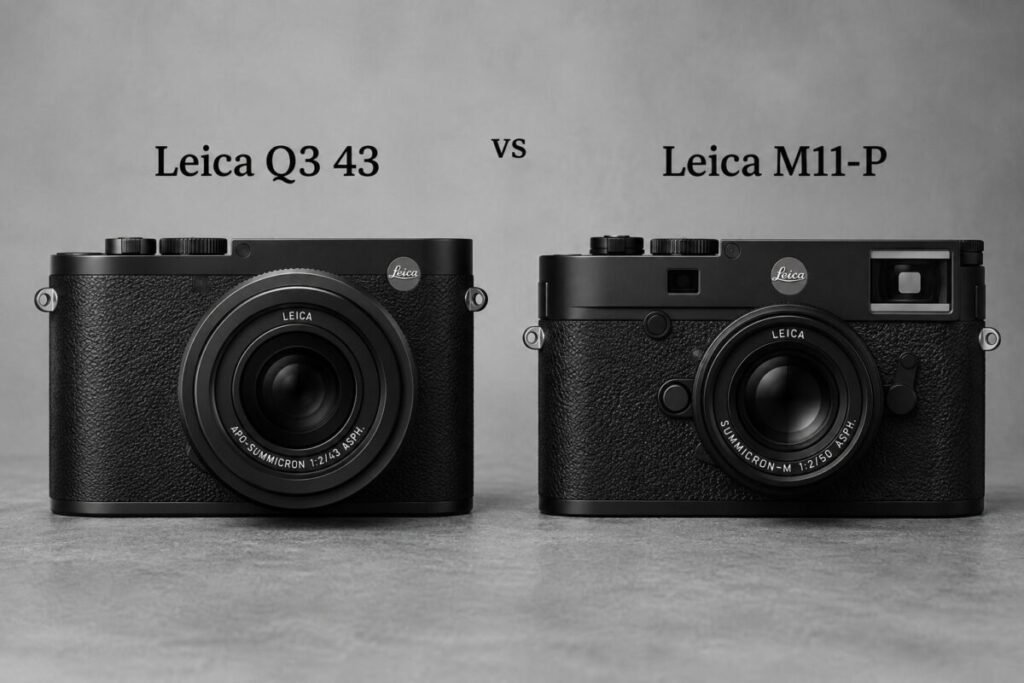
Both cameras feel like premium objects. Leica builds each one with high-end materials and a minimalist approach to controls.
The Q3 43 keeps its controls simple, so you spend less time in menus and more time shooting. The camera feels complete in your hands, because the lens, the body, and the controls belong together.
The M11-P adds a sapphire-crystal display and a restrained P-series exterior that favors understated design over visible branding. The camera feels like a classic tool, and it invites you to slow down. If you value a quiet, low-profile camera, the M11-P speaks to you. If you value a simple, complete tool, the Q3 43 speaks to you.
Storage and Modern Features
The M11-P includes 256GB of memory and built-in Content Credentials. That storage removes one more thing to worry about, and the Content Credentials feature helps photographers who need to verify the origin of their images. For journalists, documentary photographers, and anyone who publishes work professionally, that feature carries real value.
The Q3 43 focuses its modern features on the shooting experience: autofocus, macro capability, and digital cropping that extends well past its native focal length. Those features make the camera practical every day, even when you do not think about them.
Workflow: What Happens After You Shoot
A camera does not end at the shutter button. Your workflow shapes how much you enjoy the camera over months and years.
Q3 43 Workflow
The Q3 43 produces a 60MP file, and you can use it for almost anything: prints, social media, client work, and heavy cropping. Autofocus gives you a higher keeper rate, so you spend less time culling missed frames. You can import, edit, and publish quickly.
M11-P Workflow
The M11-P produces a 60.3MP file with the same editing flexibility. Your keeper rate depends more on your focusing skill, so you may cull more frames in the beginning. Over time, many M11-P owners report a slower, more selective shooting habit. They take fewer pictures and keep a higher percentage of them. If you enjoy that approach, the M11-P rewards you. If you prefer to shoot freely and edit later, the Q3 43 fits better.
Total Cost of Ownership: What You Really Pay
A price comparison between these two cameras requires you to think beyond the sticker price.
The Q3 43 Cost Advantage
The Q3 43 includes a premium lens in the purchase. You pay once and you shoot. You face no second decision and no hidden lens budget. The cost you see is the cost you pay.
The M11-P Hidden Costs
The M11-P is extremely expensive as a body, and it still needs lenses. Leica M lenses carry premium pricing, so the real cost of a working M11-P kit rises quickly. A single quality lens can add a major expense, and many owners eventually buy a second or third.
You should also budget for the time it takes to learn manual focusing. That time has no price tag, but it affects how soon you feel confident with the camera.
Buying Used Lenses to Reduce the Gap
M11-P buyers can reduce lens costs by shopping for pre-owned M lenses, including older designs that still perform beautifully. That strategy narrows the gap, but it takes research and patience. The Q3 43 asks for none of that.
Cost Verdict
The Q3 43 delivers a more predictable total cost. The M11-P can deliver a more tailored kit, but it demands a larger and more open-ended investment. Check current pricing on the official Leica Camera website before you decide.
Who Should Buy the Leica Q3 43?
Buy the Q3 43 if you fit any of these profiles:
- You want one camera that works immediately.
- You shoot street, travel, environmental portraits, or documentary work.
- You like 43mm more than 28mm and you do not need to swap lenses.
- You want autofocus and manual focus in the same body.
- You want macro capability without carrying extra gear.
- You prefer a simple purchase over a system to build.
- You shoot fast or unpredictable subjects and want a high keeper rate.
- You travel often and want a light, complete setup.
Who Should Buy the Leica M11-P?
Buy the M11-P if you fit any of these profiles:
- You want the optical rangefinder experience above everything else.
- You enjoy manual focusing and see it as part of the craft.
- You want the freedom to mount any M lens, modern or vintage.
- You value a discreet camera with a quiet P-series exterior.
- You already own M lenses or plan to build a collection.
- You accept a slower, more deliberate way of working.
- You need built-in Content Credentials for your professional work.
- You enjoy the lens as a creative variable and want many looks from one body.
Who Should Skip Each Camera?
Honest buying advice includes the people who should walk away.
Skip the Q3 43 if you love changing lenses, you want a rangefinder, or you committed to 28mm and cannot imagine another focal length. A committed 28mm shooter will likely still prefer the standard Q3.
Skip the M11-P if you shoot fast action, you dislike manual focus, you want a complete camera without a lens shopping list, or you feel overwhelmed by gear decisions. The M11-P rewards patience, and it punishes impatience.
Leica Q3 43 vs M11-P vs the Rest of the Lineup
These two cameras did not win by default. The SL3-P holds the title of most capable Leica, but it competes directly with Canon, Nikon, Sony, and Panasonic, which makes its pricing harder to justify. The Q3 and the M11 Monochrom also earned strong rankings, but each asks you to accept a limit: 28mm for the Q3, and permanent black and white for the Monochrom.
The M11-D removes the rear screen, and the M EV1 replaces the optical rangefinder with an electronic viewfinder. Both cameras make bold choices, but each one gives up something that many buyers value. The Q3 43 and the M11-P avoid those trade-offs in different ways. That is why they sit at #1 and #2 in our full ranking.
Why the Q3 43 Beat the M11-P in Our Ranking
The M11-P makes the fewest compromises within its own family. It keeps the screen that the M11-D drops, the color that the Monochrom drops, and the rangefinder that the M EV1 drops. Nothing is quietly missing.
Still, it loses to the Q3 43 for three reasons. You buy the body only. You focus manually. You still need to buy lenses. The Q3 43 removes all three barriers.
Compare them directly:
- Lens: The Q3 43 includes an exceptional lens. The M11-P requires a separate purchase.
- Focusing: The Q3 43 offers autofocus and manual focus. The M11-P offers manual focus only.
- Decisions: The Q3 43 leaves nothing to decide. The M11-P leaves a whole system to build.
The Q3 43 does not win because it is a better rangefinder camera. It wins because it delivers the most complete version of what buying a Leica should feel like, in one purchase, with nothing missing and nothing left to decide.
When the M11-P Should Win for You
My ranking reflects how I shoot, and your priorities may differ. A rangefinder purist may crown the M11-P without hesitation. Someone who already owns M lenses gains far more from the M11-P than from a new fixed-lens camera. A photographer who loves the slow ritual of manual focus will find the Q3 43 too easy.
That is not a flaw in either camera. It is what makes Leica worth arguing about. The best camera is the one that makes you pick it up every day, and only you know which one does that.
A Simple Decision Framework
Use these five questions to settle the Leica Q3 43 vs M11-P choice:
- Do you already own M lenses? If yes, lean toward the M11-P. If no, lean toward the Q3 43.
- Do you shoot fast, unpredictable subjects? If yes, choose the Q3 43.
- Do you love manual focus as a craft? If yes, choose the M11-P.
- Do you want one camera with no extra purchases? If yes, choose the Q3 43.
- Do you want to explore many focal lengths and lens characters? If yes, choose the M11-P.
Count your answers. If three or more point to one camera, you have your answer.
Leica Q3 43 vs M11-P: Frequently Asked Questions
Which is better, the Leica Q3 43 or the M11-P?
The Q3 43 is better for most photographers because it delivers a complete package in one purchase. The M11-P is better for photographers who want the traditional optical rangefinder experience above everything else.
Does the Leica Q3 43 have autofocus?
Yes. The Q3 43 offers autofocus when you want it and manual focus when you do not.
Does the Leica M11-P have autofocus?
No. The M11-P uses an optical rangefinder, so you focus manually.
Does the M11-P include a lens?
No. The M11-P ships as a body only, so you must buy M-mount lenses separately.
Can the Leica Q3 43 shoot macro?
Yes. The Q3 43 offers real macro capability built into its lens.
Do the Q3 43 and M11-P have the same resolution?
They sit in the same class. The Q3 43 offers 60MP, and the M11-P offers a 60.3MP sensor.
Is 43mm better than 28mm for the Q3?
It depends on how you see. 43mm suits street work, environmental portraits, travel, and documentary details. A committed 28mm shooter will likely still prefer the standard Q3.
Does the M11-P have Content Credentials?
Yes. The M11-P includes built-in Content Credentials, along with 256GB of memory and a sapphire-crystal display.
Which camera is better for street photography?
Both work well. The Q3 43 forgives more mistakes thanks to autofocus, while the M11-P rewards patient, deliberate shooters who pre-focus.
Which camera is better for travel?
The Q3 43 suits travel better because you carry one camera and one lens with no decisions to make.
Is the M11-P worth the extra cost?
It is worth it if you value the rangefinder experience and plan to use M lenses creatively. If you want a simple, complete camera, the Q3 43 delivers better value.
Where did the Q3 43 rank in your Leica list?
The Q3 43 ranked #1 out of 12 Leica cameras in our hands-on ranking, and the M11-P ranked #2.
Final Verdict: Leica Q3 43 vs M11-P
The Leica Q3 43 vs M11-P comparison ends with a clear split. The Q3 43 delivers the strongest complete package, with an exceptional lens, autofocus, macro capability, and nothing left to decide. The M11-P delivers the purest traditional Leica experience, with an optical rangefinder, full M-lens freedom, and a quiet, discreet design.
I choose the Q3 43 for how I shoot. You might choose the M11-P for how you think. Both cameras deserve a place at the top of any Leica list, and neither one is a mistake.
Tell me in the comments: which camera fits your style, and would you give up autofocus for the rangefinder?
Read More from Altbuzz
- Best Leica Cameras 2026: All 12 Models Ranked After Real-World Use
- Leica Q3 43 vs M11-P: Which Leica Should You Buy in 2026?
- More camera reviews, rumors, and photography guides on Altbuzz
Subscribe to Altbuzz YouTube Channel
Want more rankings and comparisons built on real ownership instead of spec sheets? Subscribe to the Altbuzz YouTube channel for hands-on camera reviews and honest verdicts. You can also support the channel through the Core and Elite memberships linked in the video description, and you will find more camera coverage at altbuzzmedia.com.