
Leica X2 Review: Still Worth Buying Today?
The Leica X2 remains one of the most talked about compact cameras from Leica’s early APS-C lineup. Photographers still search for it years after its release. This Leica X2 review looks at every part of the camera, from the sensor to the lens to the overall shooting experience.
Leica launched the X2 in May 2012 as the successor to the X1. It kept the same minimalist design while upgrading the sensor and processor. The camera targeted photographers who wanted Leica quality in a smaller, simpler package than a rangefinder M camera.
This review covers image quality, build, autofocus, handling, and value. By the end, you will know whether the Leica X2 deserves a spot in your bag today.
Leica X2 Quick Specs
A fast overview helps before diving into the details.
| Feature | Leica X2 |
|---|---|
| Release year | 2012 |
| Sensor | 16.1MP APS-C CMOS |
| Lens | Leica Elmarit 24mm f/2.8 (36mm equivalent) |
| Autofocus | Contrast detection, 1-point, 11-point, spot, face detection |
| ISO range | 100 to 12,500 |
| Continuous shooting | Up to 5 fps |
| Screen | 2.7-inch LCD, 230,000 dots |
| Viewfinder | Optional external accessory |
| Video | None |
| Weight | 345g without battery |
| Launch price | $1,995 |
These numbers set the stage for a deeper look at how the Leica X2 actually performs in the field.
Design and Build Quality
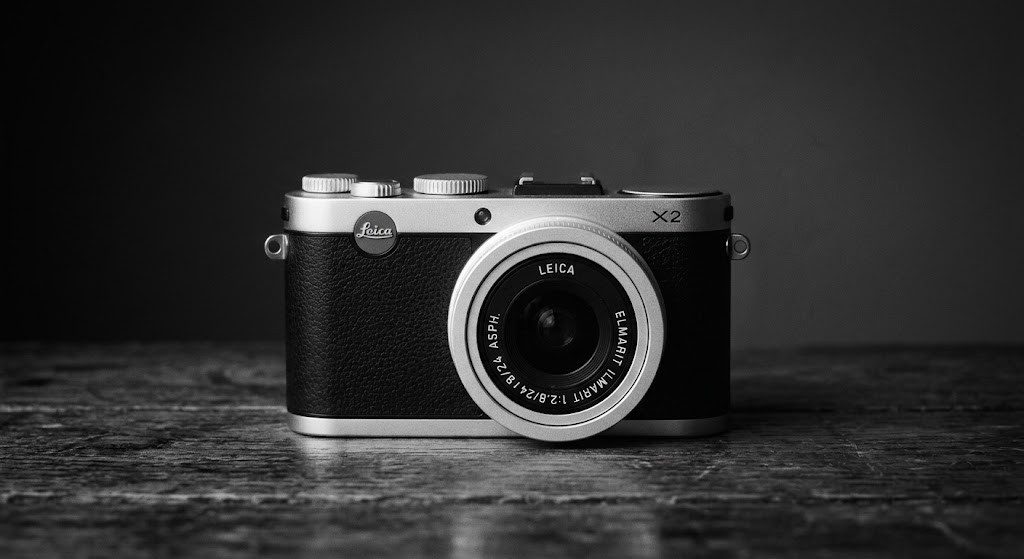
Leica built the X2 with a focus on materials and simplicity. The top plate uses aluminum, and the body wraps in textured leatherette. This combination gives the camera a solid, premium feel in the hand. Every dial and switch feels tight and deliberate, which matches Leica’s reputation for careful manufacturing.
The layout stays minimal. A mode dial and shutter button sit on top, next to a thumbwheel for manual focus adjustments. A four-way directional pad on the back handles exposure compensation, autofocus mode, flash settings, and the self-timer. There is no clutter and no unnecessary menu depth.
Weight comes in at 345 grams without the battery, which makes the X2 easy to carry all day. The dimensions measure 124 x 69 x 52mm, slightly thicker than many rivals in its class due to the built-in flash and battery compartment. Leica did not add any weather sealing, so owners need to keep the camera away from rain and dust.
Overall, the build quality stands out as one of the strongest points in this Leica X2 review. It feels like a camera built to last for years of regular use.
Sensor and Image Quality
Image quality sits at the center of any camera review, and the Leica X2 performs well within its limits.
The X2 uses a 16.1-megapixel APS-C CMOS sensor. Maximum resolution reaches 4928 x 3264 pixels. This resolution suits prints up to roughly 16×20 inches without trouble. Files come out sharp with strong detail, especially in the center of the frame.
Color rendering carries the Leica signature look. Skin tones appear natural, and the overall palette leans toward accurate rather than punchy. Photographers who shoot RAW and process files in Lightroom, which comes bundled with the camera, get the most out of the sensor’s dynamic range.
Sharpness holds up well across the frame, with detail extending close to the edges thanks to the quality of the Elmarit lens paired with this sensor. Out-of-camera JPEGs look slightly soft at default sharpening settings, so many photographers add a touch of sharpening in post.
The Leica X2 image quality shines at low ISO settings between 100 and 800. Files stay clean, detailed, and full of tonal range. This makes the camera a strong choice for daylight street photography, landscapes, and travel shots.
Lens Performance
The lens defines much of the character in this Leica X2 review.
Leica fits the X2 with a fixed Elmarit 24mm f/2.8 lens, giving a 36mm equivalent field of view on the APS-C sensor. This focal length works well for street photography, environmental portraits, and travel documentation. It sits slightly longer than the 35mm equivalent found on many rival compacts.
Optically, the lens produces excellent sharpness even at its widest aperture. Corner performance stays strong, with only minor softness compared to the center. Distortion stays minimal, and chromatic aberration rarely shows up in real-world shooting.
The maximum aperture of f/2.8 limits low-light flexibility somewhat compared to faster f/2 lenses on competing cameras. Photographers who shoot indoors or after sunset may need to raise ISO more often to compensate. Still, the rendering quality and micro-contrast from this lens give images a distinct look that many photographers associate directly with the Leica brand.
Autofocus and Shooting Speed
Autofocus received real attention when Leica moved from the X1 to the X2, and this review found clear improvement.
The X2 offers four autofocus modes: single point, 11-point, spot, and face detection. In good light, the system locks focus reliably, though it still trails behind autofocus systems found in more modern compacts. Indoors or in dim settings, focus hunting becomes more common, and manual focus becomes a useful backup.
Manual focusing works through a thumbwheel on the back of the camera. The center of the frame magnifies automatically to help confirm sharp focus. This method takes practice but rewards patient photographers with precise results.
Continuous shooting reaches 5 frames per second, with a buffer that holds around 8 combined RAW and JPEG files before slowing down. This burst rate suits casual action shots but will not keep up with fast sports or wildlife photography.
Handling and Controls
Handling on the Leica X2 favors simplicity over speed.
The camera lacks a traditional grip, so many owners add the optional handgrip accessory for better stability. The scroll wheel around the four-way pad allows quick access to shutter speed or aperture depending on the shooting mode. Menu depth stays shallow, with most settings accessible within two or three taps.
Metering offers three modes: smart multizone, center-weighted, and spot. The multizone mode performs well in mixed lighting, rarely requiring manual exposure compensation. White balance also performs accurately across most lighting conditions, including tricky tungsten and fluorescent scenes.
Photographers coming from more automated cameras may need an adjustment period. The X2 rewards a slower, more considered shooting style rather than fast, reactive shooting.
Screen and Viewfinder
This area represents one of the weaker points in this Leica X2 review.
The rear screen measures 2.7 inches with only 230,000 dots of resolution. This screen feels dim and low-resolution even by 2012 standards, let alone today. Reviewing images or checking focus on the LCD can prove difficult in bright sunlight.
Leica sold an optional external viewfinder that slides into the hot shoe. This accessory improves the shooting experience considerably, especially for photographers who prefer eye-level composition. However, it adds extra cost on top of an already premium camera price.
The lack of a built-in viewfinder stands out as a real limitation, especially compared to rivals that included one at a similar or lower price point.
ISO and Low Light Performance
Low light handling shows both strengths and limits on the Leica X2.
At ISO 100 through 800, images stay clean with minimal visible noise. Detail remains strong, and colors stay accurate. Between ISO 1600 and 3200, fine grain starts to appear, though detail remains usable for most purposes.
At the top setting of ISO 12,500, noise becomes clearly visible, though it presents as fine, film-like grain rather than blotchy digital noise. Many photographers find these higher ISO files still useful when converted to black and white or resized for web use.
Overall, the Leica X2 handles low light reasonably well for a camera from its era, though newer APS-C compacts offer cleaner results at higher sensitivities.
Battery Life and Everyday Use
Battery life on the X2 rates around 450 shots per charge, which holds up well for a full day of casual shooting. The camera charges through a dedicated wall charger rather than USB, so travelers need to pack the charger separately.
Storage relies on standard SD cards, and the X2 does not demand fast write speeds since it lacks video recording and high-speed burst modes. Budget SD cards work fine for everyday use.
The included copy of Adobe Lightroom adds real value for photographers who plan to shoot RAW regularly, since it handles the DNG files produced by the camera without any conversion needed.
A Closer Look at Real-World Shooting
Numbers on a spec sheet only tell part of the story. Real shooting conditions reveal how a camera actually behaves day to day.
On a sunny afternoon walk through a city center, the Leica X2 handles exposure changes smoothly. Multizone metering adjusts well as light shifts between shaded streets and open squares. Photographers rarely need to touch exposure compensation in these conditions, which keeps the shooting experience relaxed and quick.
Indoor cafe scenes present more of a challenge. Autofocus slows down noticeably under artificial lighting, and the lens’s f/2.8 maximum aperture pushes ISO higher than photographers might prefer. Manual focus becomes a practical workaround in these settings, especially for static subjects like a coffee cup or a seated portrait.
Landscape shooting plays directly to the X2’s strengths. The lens resolves fine detail across the frame, and the sensor’s dynamic range holds up well in scenes with bright skies and shadowed foregrounds. Photographers who bracket exposures and blend in post can pull even more detail from tricky landscape scenes.
Portrait work benefits from the 36mm equivalent focal length, which sits close enough for environmental portraits without excessive background compression. Skin tones render naturally straight out of camera, reducing the need for heavy color correction during editing.
Accessories Worth Considering
A few accessories round out the Leica X2 shooting experience considerably.
The Leica VF-2 external viewfinder ranks as the most useful addition for photographers who prefer eye-level composition. It slides into the hot shoe and provides a bright, clear view that compensates for the camera’s weak rear screen.
The optional handgrip improves stability during handheld shooting, especially for photographers with larger hands. Since the X2 body stays flat and minimal, this grip adds meaningful comfort during longer shooting sessions.
A spare battery is worth carrying for full-day outings, since the X2 does not support USB charging on the go. Photographers who travel frequently should also consider a compact charger to keep in a bag alongside spare SD cards.
How the Leica X2 Fits Into a Modern Kit
Many photographers today pair an older camera like the X2 with newer gear rather than relying on it exclusively.
Some use the X2 as a dedicated street or travel companion, saving their primary mirrorless system for planned shoots or client work. The compact size and simple operation make it easy to carry without the bulk of an interchangeable lens system.
Others treat the X2 as a deliberate creative constraint. Shooting with a fixed 36mm lens and a slower autofocus system forces a more thoughtful approach to composition and timing. This constraint can sharpen a photographer’s eye over time, even if it means missing a few fast-moving shots along the way.
Collectors sometimes keep the X2 as a working piece of Leica history rather than a primary shooter. Its design bridges the gap between Leica’s rangefinder heritage and its later digital compact lineup, making it an interesting camera to study and use occasionally.
Leica X2 Pros and Cons
Pros
- Sharp Elmarit 24mm f/2.8 lens with excellent center and edge performance
- Strong build quality with premium materials
- Accurate metering and reliable white balance
- Clean image quality at low ISO settings
- Simple, distraction-free control layout
- Includes Adobe Lightroom for RAW processing
Cons
- Low-resolution, dim rear screen
- No built-in viewfinder
- Contrast-detection autofocus struggles in low light
- No video recording capability
- Premium price compared to similarly specced rivals
- Autofocus speed trails behind more modern compacts
Who Should Buy the Leica X2
The Leica X2 suits a specific type of photographer rather than a general audience.
Street photographers who enjoy a slower, deliberate shooting pace will appreciate the simple controls and excellent lens rendering. The compact size makes it easy to carry without drawing much attention.
Travel photographers who prioritize image quality over speed can also get strong results from the X2, especially in good daylight. The camera handles landscapes, architecture, and casual portraits well.
Collectors and Leica enthusiasts drawn to the brand’s design language will enjoy owning the X2 as a lower-cost entry point compared to Leica’s rangefinder M series or current X-series compacts.
Photographers who need fast autofocus, video recording, or a built-in viewfinder should look elsewhere. The X2 was never designed to compete on speed or modern convenience.
Leica X2 vs Rivals
Comparing the X2 to its era’s competition helps frame its place in the market.
Fujifilm’s X100 series offered a similar concept with a fixed lens, APS-C sensor, and retro styling, often at a lower price with a built-in hybrid viewfinder. Readers curious about how the current X100V compares to the Leica lineup can check our full breakdown in the Fujifilm X100V vs Leica X2 comparison on Altbuzz.
Sony’s Cyber-shot RX100 line also competed in this space, offering a smaller body and a zoom lens rather than a fixed prime. The X2 held its ground on image quality and build, though it lacked the zoom flexibility and video features found on the Sony.
Against these rivals, the Leica X2 carved out a niche built around simplicity, lens quality, and brand prestige rather than outright feature count.
Editing and Post-Processing the X2’s Files
Getting the most from the Leica X2 often comes down to editing choices.
The camera ships with a full copy of Adobe Lightroom, which pairs naturally with the DNG RAW files it produces. Shadows lift cleanly without introducing much noise at low ISO settings, giving editors real flexibility when balancing exposure after the fact.
Sharpening deserves special attention. Out-of-camera JPEGs look soft at default settings, so applying a moderate amount of sharpening in post brings out the lens’s true resolving power. Many photographers apply capture sharpening first, then add a lighter output sharpening pass depending on whether the image is headed to print or web.
Color grading also plays to the camera’s strengths. Because the X2 renders accurate, neutral colors by default, it takes well to both warm film-inspired presets and cooler, more editorial looks. Black and white conversions in particular hold up beautifully, given the sensor’s smooth tonal transitions and film-like grain structure at higher ISO settings.
Photographers new to RAW editing will find the X2’s files forgiving. There is enough dynamic range to recover moderate highlight and shadow detail without introducing harsh artifacts, which makes the learning curve gentler than some rival systems from the same era.
Frequently Asked Questions
Is the Leica X2 good for beginners? The X2 works better for photographers who already understand exposure basics. Its manual-friendly controls and simple menu reward those comfortable making their own settings decisions rather than relying on automatic modes.
Does the Leica X2 shoot RAW? Yes. The X2 captures RAW files in Adobe’s DNG format, and the camera ships with a full copy of Adobe Lightroom for processing.
What is the Leica X2 best used for? The X2 performs best for street photography, travel, and daylight portraiture. Its lens delivers sharp, characterful images in good lighting conditions.
Does the Leica X2 have image stabilization? No. The X2 relies on a fast shutter and steady handholding technique rather than in-body or lens-based stabilization.
Is the Leica X2 worth buying used today? Used prices have dropped significantly since launch, making the X2 a more accessible way to experience Leica image quality. Buyers who value the lens rendering and build quality over speed or video will still find it worthwhile.
Final Verdict: Leica X2 Review
The Leica X2 delivers on image quality and build, even years after its original release. The Elmarit lens produces sharp, characterful files, and the aluminum body feels built to last. Weak points remain the dim rear screen, the missing built-in viewfinder, and autofocus speed that trails behind newer compacts.
This Leica X2 review lands on a clear conclusion. Photographers who value a slower, deliberate shooting style and appreciate Leica’s design philosophy will enjoy this camera. Buyers who need speed, video, or built-in eye-level composition should look toward newer options instead.
For current pricing, accessories, and official specifications, visit the Leica Camera website directly.
More From Altbuzz
Altbuzz publishes in-depth camera reviews and comparisons across every major brand, from Leica to Fujifilm to Sony. Readers who enjoyed this Leica X2 review can browse more detailed gear breakdowns on the Altbuzz website.
Altbuzz also shares hands-on video reviews and the latest camera rumors. Subscribe to the Altbuzz YouTube channel for more reviews like this one, along with fresh camera news as it happens.