
Fujifilm X100V vs Leica X2: The Real Winner
Choosing between two legendary compact cameras is never easy. The Fujifilm X100V vs Leica X2 debate comes up often among street photographers and collectors. Both cameras pack an APS-C sensor into a small body. Both chase the same classic rangefinder look. Yet they come from different eras and different design philosophies.
This guide breaks down every part of the Fujifilm X100V vs Leica X2 comparison. We cover the sensor, the lens, the design, the autofocus, and the price. By the end, you will know exactly which camera fits your style of shooting.
Quick Overview: Fujifilm X100V vs Leica X2
The Fujifilm X100V arrived in 2020 as the fifth model in Fujifilm’s X100 series. It uses a 26.1-megapixel X-Trans BSI CMOS 4 sensor. A fixed 23mm f/2 lens sits on the front, giving a 35mm equivalent field of view. Fujifilm built the X100V for photographers who want speed, autofocus, and a hybrid viewfinder in one small package.
The Leica X2 launched back in 2012. It carries a 16.1-megapixel APS-C CMOS sensor and a fixed 24mm f/2.8 lens, which gives a 36mm equivalent view. Leica designed the X2 as a minimalist, rangefinder-styled compact. It skips many modern features in favor of a simple, deliberate shooting experience.
These two cameras attract very different buyers. Photographers who value speed and modern convenience tend to favor Fujifilm. Photographers who value simplicity and the Leica name often lean toward the X2. Let’s dig into the details.
Fujifilm X100V vs Leica X2: Quick Spec Comparison
A side-by-side table makes the differences easier to scan.
| Feature | Fujifilm X100V | Leica X2 |
|---|---|---|
| Release year | 2020 | 2012 |
| Sensor | 26.1MP APS-C X-Trans BSI CMOS 4 | 16.1MP APS-C CMOS |
| Lens | 23mm f/2 (35mm equivalent) | 24mm f/2.8 (36mm equivalent) |
| Autofocus | Hybrid, 117 points, face and eye detection | Contrast detection only |
| Viewfinder | Hybrid optical or electronic, built-in | Optional external, sold separately |
| Screen | 3-inch tilting touchscreen | Fixed, non-touch LCD |
| Continuous shooting | Up to 11 fps | Around 3 fps |
| Video | 4K at 30fps, Full HD at 120fps | None |
| Weight | 478g | 345g |
| Launch price | $1,399 | $1,995 |
This table gives a fast summary. The next sections explain the reasoning behind each number.
A Short History of Each Camera Line
Understanding where these cameras came from adds useful context to the Fujifilm X100V vs Leica X2 comparison.
Fujifilm launched the original X100 in 2010. That camera introduced the hybrid viewfinder and the retro rangefinder look that defined the whole series. Fujifilm followed with the X100S, X100T, and X100F, refining autofocus and sensor resolution with each release. The X100V arrived in 2020 as a major update. It added a redesigned lens, a tilting screen, and 4K video. Fujifilm later released the X100VI, but the X100V remains a favorite among used buyers for its balance of size, speed, and price.
Leica introduced the X1 in 2009 as its first fixed-lens APS-C compact. The X2 followed in 2012, keeping the same body style while upgrading the sensor and adding a faster processor. Leica later replaced the X2 with the X Vario and eventually the X-series moved toward the X (Typ 113) and X-U models. The X2 sits early in this lineage, which explains why it lacks video, touch controls, and a built-in viewfinder. It represents an older, simpler era of compact camera design.
Handling and Ergonomics in Daily Use
Comfort in the hand affects how often a photographer actually picks up a camera.
The X100V places the shutter speed dial and exposure compensation dial on top, within easy reach of the shooter’s thumb and finger. The front command dial doubles as the aperture ring on the lens barrel. This layout lets photographers change settings without lifting the camera from their eye. The grip is small but textured, which helps with one-handed shooting during quick street scenes.
The Leica X2 keeps a flatter top plate with fewer controls. A mode dial and shutter button sit on top, while aperture is set through a ring on the lens. The lack of a proper grip means two-handed shooting feels more secure, especially with the optional handgrip accessory. Leica’s minimal button layout appeals to photographers who prefer fewer menus and fewer distractions between them and the shot.
Menu systems also differ sharply. Fujifilm’s menu carries many options across several tabs, covering film simulations, autofocus behavior, and video settings. Leica’s menu stays short and simple, reflecting the camera’s stills-only design. New users often find the Leica menu easier to learn quickly, while experienced shooters appreciate the depth of Fujifilm’s settings.
Battery Life and Storage
Practical shooting days depend on battery stamina and card compatibility.
The Fujifilm X100V uses the NP-W126S battery, rated for around 420 shots per charge using the electronic viewfinder and touchscreen. Battery life stretches further when using the optical viewfinder mode, since it draws less power. The camera charges over USB-C, which makes topping up easy while traveling.
The Leica X2 uses a smaller battery rated for roughly 450 shots per charge, since the camera lacks power-hungry features like a built-in EVF or 4K video processing. Charging requires a separate wall charger rather than USB, which adds a small inconvenience for travel.
Both cameras use SD cards, so storage costs stay similar. The X100V supports UHS-I cards, which suit its faster burst shooting and 4K video needs. The X2 works fine with slower, cheaper cards since it never demands high write speeds.
Fujifilm X100V vs Leica X2: Sensor and Image Quality
Sensor size and resolution shape the final image. This section compares how each camera handles light and detail.
The Fujifilm X100V uses a 26.1-megapixel BSI-CMOS sensor with no optical low-pass filter. This sensor pulls in more light thanks to its backside-illuminated design. It produces sharp files with strong dynamic range. Fujifilm’s color science also adds a distinct look through its film simulation modes. Photographers get access to Classic Chrome, Acros, and Velvia profiles straight out of camera.
The Leica X2 uses a 16.1-megapixel CMOS sensor. This sensor produces clean files at lower ISO settings. However, it struggles in low light compared to the newer Fujifilm sensor. The X2 also lacks the built-in film simulations that Fujifilm offers. Leica shooters usually process RAW files by hand to match the brand’s known color rendering.
In pure numbers, the X100V wins this round. It offers more resolution, better low-light performance, and more flexibility. The Leica X2 still holds up for print sizes under 16×20 inches. But it cannot match the newer sensor technology inside the X100V.
Fujifilm X100V vs Leica X2: Lens Comparison
The lens defines the character of a fixed-lens camera. Here is how the two lenses compare.
Fujifilm fits the X100V with a 23mm f/2 lens. This lens includes two aspherical elements for sharper corners. It focuses down to 10cm, which helps with close-up shots. The aperture range runs from f/2 to f/16, giving good control over depth of field.
Leica fits the X2 with a 24mm f/2.8 Elmarit lens. This lens delivers the classic Leica rendering that many photographers love. It produces smooth backgrounds and pleasing contrast. However, the maximum aperture of f/2.8 lets in less light than Fujifilm’s f/2 lens. This matters in dim rooms or evening shoots.
Both lenses sit at a similar focal length near 35mm equivalent. This range suits street photography, travel, and everyday shooting. Fujifilm’s lens edges ahead on speed and close-focus ability. Leica’s lens wins on its signature rendering style, which many photographers pay a premium for.
Fujifilm X100V vs Leica X2: Autofocus and Speed
Autofocus performance separates a modern camera from an older one quickly.
The X100V uses a hybrid autofocus system with 117 selectable points. Phase-detection pixels cover most of the sensor area. This setup locks focus fast, even in lower light. Fujifilm also added face and eye detection, which helps with portraits and street candids.
The Leica X2 relies on contrast-detection autofocus only. This system works fine in bright daylight but slows down indoors. The X2 has no face detection and no eye tracking. Shooters often switch to manual focus for tricky scenes.
Continuous shooting also favors Fujifilm. The X100V shoots at up to 11 frames per second. The Leica X2 manages a much slower burst rate, closer to 3 frames per second. Sports, kids, and fast street scenes are easier to capture on the X100V.
Design and Build Quality
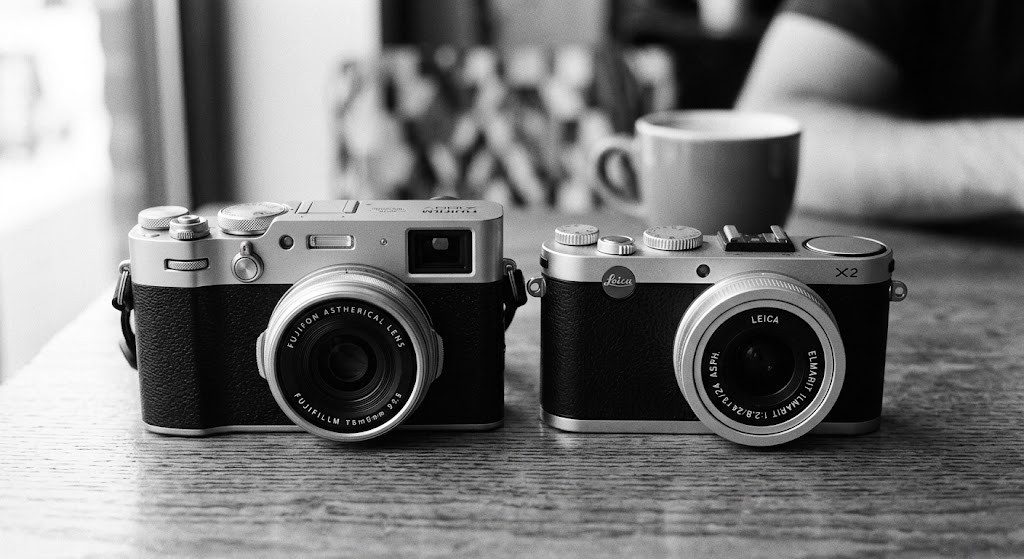
Both cameras chase a retro, rangefinder-inspired look. But they achieve it in different ways.
Fujifilm builds the X100V with a magnesium alloy top and bottom plate. The body feels dense and well sealed against dust and light rain when paired with an optional adapter ring. Dials for shutter speed and exposure compensation sit on top, giving direct manual control. The tilting touchscreen adds flexibility for low or high-angle shots.
Leica builds the X2 with an aluminum top plate and a leather-wrapped body. The design feels minimal and clean. There is no tilting screen and no touchscreen. Leica kept the control layout simple, with fewer buttons and dials than the Fujifilm. Some photographers prefer this stripped-down approach because it removes distractions.
Weight also differs. The X100V weighs about 478 grams. The Leica X2 weighs around 345 grams without the battery, making it slightly lighter to carry all day.
Viewfinder and Screen
A good viewfinder changes how a photographer works in the field.
Fujifilm equips the X100V with an Advanced Hybrid Viewfinder. This system switches between an optical viewfinder and a 3.69-million-dot electronic viewfinder. Photographers can preview exposure changes in real time through the EVF, or shoot with a clean optical view. The 3-inch tilting LCD adds a modern touch for street and travel work.
The Leica X2 skips a built-in viewfinder entirely. Leica sold an optional external optical viewfinder that slides into the hot shoe. This accessory adds cost and bulk. The rear screen on the X2 is fixed and lower resolution than the X100V’s display. Composing shots relies mostly on the LCD or the add-on viewfinder.
This is one area where the newer Fujifilm design clearly pulls ahead. The built-in hybrid finder gives more flexibility without extra accessories.
Video Capabilities
Video matters more today than it did in 2012, so this section carries real weight for many buyers.
The X100V records 4K video at up to 30 frames per second. It also shoots Full HD at up to 120 frames per second for slow motion. Fujifilm added a microphone input through an adapter, which helps content creators capture cleaner audio.
The Leica X2 offers no video recording function at all. Leica designed this camera purely as a stills tool. Buyers looking for hybrid photo and video use will find the X100V far more capable.
Price and Value
Price shapes every camera decision, and these two models sit in very different brackets today.
The Fujifilm X100V launched at $1,399 and remains in demand on the used market, often selling above its original price due to strong resale value. Stock has also been limited at times since launch, which pushed prices even higher.
The Leica X2 originally launched near $1,995. On the used market today, it sells for a fraction of that price since Leica has moved on to newer X-series models. Buyers who want the Leica name and rangefinder styling at a lower cost often find the X2 an approachable entry point into the brand.
Value depends on what a photographer wants. The X100V costs more but delivers modern features, faster autofocus, and video. The Leica X2 costs less today and delivers the Leica shooting experience without the current flagship price tag.
Fujifilm X100V vs Leica X2: Who Should Buy Which
Different photographers need different tools. Here is a simple breakdown.
Choose the Fujifilm X100V if speed matters to your work. Street photographers who shoot fast-moving scenes benefit from the quick autofocus. Travel photographers benefit from the tilting screen and weather resistance. Content creators benefit from 4K video and a mic input. Anyone who wants one camera that handles almost every situation should lean toward the X100V.
Choose the Leica X2 if simplicity and character matter more than speed. Collectors who value the Leica brand will appreciate the build and lens rendering. Photographers who shoot slower, deliberate work such as portraits or landscapes may enjoy the X2’s minimal control layout. Budget-conscious buyers who still want a taste of Leica ownership often pick the X2 over newer, pricier Leica compacts.
Fujifilm X100V vs Leica X2: Sample Use Cases
Real-world shooting scenarios help clarify the differences further.
A wedding photographer capturing candid moments needs fast autofocus and low-light performance. The X100V handles this better because of its phase-detection system and higher ISO ceiling.
A fine art photographer shooting still subjects in daylight may not need speed at all. The Leica X2 can produce beautiful files in this setting, and its lens rendering adds a distinct look to portraits and product shots.
A travel vlogger needs video, a flip screen, and quick file transfer. The X100V wins this category easily since the X2 offers no video mode.
A collector building a Leica kit values the brand history and design lineage. The X2 fits that goal at a friendlier price point than current Leica compacts.
Pros and Cons: Fujifilm X100V
Pros
- Sharp 26.1MP sensor with strong low-light performance
- Fast hybrid autofocus with face and eye detection
- Built-in hybrid viewfinder switches between optical and electronic modes
- 4K video and a tilting touchscreen add versatility
- Strong resale value on the used market
Cons
- Higher price than the Leica X2 on the used market
- Heavier body compared to the X2
- Popular demand can make stock hard to find at times
Pros and Cons: Leica X2
Pros
- Compact, lightweight body that feels great for all-day carry
- Leica lens rendering with a distinct color and contrast signature
- Simple menu system with a short learning curve
- Lower used price gives an accessible way into the Leica brand
Cons
- No video recording of any kind
- Slower contrast-detection autofocus struggles indoors
- No built-in viewfinder, so composing relies on the LCD or an accessory
- Lower resolution sensor with weaker low-light results
Which Camera Fits Your Shooting Style
Photography style matters as much as specs when picking between these two cameras.
Street photographers who shoot in changing light need fast, reliable autofocus. The X100V handles this task with confidence. Its hybrid viewfinder also helps track subjects without lag between shots.
Documentary and travel photographers benefit from the X100V’s video mode and tilting screen. These features turn one camera into a tool for both stills and short clips during a trip.
Portrait and product photographers who work in controlled light may prefer the Leica X2. Its lens produces a distinct look that some photographers seek out specifically for editorial or fine art work.
Collectors and enthusiasts drawn to Leica’s design heritage often buy the X2 as an entry point. It carries the brand’s build quality and shooting philosophy without the cost of newer Leica compacts.
Frequently Asked Questions
Is the Fujifilm X100V better than the Leica X2? The X100V offers a newer sensor, faster autofocus, video recording, and a hybrid viewfinder. It performs better in most technical categories. The Leica X2 still appeals to photographers who value simplicity and the Leica shooting experience.
Which camera has better image quality? The X100V produces sharper files with better dynamic range and low-light performance thanks to its 26.1-megapixel BSI sensor. The X2 produces solid images in daylight but falls behind in tougher lighting.
Does the Leica X2 shoot video? No. The Leica X2 does not record video. It functions purely as a stills camera.
Is the Fujifilm X100V good for beginners? Yes. The autofocus system, tilting screen, and film simulation modes make it approachable for new photographers while still offering manual control for advanced users.
Which camera holds its value better? The Fujifilm X100V has held strong resale value due to steady demand and limited stock. The Leica X2 has dropped in price significantly since Leica introduced newer X-series models.
Can I use an external viewfinder with the Leica X2? Yes. Leica sold an optional optical viewfinder that fits into the hot shoe on top of the camera. This accessory adds cost but improves the composing experience for photographers who dislike relying on the rear screen.
How does low light performance compare between the two cameras? The X100V performs noticeably better in low light thanks to its backside-illuminated sensor and wider f/2 aperture. The Leica X2 can still produce usable images in dim settings, but noise appears sooner and autofocus slows down as light drops.
Is the Leica X2 still worth buying today? It depends on the buyer’s goals. Photographers who want the Leica look and a simple shooting experience at a lower price can still enjoy the X2. Buyers who need speed, video, or the latest sensor technology should choose the Fujifilm X100V instead.
Final Verdict: Fujifilm X100V vs Leica X2
The Fujifilm X100V vs Leica X2 comparison comes down to priorities. The X100V wins on nearly every technical measure. It has a newer sensor, faster autofocus, a hybrid viewfinder, and 4K video. It suits photographers who need a capable, modern tool for daily shooting.
The Leica X2 still holds appeal for a specific type of buyer. Its minimal design, Leica lens rendering, and lower used price make it an interesting choice for collectors and slow-paced shooters.
Most photographers today will get more practical value from the Fujifilm X100V. But the Leica X2 remains a charming option for anyone drawn to the brand’s history and rangefinder styling.
For full specifications and current pricing, check the official product pages from Fujifilm and Leica Camera.
More From Altbuzz
Altbuzz covers camera reviews, rumor updates, and gear comparisons across every major brand. Readers who enjoyed this Fujifilm X100V vs Leica X2 breakdown can find more in-depth camera guides on the Altbuzz website.
Altbuzz also posts hands-on video reviews and camera news updates. Subscribe to the Altbuzz YouTube channel for more comparisons like this one, along with the latest camera rumors and release coverage.