
Fujifilm’s X-E series has always occupied a particular place in the photography world. Compact. Understated. Built for photographers who prefer form and function over flash. The X-E5, released in 2024, extended that tradition with a 40MP X-Trans V sensor and a quieter, distraction-free design that earned strong reviews from street and travel photographers.
Now attention shifts to the Fujifilm X-E6, the next chapter in the series. The X-E6 will not arrive alone. It will be part of Fujifilm’s sixth-generation platform rollout, a full system refresh that also includes the X-T6, the rumored X-Pro4 or X-Pro5, and potentially the X100VII. This generation defines Fujifilm’s APS-C direction for the next several years.
This is not just a minor product update. The sixth-generation platform represents a fundamental architecture shift for Fujifilm’s X system. Understanding it means understanding what the X-E6 will and will not do.
The Sixth-Generation Platform: What It Is and Why It Matters
The Case for a Generational Upgrade
Fujifilm organizes its cameras around generations of sensor and processor hardware. The fifth-generation platform powers most current X-series bodies, including the X-T5, X-H2, X-H2S, and X-E5. These cameras use either the 40MP X-Trans V sensor (in stills-focused bodies) or the 26.1MP X-Trans V sensor with partially stacked architecture (in speed-focused bodies like the X-H2S).
The sixth-generation platform is the successor to all of that. FujiRumors confirmed in late 2025 that the sixth-generation platform will not arrive in 2025. However, the X-T6 is expected in September 2026 as the platform’s debut vehicle. Other bodies, including the X-E6, will follow in subsequent years.
What Platform 6 Changes
Canon Rumors described the sixth-generation platform as analogous to Canon’s DIGIC processor lineage: a foundational architecture update that changes what every camera built on it can do.
The expected improvements cover several areas.
Processing speed increases significantly. The fifth-generation processor struggled with the demands of the 40MP X-Trans V sensor during high-speed burst shooting and video encoding. Sixth-generation processing addresses that bottleneck directly, enabling faster frame rates, reduced shutter lag, and more responsive subject tracking.
AI and autofocus capabilities also take a major step forward. Fifth-generation bodies improved AF considerably over earlier Fujifilm cameras, but they still trail Sony and Canon in tracking reliability during fast, unpredictable action. The sixth-generation platform is expected to close that gap through deeper learning models and faster inference on the new processor.
Video encoding also benefits. Better heat management and faster readout allow higher-quality video capture at larger file sizes without the thermal throttling that affected some fifth-generation bodies.
Resolution Direction: 40MP or 46MP?
The sensor resolution question is where rumors diverge. Two schools of thought exist.
The first is that the sixth-generation platform continues with 40MP sensors, focusing on speed and efficiency rather than resolution. FujiRumors suggested this could take the form of a 40MP X-Trans VI sensor with a partially stacked architecture, delivering faster readout speeds than the current 40MP X-Trans V.
The second possibility is a resolution bump to approximately 45 or 46MP. FujiRumors also reported a speculation, based on the rumored Fujifilm GFX180 medium format camera, that Fujifilm might use the same sensor across system tiers. Medium format and APS-C bodies in Fujifilm’s history have sometimes shared sensor generations. If the GFX180 uses a sensor that, when cropped to APS-C dimensions, yields approximately 46MP, then APS-C bodies on the sixth-generation platform could reach that same resolution.
The most widely cited figure remains 40MP for entry-level bodies and 45 to 46MP for flagship bodies. The X-E6, as a compact enthusiast camera, would likely land at 40MP rather than the higher resolution tier.
Fujifilm X-E6: Expected Specs and Features
Sensor and Processor
Based on the platform trajectory, the X-E6 is expected to use a 40MP APS-C X-Trans VI sensor paired with the X-Processor 6. The X-Trans color filter arrangement, which Fujifilm uses instead of the standard Bayer pattern, remains the brand’s signature technical choice and will continue in the sixth-generation platform.
The X-Trans pattern requires more complex demosaicing algorithms but delivers distinctive color rendering that many photographers consider superior to Bayer sensors of equivalent resolution. Fujifilm’s film simulation modes build on this foundation.
Whether the sensor uses a fully non-stacked BSI design or a partially stacked BSI design with DRAM matters a great deal for video performance and electronic shutter usability. The X-T6 is expected to use a partially stacked design. The X-E6, as a later, more compact body, may use a non-stacked BSI design to reduce cost and heat. That is consistent with Fujifilm’s approach with the X-E5, which used the same sensor as the X-T5.
In-Body Image Stabilization
The X-E5 includes IBIS, rated at up to 7 stops. For the X-E6, this figure is expected to increase, consistent with the improvements introduced across the sixth-generation platform. An 8-stop rating with compatible lenses would be a reasonable expectation.
The X-E6’s compact body creates engineering challenges for IBIS. Sensor-shift stabilization requires mechanical clearance around the sensor element, which competes directly with the miniaturization goals of the X-E design philosophy. Fujifilm has solved this problem well in the X-E5, and the X-E6 will continue that approach.
Autofocus System
Autofocus is where the sixth-generation platform makes its biggest leap. The X-E5’s AF system, while much improved over previous generations, still shows weaknesses in low-contrast scenes, during fast lateral subject movement, and in video tracking consistency.
Sixth-generation AI-driven tracking builds on deeper training datasets and faster inference. The Canon Rumors description of the platform noted that major autofocus advancements would bring sixth-generation Fujifilm bodies “closer to its peers.” For sports and wildlife shooters, that means more reliable subject lock and prediction in difficult conditions.
For the X-E6’s typical users, who shoot street, travel, and documentary work, the practical benefit is more consistent hit rates in candid situations. Face and eye detection that works more reliably in mixed lighting, for example, directly improves keeper rates for reportage-style photography.
Film Simulation and Color Science
The X-E6 will carry forward Fujifilm’s full film simulation library. As of the X-E5, this includes Provia/Standard, Velvia/Vivid, Astia/Soft, Classic Chrome, Pro Neg Hi, Pro Neg Std, Classic Neg, Reala Ace, Nostalgic Neg, Acros (black and white), Sepia, and multiple toning options.
The sixth-generation platform could introduce new film simulations. Fujifilm has historically timed simulation additions to major platform releases. Eterna Cinema and Eterna Bleach Bypass both arrived with major camera launches. The X-E6 could carry a new simulation targeting documentary or archival aesthetics.
Video Capabilities
The X-E6 is not a video-first camera. Fujifilm’s X-E line has always positioned itself as a hybrid tool for photographers who want usable video, not a cinema camera that also shoots stills.
Based on sixth-generation platform capabilities reported for the X-T6 (which will launch before the X-E6), expected video specs for the broader platform include 6.2K capture for oversampled 4K delivery and 4K at up to 60fps in 10-bit. The X-E6 will likely receive a subset of those capabilities, similar to how the X-E5 inherited video specs from the X-T5 but without F-Log2 recording options available in the higher-tier bodies.
4K 30p in 10-bit with LOG profile support would be the realistic expectation for the X-E6. Video shooters who want more will choose the X-T6 or X-H3.
Display and Interface
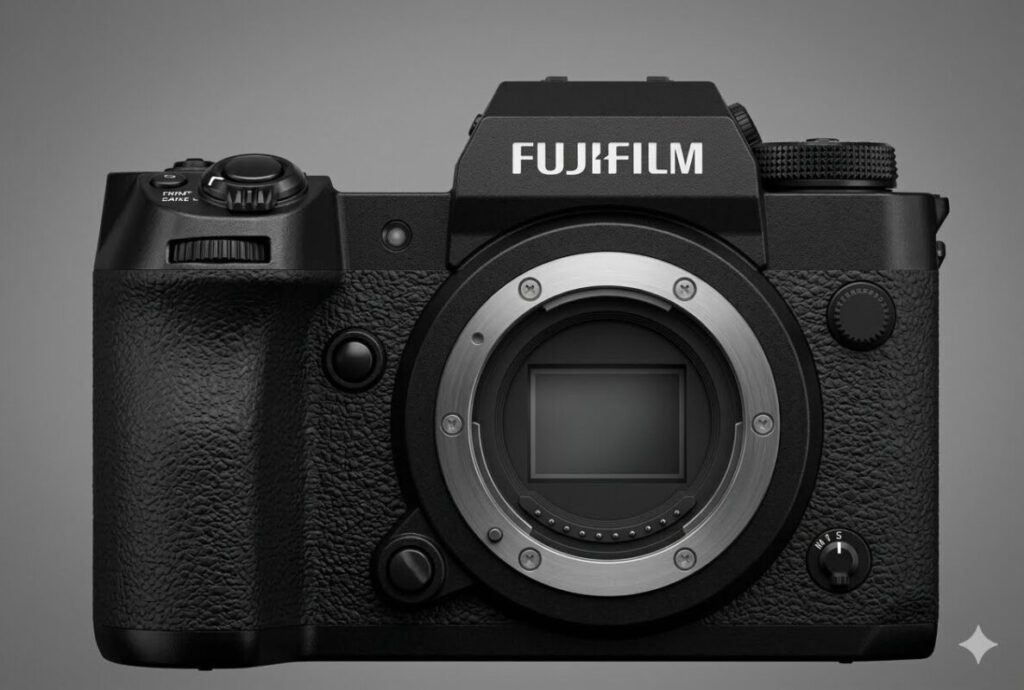
The X-E5 introduced a film dial on the top plate for direct simulation selection, a detail that enthusiasts appreciated. The X-E6 will almost certainly carry this forward.
Screen design is an area where community preferences diverge. Some users want the tilting rear screen of the X-E5. Others would prefer a fully articulating display for video use. Based on broader Fujifilm trends (the X-T6 may receive a fully articulating screen), the X-E6 could move in that direction as well.
The electronic viewfinder will likely remain optical-tunnel style: a small, discreet finder that matches the camera’s understated design. A resolution of 3.69 million dots would be competitive with current standards.
Where the X-E6 Fits in Fujifilm’s Lineup
The X-E Line’s Philosophy
Fujifilm’s X-E cameras have always sat below the X-T line in terms of features and price, but not in terms of image quality. Both lines share the same core sensor and processor. The X-E differs in body design (less weather sealing, fewer external controls, lighter weight) rather than imaging capability.
This positioning makes the X-E6 particularly interesting for photographers who want flagship image quality in a smaller package. Someone who does not need the X-T6’s advanced burst rates, weather sealing, or expanded video specs can choose the X-E6 and get the same output from the same sensor.
Positioning Against the X-T6
The X-T6 is the sixth-generation flagship for Fujifilm’s APS-C stills lineup. It targets photographers who shoot sports, wildlife, events, and professional assignments that demand weather sealing, fast burst performance, and a full control layout.
The X-E6 targets the opposite profile: the deliberate, detail-oriented photographer who shoots at a measured pace, carries the camera all day, and wants it to disappear in a crowd. Street work. Travel. Documentary projects. Environmental portraiture.
These audiences overlap, but they are not identical. Fujifilm serves both well by offering distinct bodies rather than trying to build one camera that satisfies everyone.
Timeline: When Will the X-E6 Arrive?
This is the honest, research-grounded answer: not soon.
The X-T6 is the first sixth-generation body and is expected in September 2026. After that, Fujifilm typically staggers releases across a 12 to 24 month period to serve different market segments without cannibalizing sales.
Fuji X Weekly, a respected independent Fujifilm analysis site, predicted an X-E6 release in late 2029, after the X-T60 in 2028. That timeline may feel discouraging, but it follows the pattern Fujifilm has maintained across multiple generations.
For practical planning purposes, photographers should not hold off purchasing an X-E5 while waiting for the X-E6. The wait is likely several years. The X-E5, with its 40MP X-Trans V sensor and 7-stop IBIS, remains one of the best compact APS-C cameras available today.
Comparing the X-E6 to Key Competitors
Against the OM System PEN-F II
Both cameras target compact, design-conscious photographers who prioritize portability and image quality over speed and bulk. However, they come from different system philosophies.
The X-E6 offers APS-C sensor size, which provides a roughly 2.5x advantage in total light-gathering area compared to Micro Four Thirds. At equivalent apertures and ISOs, full APS-C sensors deliver slightly better high-ISO performance and marginally shallower depth of field.
The PEN-F II, on the other hand, will offer access to the Micro Four Thirds lens ecosystem and OM System’s distinctive computational photography features. The system also produces smaller lens-body combinations overall.
Photographers choosing between them will weigh sensor size against system size and ecosystem fit.
Against Sony’s A-Series Compact Bodies
Sony does not offer a direct compact rangefinder-style competitor. The A6700 is Sony’s most recent APS-C body, and it is more of a performance camera with a conventional mirrorless design than a compact travel camera.
In this sense, the X-E6 faces less direct competition from Sony than from Fujifilm’s own internal lineup decisions.
Buying Advice: Should You Wait for the X-E6?
Here is the direct answer: only wait if you are not yet invested in the X system and have time.
If you shoot Fujifilm now and your X-E4 or X-E5 is working well, there is no reason to delay your photography for a camera that is likely three or more years away. Upgrade when the X-E6 actually ships and when you can evaluate it against what is available at that time.
If you are considering entering the Fujifilm system for the first time, the X-E5 is still the right choice. The sixth-generation sensor, when it arrives in the X-E body, will be better. But the X-E5 is excellent today, available now, and will not become obsolete the day the X-E6 launches.
For those who want the sixth-generation platform sooner rather than later, the X-T6 will be the first access point. Its September 2026 expected launch means the new processor and sensor architecture will be available before the end of the year. If the X-T6’s body design and feature set appeal to you, that is the most direct route to sixth-generation performance.
The X-E6 in the Context of Fujifilm’s Broader 2026 Strategy
Fujifilm’s focus for 2026 is clear from the rumor landscape: deliver the sixth-generation platform through the X-T6 launch and use that release to prove the technology works. The X-E6, X-Pro4 or X-Pro5, X100VII, and other sixth-generation bodies will follow in subsequent years.
This is a deliberate, measured strategy. Fujifilm does not rush product releases across its entire lineup simultaneously. Instead, the company introduces a platform through one or two high-visibility cameras and then extends it methodically.
The result is a roadmap where the X-E6 represents the eventual democratization of sixth-generation technology into the format that appeals most to street and travel photographers. When it arrives, it will carry the full weight of whatever Fujifilm has refined in the platform since the X-T6 launch.
That is worth waiting for. But it is not worth stopping your photography today.
This Blog Is Part of a Three-Part Rumor Series
This is the second entry in our 2026 rumored camera series. The first blog covers the OM System PEN-F II, another compact enthusiast camera with a devoted following and a long development history. The third blog examines the Sony A1 IIH, the rumored ultra-high-speed professional flagship targeting sports and action photographers at the professional tier.
Key Takeaways for X-E6 Watchers
The X-E6 will be a compelling camera when it arrives. The sixth-generation platform will bring meaningfully better autofocus, faster processing, and likely a sensor upgrade to around 40MP. Film simulations will expand. IBIS will improve. Video will be more capable without becoming the camera’s main identity.
However, the X-E6 is not coming soon. The realistic timeline places it no earlier than 2028, and possibly as late as 2029. The X-T6 is the near-term sixth-generation story. Everything else follows later.
Watch FujiRumors and Fuji X Weekly for ongoing updates. Both sites track Fujifilm’s platform cycles with the depth of evidence needed to distinguish real signals from speculation.
Explore more in our series: Best Compact Mirrorless Cameras for Street Photography in 2026 and Fujifilm X-Trans vs Bayer: Does the Difference Still Matter?
The X-E Series Legacy: Five Generations of Compact Philosophy
Understanding what the X-E6 must achieve requires understanding where the line came from. Each X-E generation told a slightly different story about what a compact Fujifilm camera should be.
X-E1 Through X-E3: Building the Foundation
The Fujifilm X-E1 launched in 2012 as a more affordable, more compact alternative to the X-Pro1. It shared the same 16MP X-Trans I sensor but offered the appeal in a slimmer, lighter body. The X-E1 found an audience immediately among street photographers and travel shooters who wanted X-Trans color science without the larger profile of the X-Pro body.
The X-E2 in 2013 brought phase detection AF pixels to the sensor, dramatically improving autofocus speed. The X-E3 in 2017 pushed further with improved AF performance and a cleaner top plate design. Each iteration refined rather than reinvented.
X-E4: Minimalism Taken to Its Logical Conclusion
The X-E4, released in 2021, was a polarizing camera. Fujifilm stripped the body down to an almost alarming degree. The D-pad disappeared. The exposure compensation dial disappeared. The four-way controller was replaced by a touchscreen-first interface. The body was thinner and lighter than any previous X-E model.
Photographers who wanted a discreet, minimalist camera loved it. Photographers who preferred physical controls found it frustrating in use. This tension is instructive. The X-E4 showed that there is a limit to how far you can remove physical controls before the camera feels incomplete for serious use.
X-E5: Finding the Balance
The X-E5, released in 2024, addressed the X-E4’s criticisms while keeping its positive characteristics. The film dial returned, giving direct physical access to film simulations. The body remained compact and lightweight. The 40MP X-Trans V sensor delivered a substantial resolution upgrade. IBIS arrived for the first time in the X-E line.
The X-E5 is currently considered the benchmark compact Fujifilm camera. The X-E6 will need to justify its existence as an upgrade over a camera that is already very good.
Understanding X-Trans Sensors: Why Fujifilm Does It Differently
The X-Trans color filter array is central to understanding why Fujifilm cameras produce the files they do, and why the X-E6 discussion is so closely tied to the sensor question.
The Bayer Pattern Versus X-Trans
Most digital cameras use a Bayer color filter array: a repeating 2×2 grid of red, green, blue, and green filters over the sensor pixels. This pattern has been standard since the 1970s and is well-understood. Demosaicing algorithms for Bayer sensors have been refined for decades.
Fujifilm’s X-Trans pattern uses a larger 6×6 grid of color filters with a pseudo-random arrangement. The primary motivation is to reduce the moiré patterning that appears when the regular Bayer grid interacts with fine repeating patterns in the subject, such as fabric weave or architectural details.
The X-Trans pattern also reduces reliance on an optical low-pass filter, which Fujifilm omits from X series sensors to preserve maximum sharpness from the lens.
Color Rendering Characteristics
X-Trans sensors produce a distinctive color rendering that many photographers describe as “filmic” in a specific sense. Fine detail, particularly in human skin tones and foliage, can retain a quality that photographers associate with medium-format color film rather than digital capture.
This is not universally positive. Some photographers find X-Trans files more challenging to edit in certain raw processors due to the complexity of the demosaicing algorithm. Adobe Lightroom has historically shown soft fine detail in X-Trans files compared to dedicated software like Capture One or Iridient X-Transformer.
Fujifilm’s sixth-generation platform is expected to improve the in-camera processing quality for X-Trans output, potentially reducing the gap between in-camera JPEG rendering and third-party raw processing.
Will the X-E6 Keep X-Trans?
Almost certainly yes. X-Trans is a Fujifilm brand differentiator. Switching the X-E line to a Bayer sensor would be a significant departure from Fujifilm’s system identity and would create confusion about why a Fujifilm camera was chosen over alternatives.
The question is which generation of X-Trans the X-E6 receives and whether it uses the partially stacked architecture or a standard BSI design.
Film Simulations: The Creative Core of the X-E Experience
No discussion of the Fujifilm X-E6 is complete without addressing film simulations. For many photographers, film simulations are the primary reason to choose Fujifilm over competitors with technically superior sensors.
What Film Simulations Actually Do
Film simulations are tone curve, color response, and noise rendering presets built directly into the camera’s image processor. They produce JPEG files (and optionally embedded previews in RAW files) that reproduce the general characteristics of specific analog film stocks.
Provia/Standard is Fujifilm’s neutral simulation: accurate color with moderate contrast. Velvia/Vivid exaggerates saturation and contrast to mimic the look of Fujifilm’s slide film, popular for landscape and nature photography. Classic Chrome produces a muted, desaturated look associated with documentary photography. Eterna simulates the color response of cinema film stocks.
Each simulation also affects the grain rendering, highlight rolloff, shadow lift, and color channel relationships in a way that goes beyond simple hue and saturation adjustments. The result is that each simulation produces a recognizably different aesthetic that influences creative intent.
Sixth-Generation Simulation Possibilities
Fujifilm typically introduces one to three new film simulations with major platform launches. The X-T5 brought Nostalgic Neg and Reala Ace. The sixth-generation platform will likely add new simulations that extend the library into territory currently underrepresented.
Photography communities have long requested a simulation based on Fujifilm’s Superia negative film, which offers a distinctive warm color bias with specific skin tone rendering. An Acros variant with different halation and film base characteristics is another frequent request.
Whatever Fujifilm introduces, the X-E6 will carry the full simulation library forward with additional options unavailable on any fifth-generation body.
Autofocus Deep Dive: What Fifth Generation Does and What Sixth Generation Needs to Fix
Fujifilm’s autofocus evolution across the X series tells an important story about where the sixth-generation platform needs to go.
Fifth-Generation AF Performance
The X-T5 and X-E5, both fifth-generation bodies, use a phase detection AF system with 425 focus points across the full sensor area. Subject detection covers humans (eye, face, body), animals (dogs, cats, birds), vehicles (cars, aircraft), and trains.
In practice, the fifth-generation system performs well in controlled or moderately challenging conditions. Portrait and wedding photographers report reliable eye tracking and consistent face detection. Wildlife photographers report good bird tracking when subjects are well-separated from the background.
The system struggles with fast lateral movement at longer focal lengths, small subjects at a distance, and subjects with low contrast against complex backgrounds. Photographers comparing Fujifilm’s fifth-generation AF to Sony’s A9 or Canon’s R3 consistently find Fujifilm behind in tracking reliability for elite action work.
Sixth-Generation AI Autofocus: The Expected Improvement
The sixth-generation processor enables deeper neural network inference for subject detection and a faster prediction algorithm for tracking.
Deeper inference means the AF system can recognize subjects with higher confidence even when partially occluded, at extreme angles, or in low-contrast situations. A bird photographed against a cluttered forest background will be recognized and tracked more reliably because the sixth-generation model has been trained on more examples and uses a larger feature set for recognition.
Faster prediction means the AF system can extrapolate subject position more accurately between focus updates. When a subject moves faster than the AF system can reacquire focus frame by frame, predictive tracking fills the gaps by calculating where the subject will be based on velocity and acceleration history.
For X-E6 photographers, who are more likely to shoot street candids and travel work than sports action, the practical benefit is stronger face and eye detection in less-than-ideal lighting and more reliable tracking when subjects make sudden direction changes.
The Retro Dial Experience: Physical Controls in a Digital Camera
One area where Fujifilm consistently outperforms competitors in user satisfaction is physical control design. The X series has always offered dedicated dials for shutter speed, aperture (on compatible lenses), ISO, and exposure compensation. These controls let photographers set exposure without touching a menu.
The X-E5’s Film Dial: A Step Forward
The X-E5 introduced a dedicated film simulation dial on the top plate, replacing a more conventional control assignment. This dial, which debuted in a slightly different form on the X100VI, gives photographers direct access to their six most-used film simulations without any button pressing or menu navigation.
The experience mirrors using a film camera: you physically select your film before raising the camera to your eye. For photographers who think about color rendering as part of their creative process rather than a post-processing decision, this is a meaningful workflow improvement.
The X-E6 will almost certainly inherit this dial. The sixth-generation platform’s improved processor may also allow faster switching between simulations, including any new simulations the platform introduces.
Exposure Dials and Shooting Philosophy
The X-E4’s removal of the exposure compensation dial was controversial precisely because it disrupted Fujifilm’s most appreciated control design philosophy. The X-E5 restored this dial. The X-E6 will keep it.
For photographers coming from fully electronic cameras, where exposure compensation is buried in button combinations or touchscreen swipes, the experience of having a physical dial feels revelatory. It reconnects the photographer to the physics of exposure in a tactile, immediate way.
The Fujifilm Ecosystem: Lenses, Accessories, and Long-Term Investment
Choosing a camera system involves more than selecting a body. The investment in lenses, accessories, and workflow tools locks photographers into an ecosystem for years. The Fujifilm X system offers one of the strongest lens libraries in APS-C mirrorless.
Prime Lens Highlights for X-E6 Photographers
The XF 27mm f/2.8 R WR is the natural pancake companion for a compact X-E body: 41mm equivalent field of view, weather resistance, and a slim profile that matches the camera’s design ethos. At 84 grams, it adds almost nothing to the system weight.
The XF 23mm f/2 R WR (35mm equivalent) and XF 35mm f/2 R WR (53mm equivalent) form the core of many X-system street photography setups. Both are lightweight, weather-resistant, and optically excellent. They are among the most popular X-mount lenses for a reason.
For longer work, the XF 56mm f/1.2 R WR (85mm equivalent) is a portrait lens that stands among the best in any APS-C system. The rendering at wide apertures is smooth and the color transition from focus to out-of-focus areas is gradual and pleasing.
Zoom Options for Versatility
The XF 18-55mm f/2.8-4 R LM OIS remains a strong standard zoom for X system photographers who want flexibility. Despite being one of the older X-mount lenses, its optical quality holds up well at 24MP resolution and will continue to perform on the X-E6.
The XF 16-80mm f/4 R OIS WR is a more recent, weather-resistant standard zoom that covers a versatile range for travel. At 440 grams with weather resistance across the full zoom range, it pairs logically with a weather-sealed X-E body.
Video Use Cases for the X-E6
While video is not the X-E line’s primary identity, a growing number of photographers use compact mirrorless cameras as secondary video tools for documentary projects, travel content, and personal film work.
Realistic Video Expectations
The X-E5 delivers 6.2K video for downsampled 4K output, 4K at 30fps in 10-bit with F-Log profile, and 1080p at 240fps for slow-motion capture. The sixth-generation X-E6 will exceed these specifications.
Based on what the X-T6 is expected to deliver, 4K at 60fps in 10-bit is a likely minimum specification for sixth-generation bodies. Whether the X-E6 receives 8K capture at any frame rate is less certain, given the thermal and form factor constraints of a compact body.
F-Log2, Fujifilm’s wider dynamic range log profile introduced in the X-H2 generation, would expand to the X-E6 on the sixth-generation platform, giving video shooters more latitude in post-production color grading.
Rolling Shutter Considerations
For video use, rolling shutter distortion when panning or during subject motion is the most practically limiting issue with current X-E cameras. The X-E5’s stacked sensor reads out faster than the X-T5’s, but panning shots at normal video speed still show some measurable distortion.
A sixth-generation partially stacked or fully stacked BSI sensor would improve this substantially. If the X-E6 receives the same sensor architecture as the X-T6, rolling shutter in 4K video should be reduced to the point where it is a non-issue in most practical shooting scenarios.
How to Use the X-E5 While Waiting for the X-E6
For current Fujifilm photographers, the extended wait for the X-E6 is not a problem if you already own an X-E5 or another fifth-generation body. These cameras deliver excellent results today and will continue to do so.
Making the Most of X-Trans V
The 40MP X-Trans V sensor in the X-E5 responds exceptionally well to careful raw processing. Photographers who use Capture One for Fujifilm (formerly Iridient X-Transformer processed through Lightroom) report noticeably sharper fine detail than Lightroom-only workflows.
Understanding the sensor’s character, specifically its response to highlight recovery and its grain structure at higher ISO values, allows photographers to use the X-E5 at its full potential and produce files that rival cameras with much larger sensors for many types of work.
Preparing Your Lens Kit for the X-E6 Upgrade
Lenses are a longer-term investment than bodies. Investing in quality X-mount glass now means being well-prepared when the X-E6 eventually arrives. All current X-mount lenses will be fully compatible with sixth-generation bodies, including the X-E6.
Photographers planning ahead should prioritize fast primes in their most-used focal lengths and at least one weather-sealed zoom for flexibility. This foundation will serve both the current X-E5 and the eventual X-E6 equally well.
Final Thoughts: The X-E6’s Promise and Patience Required
The Fujifilm X-E6 will be an exceptional camera when it arrives. The sixth-generation platform brings fundamental improvements that will make every aspect of the shooting experience better: faster, more reliable autofocus; improved sensor performance at high ISO; better video capabilities; and new film simulations that expand creative possibilities.
However, arriving is not the same as being available soon. The X-E6 sits late in Fujifilm’s generational deployment cycle. Photographers hoping to buy one in 2026 will be disappointed. Those planning a 2028 or 2029 purchase have more realistic expectations.
In the meantime, the X-E5 represents the best version of the X-E concept in its current generation. It already delivers forty megapixels, IBIS, and the full depth of Fujifilm’s film simulation library in a compact, lightweight package. For photographers who need a camera now rather than later, the X-E5 is the right choice.
The X-E6 is worth watching. But it is not worth waiting for at the expense of photography you could be making today.
For more on the broader 2026 rumored camera landscape, see our full series including the OM System PEN-F II and the Sony A1 IIH. For current buying advice on compact APS-C cameras, visit our guide to the best mirrorless cameras under $1,500 in 2026.
Technical Glossary: Key Terms for X-E6 Research
Understanding the rumor discussions around the X-E6 requires familiarity with several technical terms that appear frequently in Fujifilm community discourse.
X-Trans vs Bayer
Covered earlier in this blog, but worth summarizing for readers who encounter these terms in other articles. X-Trans uses a 6×6 pseudo-random color filter pattern. Bayer uses a standard 2×2 repeating grid. X-Trans is exclusive to Fujifilm’s X and GFX systems.
DGO and DCG Sensors
Dual Gain Output (DGO) and Dual Conversion Gain (DCG) are competing sensor architectures that improve dynamic range by reading each pixel at two different gain settings simultaneously or sequentially.
DGO, used in Sony sensors including the A1, reads each pixel at high gain and low gain at the same time, then merges the two readings. This improves shadow detail while preventing highlight clipping.
DCG changes the pixel’s conversion gain (sensitivity) between two states: one optimized for highlights and one for shadows. The merge process is different from DGO but achieves similar goals.
FujiRumors has noted active community discussion about whether the sixth-generation platform uses a DGO or DCG architecture for dynamic range improvement. This choice affects how the sensor handles high-contrast scenes and matters significantly for landscape and interior photography.
Partially Stacked vs Fully Stacked
Partially stacked sensors add only a DRAM buffer layer beneath the pixel layer. Fully stacked sensors add both DRAM and additional logic circuitry layers, enabling more sophisticated pixel-level processing.
The A9 III uses a fully stacked global shutter design. The X-H2S uses a partially stacked BSI design. The distinction affects readout speed, rolling shutter behavior, and power consumption.
For the X-E6, a partially stacked design is the more likely choice given the cost and heat management advantages it offers in a compact body versus the added complexity of full stacking.
X-Processor 5 vs X-Processor 6
The X-Processor 5 powers current fifth-generation X-series bodies. It handles all image processing, noise reduction, film simulation rendering, and autofocus calculation. The X-Processor 6, which will debut in the X-T6, represents a full architecture revision with faster core speeds, more efficient processing pipelines, and a more powerful AI inference engine.
The difference between the two processors is not incremental. Moving from generation five to generation six in Fujifilm’s history has always brought meaningful improvements in AF speed, burst processing, and computational feature capability. The sixth-generation processor in the X-E6 will deliver a noticeable experience upgrade over the X-E5.
The Fujifilm Community: Why It Matters for the X-E6
Fujifilm’s camera community, particularly the online segment organized around FujiRumors, Fuji X Weekly, and various Facebook and Reddit groups, plays an unusual role in the brand’s product development dialogue.
Community Influence on Fujifilm Decisions
Unlike some camera manufacturers that treat firmware and product decisions as entirely internal processes, Fujifilm has a documented history of responding to community feedback. The addition of Classic Neg and Nostalgic Neg film simulations came after sustained community request. The return of the exposure compensation dial in the X-E5 after its removal in the X-E4 reflected user criticism.
This dialogue does not mean that Fujifilm simply builds whatever the community requests. Commercial realities, engineering constraints, and corporate strategy all shape product decisions. But it does mean that organized community feedback reaches decision-makers and influences outcomes more than at most brands.
For the X-E6, community discussions carry genuine weight. The sustained conversation about wanting an EVF, wanting the film dial, wanting IBIS, and wanting better AF all contribute to the product requirements that Fujifilm’s planners are aware of.
Following the Right Sources
For photographers tracking X-E6 development, FujiRumors (fujirumors.com) is the primary English-language source for confirmed and speculative reports. The site has a strong track record for Sony and Canon sourcing as well, but Fujifilm is its core focus.
Fuji X Weekly (fujixweekly.com) offers thoughtful independent analysis on where Fujifilm’s product lineup is heading, often with longer-term timeline predictions based on historical pattern analysis rather than leaked information.
Digital Camera World’s camera rumor coverage includes regular Fujifilm updates alongside other brands and provides useful competitive context.
Summary: Everything the X-E6 Needs to Be
The Fujifilm X-E6 enters a competitive market with a clear mandate. It must justify the wait since the X-E5. It must deliver the sixth-generation platform’s capabilities in a compact body without compromising the design principles that define the X-E experience. And it must do this at a price that makes sense relative to the X-T6, X-Pro4 or X-Pro5, and competing compact cameras from other brands.
If Fujifilm executes well, the X-E6 will offer a 40 to 46MP X-Trans VI sensor, improved IBIS to 8 stops or beyond, sixth-generation AI autofocus that closes the gap with Sony and Canon, new film simulations, better video capabilities, and the same understated physical control design that makes every X-E camera feel like a deliberate creative tool rather than a spec-sheet exercise.
That camera will be worth waiting for. It will also be worth the patience required to actually reach the point of holding one.
The X-E6’s timeline is long. Its promise is real. And Fujifilm’s track record with the X-E line suggests that when the camera arrives, it will represent everything the fifth generation could not quite be.