
The camera world has a long memory. Photographers still talk about the original Olympus PEN-F with genuine affection, and that nostalgia has only grown since Olympus handed the torch to OM System in 2021. For five years, fans have waited for a follow-up. Now, in 2026, the wait finally feels like it might be coming to an end.
OM System executives have confirmed the PEN line is not dead. Sources from the CP+ show and the Photolari interview with senior OM Digital executives both point in the same direction: a new PEN camera is coming. The question is not whether it will happen, but what it will look like when it does.
This blog covers everything photographers need to know about the OM System PEN-F II. We examine the rumors, the community wishlist, the technical foundations, and the competitive landscape that makes this camera so important for Micro Four Thirds.
Why the OM System PEN-F II Matters
Before diving into specs, it helps to understand why this camera generates so much discussion.
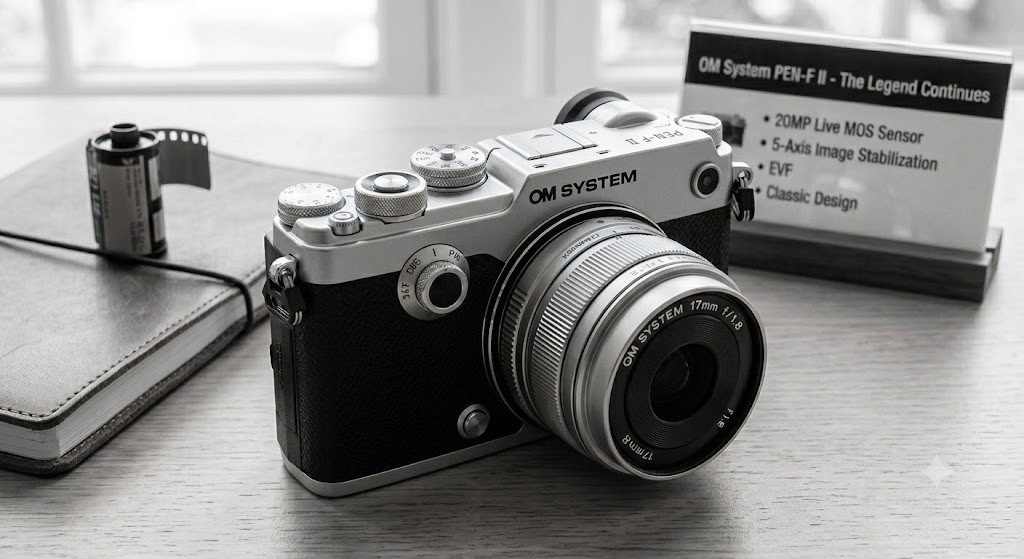
The original Olympus PEN-F, launched in 2016, was unlike anything else in the Micro Four Thirds system. It paired a rangefinder-inspired design with a 20MP sensor and a rotating Creative Control Dial on the front of the body. Photographers loved it for street work, travel, and documentary shooting. It felt like a camera designed for people who actually cared about the experience of taking pictures, not just the output.
When Olympus became OM System, the PEN-F was quietly discontinued. No replacement came. Instead, the company focused on its OM-1 and OM-5 bodies, both of which target a more serious, weather-sealed, wildlife-focused market.
That left a gap. Street photographers, travel shooters, content creators, and anyone who wanted a small, stylish, capable body had nowhere to go inside the OM System lineup. The PEN E-P7 filled part of that need in select Asian and European markets, but it launched without an EVF and never came to North America.
The PEN-F II, if it arrives, would address that gap directly.
The Current State of PEN-F II Rumors
Official Confirmation from OM System Executives
The strongest signal yet came from the CP+ 2026 show. Spanish publication Photolari interviewed two senior OM System executives: Senior Vice President Tazuhiro Togashi and Director of Product Planning Hiroki Koyama. During that interview, the executives gave what Photolari described as the first official confirmation that OM System plans to launch a new PEN camera.
That is significant. Before this, the company had only said things like “the PEN series remains an important part of our portfolio.” This time, the language shifted to something more concrete: “we have plans to launch.”
Digital Camera World reported that OM System executives had also told their team at the BILD Expo that they were “actively exploring the possibility of a PEN model.” That language, combined with the Photolari interview, suggests the project is no longer in the exploration phase. It is moving forward.
The Naming Has Been “Set Up”
Rumor site 43Rumors published a report in early 2025 citing a source called The Narrow Band Channel. That source reported that OM System managers had confirmed the naming for the PEN-F II has been “setup.” The exact meaning of that phrase is unclear, but it does suggest the product has progressed beyond concept stage.
Timeline Caution: Not Expected in 2026
Both the Photolari interview team and 43Rumors editor Andrea Moro have noted that the new PEN is unlikely to arrive in 2026. The Photolari team said they believed the camera is further out than the current year. Moro suggested the near-term release could be a simpler update to the existing PEN body under the OM System brand name, with a true new PEN-F successor potentially arriving in 2027 or 2028.
This distinction matters. There could be two releases: a transitional PEN E-P series update first, and a proper PEN-F II later. Enthusiasts should track both possibilities.
Rumored Specs and Technical Expectations
Sensor: 24MP Partially Stacked
The most discussed rumor centers on the sensor. The 43Rumors “dreaming” post from January 2026 described a community wish for a 24MP partially stacked sensor. This would be a meaningful upgrade over the 20MP sensor in the original PEN-F.
A partially stacked sensor design combines a traditional BSI CMOS imaging layer with a separate DRAM layer for faster data readout. This architecture reduces rolling shutter distortion during video recording and electronic shutter still shooting. It also allows faster burst rates without the image quality penalties associated with fully electronic readout on older sensors.
Why 24MP rather than higher? OM System executives addressed this directly in the CP+ interview. They stated clearly that future OM cameras will not chase massive resolution increases. Their reasoning is grounded in computational photography: the AI-driven subject detection and tracking algorithms that power features like Bird Detection AF and ProCapture work better on sensors in the 20MP range than on sensors with 40MP or more. Higher resolution creates larger files, demands more processing power, and reduces the effectiveness of real-time subject tracking.
This is a technically defensible position. The OM-1 Mark II uses a 20.4MP stacked sensor, and its subject tracking performance is widely considered among the best in any system at any price. A 24MP partially stacked sensor in the PEN-F II would offer a modest resolution bump while maintaining that computational advantage.
Processor: TruePic X or Next Generation
The original PEN-F used the TruePic VII processor. Since then, OM System has introduced TruePic X in the OM-1 and OM-1 Mark II. The PEN-F II will almost certainly use TruePic X or a refined version of it.
TruePic X brings several important capabilities. It enables Subject Detection AF, which covers humans, animals, birds, trains, aircraft, and motor vehicles. It also powers the high-speed computational processing that supports features like Live ND, Live Composite, and Handheld High Resolution Shot, where the camera takes multiple frames and merges them in-camera to produce files up to 80MP.
The Handheld High Resolution Shot feature alone would be a major selling point for a compact street and travel camera. Photographers could use a small, lightweight body to capture detailed landscape and architectural images without a tripod.
In-Body Image Stabilization
The original PEN-F did not include IBIS. That was a notable omission and one of the few criticisms leveled at it. The camera lacked stabilization entirely, relying on optically stabilized lenses or steady hands.
For the PEN-F II to compete in 2026, IBIS is essential. The OM-3, launched in 2025 and well-received by the community, includes five-axis IBIS rated at 6.5EV. The OM-5 Mark II offers up to 7.5EV with supported lenses via the sync IS system.
Community expectations for the PEN-F II center on a system similar to the OM-3’s. A rating of 6 to 7EV would be competitive and reasonable given the compact body size.
EVF Design
One of the defining features of the original PEN-F was its built-in EVF. At 2.36 million dots, it was not the highest resolution viewfinder of its era, but it was present and functional. Many photographers made purchasing decisions based on it.
The PEN-F II will almost certainly include a built-in EVF. Without one, the camera would feel like a step backward and would differentiate too little from the more affordable PEN E-P series.
Current expectations point to a 2.36MP to 3.69MP OLED EVF, consistent with what OM System uses in the OM-3 and OM-5 Mark II. A 120fps refresh rate would also be expected for smooth subject tracking.
Autofocus System
Subject Detection AF powered by TruePic X would be the headline autofocus feature. In the OM-1 Mark II, this system delivers reliable eye, face, and body detection for humans, as well as multi-category animal and vehicle detection.
For street and documentary photographers, the relevant question is how fast and accurate the AF performs during candid shooting at mid-range apertures. Based on the OM-3 and OM-1 Mark II performance reports, the tracking algorithm handles moving subjects well, even without explicit subject lock.
Phase detection AF across the sensor plane would also be expected, matching the implementation in current OM System bodies.
Video Capabilities
OM System has historically not prioritized video. Their cameras deliver competent 4K footage but have never positioned themselves as video tools. The PEN-F II is unlikely to change that approach.
Expect 4K 30p video recording with the option for Cinema 4K. High-speed 120fps recording at 1080p would likely appear for slow-motion use. A 10-bit flat picture profile (LOG format) would be a welcome addition and would align with what competitors like Fujifilm offer at this price tier.
OM System confirmed at CP+ that the company will not develop video-centric cameras. So video will be a secondary consideration, not a headline feature.
Design and Build: What to Expect
The Rangefinder Form Factor
The original PEN-F’s design language was clearly informed by the 1960s Olympus PEN film cameras: compact, elegant, and unmistakably photographic without being bulky. That design philosophy resonated strongly.
The PEN-F II should carry that identity forward. Expect a metal-bodied rangefinder-inspired shell, a prominent front control dial, and a grip that balances portability with usability.
A key design tension exists between keeping the body small enough to honor the PEN legacy and making it large enough to pair comfortably with modern M.Zuiko lenses. The OM-3 resolved this by offering a slightly deeper grip than the original PEN-F. The PEN-F II may take a similar approach.
Weather Sealing
This is one of the most debated questions in the community. The original PEN-F was not weather-sealed. The OM-3, by contrast, is rated IPX1 splash-resistant. The OM-5 Mark II offers full IP53 weather sealing.
Community sentiment generally supports including at least basic splash resistance in the PEN-F II. A rating similar to the OM-3 would satisfy most users without adding significant cost or weight.
Creative Controls
The original PEN-F included a rotating Creative Control Dial on the front of the body. This dial offered photographers a direct, physical way to switch between color, monotone, and artistic effect modes. It was one of the most distinctive features of the camera.
Whether the PEN-F II brings this dial back remains unknown. If it does, the community will celebrate it. If the control is eliminated, it will mark a significant departure from what made the original camera special.
Expect a film simulation or picture mode selection system, likely drawing from OM System’s Art Filter library, which includes more than 25 modes covering everything from vintage grain to watercolor effects.
Pricing Expectations
Community discussions on 43Rumors and Mu-43 have centered on a price range of $1,200 to $1,800 for the primary PEN-F II variant. Andrea Moro suggested $1,500 as a target, with a lower-tier entry model at $700 to $800 for broader market access.
These numbers reflect the positioning of the OM-3, which launched at $999. The PEN-F II, as a more premium and stylistically distinctive camera, would likely sit above it.
For comparison, the Fujifilm X-E5 launched at $899 and serves as the closest competitor in terms of design philosophy and market segment. OM System would need to price the PEN-F II competitively relative to that benchmark.
The Competitive Landscape
Fujifilm X-E5: The Current Benchmark
The Fujifilm X-E5 is the camera that currently owns the compact, stylish, APS-C rangefinder segment. It launched with a 40MP sensor, six-axis IBIS, film simulation modes, and a minimalist design that photographers love.
The PEN-F II will not match the X-E5 on raw resolution, given OM System’s stated preference for sensors around 20 to 24MP. However, the Micro Four Thirds system has its own advantages: smaller overall system size, a wider range of compact prime lenses, and the OM System computational photography features that no APS-C camera currently matches.
Ricoh GR IIIx: Different Category, Similar Appeal
The Ricoh GR IIIx targets street photographers who prioritize absolute portability. At $1,050, it offers a fixed 40mm equivalent lens and a tiny body. It serves a different use case than the PEN-F II, which will accept interchangeable lenses. However, both cameras compete for the attention of the same audience: street and travel photographers who want a small, capable, discreet body.
What the PEN-F II Means for Micro Four Thirds
The Micro Four Thirds format has faced ongoing questions about its long-term viability as full-frame sensors have become more affordable and APS-C has gained strength. However, 2025 showed something interesting: MFT interest surged. Digital Camera World noted a major upward swing in MFT-related searches and purchases during 2025, driven in part by the OM-3’s success and renewed interest from content creators who discovered the PEN E-P7.
The PEN-F II would accelerate that momentum significantly. A stylish, capable, IBIS-equipped interchangeable lens camera that appeals to both enthusiast photographers and content creators would give OM System a product with genuine crossover appeal.
More importantly, it would fill the gap in OM System’s own lineup. Currently, there is a large jump between the affordable Tough TG-7 compact and the OM-3, which targets more serious photographers. A PEN-F II at $1,200 to $1,500 would serve the large audience sitting in between.
Lens Options for the PEN-F II
One of the overlooked advantages of the Micro Four Thirds system is its lens depth. OM System and Panasonic have jointly supported the mount for over a decade. As a result, photographers pairing a PEN-F II with MFT glass have access to an enormous selection.
Several lenses stand out as natural companions for a compact, stylish PEN body.
The M.Zuiko 17mm f/1.8 (34mm equivalent) is a classic street photography choice: small, fast, and optically excellent. The M.Zuiko 45mm f/1.8 (90mm equivalent) delivers beautiful portrait rendering in a tiny package. For zoom shooters, the 12-45mm f/4 Pro offers weather sealing and consistent aperture across the range.
If OM System introduces the PEN-F II alongside a refreshed pancake zoom, as some community members hope, the system size advantages over full-frame and APS-C become even more pronounced. A PEN-F II with a collapsible 14-42mm pancake lens would rival a compact camera in portability while offering full interchangeable lens flexibility.
Related Camera Context in This Series
This blog is part of a three-part series examining the most anticipated rumored camera releases of 2026. The next blog covers the Fujifilm X-E6, which targets a similar compact enthusiast audience but with APS-C performance. The third covers the Sony A1 IIH, the rumored high-speed professional flagship for sports and wildlife photographers at the opposite end of the market.
Final Thoughts: Should You Wait for the PEN-F II?
That depends on when you need a camera and what you need it for.
If you are currently on the original PEN-F or the PEN E-P7 and you can wait, the PEN-F II makes sense to watch closely. The combination of TruePic X computational features, a partially stacked sensor, and IBIS would represent a generational leap over both predecessors.
If you need a camera now, the OM-3 is an excellent alternative. It sits in the same general price range that the PEN-F II will occupy, and it offers the full TruePic X feature set in a compact, weather-resistant body.
For those outside the OM System ecosystem who are considering switching, the PEN-F II’s appeal will depend heavily on its final design, price, and EVF quality. If OM System prices it at $1,500 with weather sealing, a 24MP sensor, and IBIS, it becomes a compelling argument for the Micro Four Thirds system at a time when the format is genuinely gaining momentum again.
The OM System PEN-F II is not yet official. But it has never felt more real.
Want to stay current on camera gear news and analysis? Explore our full coverage of mirrorless camera rumors for 2026 and our in-depth guide to choosing the right Micro Four Thirds body for your style of photography.
The Original Olympus PEN-F: A Legacy Worth Understanding
To fully appreciate what the PEN-F II needs to be, it helps to understand what made the original so special. The Olympus PEN-F launched in January 2016 to immediate critical acclaim. At the time, the Micro Four Thirds system already had capable cameras in the OM-D E-M1 and E-M5 lines. But the PEN-F was different in kind, not just degree.
Design Philosophy of the Original PEN-F
The PEN-F drew its design language from the Olympus PEN-F film camera of 1963, a half-frame 35mm camera that became iconic for its precision engineering and compact elegance. The 2016 digital version carried that spirit into the mirrorless era with a magnesium alloy body, a flush-mounted front dial, a slim grip, and a top plate that prioritized clean lines over cluttered controls.
At 427 grams, the original PEN-F was light enough to carry in a jacket pocket with a pancake lens. Its EVF offered a natural, unobtrusive shooting experience. The 20MP Live MOS sensor, while not cutting-edge by 2016 standards, delivered excellent color and tonal response, particularly with the camera’s unique Color Profile Control system.
The Creative Control Dial on the front face was genuinely original. By rotating it, photographers could shift between Color, Monotone, and Color Creator modes with an immediacy that no menu navigation could match. This physical connection between photographer and creative expression became the camera’s signature.
Why the PEN-F Was Discontinued
Understanding this requires understanding OM System’s situation after the Olympus divestiture. When Japan Industrial Partners acquired the Imaging Division from Olympus in 2021 and formed OM Digital Solutions, the company needed to focus its limited resources on products with the strongest return. The professional-level OM-D system took priority.
The PEN line’s overlap with the OM-D E-M10 Mark IV created internal competition, and the PEN-F’s premium price was difficult to justify against the entry-level appeal of simpler PEN models. Rather than invest in a successor immediately, OM System shelved the line and concentrated engineering resources on the OM-1 and OM-5 development cycles.
That decision was commercially understandable. It was also deeply frustrating for the community that had built around the PEN-F as their primary shooting tool.
Deep Dive: The 20MP vs 24MP Question for PEN-F II
The sensor resolution discussion deserves more depth than a simple number comparison. This choice affects not just image files but the entire computational photography system that makes OM cameras distinctive.
Why OM System Thinks 20-24MP Is the Sweet Spot
OM System’s engineers made an important statement at CP+ 2026. They explained that higher-resolution sensors, specifically those above 30MP, create diminishing returns or even performance penalties for their AI-driven computational features. The TruePic X processor’s subject detection, tracking, and frame merging algorithms were developed and optimized around 20MP sensor data.
When you scale to 40MP, the computational load for real-time tracking increases substantially. The algorithms must process twice as many pixels per frame to extract the same subject recognition confidence. This either slows the processing pipeline or requires a much faster processor. Either outcome adds cost or compromises performance in other areas.
At 24MP, the PEN-F II would gain a useful resolution increase over the original’s 20MP without pushing into the territory where OM’s computational features become strained. A 24MP partially stacked sensor could also deliver the 80MP+ Handheld High Resolution Shot mode, producing files up to 96MP when the camera takes and merges multiple frames.
Partially Stacked vs Standard BSI: The Technical Difference
A standard BSI (Back Side Illuminated) CMOS sensor places the photodiode layer on the back of the silicon wafer for improved light gathering efficiency. This is the architecture used in most modern mirrorless cameras, including the original PEN-F.
A partially stacked sensor adds a DRAM buffer layer beneath the photodiode layer. This DRAM acts as a temporary high-speed storage for pixel data during readout, allowing the sensor to output data faster than the main processor can accept it in real time. The sensor fills the DRAM buffer quickly, then the processor reads from the buffer at its own pace.
The practical result is dramatically faster electronic shutter operation with less rolling shutter distortion. It also enables faster burst rates during standard shooting. For a camera like the PEN-F II, the most visible benefit would be during video recording (reduced rolling shutter in 4K footage) and during sports or street photography (cleaner frame capture at high electronic shutter speeds in bright light).
The main cost consideration is that partially stacked sensors are more expensive to manufacture than standard BSI sensors. OM System would need to balance this against their target price point.
OM System’s Computational Photography: What the PEN-F II Would Inherit
One of the strongest arguments for considering the PEN-F II over APS-C alternatives is the depth of OM System’s computational photography feature set. These are not marketing bullet points. They are genuinely useful tools that change how photographers work.
ProCapture: Never Miss the Shot
ProCapture is one of OM System’s most practical innovations. When activated, the camera continuously buffers incoming frames to its internal memory. When the photographer presses the shutter halfway, the camera begins storing the stream to the memory card. When the shutter is fully pressed, the camera saves several frames that occurred before the button was fully pressed, as well as subsequent frames.
The result is that photographers effectively capture moments that happened up to 0.7 seconds before they physically pressed the shutter. For wildlife photographers capturing bird takeoffs, or street photographers waiting for a fleeting gesture, this eliminates the reaction time penalty that causes missed shots.
The PEN-F II would almost certainly include ProCapture, likely with the expanded frame buffer available in the OM-1 Mark II.
Handheld High Resolution Shot
This feature takes between eight and sixteen frames in rapid succession while the sensor shifts slightly between each exposure. The TruePic X processor merges these frames, averaging out noise and combining information to produce a single high-resolution output file.
At 24MP, the PEN-F II could produce 48MP or even 80MP+ Handheld High Resolution files, depending on the final algorithm configuration. This means a traveler carrying only the PEN-F II could capture files large enough for gallery-print detail from a compact, unobtrusive body.
Live ND and Live Composite
Live ND simulates the effect of a neutral density filter by merging multiple frames in real time, creating the motion blur associated with long exposures without requiring the photographer to change physical filters. The camera processes incoming frames and displays the cumulative exposure simulation live in the viewfinder.
Live Composite addresses the challenge of capturing light painting, star trails, and fireworks. The camera captures an initial base exposure, then continues capturing and compositing only the brighter elements from each subsequent frame. This prevents overexposing the background while accumulating the bright light trails.
Both features would make the PEN-F II a remarkable creative tool for travel and documentary photographers who want to work light without losing access to long-exposure techniques.
Subject Detection AF in Context
The OM-1 Mark II’s subject detection AF covers humans (body, face, eye), dogs, cats, birds, trains, aircraft, and motor vehicles. It also includes motorsports subject detection for racing scenarios. In field use, the system demonstrates strong performance across these categories.
For a PEN-F II targeted at street and travel photography, human subject detection with reliable eye and face tracking is the most important component. Candid portraits, environmental documentary work, and event coverage all benefit from AF systems that lock on faces quickly and track them reliably through partial occlusion.
The MFT Lens Ecosystem: A Critical Advantage
APS-C and full-frame photographers sometimes dismiss Micro Four Thirds based on sensor size. However, the lens ecosystem argument cuts the other way with considerable force.
Compact Prime Lenses
The Micro Four Thirds system offers a collection of compact prime lenses that have no equivalent in APS-C or full-frame for portability at equivalent field of view.
The M.Zuiko 17mm f/1.8 (34mm equivalent full-frame field of view) weighs 120 grams and measures 57mm in diameter by 35mm in length. The equivalent APS-C lens from most manufacturers weighs two to three times as much and costs more.
The M.Zuiko 25mm f/1.8 (50mm equivalent) weighs just 137 grams. The M.Zuiko 45mm f/1.8 (90mm equivalent portrait lens) weighs 116 grams. These are professional-quality optics in packages that slip into cargo pockets.
Paired with a PEN-F II body, these lenses create a system that weighs less than 600 grams total while delivering excellent optical quality. That is genuinely unique in the interchangeable lens camera market.
Pro Zoom Options
For photographers who want zoom flexibility, the M.Zuiko 12-45mm f/4 Pro is a weather-resistant constant-aperture standard zoom that weighs just 254 grams. At 24mm equivalent on the wide end and 90mm equivalent on the telephoto end, it covers most everyday focal lengths in a lens that is smaller than many APS-C kit lenses.
The M.Zuiko 12-40mm f/2.8 Pro offers a faster f/2.8 aperture at 253 grams, making it a compelling standard zoom for photographers who work in lower light and need the extra stop.
Panasonic Lens Compatibility
Because Micro Four Thirds is a shared mount between OM System and Panasonic, the PEN-F II can also use Panasonic Lumix lenses. This expands the available glass significantly, including Panasonic’s own 20mm f/1.7 pancake, the 42.5mm f/1.7, and the high-performance Leica-badged Lumix lenses.
The depth of this ecosystem is difficult to overstate. Photographers entering the MFT system through the PEN-F II inherit decades of lens development across two major manufacturers.
Community Wishlist: What Photographers Want From the PEN-F II
The 43Rumors community threads, Mu-43 forum discussions, and Digital Camera World comment sections reveal consistent themes about what photographers expect from a PEN-F II.
The Non-Negotiables
EVF inclusion ranks first. Photographers who preferred the original PEN-F over the PEN E-P7 specifically because of its built-in viewfinder will not accept a follow-up without one. Any PEN-F II that omits the EVF will generate immediate backlash and will struggle to justify the “F” designation.
IBIS ranks second. Five years of competing cameras have raised the baseline expectation for stabilization. A camera without IBIS in 2027 would feel like a significant omission regardless of its other qualities.
The Creative Control Dial on the front face ranks third. This is the feature that made the original PEN-F emotionally distinctive. Removing it would eliminate one of the main reasons photographers choose a PEN-F over an E-M10 or OM-3.
Strong Preferences
Weather sealing appears frequently, though not universally. Street photographers working in unpredictable outdoor conditions want at least splash resistance. The IPX1 rating on the OM-3 is considered the minimum acceptable level.
Dual card slots rank highly among photographers who use the camera professionally. Single-card systems create a point of failure during paid assignments. While the original PEN-F had a single SD slot, the market has moved toward expecting dual slots in cameras above $1,000.
Film-style color science with direct dial access is another strong preference. The Art Filter dial on the original PEN-F gave photographers a direct, immediate creative control that menu navigation cannot replicate. Community members consistently request this or an equivalent physical control.
Nice to Have
USB-C charging with Power Delivery support would allow travel photographers to charge the camera from laptop power banks. The original PEN-F predates this standard, but its successor will need it.
Bluetooth continuous connection for persistent GPS logging is another wish. Travel photographers want camera GPS data in their files without having to pair a phone for every shooting session.
OM System’s Market Position in 2026
OM System’s survival as an independent company remains a topic of discussion. The company operates in a competitive market with significantly fewer resources than Sony, Canon, Nikon, or Fujifilm. Each product launch requires careful resource allocation.
The company’s strategic positioning has become clearer over time. OM System focuses on the unique selling proposition of the Micro Four Thirds system rather than competing directly with full-frame cameras on raw sensor size. Computational photography, system portability, subject tracking performance, and creative tools are the pillars.
The OM-3 launch in 2025 validated this strategy. The camera was well-received, sold at strong rates, and brought new photographers into the MFT system who had never previously considered it. The PEN line’s social media renaissance, cited in Digital Camera World’s analysis, shows that content creators and documentary photographers are discovering the original PEN cameras and wanting more.
A well-executed PEN-F II would build on that momentum. It would give OM System a product that appeals to a consumer segment currently underserved: photographers who value design and creative control alongside technical capability, and who do not want to carry a heavy professional system for personal and travel work.
Frequently Asked Questions About the PEN-F II
Will the PEN-F II use the Micro Four Thirds mount? Yes. OM System has committed to the Micro Four Thirds system, and all future OM cameras will continue to use MFT. The PEN-F II will be fully compatible with existing M.Zuiko and Lumix MFT lenses.
Is the PEN-F II confirmed? OM System has officially confirmed plans for a new PEN camera. Whether the first release will be a true PEN-F successor or a simpler PEN E-P update remains unclear. The full PEN-F II may arrive in 2027 or later.
Will it replace the OM-3? No. The OM-3 and PEN-F II will serve different audiences. The OM-3 is a more traditional enthusiast camera with conventional controls. The PEN-F II will be a design-forward, rangefinder-inspired body with its own distinctive feature set and physical controls.
Can the PEN-F II use lenses from other brands? With adapters, the PEN-F II can use lenses designed for other mounts, including Four Thirds (with autofocus support via the MMF-3 adapter), Canon EF, Leica M, and others. Native MFT lenses provide full electronic communication and autofocus.
What competing cameras should I consider while waiting? The OM System OM-3 is the most direct alternative today. The Fujifilm X-E5 is the closest competitor in design philosophy, though it uses APS-C. The Ricoh GR IIIx serves street photographers who prioritize portability above lens flexibility.
Summary: The Case for the PEN-F II
The OM System PEN-F II is not just another camera rumor. It represents the potential resurgence of a camera philosophy that a large and dedicated community has missed since 2020. Small, beautiful, technically capable, and emotionally engaging, the original PEN-F showed that a camera can be both a precision instrument and an object of genuine pleasure to use and own.
When OM System delivers the PEN-F II, and the evidence suggests they will, the camera will need to do three things well. First, it must honor the design heritage of the original with a body that feels as distinctive and well-made as what came before. Second, it must deliver the modern technical capabilities that 2026 photographers expect: IBIS, Subject Detection AF, high-quality EVF, and the full TruePic X computational feature set. Third, it must price competitively enough to attract new photographers to the system while rewarding existing MFT users who have waited patiently.
If OM System achieves those three things, the PEN-F II will be one of the most significant camera launches in the Micro Four Thirds system’s history. It will give street photographers, travel shooters, and creative documentary workers a camera that is genuinely without rival in its category.
The wait continues. But it has never felt more justified.
Read More from AltBuzz
Read more from Altbuzz for camera reviews, rumors, and detailed specs. AltBuzz delivers trusted and easy-to-understand photography content.
Subscribe AltBuzz YouTube Channel
Stay updated with camera reviews, rumors, and comparisons. AltBuzz shares regular camera content. Subscribe Altbuzz to stay ahead of every major camera announcement.