
Introduction: Two Cameras, One Very Difficult Decision
Shopping for a full-frame mirrorless camera in the $2,500 price range puts you in front of one of the most competitive segments in modern photography. Two cameras dominate the conversation at this level: the Nikon Z6 III, released in June 2024, and the Sony A7 IV, which Sony launched in October 2021. Both cameras offer full-frame sensors, professional-grade build quality, weather sealing, and the ability to shoot high-quality stills and video. On paper, they look like equals. In reality, they are built for very different kinds of photographers.
This comparison goes deep. We will cover sensor performance, autofocus systems, video capabilities, viewfinder quality, lens ecosystems, ergonomics, battery life, and value for money. By the time you finish reading, you will have a clear picture of which camera fits your shooting style and your budget. We will not waste your time with vague conclusions. Each section ends with a clear winner, and the final verdict gives you a direct recommendation based on your use case.
One important note before we begin: the Sony A7 IV is three years older than the Nikon Z6 III. That age gap matters a great deal in a market that moves as fast as mirrorless photography. Newer does not always mean better, but in this case, it explains many of the performance differences you will see throughout this comparison.
Quick Verdict: Skip Ahead If You Are in a Hurry
Before diving into the details, here is the short version for readers who need a fast answer.
Choose the Nikon Z6 III if burst speed, uncropped 4K video, and a world-class electronic viewfinder sit at the top of your priority list. Nikon built the Z6 III to compete with the very best hybrid cameras available, and it shows in nearly every specification.
Choose the Sony A7 IV if you already own Sony E-mount lenses, need more resolution for large-format printing or aggressive cropping, or want to spend less money on a camera that still delivers excellent image quality. The A7 IV also benefits from one of the most mature autofocus systems in the industry and a lens ecosystem that no competitor can fully match.
Both cameras will serve you well. The question is which one serves you better for the specific work you do.
Background: Who Makes These Cameras and Why It Matters
Nikon launched the Z6 III as a direct statement of intent. After years of criticism that the Z-series lagged behind Sony and Canon in autofocus performance, Nikon borrowed technology directly from its flagship Z9 and packed it into a more affordable body. The Z6 III uses a partially-stacked CMOS sensor, the same Expeed 7 processor found in the Z9, and a subject-recognition system that handles humans, animals, vehicles, and aircraft. This is not a budget camera wearing flagship clothes. Nikon genuinely pushed the technology as far as it could at this price point.
Sony, on the other hand, launched the A7 IV in 2021 as the successor to the legendary A7 III. That previous model changed the full-frame market entirely by bringing professional image quality to an accessible price. The A7 IV continued that tradition with a 33-megapixel sensor, the BIONZ XR processor, and improved video features. Sony has since launched the A7 V, which improves on the A7 IV in almost every area. But the A7 IV remains in production, often at a significantly reduced price, and it still competes strongly in 2025.
Understanding the philosophy behind each camera helps you pick the right one. Nikon built the Z6 III for performance. Sony built the A7 IV for versatility and value.
Section 1: Sensor Technology and Resolution
The sensor sits at the heart of any camera, and the two cameras here take very different approaches to the same full-frame format.
The Sony A7 IV uses a back-illuminated (BSI) 33-megapixel full-frame CMOS sensor with a pixel pitch of 5.12 micrometers. At 33 megapixels, it gives you a lot of data to work with. You can crop aggressively and still produce a sharp 20-megapixel image. You can print at very large sizes without losing detail. Portrait photographers, landscape shooters, and product photographers all benefit from this extra resolution, especially when clients request large-format prints or highly detailed crops.
The Nikon Z6 III uses a partially-stacked CMOS sensor at 24 megapixels with a pixel pitch of 5.94 micrometers. Partially-stacked sensors differ from traditional BSI sensors in a meaningful way. They add extra processing circuitry in layers above and below the main sensing layer, which dramatically increases the speed at which the sensor reads data. This faster readout enables the Z6 III’s high burst speeds and reduces rolling shutter distortion during video capture. The trade-off is fewer megapixels compared to the A7 IV.
In low-light situations, the larger pixels on the Z6 III capture more light individually, which generally produces cleaner images at high ISO settings. Both cameras handle ISO 6400 with excellent results, but the Z6 III tends to produce slightly less noise at ISO 12,800 and above. For wedding photographers, event shooters, or anyone who works frequently in dark venues, this matters.
Also for photographers who prioritize resolution above everything else, the A7 IV wins this section. And for photographers who shoot in challenging light or need the fastest possible readout speed, the Z6 III holds the advantage.
Winner: Sony A7 IV for resolution. Nikon Z6 III for low-light sensitivity and readout speed.
Section 2: Burst Speed and Continuous Shooting
This is the area where the age gap between these two cameras shows most clearly, and the Nikon Z6 III wins by a significant margin.
The Nikon Z6 III shoots at 20 frames per second using its electronic shutter with full autofocus and autoexposure active throughout. With the mechanical shutter, it reaches 14 frames per second. These are numbers you would have found only in professional sports cameras just a few years ago. The partially-stacked sensor deserves credit here. Because it reads sensor data so quickly, the camera can process and save full-resolution raw files at speeds that a conventional BSI sensor simply cannot match.
The Sony A7 IV reaches 10 frames per second in continuous shooting. That is a respectable number for a camera released in 2021, but it is exactly half the speed of the Nikon. Sports photographers, wildlife photographers, and anyone shooting fast-paced events will feel that difference immediately.
Beyond the raw frame rate numbers, the buffer capacity matters too. The Z6 III handles extended bursts without slowing down prematurely, which means you can hold the shutter through a long sequence of action without the camera struggling to write data to the card. The A7 IV’s buffer at 10 fps is adequate but does not inspire the same confidence for demanding action sequences.
Rolling shutter also plays into this conversation. When you pan a camera quickly or photograph fast horizontal movement, conventional sensors can produce a skewing effect where vertical lines appear to lean. The Z6 III’s fast readout dramatically reduces this problem. The A7 IV, using a conventional BSI sensor, shows more rolling shutter in demanding situations.
If your subjects move fast, the Nikon Z6 III is the clear answer. Wildlife, sports, children, pets, dance, and motorsports all benefit from the higher frame rate and faster readout.
Winner: Nikon Z6 III by a wide margin.
Section 3: Autofocus Performance
Autofocus performance represents one of the most important factors in any modern mirrorless camera purchase, and this is an area where the competition has become much closer in recent years.
Sony built its reputation on autofocus excellence, and the A7 IV upholds that tradition. The camera uses a hybrid phase-detection and contrast-detection system with strong face detection, eye detection for humans and animals, and reliable real-time tracking. When you shoot portraits, the A7 IV locks onto an eye and holds it even as the subject moves through the frame. The system works smoothly in video mode too, making it a favorite among videographers who need reliable, quiet focus pulls during interviews or documentary work.
The Nikon Z6 III surprised the photography community by closing the autofocus gap significantly. It carries subject-recognition technology derived directly from the Z9, Nikon’s top professional camera. The Z6 III detects and tracks humans, dogs, cats, birds, aircraft, trains, and vehicles. Its low-light autofocus performance is particularly impressive, maintaining subject lock in situations where other cameras begin to hunt or lose the subject entirely.
Independent review outlets that tested both cameras found that the Z6 III performs on par with the A7 IV in most situations and even outperforms it in challenging low-light tracking scenarios. Neither camera will let you down for mainstream photography, and both handle face and eye detection with a reliability that professional photographers expect.
The one area where Sony still holds a slight edge is video autofocus behavior. The A7 IV produces smoother, more cinematic focus transitions when recording video, with less hunting and more natural-looking rack focus movement. The Z6 III’s video autofocus is excellent, but the Sony system has had more time to mature and optimize for video-specific behavior.
Winner: Tie for still photography. Sony A7 IV for video autofocus smoothness.
Section 4: Video Capabilities and Recording Formats
Video performance separates these two cameras more clearly than almost any other specification, and the Nikon Z6 III holds a genuine advantage here for serious hybrid shooters.
The Nikon Z6 III shoots 4K at 60 frames per second from the full-frame sensor with no crop penalty. It also raises the electronic shutter speed to 1/16,000 of a second, which matters enormously when shooting video outdoors in bright conditions. When your shutter speed follows the 180-degree rule (double your frame rate), you often need a neutral density filter in daylight. The higher maximum shutter speed gives you additional flexibility. The Z6 III also supports RAW video output to external recorders and N-Log picture profiles, which give colorists a wide latitude for grading in post-production.
The Sony A7 IV records 4K video at 30 frames per second from the full frame. If you want 4K at 60fps, the camera introduces a 1.5x APS-C crop, which changes your effective field of view and forces you to use wider lenses to achieve the same composition. For run-and-gun shooters, event videographers, and documentary creators who frequently use 60fps for smooth motion or slow-motion sequences, this crop is a frustrating limitation. The A7 IV does support S-Log3 and other picture profiles for professional grading, and its codec support is strong.
Both cameras record 10-bit video internally, which gives editors a good amount of data to work with. Neither camera has a cooling fan, so very long recording sessions in demanding modes can trigger thermal shutdowns. In practice, most shooting scenarios do not push either camera to that limit.
The Z6 III also offers ProRes RAW output when connected to an Atomos Ninja external recorder. This appeals to commercial filmmakers and high-end documentary crews who want maximum dynamic range and flexibility in the edit suite. The A7 IV does not support this workflow.
For photographers who occasionally shoot video, both cameras serve well. For hybrid shooters who treat video as equally important to stills, the Nikon Z6 III offers a more capable and flexible system.
Winner: Nikon Z6 III for full-frame 4K 60p and RAW video output.
Section 5: Electronic Viewfinder and Rear Screen
The viewfinder is where you spend most of your time when shooting, and the difference between these two cameras is genuinely startling.
The Nikon Z6 III features a 9.44 million dot OLED electronic viewfinder. That resolution number places it among the finest EVFs ever built into a non-flagship mirrorless camera. Reviewers who have tested the Z6 III consistently describe the viewfinder as a revelation. At this resolution, individual pixels become invisible, and the image takes on a clarity and smoothness that approaches an optical viewfinder experience. Photographers who switched from DSLRs and resisted mirrorless cameras because of poor EVF quality will likely change their minds when they look through the Z6 III’s finder.
The Sony A7 IV uses an OLED electronic viewfinder with 3.69 million dots. This is a perfectly functional and competent viewfinder. It represents a genuine step up from older cameras. But placed side by side with the Z6 III, it looks noticeably softer and less detailed. For photographers who shoot with their eye to the finder for hours at a time, this difference in comfort and clarity adds up over a long day of work.
Both cameras include fully articulating rear touchscreens. The Z6 III’s screen measures 3.2 inches diagonally, while the A7 IV uses a 3.0-inch panel. The difference in screen size is minor. Both screens perform well in daylight with adequate brightness, and both support touch-to-focus and touch-to-shoot functionality. Vloggers and content creators who film themselves will appreciate the fully articulating design on both bodies.
Winner: Nikon Z6 III on viewfinder quality. Draw on the rear screen.
Section 6: Lens Ecosystems Compared
The lens ecosystem surrounding a camera body can matter more than the body itself in the long run. Lenses last longer than camera bodies, and the breadth of available glass shapes what you can create.
Sony’s E-mount is the largest and most mature full-frame mirrorless lens ecosystem in the world. Sony has been building E-mount lenses since 2010, and the current lineup spans everything from ultra-wide zooms to super-telephoto primes. Third-party manufacturers have invested heavily in E-mount as well. Sigma offers a wide range of Art-series lenses in E-mount. Tamron has built some of the most popular affordable zoom lenses specifically for the platform. Zeiss contributes high-end primes. Voigtlander, Laowa, Venus Optics, and dozens of smaller manufacturers add even more variety. This depth of choice means that no matter your specialty or budget, you can find an E-mount lens that fits your needs.
Nikon’s Z-mount is younger but impressive in its own right. Nikon designed the Z-mount with a very large throat diameter and a short flange distance, which gives optical engineers more freedom to create ambitious designs. The first-party Nikkor Z lens lineup includes some outstanding optics, particularly the Z 58mm f/0.95 S Noct and the Z 400mm f/2.8 TC VR S. Nikon’s S-line designation marks their highest quality glass, and these lenses genuinely compete with or surpass any comparable lens from any manufacturer.
However, third-party Z-mount support is still growing. Sigma and Tamron have expanded their Z-mount offerings in recent years, and the selection improves regularly. Photographers who already own Nikon F-mount lenses can adapt them to the Z-mount using the FTZ II adapter with excellent results.
For photographers starting fresh with no existing investment in either system, this section deserves serious research. Consider the specific focal lengths you need and check what is available at your budget in each mount before deciding.
Winner: Sony A7 IV on ecosystem depth and third-party variety.
Section 7: Body Design, Build Quality, and Ergonomics
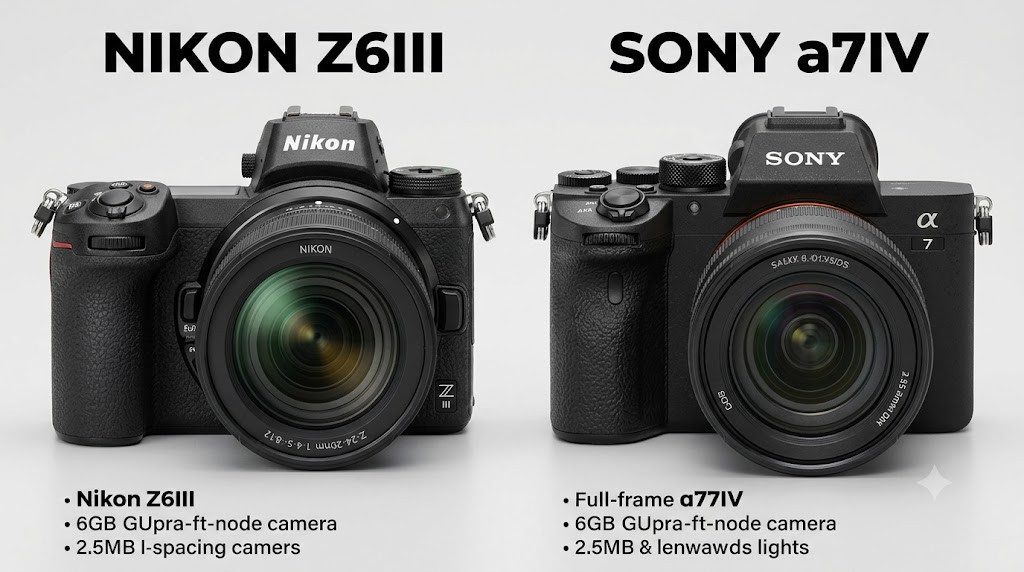
Both cameras represent professional-grade build quality, but they feel different in the hand in ways that matter for all-day shooting.
The Nikon Z6 III weighs 760 grams with battery and memory card. It measures 139 x 102 x 74 millimeters. The body has a deep, sculpted grip that fills the hand naturally. Photographers with larger hands tend to prefer the Z6 III’s grip, reporting less fatigue during extended sessions. The button layout follows Nikon’s traditional DSLR-inspired design, placing key controls in positions that feel intuitive for anyone with experience on Nikon bodies. The camera uses a large Multi-Selector joystick on the rear for moving the autofocus point, which many photographers consider the fastest and most comfortable way to reposition focus.
The Sony A7 IV weighs 658 grams with battery and memory card. It measures 131.3 x 96.4 x 79.8 millimeters. The body is slightly smaller and lighter, which makes it a more comfortable travel companion when pack size and weight matter. Sony has gradually improved the grip depth across generations of A7-series cameras, and the A7 IV grip represents a significant improvement over older models. The menu system, which Sony completely redesigned with the A7 IV, is now much more organized and navigable than earlier Sony cameras.
Both cameras use dual memory card slots. The Z6 III accepts CFexpress Type B and SD cards. The A7 IV uses two SD card slots, both compatible with UHS-II cards. CFexpress Type B cards offer much faster write speeds than SD cards, which helps the Z6 III sustain its high burst rate without buffer issues. However, CFexpress cards cost more than SD cards, which adds to the total cost of ownership for Z6 III buyers.
Both cameras carry weather sealing rated for dust and moisture resistance. Neither uses a cooling fan, and neither camera is described as fully weatherproof or submersible, but both handle light rain and dusty conditions without issues reported in professional use.
Winner: Draw. The Z6 III suits photographers who prefer a larger, deeper grip. The A7 IV suits those who prefer a lighter, more compact body.
Section 8: Battery Life and Practical Shooting Endurance
Battery life does not generate excitement in camera reviews, but it absolutely determines whether a camera works for your actual shooting schedule.
The Nikon Z6 III uses the EN-EL15c battery and delivers approximately 360 shots per charge under CIPA standard testing conditions. Real-world usage, which involves more varied behavior than the CIPA test, typically produces more shots for photographers who use the EVF and power down between sessions. The camera also supports USB-C charging and power delivery, which means you can top up the battery through a power bank in the field.
The Sony A7 IV uses the NP-FZ100 battery and achieves around 520 shots per charge under CIPA conditions. Sony’s battery management system and the NP-FZ100’s larger capacity give the A7 IV a meaningful endurance advantage over the Z6 III. Wedding photographers and travel photographers who cannot easily swap batteries between scenes will appreciate this extra capacity. The A7 IV also supports USB-C charging.
For shooting styles that involve heavy video use, both cameras drain batteries faster than stills-only work. Video shooters routinely carry multiple batteries for either camera.
Winner: Sony A7 IV on battery endurance.
Section 9: Price and Value
Price plays a decisive role for many photographers, and the two cameras have moved to different positions in the market since launch.
Both the Nikon Z6 III and the Sony A7 IV launched at approximately $2,499 to $2,599 USD body only. Since then, the A7 IV has seen consistent price reductions as retailers clear inventory ahead of the A7 V. In mid-2025, the A7 IV frequently sells for $1,900 to $2,100 at major retailers, representing a $400 to $600 saving over the Z6 III.
That price difference buys you a lot. At $400 saved on the camera body, you can invest in a quality lens that opens creative possibilities the camera body alone cannot provide. For photographers who shoot primarily stills in controlled lighting conditions, the A7 IV at a reduced price represents extraordinary value.
The Z6 III commands its higher price because it is newer and because the technology gap is real. The faster burst speed, the superior viewfinder, and the uncropped 4K 60p video all justify the premium for photographers who use those features regularly.
Consider also the cost of lenses when calculating total system price. E-mount lenses, particularly from Tamron and Sigma, offer exceptional quality at very competitive prices. Nikon’s Z-mount first-party lenses tend to carry higher prices, and the third-party alternatives, while improving, are not yet as numerous or affordable as E-mount options.
Winner: Sony A7 IV for value at current market prices.
Section 10: Common Photography Scenarios and Which Camera Wins
Rather than ending with abstract specifications, it helps to think about real photography situations and which camera handles each one better.
Wedding photography: The A7 IV’s 33 megapixels give you generous cropping latitude when capturing candid moments from a distance. Its reliable autofocus handles fast-moving subjects in complex, mixed lighting. The Z6 III’s superior burst speed helps capture the first kiss or the bouquet toss with more frames to choose from. Both cameras work extremely well for weddings, but the A7 IV’s higher resolution and lower current price make it the more practical choice for most wedding photographers.
Sports and wildlife photography: The Nikon Z6 III wins this category clearly. Its 20 fps burst rate, advanced subject tracking, and fast sensor readout give action photographers a genuine advantage. Capturing a bird in flight, a sprinter crossing the finish line, or a child mid-jump all become more reliable with 20 fps versus 10 fps.
Landscape and architecture photography: The Sony A7 IV’s 33 megapixels give landscape photographers the resolution to capture fine texture in rock formations, foliage, and architectural detail. Large-format prints and heavily cropped compositions both benefit from the higher pixel count.
Portrait photography: Both cameras handle portrait work beautifully. The A7 IV’s resolution produces finer skin texture and hair detail. The Z6 III’s larger pixels can give skin tones a slightly more organic, smooth rendering. Eye detection on both cameras works reliably enough that focus rarely causes issues in a portrait session.
Travel photography: The A7 IV’s lighter weight, lower price, and broader lens selection make it the more practical travel camera. Losing or damaging a $2,000 camera hurts less than losing or damaging a $2,499 camera. The compact Tamron E-mount zoom lenses also make for a very light, capable travel kit.
Video and filmmaking: The Nikon Z6 III takes this category. Full-frame 4K at 60fps with no crop, N-Log support, and ProRes RAW external recording give it a clear advantage over the A7 IV’s cropped 4K 60p and more limited output options.
Full Specification Comparison Table
| Specification | Nikon Z6 III | Sony A7 IV |
|---|---|---|
| Sensor Resolution | 24.5 MP | 33 MP |
| Sensor Type | Partially-Stacked CMOS | BSI CMOS |
| Pixel Pitch | 5.94 micrometers | 5.12 micrometers |
| Processor | Expeed 7 | BIONZ XR |
| Burst Speed (Electronic) | 20 fps | 10 fps |
| Burst Speed (Mechanical) | 14 fps | 10 fps |
| 4K Video Full-Frame | Up to 60p | 30p only |
| 4K 60p Crop | None | 1.5x APS-C |
| RAW Video Output | Yes (external) | No |
| EVF Resolution | 9.44 million dots | 3.69 million dots |
| Rear Screen | 3.2″ fully articulating | 3.0″ fully articulating |
| Weather Sealing | Yes | Yes |
| IBIS | Yes | Yes |
| Card Slots | CFexpress B + SD | 2x SD UHS-II |
| Battery Life (CIPA) | ~360 shots | ~520 shots |
| Body Weight | 760g | 658g |
| Lens Mount | Z-mount | E-mount |
| Launch Price | ~$2,499 | ~$2,499 (now ~$1,900) |
Who Should Buy the Nikon Z6 III?
The Z6 III is the right camera for photographers and videographers who want the newest technology and need high performance across multiple disciplines. Sports photographers, wildlife photographers, and documentary filmmakers who need uncropped 4K 60p will find it justifies every dollar of its price. Photographers who shoot in low light regularly will also appreciate the clean high-ISO performance and outstanding low-light autofocus. Anyone who values a world-class viewfinder as a core part of their shooting experience will immediately notice the difference.
Who Should Buy the Sony A7 IV?
The A7 IV remains an exceptional choice for photographers who want a versatile, high-resolution full-frame camera at a very competitive price. Existing Sony lens owners should not hesitate. Photographers who prioritize resolution for commercial work, large prints, or detailed landscapes will use every one of those 33 megapixels. Travel photographers who want a lighter kit with access to the broadest possible lens selection will find the E-mount ecosystem hard to beat. And for photographers who do not need 20 fps or uncropped 4K 60p, the A7 IV delivers comparable real-world results at a meaningfully lower cost.
Final Verdict
The Nikon Z6 III wins more specification categories in this comparison: burst speed, video capabilities, viewfinder quality, and sensor readout speed all go to the Nikon. Nikon built a genuinely impressive camera with technology that competes above its price class.
The Sony A7 IV wins on resolution, battery life, ecosystem depth, and current market value. Three years on, it remains a phenomenally capable camera that holds its own against newer competition in every real-world shooting situation except the most demanding action scenarios.
For most photographers buying today with no existing investment in either system, the choice comes down to this: if you shoot fast-moving subjects or need the best video for hybrid work, invest in the Nikon Z6 III. If you shoot primarily stills, work in controlled environments, or want to put the money you save on the body into better lenses, the Sony A7 IV at its current price is one of the best values in full-frame photography.
Both cameras will produce exceptional images. The right one is the one that fits how you actually work.
Read More from AltBuzz
Check more from Altbuzz for camera reviews, rumors, and detailed specs. AltBuzz delivers trusted and easy-to-understand photography content.
Subscribe AltBuzz YouTube Channel
Stay updated with camera reviews, rumors, and comparisons. AltBuzz shares regular camera content. Subscribe Altbuzz to stay ahead of every major camera announcement.