
Panasonic Lumix G100D Review: Is This Still the Best Budget Vlog Camera?
The Panasonic Lumix G100D sits in one of the most competitive corners of the camera market: budget interchangeable-lens vlogging. It refreshes the original G100 with small but meaningful tweaks, and it still targets the same buyer, a content creator who wants a real camera without spending four figures to get one.
This Panasonic Lumix G100D review breaks down the sensor, video performance, audio system, connectivity, and price so you can decide whether it deserves a spot in your bag in 2026.
What Is the Panasonic Lumix G100D?
The G100D is Panasonic’s entry-level Micro Four Thirds mirrorless camera, built specifically with vloggers and solo content creators in mind. It pairs a 20.3-megapixel sensor with a compact body, a flip-out touchscreen, and a directional microphone array that adapts to different shooting situations. Panasonic positions it as a step up from a smartphone and a step below the company’s higher-end GH and S series cameras.
Where the G100D differs from the original G100 comes down to small refinements rather than a full redesign. It keeps the same core sensor and body while polishing usability details that reviewers flagged the first time around, and it ships with USB-C charging built in from the start, something the original model lacked at launch.
Panasonic Lumix G100D Key Specifications
Before diving into how the camera performs, here is what you get on paper.
Sensor and Image Quality
The G100D uses a 20.3-megapixel Live MOS sensor built around the Micro Four Thirds standard, measuring 17.3 x 13mm. The sensor size sits below APS-C, which affects depth of field and low-light performance, but it still produces noticeably cleaner images and video than a typical smartphone sensor. ISO sensitivity runs from 200 to 25,600 natively, with an extended low setting of ISO 100 available for bright conditions. The 2x crop factor means your kit lens behaves closer to a 24-64mm equivalent range, which covers everything from wide establishing shots to tighter portrait framing.
Viewfinder and Screen
Unlike many cameras in this price range, the G100D includes a built-in electronic viewfinder. It uses a 2.36-million-dot OLED panel with 0.74x magnification, which gives you a genuinely useful eye-level shooting option rather than a token add-on. The 3.0-inch rear screen carries 1.84 million dots and fully articulates, flipping around to face forward for selfie-style vlogging and framing checks. Full touch control extends to menu navigation, autofocus point selection, and playback, which speeds up everyday operation considerably.
Video Performance
Video sits at the center of what the G100D is built for. It records 4K video at up to 30 frames per second and Full HD at up to 60 frames per second, with slow and quick motion modes available for creative effects. The camera relies on a 5-axis hybrid image stabilization system, combining optical stabilization in the lens with electronic stabilization processed in-camera, since the body itself has no true in-body mechanical stabilization. For creators who want more control over color grading in post-production, the G100D also comes with V-Log L recording pre-installed, a feature that typically costs extra on other Panasonic bodies.
A dedicated Video Selfie Mode automatically keeps both the presenter and the background in reasonably sharp focus, which removes the need to manually adjust aperture and focus distance every time you set up a shot.
Audio: The G100D’s Signature Feature
Audio is where the G100D genuinely stands apart from competitors at this price point. Panasonic built the camera around a directional microphone array developed using OZO Audio technology licensed from Nokia. The system uses three built-in microphones combined with face recognition to automatically adjust its pickup pattern depending on what you are filming, narrowing focus for a selfie-style vlog, widening for a landscape shot, or isolating a subject during an interview. Five distinct audio recording modes give you further control over how the camera prioritizes voice versus ambient sound. For creators who record audio directly through the camera rather than an external microphone, this feature alone can justify the purchase.
Burst Shooting and Autofocus
For photographers who also want to shoot stills, the G100D offers continuous shooting up to 10 frames per second in single-shot autofocus mode, with a more moderate rate when continuous autofocus tracking is engaged. Autofocus relies on Panasonic’s Depth From Defocus contrast-detection system rather than the phase-detection setups found on pricier cameras, which means it performs well in good light but can hunt more in dim conditions or with fast-moving subjects. Face and eye detection work reliably for typical vlogging and portrait scenarios, which covers the majority of what this camera gets used for in practice.
Battery and Storage
The G100D uses a single UHS-I SD card slot and delivers approximately 270 to 280 shots per charge, depending on whether you shoot primarily through the EVF or the rear screen. That battery life sits on the lower end for the category, so creators planning long shooting days should budget for a spare battery or lean on the USB-C charging port to top up power from a portable battery bank between takes.
Build and Weight
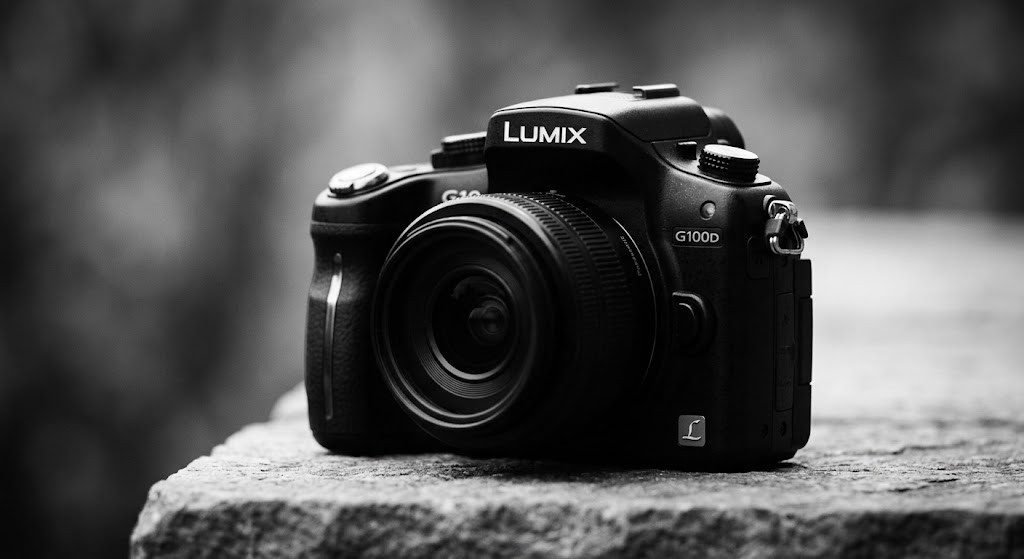
The camera body weighs roughly 352 grams on its own and around 412 grams with the standard 12-32mm kit lens attached, keeping the entire setup light enough to hold at arm’s length for extended vlogging sessions without fatigue. The kit lens itself is a Lumix G Vario 12-32mm f/3.5-5.6 ASPH design with a 37mm filter thread, retractable for easy storage in a bag or pocket when not shooting.
Connectivity and Smart Features
Beyond the core photo and video specs, the G100D includes a handful of features that matter more to modern content creators than traditional camera buyers.
Wi-Fi, Bluetooth, and the Lumix Sync App
Built-in Wi-Fi and Bluetooth let you pair the camera with a smartphone using the free Lumix Sync app for iOS and Android. Once connected, you can transfer photos and videos directly to your phone for quick posting, or use your phone as a remote control for framing and triggering shots from a distance.
Webcam and Livestreaming Support
The G100D can also double as a high-quality webcam. Connecting it to a computer via USB and running Panasonic’s Lumix Webcam Software lets you use the camera for video calls or livestreaming with noticeably better image quality than a built-in laptop camera. For streamers and remote presenters, this turns a single camera purchase into two use cases at once.
USB-C Charging
USB-C charging means you can power the camera from the same cable and power bank you likely already use for a phone or laptop, which simplifies travel packing and reduces the number of proprietary chargers you need to carry.
Lens System and the Micro Four Thirds Ecosystem
One advantage the G100D holds over fixed-lens competitors is its Micro Four Thirds lens mount. While the 12-32mm kit lens covers everyday shooting well, the mount opens the door to a wide, mature ecosystem of lenses from Panasonic, Olympus and OM System, and third-party manufacturers. Creators who outgrow the kit lens can add a fast prime for better low-light performance and background separation, a longer telephoto for interviews and event coverage, or a wide-angle for vlogging in tighter spaces, all without replacing the camera body itself. This flexibility is something smartphone-style fixed-lens cameras simply cannot offer, and it is one of the strongest long-term arguments for choosing an interchangeable-lens system at this price point.
Who Should Buy the Panasonic Lumix G100D?
Great Fit: New Vloggers and Content Creators
If you are moving up from a smartphone and want a dedicated camera for YouTube, social content, or personal video projects, the G100D makes a strong first camera. The flip-out screen, built-in EVF, and directional audio system solve real problems that smartphone footage cannot match, all without requiring a steep learning curve.
Great Fit: Creators Who Record Audio In-Camera
Anyone who films without an external microphone rig benefits the most from what the G100D offers. The adaptive audio array genuinely improves usability for run-and-gun content where stopping to manage separate audio gear is not practical.
Great Fit: Remote Workers and Livestreamers
The built-in webcam mode adds real value for anyone doing regular video calls, online teaching, or livestreaming, since the same camera pulls double duty as a professional-looking webcam without an additional purchase.
Not the Right Fit: Sports and Action Shooters
The contrast-detection autofocus system and moderate burst rate with continuous tracking mean the G100D struggles with fast, unpredictable subjects. Photographers who need reliable tracking for sports or wildlife should look toward a camera with phase-detection autofocus instead.
Not the Right Fit: Buyers Who Need Rock-Solid In-Body Stabilization
Because the G100D relies on hybrid digital and optical stabilization rather than a true mechanical in-body system, handheld footage without a stabilized lens can show more shake than footage from competitors with more robust IBIS systems. Creators who shoot handheld frequently while walking should budget for a stabilized lens or a gimbal.
Panasonic Lumix G100D Pros and Cons
Pros:
- Genuinely useful built-in electronic viewfinder at this price point
- Adaptive directional audio array with face recognition improves in-camera sound quality
- Fully articulating touchscreen suited to vlogging and selfie framing
- V-Log L recording included at no extra cost
- Doubles as a high-quality USB webcam for calls and livestreaming
- Access to the full Micro Four Thirds lens ecosystem
- Lightweight body that stays comfortable during long handheld sessions
- USB-C charging simplifies travel and backup power options
- Strong value now that street pricing sits below the original MSRP
Cons:
- No true in-body mechanical image stabilization
- Contrast-detection autofocus lags behind phase-detection rivals in tracking speed
- Battery life trails many competitors in the category
- Single card slot with only UHS-I support limits high-bitrate recording flexibility
- No built-in ND filter, which can complicate bright outdoor video
How the Panasonic Lumix G100D Compares
Against rivals like the Sony ZV-E10 and Canon EOS R50, the G100D’s biggest advantage remains its built-in viewfinder and directional audio system, features that competitors in a similar price bracket often skip entirely. Its biggest disadvantage is autofocus performance, since both of those competitors use more modern phase-detection systems that track moving subjects more reliably. The G100D also holds an edge in included software features, since V-Log L and the webcam mode typically come standard rather than as paid extras.
Buyers who prioritize audio quality, eye-level shooting, and flexible connectivity should lean toward the G100D. Buyers who prioritize autofocus tracking for moving subjects, or who plan to shoot fast-paced action regularly, may find better results elsewhere.
Frequently Asked Questions About the Panasonic Lumix G100D
Does the Panasonic Lumix G100D shoot 4K video?
Yes. The G100D records 4K Ultra HD video at up to 30 frames per second, along with Full HD recording at up to 60 frames per second for smoother slow-motion footage.
Can the G100D be used as a webcam?
Yes. Connecting the G100D to a computer via USB and installing Panasonic’s Lumix Webcam Software allows it to function as a high-quality webcam for video calls and livestreaming.
Does the G100D have in-body image stabilization?
No. The G100D uses a 5-axis hybrid system that combines optical stabilization in the lens with electronic stabilization processed in-camera, rather than a true mechanical in-body stabilization unit.
What lens does the G100D come with?
Most kits include the Lumix G Vario 12-32mm f/3.5-5.6 ASPH lens, a compact, retractable zoom equivalent to roughly 24-64mm in full-frame terms.
Is the G100D good for beginners?
Yes. Its touchscreen interface, automatic exposure modes, and adaptive audio system make it approachable for photographers and videographers who are just starting out, while V-Log L recording gives more experienced users room to grow into manual color grading.
Final Verdict: Is the Panasonic Lumix G100D Worth Buying?
The Panasonic Lumix G100D earns its reputation as one of the most sensible entry points into interchangeable-lens vlogging. It does not try to compete on autofocus sophistication or in-body stabilization, and it does not need to. Instead, it focuses on what beginner and intermediate creators actually use every day: a viewfinder that works, a screen that flips around, audio that adapts to the situation without extra gear, and connectivity features like webcam mode and USB-C charging that fit naturally into a modern content creation workflow.
If fast autofocus and rock-solid stabilization matter more to your work than price, look elsewhere. If you want an affordable, genuinely capable camera built specifically for solo content creation, with the flexibility of a full lens ecosystem behind it, the G100D remains one of the smartest choices available in 2026.
Read More from Altbuzz
Looking for more honest camera breakdowns like this one? Explore additional reviews and buying guides on the Altbuzz website covering the latest releases across Panasonic, Sony, Fujifilm, Nikon, and more.
Subscribe to Altbuzz YouTube Channel
Enjoyed this review? Subscribe to the Altbuzz YouTube channel for more straightforward camera reviews and buying guides that cut through marketing noise and help you choose the right gear.