
Ricoh GR4 Buying Guide: Should You Buy the GR4, GR3x, or Wait for the GR4x in 2026?
If you are shopping for a Ricoh GR in 2026, you already know the lineup looks more crowded than usual. This Ricoh GR4 buying guide exists because the decision now involves more than comparing megapixels or reading a spec sheet. Ricoh has released the GR4, is winding down the GR3x, and has officially confirmed development of the GR4x. Buying today could be the smartest move you make this year, or it could leave you holding a camera that feels outdated within months.
This guide walks through every current Ricoh GR option, explains the one decision that matters more than any spec, and tells you honestly who should buy now and who should wait.
Why the Ricoh GR Lineup Feels More Complicated Than Ever
Ricoh built its reputation on a simple formula: a small, pocketable, fixed-lens camera that street photographers could carry everywhere. For years, that formula stayed predictable. You picked a GR, you bought it, and you shot for a decade.
That predictability disappeared in 2026. The GR4 launched with a redesigned lens and processor. The GR3x, once the newest 40mm option, now has a confirmed end date for production. And Ricoh announced the GR4x is already in development, months before anyone expected an official word.
None of this means the lineup got worse. It means buyers need a clearer framework before they spend $1,200 to $2,200 on a camera they plan to keep for years.
The First Decision: 28mm or 40mm Focal Length
Before comparing specs, resolution, or price, answer one question honestly: how do you actually see a scene?
This single choice matters more than any feature Ricoh adds to a new model, because every GR camera is a fixed-lens camera. You cannot swap your way into a different perspective later. Whatever focal length you buy is the focal length you shoot for the life of that camera.
Why the GR4’s 28mm Lens Suits Wide, Immersive Street Photography
The GR4 shoots at a 28mm equivalent focal length. This wide angle works well for photographers who like to get physically close to their subject while still capturing the surrounding environment. It suits travel photography, architecture, and street scenes where you want to pull in a doorway, a crowd, or a building facade while standing just a few feet away.
If you naturally gravitate toward wide, immersive framing, the 28mm lens on the GR4 fits how you already shoot.
Why the GR3x and GR4x’s 40mm Lens Suits Deliberate, Considered Framing
The GR3x, and the upcoming GR4x, shoot at a 40mm equivalent focal length. Ricoh has described this focal length as closer to how the human eye naturally perceives a scene. Backgrounds simplify, compositions tighten, and the resulting images feel more deliberate than wide-angle street shots.
Photographers who prefer quiet, considered details over sweeping wide scenes tend to reach for 40mm again and again. If that sounds like your style, the GR3x or the upcoming GR4x will serve you better than any 28mm body, regardless of how new that body is.
Once you know your focal length, the rest of this Ricoh GR4 buying guide becomes far easier to apply.
Ricoh GR4 Full Review: Specs, Price, and Who Should Buy It Now
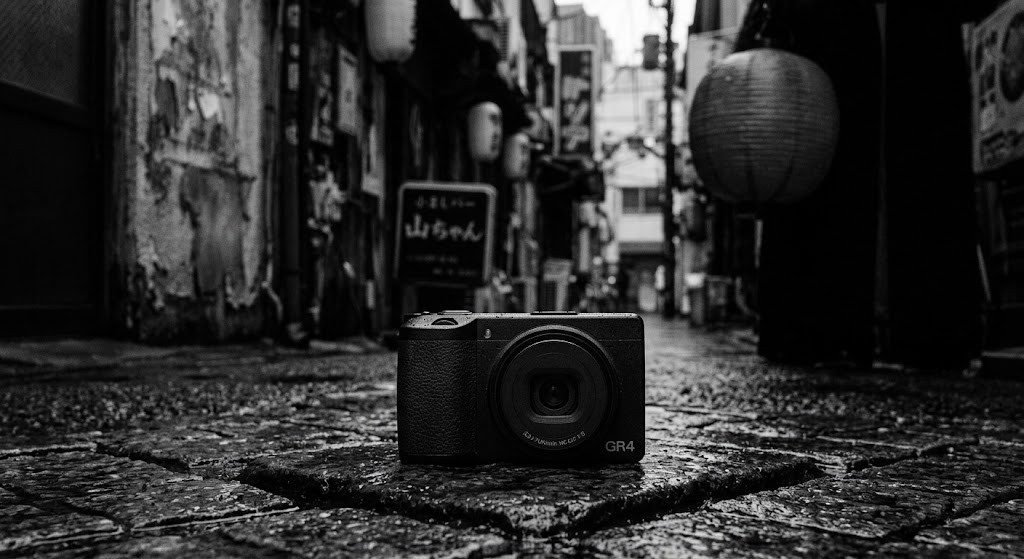
For 28mm shooters, the GR4 is currently the safest purchase in the entire Ricoh GR lineup. Its advantage comes from accumulation rather than one standout feature. Individually, the upgrades feel modest. Stacked together, they produce a camera that feels noticeably more refined to carry every day.
Ricoh GR4 Specifications
The GR4 is built around several meaningful updates over its predecessor:
- A newly designed 18.3mm lens
- A back-illuminated sensor rated at approximately 26 megapixels
- Ricoh’s latest GR Engine 7 image processor
- Five-axis image stabilization that now corrects shift blur in addition to angular shake
- A startup time of roughly 0.6 seconds, the fastest in GR history
- Approximately 53GB of internal storage
- A built-in 2-stop ND filter for shooting wide open in bright daylight
None of these features alone would justify an upgrade. Together, they add up to a camera that simply feels more capable in daily use than earlier GR models.
Ricoh GR4 Price and Availability
Ricoh’s official US store lists the GR4 at $1,599. At the time of writing, it remains out of stock directly through Ricoh, which suggests strong demand. If you already know you prefer 28mm and want the newest sensor generation in the smallest possible footprint, the GR4 is a straightforward purchase. The upcoming GR4x does not change this recommendation, because it targets a completely different focal length.
Ricoh GR4 Limitations You Should Know Before Buying
No camera in this lineup is a do-everything machine, and the GR4 is no exception. Before you buy, understand what you are giving up:
- There is no built-in viewfinder
- The rear screen does not tilt
- Video capability trails behind a dedicated hybrid mirrorless body
- Autofocus is not designed for fast-moving sports or action
These limitations do not erase what the GR4 does well. They simply confirm that you are buying a focused, specialist tool rather than an all-purpose camera.
Ricoh GR3x: Why This Is the Hardest Ricoh GR Purchase Right Now
If 28mm is not your focal length, your decision gets considerably more complicated, and this is where a genuine Ricoh GR4 buying guide has to be honest rather than simply pushing the newest release.
The GR3x remains an excellent camera. It has years of real-world use behind it, a loyal following among 40mm street photographers, and a mature feature set that still performs well today. Ricoh currently lists the GR3x at $1,249, though it is presently out of stock through the direct store as well.
The issue is not the camera itself. The issue is timing.
Ricoh GR3x Price and Discontinuation Timeline
Ricoh has confirmed that production of the GR3x, along with its HDF and Urban Edition variants, is expected to end following October shipments in Japan. The company has cited unavailable parts as the reason. Timelines outside Japan may vary, but the overall direction is clear: the GR3x is heading toward the end of its production run.
Should You Buy the GR3x Today or Wait?
The honest verdict depends entirely on your situation:
- If you need a 40mm GR immediately and you can find the GR3x at a sensible price, buy it. It still performs exactly as it always has.
- If you already own a working camera and can wait a season, hold off and wait for the GR4x instead.
The GR3x has not become obsolete overnight. It remains a strong performer. It has simply become a much harder purchase to justify at full price now that its successor has an official name and a confirmed spec sheet.
Ricoh GR4x: What We Know So Far About Ricoh’s Next 40mm Compact
Separating confirmed information from speculation matters here, because plenty of coverage online blurs that line.
Confirmed Ricoh GR4x Specifications
Ricoh officially announced development of the GR4x on August 26, 2026. Based on that announcement, here is what buyers currently know:
- A newly developed lens delivering a 40mm equivalent field of view at f/2.8
- An APS-C sensor rated at approximately 26 megapixels
- Early specifications listing ISO sensitivity up to 204,800
- A planned release window of winter 2026 or later
What Remains Unknown About the GR4x
Several important details have not been confirmed yet, including:
- Final retail price
- An exact launch date
- The complete autofocus performance story
- Whether an HDF variant will launch alongside the standard model
Ricoh has stated that the complete set of new functions will arrive with the formal announcement rather than this earlier development notice. For 40mm shooters, the GR4x is real enough to factor into your decision, but incomplete enough that waiting still carries some uncertainty. You are not waiting on a rumor. You are waiting on details Ricoh has simply not released yet.
Ricoh GR4 HDF vs Standard GR4: The Trade-Off Most Buyers Miss
Before paying extra for the HDF variant, understand exactly what you are trading away, because it is not simply the standard camera with a bonus feature attached.
The Ricoh GR4 HDF adds Ricoh’s Highlight Diffusion Filter, which softens highlights into a hazy, nostalgic, almost film-like bloom. It is priced at $1,699. The detail most buyers overlook is this: the standard GR4 includes a built-in 2-stop ND filter, and the HDF variant does not. The diffusion filter physically occupies that same spot in the optical path, so you are choosing one feature in place of the other, not gaining one for free.
If you want that softened, film-inspired look produced instantly in-camera, the HDF variant earns its higher price. If you prefer shooting clean and controlling exposure with a built-in ND filter during bright daylight, the standard GR4 remains the better tool. Choose based on how you actually shoot, not because the diffused look happens to trend well on social feeds.
Ricoh GR4 Monochrome: Is the Priciest Ricoh GR Worth It?
At $2,199, the GR4 Monochrome is likely the most expensive camera in the current lineup, and it is also one of the easiest models for most buyers to rule out.
This is not simply a color camera with a black-and-white filter applied after the fact. The GR4 Monochrome uses a dedicated monochrome sensor with no color filter array, paired with a built-in red filter tuned specifically for black-and-white rendering. It represents serious engineering aimed at a narrow, specific audience.
If black-and-white photography sits at the center of your work, and you understand why a dedicated monochrome sensor outperforms a converted color file, this camera can genuinely excel, often as a second body alongside a color GR. If you only enjoy occasionally converting a shot to black and white in post-production, you are paying a steep premium for something any other GR in the lineup already handles for free. Respect what this camera does. Just be honest with yourself about whether you are the photographer it was built for.
Is a Used Ricoh GR3 Still Worth Buying in 2026?
The older GR3 deserves a brief mention, because used pricing can still make it a smart buy. Older does not automatically mean irrelevant. A sensibly priced GR3 still delivers real APS-C image quality, the same trusted 28mm lens, in-body stabilization, and the pocketable experience the entire GR series is built around.
The rule here stays simple: buy used only if the price genuinely makes sense. If a secondhand GR3 creeps close to the cost of a brand-new GR4, the value proposition collapses, and you end up paying nostalgia pricing for a previous sensor generation.
Ricoh GR4 30th Anniversary Edition: Special but Not Superior
Ricoh has also announced a limited GR4 30th Anniversary Edition, arriving in autumn 2026 with only 6,000 units available worldwide. The specifications are identical to the standard GR4. Unless you are a collector who specifically wants the limited build, there is no practical reason to wait for this edition expecting a more capable camera. It offers the same performance in a commemorative package, nothing more.
Who Should Not Buy a Ricoh GR Camera
A genuinely useful Ricoh GR4 buying guide has to tell you when to walk away entirely, not just which model to pick.
If you need interchangeable lenses, a built-in viewfinder, a tilting screen, serious video specs, or reliable autofocus for fast action and sports, the GR series was never designed for you, and no amount of waiting will change that. This is not a flaw in Ricoh’s design. The GR lineup deliberately does less so it can remain this small and this immediate to use. That trade-off is the entire point of the camera, not a limitation Ricoh overlooked.
Ricoh GR Buying Matrix: A Quick Decision Guide
Use this quick reference to match your situation to the right camera:
- Want 28mm and the newest all-around GR? Buy the GR4.
- Want 28mm with built-in film-style diffusion? Consider the GR4 HDF, but only if that rendering genuinely fits your style.
- Living primarily in black and white? The GR4 Monochrome deserves serious consideration.
- Need 40mm immediately? The GR3x still makes sense at a fair price.
- Want 40mm and already own a working camera? Wait for the GR4x.
- Found a GR3 at a genuinely attractive used price? Still worth buying.
- Found a GR3 priced like rare gold? Walk away.
Final Verdict: Which Ricoh GR Camera Should You Buy in 2026?
The answer comes down to your focal length preference and your patience. If you shoot 28mm, the GR4 is sitting on the shelf right now, refined, current, and ready to use. There is little reason to wait.
If you shoot 40mm, the calculation changes. The GR3x still performs exactly as well as it always has, and buying one at a fair price remains a reasonable decision if you need a camera now. But if 40mm is genuinely your focal length and you can survive a few more months with the gear you already own, waiting for the GR4x makes sense. You are not waiting on a rumor. You are waiting on a confirmed camera that simply has not finished revealing its full specification sheet yet.
Whichever path fits you, base the decision on how you actually shoot, not on which model happens to be newest.
Read More from Altbuzz
Looking for more in-depth camera buying breakdowns like this one? Explore additional guides and reviews on the Altbuzz website covering the latest releases, rumors, and comparisons across Fujifilm, Sony, Nikon, and more.
Subscribe to Altbuzz YouTube Channel
Enjoyed this breakdown? Subscribe to the Altbuzz YouTube channel for more honest, no-nonsense camera buying guides that cut through marketing noise and help you make the right purchase.